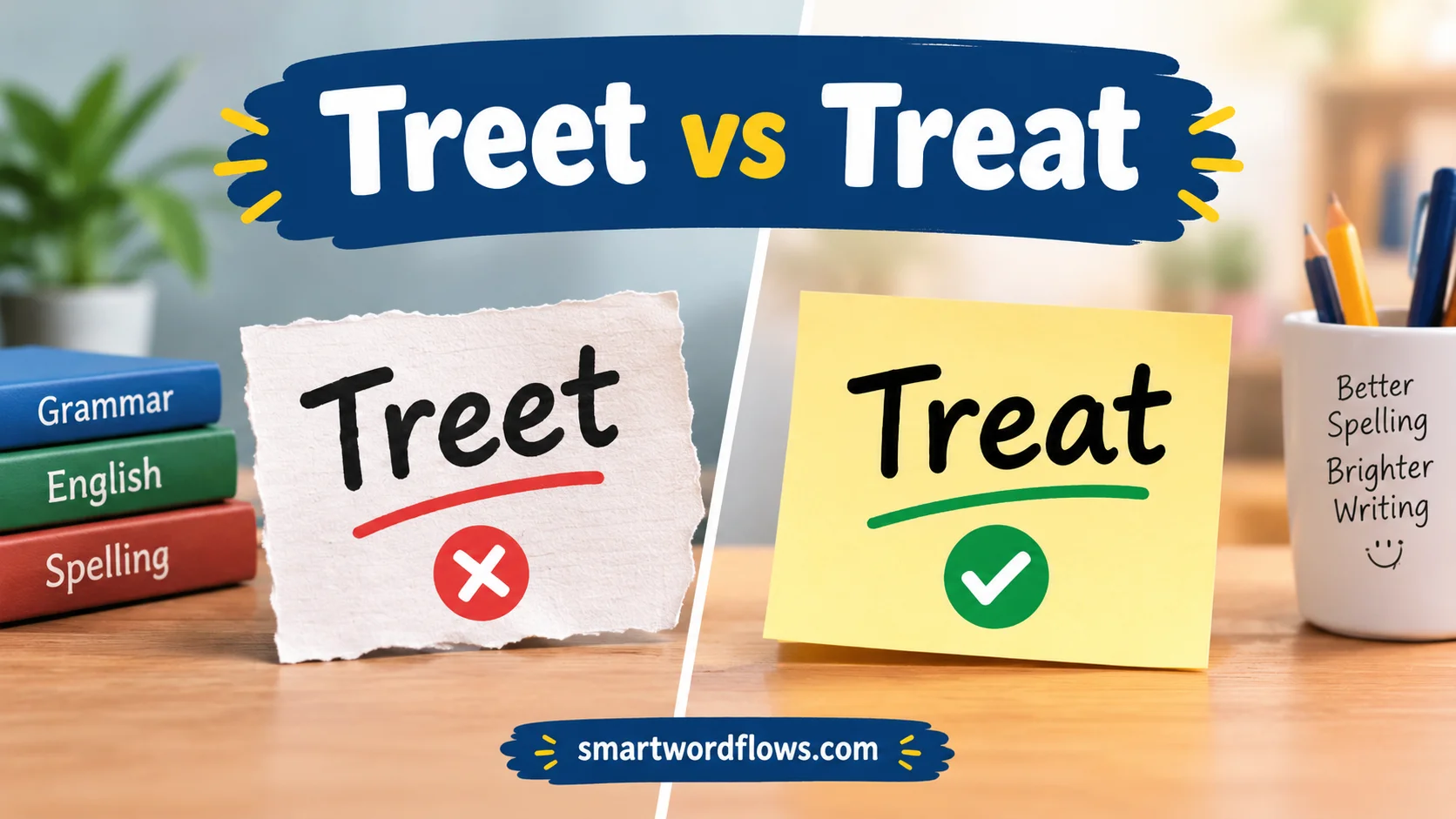

Treet vs Treat can be confusing because both spellings may sound similar when spoken. However, only treat is a standard English word, while treet is generally an incorrect spelling. The word treat can describe a special pleasure, reward, or something enjoyable. This small spelling difference can easily cause mistakes in schoolwork, messages, and everyday writing. Once you understand which form is correct and how it works in a sentence, you can avoid this common error and write with greater confidence.
The confusion usually comes from pronunciation, fast typing, and spelling habits. Since “treet” may look reasonable at first glance, writers sometimes use it without realizing that it isn’t accepted in standard English. Learning the correct form makes your writing more clear, accurate, and professional. In this guide, you’ll see the meaning of treat, examples of its proper usage, common spelling mistakes, and simple ways to remember the correct spelling whenever you need it.
Quick Answer
Treat is the correct standard English spelling.
Treet is incorrect when you’re trying to spell the word treat.
The correct spelling is:
T-R-E-A-T = TREAT
For example:
- Correct: The dog received a treat after following the command.
- Incorrect: The dog received a treet after following the command.
The word treat can function as both a noun and a verb. As a noun, it can describe something enjoyable, such as a special food or pleasant experience. As a verb, it can mean to behave toward someone in a particular way, provide medical care, pay for something enjoyable, or process something to change or protect it. (Cambridge Dictionary)
So, if you’re wondering “Treet or treat?”, the answer is simple: use treat.
Comparison Overview
| Word | Standard spelling? | Part of speech | Common meaning | Example |
| Treat | Yes | Noun and verb | Something enjoyable or an action involving care, behavior, payment, or processing | She bought herself a treat. |
| Treet | No, not as the standard spelling of treat | — | Usually an incorrect spelling in this context | Avoid treet when you mean treat. |
The important point isn’t simply that one spelling contains an extra letter. The two forms don’t have equal status in standard English.
Treat appears in established English dictionaries with multiple definitions and grammatical uses. Cambridge gives definitions covering behavior, medical care, special purchases, processing, enjoyable experiences, and payment. (Cambridge Dictionary)
Oxford also lists treat as both a noun and a verb. Its verb meanings include behaving toward someone, considering something in a particular way, providing medical care, processing materials, and paying for something enjoyable. (Oxford Learner’s Dictionaries)
That makes the choice straightforward in ordinary English writing.
Main Differences Between Treet vs Treat
The biggest difference between Treet vs Treat is standard usage.
Treat is an established English word with several meanings. Treet doesn’t serve as the standard spelling of that word.
Here’s the practical distinction:
- Treat is the correct spelling.
- Treet is generally a spelling error when the intended word is treat.
- Treat can be a noun.
- Treat can also be a verb.
- Treat has several meanings depending on context.
- The pronunciation of treat doesn’t change simply because someone writes it incorrectly as treet.
Consider this sentence:
The nurse will treat the patient.
Here, treat is a verb meaning to provide medical care.
Now look at this one:
The puppy received a tasty treat.
Here, treat is a noun referring to something given as a reward or something enjoyable.
The spelling stays exactly the same in both cases.
What Does Treat Mean?
The word treat has a surprisingly broad range of meanings. Context determines which meaning the reader understands.
Cambridge and Oxford both document several major uses of the verb and noun. (Cambridge Dictionary)
Treat as a Verb
As a verb, treat can describe how someone behaves toward another person or thing.
For example:
She treats everyone with respect.
Here, treats means behaves toward.
You can also use treat when discussing how someone considers or handles an idea:
We should treat the problem seriously.
The word can therefore describe an attitude, approach, or method of dealing with something.
Oxford gives examples involving treating people with respect, caution, dignity, suspicion, or care. (Oxford Learner’s Dictionaries)
Treat Someone in a Particular Way
One common structure is:
treat + someone + in a particular way
Examples include:
- Treat your guests with respect.
- She treats her employees fairly.
- Don’t treat him like a child.
- They treated the animals carefully.
- The company treats its customers well.
The meaning changes slightly with the surrounding words, but the basic idea remains the same: how someone behaves toward another person or thing.
Treat an Illness or Injury
In medical contexts, treat means to provide care for an illness, disease, injury, or medical condition.
For example:
Doctors treated the patient for a serious infection.
Cambridge defines this use as doing something to improve an ill or injured person’s condition or trying to cure a disease. (Cambridge Dictionary)
More examples include:
- The doctor treated the wound.
- The medicine helps treat the infection.
- The hospital treats hundreds of patients.
- The specialist treated him for a severe allergic reaction.
This meaning is especially important because treat appears frequently in medical and health-related writing.
Treat Someone to Something
Another useful meaning involves paying for something enjoyable.
For example:
I’m going to treat my sister to dinner.
This means the speaker intends to pay for dinner for their sister.
You can also say:
I’ll treat you to coffee.
Or:
She treated her parents to lunch.
Cambridge and Oxford both recognize this construction. (Cambridge Dictionary)
The pattern is easy to remember:
treat + someone + to + something
Examples:
- He treated us to ice cream.
- They treated their friends to dinner.
- I’m treating myself to a new pair of shoes.
Treat Yourself
You’ve probably heard the phrase “treat yourself.”
It means doing or buying something enjoyable for yourself, especially something you don’t normally have or do.
For example:
I worked hard all week, so I’m going to treat myself to a nice dinner.
Oxford specifically lists this use of treat as paying for something enjoyable for yourself. (Oxford Learner’s Dictionaries)
It’s a useful everyday expression because the word isn’t limited to gifts from one person to another.
Treat as a Noun
Now let’s look at treat as a noun.
A noun treat usually refers to something enjoyable, special, or given as a reward.
Oxford defines this sense as something pleasant that someone can enjoy, particularly something given to someone or done for them. (Oxford Learner’s Dictionaries)
Treat as Special Food
A treat can be food that you enjoy occasionally rather than something you normally eat.
For example:
- Ice cream can be a special treat.
- The children received a chocolate treat.
- We bought some treats for the party.
- The cake was a real treat.
Cambridge also recognizes treat for food eaten in addition to regular meals, including sweet foods. (Cambridge Dictionary)
The word doesn’t necessarily mean unhealthy food. It mainly emphasizes that the food is special or enjoyable.
Treats for Pets
Pet owners commonly use treat for a small piece of food given to an animal, often as a reward.
For example:
The dog gets a treat after completing the training exercise.
You might also hear:
- Give the cat a treat.
- The puppy loves these treats.
- Keep the treats away from the dog.
- She gave her horse a small treat.
Cambridge specifically includes this pet-related meaning in its definition of treat. (Cambridge Dictionary)
Treat as a Pleasant Experience
A treat doesn’t have to be something you eat.
It can also describe an enjoyable experience.
For example:
Seeing my old friends again was a real treat.
Oxford gives this broader meaning for something especially pleasant or enjoyable. (Oxford Learner’s Dictionaries)
Other examples include:
- The concert was a real treat.
- The museum visit was a special treat.
- Watching the sunset from the mountain was a treat.
- The new restaurant was an unexpected treat.
This broader meaning makes treat useful in everyday conversations.
“My Treat” Means “I’ll Pay”
One of the most common expressions is:
It’s my treat.
This means the speaker will pay.
For example:
Don’t reach for your wallet. Lunch is my treat.
The phrase doesn’t mean that lunch itself is necessarily a special gift. It means the person speaking has offered to pay.
Cambridge and Oxford both identify this payment-related meaning. (Cambridge Dictionary)
Why Is Treet Incorrect?
The spelling treet can look tempting because the word treat has a long “ee” sound.
However, English spelling doesn’t always work by simply writing the sounds we hear.
The standard spelling is treat, with the letter combination ea.
Think about these examples:
- treat
- great
- bread
- break
- steak
English uses ea in several different ways. That’s one reason spelling by sound alone can cause mistakes.
In treat, the ea combination represents the vowel sound heard in the word. Cambridge and Oxford both give the pronunciation as /triːt/. (Cambridge Dictionary)
So even though treet might seem logical from a sound-based perspective, it isn’t the standard spelling of the word.
A Simple Memory Trick
Here’s an easy way to remember it:
TREAT has EAT inside it.
Look closely:
TR + EAT = TREAT
That’s useful because a treat can often be something you eat.
For example:
Ice cream is a treat.
The memory trick isn’t a grammar rule. It’s simply a convenient spelling aid.
Treet vs Treat Pronunciation
The correct word treat is pronounced /triːt/ in the standard dictionary pronunciation shown by Cambridge and Oxford. (Cambridge Dictionary)
The pronunciation contains a long ee vowel sound followed by the t sound.
This can create a spelling trap. When people hear the word, they may focus on the sound and imagine a spelling such as treet.
English frequently separates pronunciation from spelling. A sound can have multiple possible spellings, while a particular word still has one conventional written form.
For that reason, pronunciation shouldn’t be used as the only guide when spelling treat.
Correct:
treat
Incorrect for the intended word:
treet
The pronunciation doesn’t make the alternative spelling standard.
Common Mistakes With Treat
Mistake 1: Writing Treet Instead of Treat
This is the central error behind Treet vs Treat.
Incorrect:
The children received a treet after dinner.
Correct:
The children received a treat after dinner.
The correction is simple: replace treet with treat.
Mistake 2: Using Treet in Medical Writing
The mistake can become more noticeable in professional or academic writing.
Incorrect:
The doctor will treet the infection.
Correct:
The doctor will treat the infection.
Since treat is an established medical verb, spelling it correctly matters in healthcare-related writing. (Cambridge Dictionary)
Mistake 3: Confusing Treat With Treatment
The words treat and treatment are related, but they don’t perform the same grammatical job.
Compare:
The doctor will treat the patient.
The patient needs medical treatment.
Treat is a verb in the first sentence. Treatment is a noun in the second.
Cambridge defines treatment as the way someone or something is dealt with, as well as medical care in relevant contexts. (Cambridge Dictionary)
Mistake 4: Misusing “My Treat”
Remember that my treat usually means I’ll pay.
Correct:
Dinner is my treat.
This is different from:
Dinner was a treat.
The first sentence talks about payment. The second describes dinner as something enjoyable.
That small distinction becomes clear once you pay attention to context.
Treat vs Related Words
The word family around treat contains several forms that look similar but serve different grammatical roles.
| Word | Part of speech | Meaning | Example |
| Treat | Verb/Noun | Behave toward, provide care, pay for, or something enjoyable | The doctor will treat him. |
| Treated | Past tense/Past participle | Past form of treat | She was treated yesterday. |
| Treating | Present participle | Ongoing action | The doctor is treating the patient. |
| Treatment | Noun | The act or process of treating | He received treatment. |
| Treats | Noun/Verb | Plural noun or third-person verb | She gives her dog treats. |
Cambridge identifies treated as the past simple and past participle form of treat. (Cambridge Dictionary) Oxford likewise lists treated and treating among the verb forms. (Oxford Learner’s Dictionaries)
Understanding these forms helps prevent another common mistake: changing the spelling incorrectly when the grammatical form changes.
Treet vs Treat in Different Contexts
The meaning of treat becomes easier to understand when you see it in different situations.
Food and Desserts
When talking about enjoyable food, use treat.
Examples:
- Chocolate cake is a special treat.
- We bought treats for the children.
- She saved a small treat for later.
- The cookies were a delicious treat.
In this context, treat functions as a noun.
Medical Context
When discussing medical care, treat functions as a verb.
Examples:
- Doctors treat infections with appropriate medicines.
- The clinic treated several injured patients.
- The physician treated the wound carefully.
Cambridge and Oxford both list medical care as a major meaning of the verb. (Cambridge Dictionary)
Social Situations
The word also appears when discussing how people behave toward one another.
Examples:
- Treat people with respect.
- She treats her coworkers kindly.
- Don’t treat him unfairly.
- They treated the guests warmly.
Here, treat describes someone’s behavior or approach.
Paying for Someone
Use treat when someone offers to pay for another person.
Examples:
- Lunch is my treat.
- I’ll treat you to coffee.
- He treated his friends to dinner.
- She treated herself to a new phone.
This meaning appears frequently in casual American English.
Processing Materials
There’s another meaning that often gets overlooked.
Treat can describe changing or protecting a material through a special process.
For example:
The wood was treated with a protective chemical.
Oxford includes this use for applying substances or processes to materials such as wood, crops, and other substances. (Oxford Learner’s Dictionaries)
Cambridge also gives examples involving materials and chemical treatment. (Cambridge Dictionary)
So treat isn’t limited to people, pets, food, and medicine.
Read This: Tweek vs Tweak: Which Spelling Is Correct?
Treet vs Treat: Example Sentences
Seeing the words in context is one of the fastest ways to remember the correct spelling.
Correct Examples With Treat
- The children received a special treat after dinner.
- The doctor will treat the infection.
- Please treat everyone with respect.
- I’m going to treat myself to a new book.
- The dog received a treat after training.
- Dinner is my treat tonight.
- The concert was a wonderful treat.
- The wood needs to be treated before installation.
- She treated her parents to lunch.
- The hospital is treating several patients.
Each sentence uses a recognized form or meaning of treat.
Incorrect Examples With Treet
These sentences use treet where standard English requires treat:
- She gave the dog a treet.
- The doctor will treet the patient.
- It was a wonderful treet.
- I’ll treet you to dinner.
- Please treet the equipment carefully.
Correct them by replacing treet with treat:
- She gave the dog a treat.
- The doctor will treat the patient.
- It was a wonderful treat.
- I’ll treat you to dinner.
- Please treat the equipment carefully.
A Practical Case Study: Catching the Spelling Error
Imagine you’re writing this sentence:
“After finishing the project, I bought myself a treet.”
Something may feel slightly off, even if the sentence sounds natural when spoken.
The problem isn’t the meaning. The intended meaning is clear. The issue is spelling.
Change treet to treat:
“After finishing the project, I bought myself a treat.”
Now the sentence follows standard English spelling.
The same correction works across completely different contexts:
| Context | Incorrect | Correct |
| Food | a chocolate treet | a chocolate treat |
| Medical | treet an illness | treat an illness |
| Payment | I’ll treet you | I’ll treat you |
| Behavior | treet people fairly | treat people fairly |
| Materials | treet the wood | treat the wood |
The meaning changes from sentence to sentence, but the spelling doesn’t.
How to Remember the Correct Spelling
If Treet vs Treat keeps causing trouble, use a simple visual connection.
Remember “EAT” Inside “TREAT”
Look at the spelling:
T R E A T
You can spot EAT inside it:
TR + EAT
That gives you a quick memory hook:
A TREAT has EAT inside it.
This works especially well because one common meaning of treat involves food.
For example:
The cookie was a treat.
You can connect treat with eat and reinforce the correct spelling at the same time.
Don’t Spell Words Only by Sound
Another useful lesson comes from pronunciation.
You hear /triːt/, but English doesn’t require you to spell every sound exactly as it appears.
For instance, English contains many words where the written form doesn’t perfectly match the sound pattern. That’s normal.
The safest approach is to remember the conventional spelling:
Treat = T-R-E-A-T
Once you’ve seen it repeatedly, the correct form becomes much more automatic.
Grammar Guide for Treat
Because treat works as both a noun and a verb, its position in a sentence can help you identify its meaning.
Treat as a Verb
Examples:
They treat their employees fairly.
The doctor treats the patient.
She treated me kindly.
They are treating the problem seriously.
Notice the changing verb forms:
- treat
- treats
- treated
- treating
Treat as a Noun
Examples:
The cake was a treat.
We bought several treats.
The concert was a real treat.
Here, the word names something enjoyable rather than describing an action.
This distinction becomes especially useful when proofreading your writing.
Common Phrases With Treat
Several everyday expressions contain treat.
Treat Someone With Respect
Always treat others with respect.
Here, treat means behave toward.
Treat Someone to Something
I’ll treat you to lunch.
Here, treat means pay for something enjoyable for someone.
Treat Yourself
You deserve to treat yourself after all that hard work.
Here, treat yourself means give yourself something enjoyable.
My Treat
Don’t worry about the bill. It’s my treat.
Here, the speaker means they’ll pay.
A Real Treat
The live performance was a real treat.
Here, treat means something especially enjoyable.
Trick or Treat
The children went from house to house saying, “Trick or treat!”
This familiar Halloween expression also uses the standard spelling treat.
Treet vs Treat: Quick Grammar Guide
| Question | Answer |
| Which spelling is standard? | Treat |
| Is treat a noun? | Yes |
| Is treat a verb? | Yes |
| Can treat describe food? | Yes |
| Can treat describe medical care? | Yes |
| Can treat describe behavior? | Yes |
| Can treat mean to pay for someone? | Yes |
| Can treat describe processing materials? | Yes |
| Is treet the standard spelling of treat? | No |
| How do you spell it? | T-R-E-A-T |
Why Does the Treet Spelling Look So Plausible?
There’s a simple reason this mistake can happen.
When you say treat, the vowel sound resembles the sound people associate with the letter combination “ee.” A person spelling entirely from pronunciation might therefore write treet.
But English spelling contains many historical patterns that aren’t perfectly phonetic.
The correct written form developed from the word’s linguistic history rather than from a simple letter-for-sound formula. Oxford traces treat through Middle English and Old French to Latin tractare. (Oxford Learner’s Dictionaries)
That history also helps explain why modern English spelling isn’t always predictable from pronunciation alone.
The practical lesson is simple: learn the established spelling rather than rebuilding the word from its sound.
Frequently Asked Questions About Treet vs Treat
Is Treet a Correct Word?
Treet isn’t the standard spelling when you mean the English word treat. In ordinary writing, use treat.
Specialized names, trademarks, or unusual proper forms can exist outside normal dictionary vocabulary. However, they don’t make treet the standard spelling of the common word treat.
Is Treat the Correct Spelling?
Yes. Treat is the standard English spelling.
It can work as both a noun and a verb. Major dictionaries document its uses for behavior, medical care, payment, special experiences, food, and material processing. (Cambridge Dictionary)
What Is the Difference Between Treet and Treat?
The key difference is standard English usage.
Treat is the established word. Treet isn’t the standard spelling when you intend treat.
For example:
Correct: The puppy received a treat.
Incorrect: The puppy received a treet.
How Do You Spell Treat?
The correct spelling is:
T-R-E-A-T
A useful memory trick is “TREAT has EAT inside it.”
What Does Treat Mean?
Treat has several meanings.
As a verb, it can mean to behave toward someone, provide medical care, pay for something enjoyable, consider something in a particular way, or process a material.
As a noun, it can mean something enjoyable, a special experience, or a piece of food given as a reward. (Cambridge Dictionary)
Is Treat a Noun or a Verb?
It’s both.
As a noun:
The movie was a treat.
As a verb:
Doctors treat patients.
The surrounding sentence tells you which grammatical role the word has.
Is “My Treat” Correct English?
Yes.
“My treat” is a common expression meaning that the speaker will pay for something.
For example:
Don’t worry about lunch. It’s my treat.
Both Cambridge and Oxford document this usage. (Cambridge Dictionary)
Faqs :
1. Is “treet” a correct English word?
No, treet is not a standard English word. It is usually a misspelling of “treat.” In normal English writing, you should use treat.
2. What is the correct spelling, treet or treat?
The correct spelling is treat. It can be used as a noun or verb. For example, “This dessert is a special treat” or “They will treat us to dinner.”
3. What does “treat” mean?
Treat has several meanings depending on the sentence. It can mean something enjoyable or special, such as a dessert or reward. As a verb, it can also mean to behave toward someone in a particular way or provide medical care.
4. Why do people spell treat as “treet”?
The mistake often happens because of pronunciation. The vowel sound can make the spelling seem unclear, especially for English learners. Fast typing and unfamiliarity with the correct spelling can also lead to this error.
5. How can I remember the correct spelling?
A simple way to remember it is to associate treat with familiar words such as treatment and treating. Whenever you mean a reward, pleasure, or the verb related to treatment, remember that the correct spelling contains “ea.”
Conclusion :
Treat is the correct spelling, while treet is generally a spelling mistake. Although the two forms may cause confusion because of their similar pronunciation, only treat belongs in standard English. Remembering its meaning and common examples can make the difference easier to recognize. Whether you’re writing a school assignment, sending a message, or creating professional content, using treat will keep your writing accurate and clear.