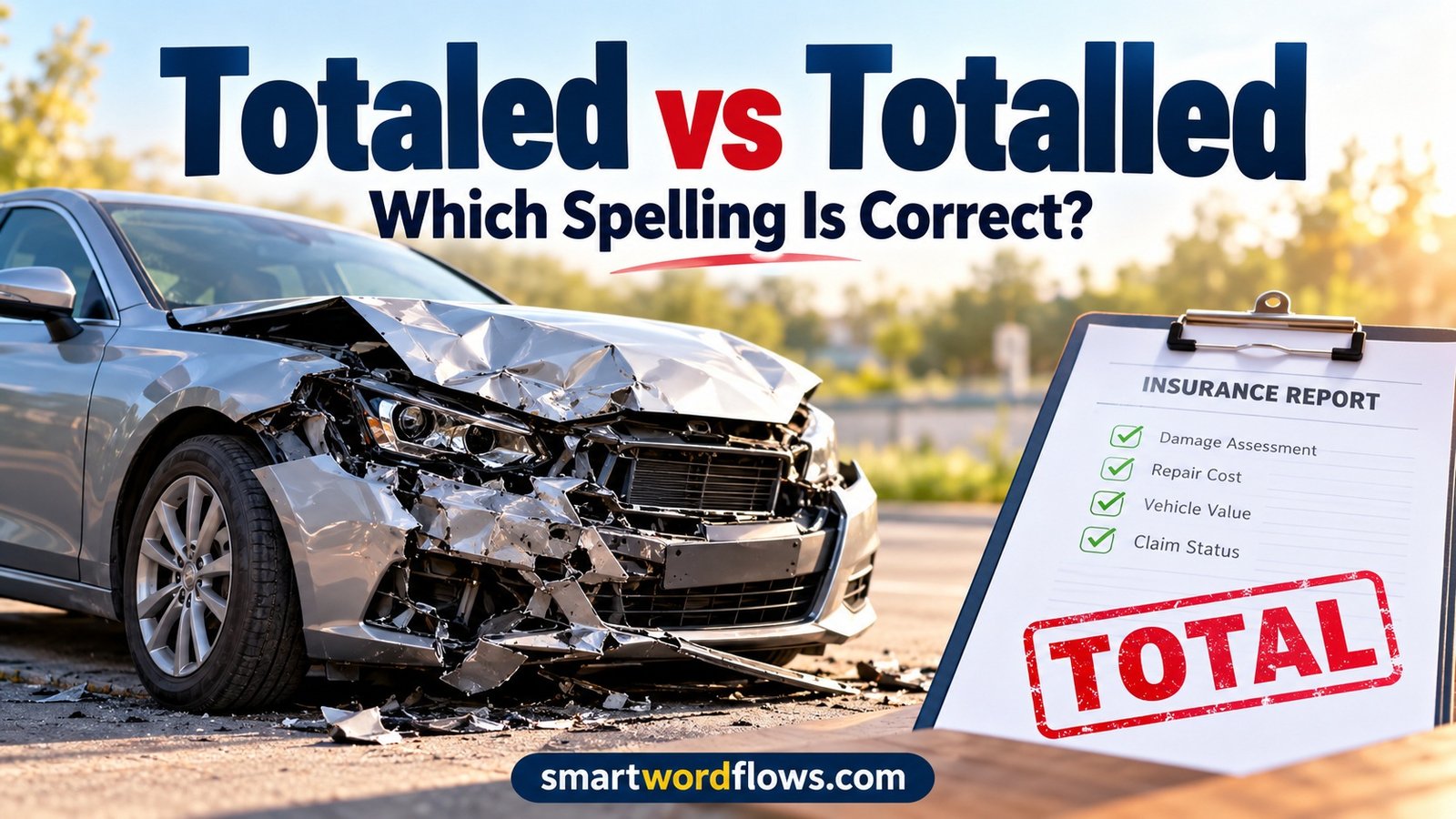

Totaled vs Totalled: Which Spelling Is Correct? Both are correct spellings, but English varieties differ in their standard form and usage today. In American English, totaled is the standard spelling, while British English and many other varieties prefer totalled. This difference comes from how verbs work when adding -ed to a word ending in -l. American usage usually keeps one l, while British usage uses double the l. The meaning does not change, and both forms can describe something that added up to a total. The related participles, totaling and totalling, follow the same pattern, with totaling preferred in American English and totalling used in British English.
The spelling difference has roots in an early 20th century transition in the United States, when many words and verb forms with similar endings developed different spelling practices. These British spelling conventions and American conventions remain part of modern international English usage. In cars and other situations, a vehicle can be described as totaled or totalled when it is damaged beyond economical repair, with the same meaning. In my experience with writing, writers, students, and professionals can avoid confusion by checking their audience and keeping their spelling consistent throughout a document. Both spellings may appear in books, websites, news articles, an email, a school paper, a business report, or online content, and seeing one does not mean the other is wrong.
The simple answer is to use totaled for American English and totalled for British English or writing that follows British spelling conventions. Choosing the right form for your context can help you avoid spelling mistakes, unnecessary corrections, and confusion about the difference between totalled and totaled. A clear guide with practical explanations and real-world examples makes the choice easier, especially when deciding which preferred form fits your variety of English and intended readers.
Quick Answer
Totaled is the standard spelling in American English, while totalled is the standard spelling in British English.
Both words are the past tense and past participle of total. They have the same meaning and pronunciation. The extra l reflects a difference in regional spelling conventions rather than a difference in definition.
Here is the simplest rule to remember:
- Totaled = American English
- Totalled = British English
For example:
- US English: The accident totaled the car.
- British English: The accident totalled the car.
- US English: The expenses totaled $5,400.
- British English: The expenses totalled £5,400.
Cambridge Dictionary specifically lists the US form as totaled and the British form as totalled. It also gives the related forms totaling in US English and totalling in British English.
Comparison Overview
| Feature | Totaled | Totalled |
| Main variety | American English | British English |
| Number of Ls | One L before -ed | Two Ls before -ed |
| Base verb | Total | Total |
| Past tense | Totaled | Totalled |
| Past participle | Totaled | Totalled |
| Present participle | Totaling | Totalling |
| Meaning | Same | Same |
| Pronunciation | Same basic pronunciation | Same basic pronunciation |
| Vehicle damage | Common US usage | British spelling of the same verb |
| Adding amounts | Standard US spelling | Standard British spelling |
The important point is simple: the extra L doesn’t create a new meaning. It signals a spelling convention.
Cambridge’s entry for total explicitly marks the verb with “UK -ll | US -l-”, confirming the regional distinction.
Main Differences Between Totaled vs Totalled
The biggest difference between totaled vs totalled is regional spelling.
American English generally prefers a single l when forming this verb’s past tense and present participle:
- totaled
- totaling
British English generally uses the doubled l:
- totalled
- totalling
The meaning remains unchanged.
Totaled in American English
Totaled is the normal spelling for American readers. You’ll find it in US business writing, news reports, insurance discussions, school assignments, emails, and everyday conversations.
For example:
The mechanic estimated that the repairs totaled $7,500.
Here, totaled means that the repair costs added up to $7,500.
The word can also describe severe vehicle damage:
The insurance company declared the car totaled after the crash.
In American English, totaled has a well-established informal use for a vehicle that has suffered severe damage. Cambridge identifies this vehicle-damage meaning as mainly US usage and notes that British English commonly uses write off in this context.
Totalled in British English
Totalled follows the spelling convention normally used in British English.
For example:
The project costs totalled £18,000.
Or:
The three departments totalled 450 employees.
Cambridge Dictionary defines totalled as the past simple and past participle of total and provides examples involving amounts, losses, scores, and other quantities.
A British writer therefore isn’t adding an unnecessary letter. The double l is part of the conventional spelling.
Why Does Total Have Two Different Past-Tense Spellings?
The difference comes from broader spelling patterns between American and British English.
When some verbs ending in l take suffixes such as -ed or -ing, British English commonly doubles the final l. American English often doesn’t.
That gives you patterns such as:
| American English | British English |
| totaled | totalled |
| totaling | totalling |
| traveled | travelled |
| traveling | travelling |
| labeled | labelled |
| labeling | labelling |
This pattern helps explain the difference, but it shouldn’t be treated as a universal rule for every English word. English spelling contains plenty of individual conventions and exceptions.
For total, however, the distinction is straightforward.
US: totaled
UK: totalled
What Does Total Mean?
Before deciding between totaled and totalled, it helps to understand the base word.
Total works as a noun, adjective, and verb. Its meaning changes slightly depending on the grammatical role.
Total as a Verb
As a verb, total can mean to add amounts together.
For example:
The four invoices total $12,800.
In the past tense:
The four invoices totaled $12,800.
A British writer would normally write:
The four invoices totalled £12,800.
Cambridge defines this use as having a complete amount or calculating the complete amount.
The verb can also describe severe damage, particularly in American English.
The collision totaled the family car.
In this context, totaled means the vehicle suffered damage so severe that it was treated as a total loss.
Total as a Noun
As a noun, total refers to the complete amount produced by adding smaller amounts.
For example:
The total came to $450.
Or:
The final total was higher than expected.
The noun doesn’t change to totalled simply because you’re using British English. The regional difference appears in particular verb forms.
Total as an Adjective
As an adjective, total means complete, entire, or absolute.
Examples include:
- total silence
- total failure
- total agreement
- total destruction
- total control
You wouldn’t write totalled silence or totaled silence in these expressions.
That distinction matters because totalled and totaled are verb forms, while total remains the adjective.
When to Use Totaled
Use totaled when your writing follows American English conventions.
This is especially important when you’re preparing content for a US audience. Consistent spelling makes professional writing look deliberate rather than patched together from different regional styles.
You might use totaled in:
- US business reports
- American academic writing
- Insurance correspondence
- Financial documents
- Emails
- Websites aimed at US readers
- News articles
- School assignments
- Customer service messages
- Internal company documents
Consider these examples:
The monthly expenses totaled $4,250.
The team’s points totaled 96.
The repairs totaled more than $10,000.
The accident totaled the vehicle.
Sales totaled $2.4 million during the quarter.
In each case, totaled fits standard American English.
Totaled in Financial Writing
Financial writing frequently uses totaled when describing a final amount.
For example:
The company’s operating expenses totaled $4.8 million in 2025.
Here, the verb explains the combined amount of several expenses.
Other natural examples include:
- The invoices totaled $72,500.
- The donations totaled $18,400.
- The quarterly expenses totaled $950,000.
- The department’s costs totaled $210,000.
- The sales returns totaled $35,000.
Notice how naturally the word works with numbers. That’s one reason you’ll encounter it often in reports and financial news.
When to Use Totalled
Use totalled when you’re following British English spelling conventions.
The word works in the same grammatical situations as totaled.
For example:
The project expenses totalled £25,000.
The company reported that annual sales totalled £4.2 million.
The donations totalled £15,000.
The combined losses totalled £2 million.
The spelling changes, but the underlying meaning does not.
Totalled in British Financial Writing
British publications often use totalled when describing sums and quantities.
Cambridge provides corpus examples such as costs and losses that totalled specific amounts.
That makes totalled a perfectly normal choice in British financial and business writing.
If your entire document uses British spellings, switching suddenly to totaled can create an unnecessary style inconsistency.
Totaled vs Totalled in Different English Varieties
English isn’t a single uniform spelling system. Different countries and publishing traditions have developed their own conventions.
The safest approach is to identify your target audience first.
| Audience or Style | Recommended Form |
| United States | totaled |
| United Kingdom | totalled |
| British-style international writing | totalled |
| US-style international writing | totaled |
| A publication with its own style guide | Follow its specified style |
It’s worth being careful with country-by-country assumptions. English spelling practices can vary within countries and across publishers. A particular organization may also adopt a house style that differs from general regional usage.
Therefore, audience and style guide should take priority.
Totaled vs Totalled in Vehicle Damage
One of the most recognizable uses of totaled appears in conversations about cars.
In American English, saying that a car was totaled generally means that it was damaged so severely that it was treated as a total loss.
For example:
The SUV was totaled in the collision.
This doesn’t necessarily mean the vehicle is physically destroyed beyond any possible repair. The insurance classification depends on factors such as repair costs, vehicle value, salvage value, and applicable rules.
That’s an important distinction.
A badly damaged vehicle isn’t automatically totaled simply because it looks wrecked. The term describes a determination about the vehicle’s status rather than merely the visual severity of the accident.
Cambridge lists total as a verb meaning to damage a vehicle so badly that it cannot be repaired and marks this sense as mainly US. It gives write off as the British equivalent.
American Example
The insurer totaled the car after the accident.
British Equivalent
The insurer wrote the car off after the accident.
British English can use totalled for the verb total in other contexts, but write off is the established British expression for this particular vehicle-insurance meaning.
That difference goes beyond spelling. It shows how regional varieties can sometimes differ in vocabulary as well as orthography.
Read More:Compair vs Compare: Which Spelling Is Correct?
Totaled vs Totalled in Mathematics and Accounting
The word total has an especially useful role in accounting, mathematics, budgeting, and data analysis.
Suppose you have these expenses:
| Expense | Amount |
| Rent | $2,000 |
| Utilities | $350 |
| Supplies | $650 |
| Insurance | $500 |
| Total | $3,500 |
You could say:
The monthly expenses totaled $3,500.
In British English:
The monthly expenses totalled £3,500.
The grammatical structure stays the same. Only the regional spelling changes.
The verb can also describe quantities rather than money:
The survey responses totaled 1,250.
The three buildings totalled 42 floors.
The team’s points totaled 87.
This makes totaled and totalled useful in reports where a writer needs to summarize several separate figures into one final amount.
Totaled vs Totalled and the Present Participle
The spelling difference doesn’t stop with the past tense.
The same regional distinction appears in the -ing form.
| Form | American English | British English |
| Base verb | total | total |
| Present participle | totaling | totalling |
| Past tense | totaled | totalled |
| Past participle | totaled | totalled |
For example:
American English:
The costs are totaling more than $50,000.
British English:
The costs are totalling more than £50,000.
Cambridge’s learner dictionary explicitly lists totaling as the US present participle and totalling as the mainly UK form. It also lists totaled and totalled as the corresponding past forms.
So, if you choose American English, keep the pattern consistent:
- total
- totaling
- totaled
If you choose British English, use:
- total
- totalling
- totalled
Common Spelling Mistakes With Totaled and Totalled
The two forms create several predictable mistakes.
Assuming Totalled Is Always Wrong
This is one of the most common misunderstandings.
Totalled isn’t an accidental extra-L spelling. It’s the standard British form of the verb.
A British newspaper, school assignment, or business document can correctly use totalled.
Assuming Totaled Is Always Wrong
The reverse mistake is just as misleading.
American English normally uses totaled, not totalled.
Therefore, someone writing for a US audience shouldn’t automatically add another l simply because the base word ends in L.
Mixing Both Forms
Another problem occurs when writers switch between regional spellings in the same document.
For example:
The company totalled its British sales at £2 million, but its US sales totaled $3 million.
This sentence can be perfectly reasonable if the writer is deliberately reporting terminology from different sources or markets.
However, if the writer simply switches spelling styles without a reason, the document can look inconsistent.
For a general US document, choose:
The company totaled its sales at $5 million.
For a general British document, choose:
The company totalled its sales at £5 million.
Consistency makes the choice clear.
Totaled vs Totalled: Real-World Examples
Seeing both forms in context makes the difference easier to remember.
American English Examples
The restaurant’s sales totaled $48,000 last month.
The repair estimate totaled $9,200.
The team’s final score totaled 84 points.
The accident totaled the vehicle.
The expenses totaled more than $100,000.
British English Examples
The restaurant’s sales totalled £48,000 last month.
The repair estimate totalled £9,200.
The team’s final score totalled 84 points.
The project costs totalled more than £100,000.
The combined losses totalled £2 million.
The structure and meaning remain remarkably similar. The key change is the spelling convention.
A Practical Case Study: Choosing the Right Form
Imagine that a US company is preparing its annual financial report.
The report uses:
- color
- center
- canceled
- traveled
- totaled
That document clearly follows American English.
Now imagine that the same company publishes a separate report for a UK audience. Its style guide uses:
- colour
- centre
- cancelled
- travelled
- totalled
Both documents can be correct.
The mistake would be to assume that one spelling must replace the other everywhere.
Regional consistency is the real goal.
Case Study: A US Insurance Email
Suppose an American customer receives an email saying:
Your vehicle was determined to be a total loss because the estimated repair costs exceed the applicable value threshold. The vehicle was totaled following the collision.
Here, totaled fits American usage.
A British customer might encounter a different expression:
Your vehicle has been written off following the collision.
The distinction shows why spelling cannot always be separated from regional vocabulary. English varieties sometimes change both the form of a word and the preferred expression around it.
How to Remember Totaled vs Totalled
The easiest memory trick is remarkably short:
US = one L → totaled
UK = two Ls → totalled
You can also connect the word to related forms:
| American | British |
| totaled | totalled |
| totaling | totalling |
| canceled | cancelled |
| labeling | labelling |
| traveled | travelled |
This isn’t a license to double every final l in British English or remove every extra l in American English. English has plenty of exceptions.
Instead, use the pattern as a memory aid and check the established spelling when you’re uncertain.
For total, the answer is clear:
American English: totaled
British English: totalled
Totaled vs Totalled in Formal Writing
The correct choice depends on the English variety required by your audience or organization.
Academic Writing
If you’re writing an American research paper, use totaled.
If your institution follows British English, use totalled.
The same principle applies to dissertations, essays, reports, and professional research.
Business Writing
Businesses should follow their established editorial or corporate style.
A US company might use:
Annual costs totaled $3.2 million.
A UK company might use:
Annual costs totalled £3.2 million.
Neither organization needs to change its spelling simply because another English variety uses the alternative.
Website Content
Website owners should think about their primary audience.
If a website targets US readers, totaled is the natural choice.
If it targets UK readers, totalled is usually more appropriate.
For websites serving international readers, consistency still matters. Choose a house style and apply it throughout the site.
Is Totaled or Totalled More Correct?
Neither spelling is universally “more correct.”
That question misses the main point.
Totaled is correct in standard American English.
Totalled is correct in standard British English.
The words have the same core meaning. The spelling reflects the regional variety being used.
This is similar to other familiar differences:
- color / colour
- center / centre
- traveled / travelled
- canceled / cancelled
A writer doesn’t need to declare one version wrong. The better question is:
Which English variety does this piece of writing follow?
Once that question has an answer, the spelling choice becomes much easier.
Frequently Asked Questions About Totaled vs Totalled
Is “totaled” or “totalled” correct?
Both are correct. American English normally uses totaled, while British English normally uses totalled.
Is “totalled” British or American?
Totalled is the standard spelling associated with British English. It is also used in other varieties and publications that follow British spelling conventions.
Is “totaled” American English?
Yes. Totaled is the standard American English spelling of the past tense and past participle of total.
Does totaled mean the same as totalled?
Yes. The two forms have the same basic meaning. The difference is primarily regional spelling.
Which spelling should I use in the United States?
Use totaled for standard American English.
For example:
The repairs totaled $6,000.
Which spelling should I use in the United Kingdom?
Use totalled for standard British English.
For example:
The repairs totalled £6,000.
Is “totaling” or “totalling” correct?
Both forms are used.
Totaling is the standard US form, while totalling is the standard British form.
Is “totaled” a real word?
Yes. Totaled is the standard American past tense and past participle of total.
Is “totalled” a real word?
Yes. Totalled is the standard British past tense and past participle of total. Cambridge lists it directly as the past form of total.
Does the extra L change pronunciation?
No. The spelling difference doesn’t normally create a different pronunciation. Totaled and totalled represent the same verb form.
Is a car “totaled” or “totalled”?
In American English, a severely damaged vehicle is commonly described as totaled.
In British English, totalled follows the regional spelling of the verb, although written off is the common British expression for a vehicle treated as a total loss.
conclusion
The totaled vs totalled spelling debate becomes simple once you identify the English variety you’re using.Totaled is the standard American English form. Totalled is the standard British English form. Both come from the verb total, and both can describe adding amounts together or reaching a combined figure.
In American English, totaled can also commonly describe a vehicle damaged severely enough to be treated as a total loss.The extra l doesn’t change the meaning. It reflects a regional spelling convention. Therefore, don’t treat totalled as a simple misspelling of totaled, or vice versa.When writing for American readers, choose totaled. When following British English, choose totalled. Most importantly, keep the spelling consistent throughout your document.




1 thought on “Totaled vs Totalled: Which Spelling Is Correct?”