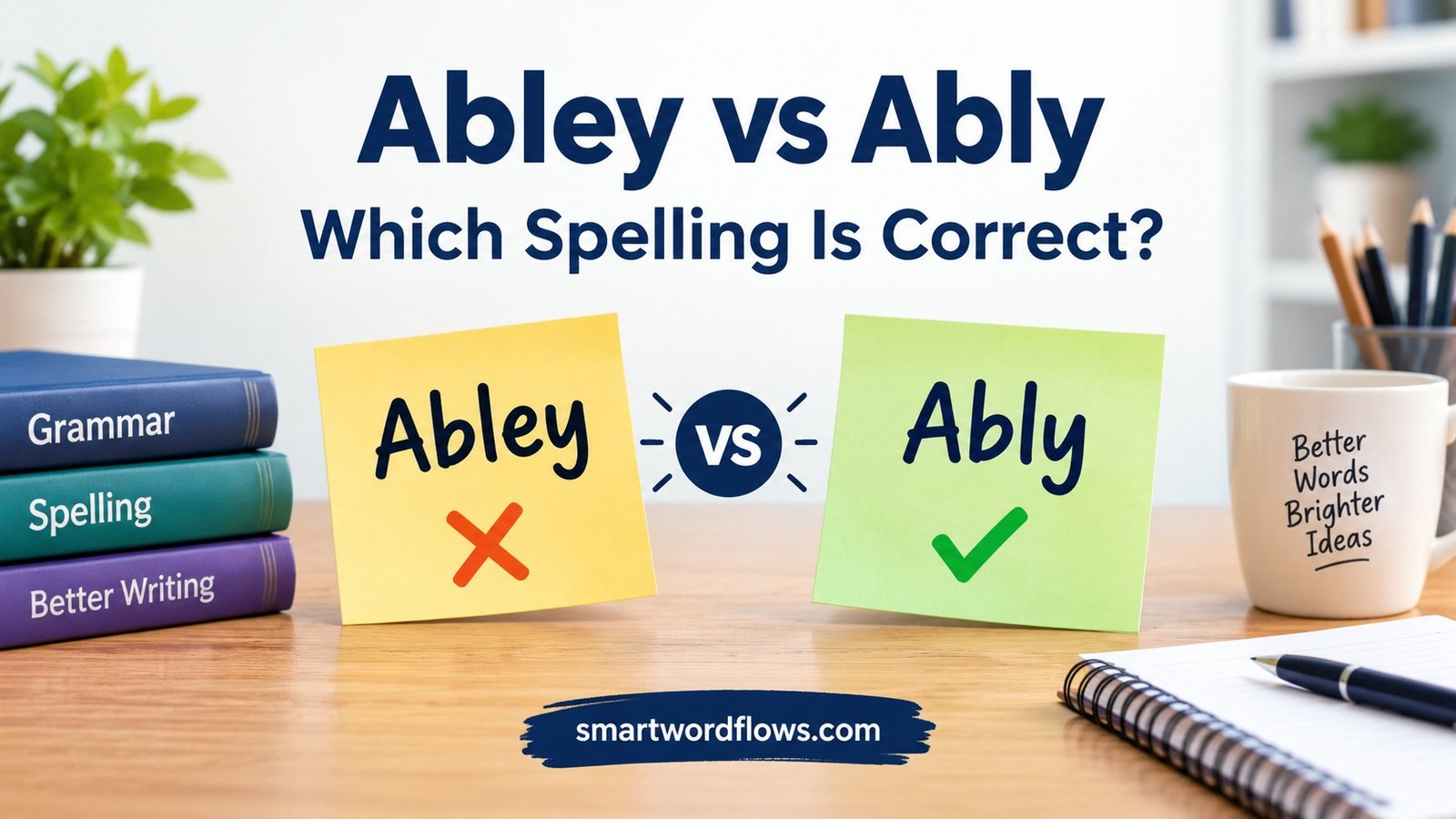

Abley vs Ably: Which Spelling Is Correct? The difference is tiny, but Ably is the correct standard word for everyday English and clear writing. In professional writing, business communication, formal writing, emails, blog posts, essays, and online writing, writers can become confused because these similar-sounding words look like possible forms. Ably is a proper adverb that describes doing something with skill, competently, or in an able manner, while able is the related adjective.
This follows a common grammar pattern that creates the standard adverb ably, a point supported by Cambridge, major dictionaries, and other dictionary sources. Abley, however, is usually an incorrect spelling, common misspelling, or misspelling when used as an adverb, although it may appear as a surname, name, proper noun, or proper name in public records and naming conventions. This word-choice split makes the standard form easy to identify: Ably is the regular English word, while Abley may have a different identity as a name. From my experience with editing, proofreading, and content writing, careful spelling details, word choice, sentence structure, and vocabulary usage can improve credibility, communication clarity, reader perception, writing accuracy, and a confident voice. These details matter in the fast-paced world of online booking, scheduling, time management, calendar updates, coordinating meetings, project management, digital communication, and workplace communication, where a small mistake may affect professional credibility and professional tone. For example, someone who handles a task ably shows the ability to perform it well, while the other form would be an English spelling mistake in ordinary usage. Helpful grammar tips, language tips, writing tips, usage examples, comparison tables, practical examples, and real-life examples support language learning, grammar learning, learning English, and English learners.
Understanding contextual meaning, semantic meaning, contextual relevance, semantic relevance, proper usage, correct usage, and spelling rules strengthens language fluency, fluent communication, writing confidence, and communication effectiveness. Style guides, editorial standards, and grammar rules generally support standard English, modern US English, and the accepted standard spelling in English writing, business writing, and formal communication. A dictionary identifies the standard, lowercase, everyday English usage and confirms the proper word choice, while the distinction can also help develop stronger grammar instincts when comparing regional preferences in the US and UK. Learning the grammar basics, grammatical structure, grammar explanation, grammar reference, grammar guide, and writing guide behind able and ably makes the correct choice more natural. It also supports English grammar, English vocabulary, vocabulary building, vocabulary skills, language skills, communication skills, and writing skills. Good accurate writing should remain professional, clear, and trustworthy, with consistency across your words. Those subtle signals help readers understand your message through clarity and precise language. When ideas move smoothly from the mind to the message, small grammar choices can influence a polished voice and help writing appear controlled and accurate. The distinction ultimately rests on competence, modern usage, authority, and the correct form used for the intended meaning.
Quick Answer
Ably is the correct standard spelling when you mean “in a capable or competent way.”
- Ably = correctly spelled adverb meaning capably or skillfully.
- Abley = generally incorrect when intended as the ordinary adverb.
- Able = adjective meaning capable or having the ability to do something.
- Abley = can be correct when it is a proper name, such as a surname.
For example:
Correct: Maria ably handled the difficult negotiation.
Incorrect: Maria abley handled the difficult negotiation.
But:
Correct: The Abley family attended the event.
The easiest way to remember the difference is able → ably, not able → abley.
Comparison Overview
| Word | Correct standard use? | Part of speech | Meaning | Example |
| Ably | Yes | Adverb | In a capable or competent way | She ably led the team. |
| Abley | Not as the ordinary adverb | Usually a proper noun when legitimate | Mr. Abley attended the meeting. | |
| Able | Yes | Adjective | Capable or having the ability | She is able to help. |
The key difference comes down to grammar and meaning. Able describes a person, thing, or situation. Ably describes the manner in which someone performs an action.
That distinction becomes much clearer when you place the words inside complete sentences.
Main Differences Between Abley vs Ably
The biggest difference between abley vs ably isn’t pronunciation alone. It involves spelling, grammar, and whether you’re using the word as an ordinary English term or as a proper name.
Ably Is the Correct Standard Adverb
Ably is an established English adverb. It describes an action performed with skill, ability, competence, or effectiveness.
Consider these examples:
- The manager ably handled the crisis.
- She ably defended her position during the debate.
- He ably explained the complicated process.
- The assistant ably managed several tasks at once.
- The team was ably guided through the difficult project.
In each sentence, ably answers a question such as “How did the person do it?”
How did she defend her position?
She defended it ably.
How did he explain the process?
He explained it ably.
That simple question provides a useful grammar test.
Abley Is Usually a Spelling Error
When someone writes abley to mean “capably,” the usual problem is that they have extended the spelling of able in a way that English doesn’t use.
For example:
She abley handled the customer complaint.
The intended meaning is clear, but the standard spelling is:
She ably handled the customer complaint.
The mistake makes sense from a visual standpoint. The word able is already familiar, so adding -y can seem logical. English spelling, however, doesn’t always follow the pattern that looks most obvious.
This is one of those cases where memorizing the established form is more useful than trying to construct it from scratch.
Abley Can Be Correct as a Proper Name
There’s an important wrinkle in the Abley vs Ably comparison.
Abley can function as a proper name or surname. Proper names don’t have to follow the spelling patterns used for ordinary vocabulary.
For example:
Mr. Abley joined the meeting at noon.
Here, Abley isn’t describing how Mr. Abley joined the meeting. It’s his surname.
Compare that with:
Mr. Abley ably presented the proposal.
The two forms now appear together, but they serve completely different purposes.
- Abley = a name.
- ably = an adverb describing how he presented something.
This distinction is especially important when editing documents, resumes, articles, legal records, directories, or correspondence. A surname shouldn’t be changed merely because it resembles a common spelling error.
Able vs Ably: Understanding the Word Family
The easiest way to understand abley vs ably is to step back and look at able.
What Does Able Mean?
Able is an adjective. It commonly means having the skill, power, opportunity, or capacity to do something.
For example:
- She is able to solve the problem.
- He is able to work under pressure.
- The machine is able to process thousands of records.
- They were able to finish the project on time.
Notice the grammar.
You can usually use able to describe someone’s capability:
She is able to complete the assignment.
You wouldn’t replace able with ably in that structure.
She is ably to complete the assignment. ❌
The second version doesn’t work because ably is an adverb rather than an adjective.
What Does Ably Mean?
Ably is the adverbial form connected with able.
It means:
- capably
- competently
- skillfully
- effectively
- successfully in a capable manner
For example:
The engineer ably solved the technical problem.
The word ably tells you something about the engineer’s performance.
Compare:
The engineer is able to solve the technical problem.
Here, able tells you about the engineer’s capability.
The engineer ably solved the technical problem.
Here, ably tells you about the quality or manner of the performance.
The difference is subtle but important.
Able vs Ably Comparison
| Feature | Able | Ably |
| Part of speech | Adjective | Adverb |
| Main function | Describes capability | Describes an action |
| Meaning | Capable of doing something | In a capable manner |
| Common structure | able to + verb | verb + ably |
| Example | She is able to lead. | She ably led the team. |
A quick trick works well here:
If you’re describing capability, think “able.”
If you’re describing how an action was performed, think “ably.”
Why Do People Write Abley Instead of Ably?
The spelling abley isn’t completely mysterious. There are several reasons someone might naturally produce it.
The Familiar Word Able Causes Confusion
The word able already ends with the letter e. Someone who wants to turn it into an adverb may assume the process is as simple as adding -y.
That produces:
able + y = abley
Unfortunately, that isn’t the established spelling.
English contains many spelling changes that don’t follow a simple add-a-suffix pattern. Writers often need to learn the conventional form rather than build it mechanically.
The correct relationship is:
able → ably
Not:
able → abley
The Final E Drops in Ably
The spelling becomes much easier to remember when you see the transformation directly:
ABLE → ABLY
The final e disappears.
You can find similar spelling patterns in other words:
- simple → simply
- gentle → gently
- noble → nobly
- idle → idly
These examples aren’t a universal rule for every English adjective. English has plenty of exceptions. Still, they provide a useful pattern for remembering why ably doesn’t retain the e.
Pronunciation Can Add to the Confusion
Spelling errors sometimes arise because writers try to represent a word according to how it sounds.
Ably can look less familiar on the page than able. Since the words are closely related, it’s easy to imagine that the adverb should preserve the entire spelling of the adjective.
However, pronunciation doesn’t determine spelling in a perfectly predictable way. English has inherited vocabulary from many languages and has retained numerous historical spelling patterns.
That means the best approach is simple: learn the established spelling ably.
Is Abley a Real Word?
This question deserves a careful answer because saying “abley isn’t a word” without qualification can create another problem.
Abley as an Ordinary English Adverb
If you intend abley to mean “in a capable way,” it isn’t the standard form.
Use ably instead.
For example:
The director ably managed the production.
Not:
The director abley managed the production.
This applies to ordinary professional, academic, business, and general writing.
Abley as a Surname or Proper Name
Abley can legitimately appear as a surname. In that context, treating it as a spelling mistake would be incorrect.
For example:
Dr. Abley presented the findings.
Here, Abley identifies a person.
You shouldn’t change the surname to Ably simply because ably is the correct adverb.
This distinction illustrates a broader principle of English spelling: proper names can have established spellings that differ from ordinary words.
If a person, organization, place, or publication uses Abley as its official name, retain that spelling.
Read More:Totaled vs Totalled: Which Spelling Is Correct?
How to Use Ably Correctly
Once you understand the difference, using ably becomes straightforward.
Ably in Professional Writing
Ably works particularly well when describing someone’s performance at work.
For example:
- She ably managed the department during the transition.
- He ably handled the client’s concerns.
- The supervisor ably coordinated the project.
- The consultant ably explained the risks.
- The director ably guided the team through the change.
The word can sound slightly more formal than well, which makes it useful in professional evaluations and formal descriptions.
Compare:
She handled the project well.
with:
She ably handled the project.
Both sentences are grammatical. The second one places more emphasis on her competence and effectiveness.
Ably in Academic and General Writing
You can also use ably when discussing arguments, research, explanations, performances, or other forms of work.
Examples include:
- The author ably explains the theory.
- The researcher ably addresses the central issue.
- The speaker ably defended the proposal.
- The article ably examines the historical evidence.
- The professor ably clarified the difficult concept.
It often fits naturally when you’re evaluating someone’s ability to perform a task rather than simply saying that the task was completed.
Example Sentences With Ably
Here are several examples across different contexts:
| Context | Example |
| Business | The manager ably led the team through the transition. |
| Education | The teacher ably explained the difficult concept. |
| Technology | The engineer ably resolved the software issue. |
| Leadership | The director ably guided the organization. |
| Customer service | The representative ably handled the complaint. |
| Writing | The author ably presents both sides of the debate. |
| Sports | The captain ably organized the team’s defense. |
| Public speaking | The speaker ably addressed the audience’s concerns. |
Each example uses ably to describe the quality or manner of an action.
Abley vs Ably: Common Mistakes
Several mistakes tend to appear around these words.
Using Abley as an Adverb
This is the most common issue.
She abley managed the department. ❌
The standard version is:
She ably managed the department. ✅
The word needs to function as an adverb because it modifies managed.
Adding an Extra E
Another mistake comes from trying to preserve the full spelling of able.
The incorrect pattern looks like this:
able → abley
The established form is:
able → ably
That missing e is small, but it changes whether the spelling matches standard English usage.
Confusing Able With Ably
This mistake works in the opposite direction.
Consider:
She is able to finish the report. ✅
Here, able is correct.
Now compare:
She ably finished the report. ✅
Here, ably is correct.
But:
She is ably to finish the report. ❌
The problem isn’t just spelling. The grammatical role has changed.
Able commonly appears in the structure able to + verb.
Ably generally modifies a verb or verbal action.
Treating Abley and Ably as Equal Alternatives
Another misconception is that abley and ably might represent American and British spelling differences.
They don’t function that way.
The ordinary English adverb is ably in both US and British English. You don’t need to switch to abley when writing for a British audience.
If Abley appears in British or American writing as a person’s surname, that’s a different matter.
Abley vs Ably Examples
A side-by-side comparison makes the distinction easier to remember.
| Confused or incorrect form | Correct form | Why? |
| She abley managed the project. | She ably managed the project. | Ably describes how she managed it. |
| He abley explained the issue. | He ably explained the issue. | Ably means competently or skillfully. |
| She is ably to help. | She is able to help. | Able follows “is” and works with “to + verb.” |
| The abley managed the department. | The Abley family attended. | Abley can be a proper name when it refers to a surname. |
| The manager handled the crisis abley. | The manager handled the crisis ably. | The standard adverb is ably. |
The third example is particularly useful because it shows that able and ably aren’t interchangeable.
Ably Synonyms and Related Words
Knowing synonyms can help you understand exactly what ably communicates.
Words With Similar Meanings
Depending on the sentence, ably can be replaced by:
- capably
- competently
- skillfully
- effectively
- expertly
- successfully
- well
However, these words aren’t always perfect substitutes.
For instance:
She handled the situation ably.
This emphasizes her competence.
She handled the situation skillfully.
This emphasizes skill.
She handled the situation effectively.
This emphasizes the result or effectiveness.
She handled the situation well.
This is broader and more conversational.
So, ably has a useful middle ground. It sounds natural in serious writing without becoming unnecessarily technical.
Choosing Between Ably and Its Synonyms
The best choice depends on the tone and the point you’re making.
If you’re writing a casual message, well may sound more natural:
You handled that really well.
In a formal evaluation, ably may fit better:
She ably managed the department during a challenging period.
In a technical assessment, competently may be more precise:
The technician competently diagnosed the fault.
The goal isn’t to use the fanciest word. It’s to use the word that conveys the intended meaning clearly.
Ably in American and British English
One useful fact about ably is that it doesn’t follow the familiar US-versus-UK spelling divide found in words such as color/colour or organize/organise.
The standard spelling remains ably in both varieties.
| Variety | Standard form | Example |
| American English | ably | She ably managed the project. |
| British English | ably | She ably managed the project. |
Therefore, abley shouldn’t be treated as a British alternative to ably.
If you’re writing an American business email, use ably. If you’re writing a British report, use ably as well.
Regional spelling isn’t the reason for the difference.
How to Remember the Correct Spelling
A few simple memory tricks can make Abley vs Ably much easier.
Use the Able → Ably Pattern
Remember these two forms together:
ABLE → ABLY
Think of the final e as stepping aside when the adverb appears.
This isn’t a rule you should blindly apply to every adjective ending in -e. Instead, use it as a memory aid for this particular word.
Ask “How?”
When you’re unsure, ask:
How did the person perform the action?
For example:
How did she manage the project?
Answer:
She managed it ably.
The word describes the manner of the action.
Now ask:
Was she capable of managing the project?
Answer:
Yes, she was able to manage it.
That simple question separates the two forms.
Ask “Is Someone Capable?”
If the sentence describes someone’s capability, able is usually the form you need.
He is able to solve the problem.
If the sentence describes the way he solved it, ably works:
He ably solved the problem.
Think ability = able and action performed capably = ably.
When Should You Use Abley?
The answer is narrower than it may first appear.
Use Abley when it is the established spelling of a proper name, surname, organization, label, or another specific name.
For example:
The Abley family moved to the area decades ago.
Here, changing Abley to Ably would alter the name.
However, don’t use abley simply because you’re trying to turn able into an adverb.
If your sentence means:
“She performed the task in a capable way.”
then ably is the appropriate choice.
This distinction becomes especially important during proofreading. Editors shouldn’t treat every unusual-looking sequence as a typo. Context comes first.
A Simple Grammar Test for Abley vs Ably
When you’re stuck, run the sentence through this four-question test.
Does the Word Describe Capability?
If yes, able is probably correct.
They are able to complete the work.
Does the Word Describe How an Action Was Performed?
If yes, ably is likely correct.
They ably completed the work.
Is It Someone’s Name?
If Abley refers to a person’s surname, keep Abley.
Mr. Abley signed the document.
Are You Trying to Mean “Competently”?
If yes, choose ably.
She ably handled the negotiations.
This test takes only a few seconds and solves most Abley vs Ably questions.
A Practical Case Study: Editing a Professional Sentence
Imagine that a manager writes this sentence in an employee evaluation:
“Jordan abley handled several difficult customer complaints this quarter.”
At first glance, the meaning is perfectly clear. The problem is the spelling.
The intended meaning is that Jordan handled the complaints competently and effectively.
The corrected sentence becomes:
“Jordan ably handled several difficult customer complaints this quarter.”
Now consider a different sentence:
“Jordan Abley joined the customer service team this quarter.”
In this case, Abley may be a surname.
Changing it to Ably would create a completely different name.
This example shows why context matters more than appearance. Two nearly identical strings of letters can have completely different grammatical functions.
Why Correct Spelling Matters in Professional Writing
A single misspelling rarely destroys the meaning of a sentence. Still, repeated spelling errors can affect how readers judge a document.
Professional writing often serves as a reflection of attention to detail. A typo in a casual text may not matter much. The same typo in a formal report, resume, proposal, application, or business communication can look careless.
Using ably correctly also demonstrates that you understand the grammatical difference between an adjective and an adverb.
For example:
The candidate is able to manage complex projects.
This describes capability.
The candidate ably managed several complex projects.
This describes performance.
Both sentences can appear in a strong professional evaluation. They simply communicate different information.
faqs
Is Abley or Ably correct?
Ably is correct when you mean “in a capable, competent, or skillful way.”
Abley isn’t the standard spelling for that adverb.
Is Abley a word?
Abley can occur legitimately as a proper name or surname. However, it isn’t the standard ordinary English adverb meaning “capably.”
For the adverb, use ably.
Why is Ably spelled without an E?
The established adverbial form is ably, which removes the final e from able.
The useful spelling pair is:
able → ably
Is Ably an adjective or an adverb?
Ably is an adverb.
It modifies an action or verb by explaining that someone performed the action in a capable or competent manner.
She ably led the team.
Can Abley be a surname?
Yes. Abley can be used as a surname or proper name.
When it identifies a person, don’t replace it with Ably simply because ably is the standard English adverb.
Is Abley a British spelling of Ably?
No. Ably is the standard form in both American and British English.
Abley isn’t a regional alternative to ably.
What is the difference between able and ably?
Able is an adjective that describes capability.
Ably is an adverb that describes how someone performs an action.
She is able to lead.
She ably led the team.
Can I use ably in formal writing?
Yes. Ably works naturally in professional, academic, business, and formal writing.
It often means that someone performed a task competently or skillfully.
Final Takeaway
The Abley vs Ably question becomes simple once you separate spelling from grammar. Ably is the standard English adverb meaning “in a capable, competent, or skillful way.” Use it when you describe how someone performed an action.
Able has a different job. It’s an adjective that describes capability, as in “She is able to help.” Meanwhile, Abley can be correct when it functions as a proper name or surname. That’s why context matters.
The easiest memory trick is able → ably. If you’re describing someone’s ability, choose able. If you’re describing how capably they performed an action, choose ably. If Abley is someone’s established name, preserve the spelling. Once you spot the grammatical role, the correct choice is usually clear.




1 thought on “Abley vs Ably: Which Spelling Is Correct?”