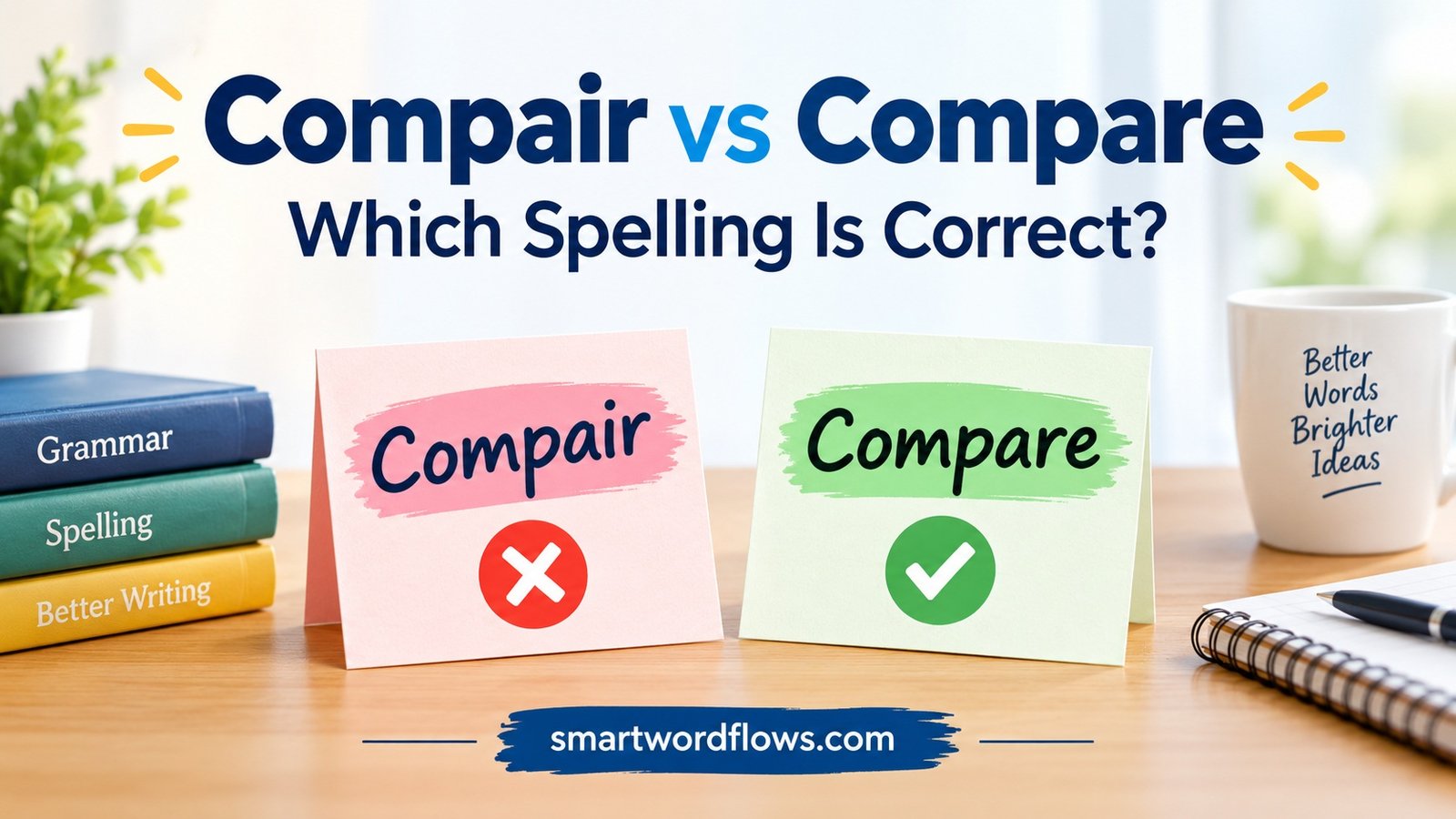

For Compair vs Compare: Which Spelling Is Correct?, the correct choice is compare, while compair remains an incorrect spelling in standard English. The pronunciation and phonetic similarity can cause confusion because the spoken sounds and word sounds may make the wrong form seem reasonable. If you are relying on how a word is spoken rather than its written form, this spelling mistake can easily happen. The standard word is compare, which means to examine two or more things and find their similarities and differences. When compair appears in a search bar, email, or document, a red underline from spellcheck can identify the spelling error.
A simple memory trick is to connect the word with its meaning and proper usage rather than guessing from its sound. Words such as chair, repair, and fair may make compair seem logical, but they do not create a dependable English spelling pattern for this word. When you stop mid sentence and begin deciding how to write, remembering the correct spelling can support clarity, accuracy, and confidence in professional, educational, and everyday communication. A useful practical rule is to check the real meaning and correct form before second guessing yourself. Writers who repeat the wrong spelling because they trust sound alone can use this common spelling confusion as a reminder to learn the basic rule and distinction.
The standard English language usage stays consistent across different contexts, including everyday writing, schoolwork, business communication, and online searches. A grammatical mistake, spelling slip, or uncertainty about whether compair looks right does not change the fact that compare is the real word needed in this sentence. The accepted form is compare, while compair is the wrong spelling. Once the logic is clear, the easiest trick is to remember the accepted form until it becomes a habit. This helps you avoid unnecessary spelling confusion and keep your writing polished and understandable. In written English, compare is the standard spelling and the established English form.
Quick Answer
Compare is the correct spelling when you mean to examine two or more people, things, ideas, or situations to identify their similarities and differences.
Compair is generally a misspelling of compare in standard English.
| Spelling | Correct for the standard verb? | Meaning |
| Compare | Yes | Examine things to identify similarities and differences |
| Compair | No | Usually a misspelling of compare |
Correct Example
Let’s compare the prices before we buy the laptop.
Incorrect Example
Let’s compair the prices before we buy the laptop.
A simple way to remember the spelling is:
Compare = com + pare
The ending is -pare, not -pair.
Comparison Overview
The difference between compair vs compare comes down to standard spelling rather than meaning. When writers use compair in an ordinary sentence, they almost always intend the verb compare.
| Feature | Compare | Compair |
| Standard English word | Yes | No, as the ordinary verb |
| Part of speech | Verb | Usually a spelling error |
| Meaning | Examine similarities and differences | Usually intended to mean compare |
| US English | Standard | Not standard |
| British English | Standard | Not standard |
| Common in academic writing | Yes | No |
| Common in professional writing | Yes | No |
| Pronunciation | /kəmˈper/ | Usually intended to represent compare |
| Correct spelling of the verb | Yes | No |
The important point is that compare isn’t an American spelling while compair is British. Neither does this represent a US-versus-UK spelling difference.
Both American and British English use compare.
For example:
- US English: “We need to compare the results.”
- British English: “We need to compare the results.”
The spelling stays the same.
Main Differences Between Compair vs Compare
The main difference is simple: compare is the standard English spelling, while compair generally represents a spelling mistake when someone intends to use the verb compare.
Compare Is the Correct Standard Spelling
Compare is a verb that means to examine two or more things in relation to one another.
You might compare their:
- Similarities
- Differences
- Prices
- Qualities
- Features
- Results
- Sizes
- Performance
- Advantages
- Disadvantages
For example:
“Before choosing a phone, compare its camera, battery life, and price.”
The word can apply to almost anything that you can evaluate side by side.
You can compare two products. You can compare several academic theories. You can compare the performance of different machines. You can even compare your current results with your previous results.
Compair Is Usually a Misspelling
Compair isn’t the standard spelling of the verb.
The mistake makes sense from a pronunciation perspective. The final part of compare sounds somewhat like pair, a familiar English word. Someone writing from memory might therefore choose compair.
However, standard spelling uses -pare.
Consider these examples:
- ❌ “Please compair these two reports.”
- ✅ “Please compare these two reports.”
- ❌ “I want to compair the prices.”
- ✅ “I want to compare the prices.”
- ❌ “We compaired the results.”
- ✅ “We compared the results.”
The error can also carry into other forms. Once someone incorrectly treats compair as the base spelling, they may produce forms such as compaired or compairing.
The standard forms are:
- compare
- compared
- comparing
- compares
Compare and Compair Have Different Spelling Patterns
The easiest visual distinction appears at the end of each word:
compare → -pare
compair → -pair
The second form resembles the spelling of pair, which means two things considered together. That resemblance can cause confusion.
However, compare doesn’t contain the word pair. Its spelling comes from the established English form compare.
A useful memory trick is:
Compare has “pare,” not “pair.”
Once you remember that final e, the spelling becomes much easier to recognize.
What Does Compare Mean?
The word compare has a broad but clear meaning. It involves considering two or more things together to determine how they relate.
Compare as a Verb
As a verb, compare means to examine people, objects, ideas, or situations in relation to one another.
For example:
“The teacher asked students to compare the two poems.”
The students might examine the poems’ themes, structure, language, tone, and subject matter.
Another example is:
“We compared three insurance plans before choosing one.”
Here, the comparison could involve premiums, coverage, deductibles, exclusions, and benefits.
The word works across many areas because comparison is a basic way of making decisions and understanding information.
Compare Can Show Similarities and Differences
One common misunderstanding is that compare only means finding differences.
That’s too narrow.
When you compare two things, you can identify both what they have in common and how they differ.
For example, suppose you compare two laptops. You might discover that both have:
- 16 GB of RAM
- 512 GB of storage
- Similar screen sizes
At the same time, one might have better battery life while the other offers a faster processor.
That entire process is a comparison.
Common Forms of Compare
The base verb appears in several common forms:
| Form | Example |
| Compare | “Compare the two options.” |
| Compares | “This chart compares three products.” |
| Compared | “We compared the results.” |
| Comparing | “She is comparing different models.” |
| Comparison | “The comparison revealed several differences.” |
| Comparable | “The two products are comparable.” |
| Comparative | “The report provides a comparative analysis.” |
These related words make the compare spelling easier to recognize in different contexts.
How to Use Compare in a Sentence
Knowing the definition isn’t enough. You also need to understand how compare works naturally in sentences.
Compare Two Things
You can use compare when examining two items.
“Compare the two phones before making your decision.”
“The report compares the old system with the new system.”
“She compared the two job offers carefully.”
The objects can be physical items, ideas, experiences, or abstract concepts.
Compare More Than Two Things
You aren’t limited to two subjects.
For example:
“We compared five different internet plans.”
Another example:
“The researchers compared results from three groups.”
So, the word compare works equally well when you’re evaluating several alternatives.
Compare One Thing With Another
The construction compare A with B is common when examining two subjects side by side.
For example:
“Compare this year’s sales figures with last year’s figures.”
This wording works especially well when you want readers to examine specific data.
Compare One Thing to Another
You can also see compare A to B.
For example:
“The article compares the city’s growth to that of neighboring towns.”
Both compare with and compare to occur in standard English. The best choice can depend on context and the relationship being described.
In careful analytical writing, compare with often suits a direct examination of similarities and differences. Compare to can work naturally when highlighting a resemblance or drawing an analogy.
The distinction isn’t an absolute rule in modern English.
Compare in Different Contexts
The usefulness of compare becomes clearer when you see it in real situations.
Compare in Everyday Conversation
People compare things constantly without thinking about the grammar involved.
You might say:
“Let’s compare prices before we order.”
Or:
“How does this restaurant compare with the one we visited last week?”
You can compare food, prices, cars, movies, neighborhoods, phones, clothes, or travel options.
Compare in Academic Writing
Academic work relies heavily on comparison.
A teacher might ask:
“Compare the causes of the two historical events.”
That instruction requires more than listing facts. It asks students to place the subjects alongside each other and explain meaningful similarities and differences.
Another example:
“The essay compares Shakespeare’s treatment of ambition in two plays.”
In this context, compare sounds precise and appropriate.
Compare in Business Writing
Businesses use comparison when evaluating:
- Sales figures
- Product features
- Market performance
- Operating costs
- Customer satisfaction
- Competitor offerings
- Quarterly results
For example:
“The management team compared this quarter’s revenue with the previous quarter.”
A business report might also say:
“The table compares the pricing structures of four competitors.”
Compare in Technical and Online Content
Comparison plays a major role in technology writing.
A website might publish an article titled:
“Compare the iPhone 17 and Galaxy S26: Features and Prices”
A software company might say:
“Compare the available plans to find the features that fit your needs.”
The same spelling remains correct regardless of the subject.
Why Do People Spell Compare as Compair?
The compair vs compare confusion has a few straightforward causes.
Pronunciation Can Cause Confusion
English contains many words whose spelling isn’t immediately obvious from pronunciation.
When someone says compare, the ending sounds like “pair.” If you know the word pair well, your brain may naturally connect that sound with its spelling.
That’s where compair can come from.
However, spoken English doesn’t provide every letter you need to write the word correctly. You need to remember the established spelling.
English Spelling Doesn’t Always Match Pronunciation
English has a complicated relationship between sounds and letters.
For example:
- there and their sound alike in many varieties of English.
- right, write, and rite share pronunciation but differ in meaning and spelling.
- pair and pare sound alike but have different meanings and spellings.
The same basic issue helps explain why compair can look plausible.
The fact that two endings sound alike doesn’t mean they share spelling.
Typing Errors Can Reinforce the Mistake
Fast typing can also create spelling errors. Someone who rarely writes the word compare may type compair automatically.
Autocorrect doesn’t always solve the problem. A word may pass through a spell-checking process differently depending on the software, dictionary, context, or platform.
For important writing, a final proofreading pass still matters.
Compare: Pronunciation and Word Forms
Understanding the pronunciation and related forms can help reinforce the correct spelling.
How to Pronounce Compare
In standard American English, compare is commonly pronounced approximately as:
kuhm-PAIR
The stress falls on the second syllable.
That pronunciation explains why people sometimes associate the ending with pair.
Yet the spelling remains:
compare
Not:
compair
Related Words
Several English words come from the same word family.
| Word | Meaning |
| Compare | Examine things in relation to one another |
| Comparison | The act or result of comparing |
| Comparable | Similar enough to be compared |
| Comparative | Involving comparison |
| Comparatively | In relation to something else |
For example:
“The comparison showed that both products were comparable.”
These related words make the spelling pattern easier to recognize.
Read More:Busing vs Bussing: Which Spelling Is Correct?
Common Mistakes With Compare
Several errors appear when people aren’t sure how to use or spell this word.
“Compair” Instead of “Compare”
This is the most direct spelling mistake.
Incorrect:
“Can you compair these two options?”
Correct:
“Can you compare these two options?”
The solution is simple: remember -pare.
Confusing Compare With Comparison
Compare and comparison belong to the same word family, but they don’t perform the same grammatical job.
Compare is a verb:
“We need to compare the prices.”
Comparison is a noun:
“The comparison showed a major price difference.”
Knowing the part of speech helps you choose the right form.
Using Compare When Contrast Is More Precise
Compare and contrast overlap, but they aren’t identical.
If you want to examine both similarities and differences, compare works well.
If you specifically want to emphasize differences, contrast can be more precise.
For example:
“Compare the two approaches.”
This could involve similarities and differences.
But:
“Contrast the two approaches.”
This directs attention toward their differences.
Compare vs. Contrast
The distinction becomes clearer in a direct comparison.
| Word | Main Focus | Example |
| Compare | Similarities and differences | “Compare the two plans.” |
| Contrast | Differences | “Contrast the two plans.” |
Neither word is automatically better. The right choice depends on what the sentence intends to communicate.
For instance, a teacher could ask students to compare two novels. Students might discuss characters, themes, writing styles, similarities, and differences.
A teacher could instead ask students to contrast the novels. That instruction puts greater emphasis on where the works diverge.
Examples of Compare in Real Sentences
Here are examples showing how naturally compare fits different situations.
Everyday Examples
- “Let’s compare the prices before buying anything.”
- “I compared both restaurants before choosing one.”
- “You should compare the ingredients on each package.”
Academic Examples
- “Students must compare the two historical periods.”
- “The paper compares two different theories.”
- “The professor asked the class to compare the poems.”
Business Examples
- “The company compared its sales with last year’s results.”
- “Customers can compare several plans online.”
- “The manager compared supplier prices before placing the order.”
Technology Examples
- “Compare the battery performance of these two phones.”
- “The review compares four popular laptops.”
- “Users can compare the features of each subscription.”
Personal Decision-Making Examples
- “I compared several apartments before signing a lease.”
- “She compared the job offers carefully.”
- “We compared our travel options before booking the trip.”
Notice that compare remains unchanged regardless of the subject.
Incorrect vs. Correct Examples
Seeing the error next to the correct form makes the distinction easy to remember.
| Incorrect | Correct |
| “Let’s compair the prices.” | “Let’s compare the prices.” |
| “I need to compair these products.” | “I need to compare these products.” |
| “She compaired the reports.” | “She compared the reports.” |
| “We are compairing the results.” | “We are comparing the results.” |
| “He compairs several models.” | “He compares several models.” |
The mistake isn’t limited to the base word. If the writer incorrectly changes compare to compair, that error can spread into the word’s other grammatical forms.
A Simple Correction Rule
Whenever the intended meaning is “examine two or more things in relation to each other,” use:
compare
Don’t replace -pare with -pair.
How to Remember the Correct Spelling
A small spelling trick can prevent this mistake.
Remember “Pare,” Not “Pair”
Break the word into two parts:
com + pare = compare
The ending is pare.
The word pair refers to two matching or associated things. Although pair sounds similar to the ending of compare, it isn’t the spelling used in the verb.
A useful sentence is:
“Compare has pare, not pair.”
That short reminder targets the exact letter combination that causes the confusion.
Think of Related Words
The word family also reinforces the spelling:
- compare
- compared
- comparing
- comparison
- comparative
- comparable
Once compare becomes familiar, the related forms become easier to recognize.
Is Compair Ever a Word?
This question deserves a little nuance.
Compair isn’t the standard English spelling of the verb compare. However, you may encounter Compair in a proper name, company name, brand, product, or specialized context.
Proper names don’t have to follow ordinary dictionary spelling conventions.
For example, a company could choose a distinctive spelling for branding purposes. That doesn’t change the standard spelling of the English verb.
Therefore, context matters.
If a sentence says:
“Let’s compair the two products.”
the writer almost certainly intended compare.
If Compair appears as the official name of a particular organization or product, changing its spelling could instead make the name inaccurate.
Compare vs. Compair in American English
In American English, compare is the standard spelling.
Use it in:
- School assignments
- College essays
- Emails
- Business reports
- Websites
- Product descriptions
- Research writing
- Customer communications
- Everyday messages
For example:
“Please compare the two proposals before Friday.”
This sentence follows standard American English spelling.
Compair shouldn’t replace compare simply because the two forms sound similar.
Compare vs. Compair in British English
British English also uses compare.
This isn’t one of the spelling differences between American and British English.
For example:
- American English: compare
- British English: compare
The same spelling applies.
That’s important because English does have genuine regional spelling differences. Consider:
- color / colour
- center / centre
- organize / organise in styles that prefer the latter
But compair vs compare doesn’t follow that pattern.
There is no standard British spelling compair for the verb compare.
Compare vs. Compair: A Quick Reference
| Question | Answer |
| Which spelling is correct? | Compare |
| Is compair the standard spelling? | No |
| What does compare mean? | To examine similarities and differences |
| Is compare used in US English? | Yes |
| Is compare used in British English? | Yes |
| Is compair a British spelling? | No |
| Why does compair look plausible? | Its ending resembles the pronunciation of compare |
| Can Compair appear as a name? | Yes, depending on the specific name or brand |
| What is the easiest spelling trick? | Remember compare = com + pare |
A Practical Case Study: Choosing Between Two Laptops
Imagine you’re buying a new laptop.
Laptop A costs $900 and has excellent battery life. Laptop B costs $850 but offers a faster processor.
Before choosing, you might compare:
- Price
- Processor
- RAM
- Storage
- Display
- Battery life
- Weight
- Warranty
- Connectivity
A natural sentence would be:
“I compared the two laptops before making my decision.”
Writing compaired or compair would introduce a spelling error without changing the intended meaning.
This example also shows why compare is such a useful word. Comparison helps you make a decision based on several pieces of information rather than one feature.
A Practical Case Study: Academic Comparison
Consider a student writing about two novels.
The assignment might say:
“Compare the main characters in the two novels.”
The student could examine:
- Personality
- Goals
- Conflicts
- Relationships
- Character development
- Decisions
- Outcomes
The student isn’t merely listing facts. The goal is to put the characters into a meaningful relationship and explain what the similarities and differences reveal.
A sentence such as this works well:
“The essay compares how both characters respond to pressure.”
The spelling remains compare, even when the word appears in formal academic writing.
Why Correct Spelling Matters
A single spelling error rarely changes the meaning of a sentence. However, repeated errors can affect how readers perceive the writing.
Consider these two sentences:
“Please compare the three proposals and select the strongest option.”
“Please compair the three proposals and select the strongest option.”
The intended meaning remains obvious. Still, the second sentence contains a standard spelling error.
In professional writing, small errors can distract readers. In academic writing, they can reduce polish. On websites, repeated mistakes can make otherwise useful content look less reliable.
Correct spelling doesn’t require complicated vocabulary. Sometimes, getting one familiar word right makes the biggest difference.
Final Difference Between Compair and Compare
The compair vs compare question has a clear answer for standard English writing.
Compare is the correct spelling of the verb meaning to examine two or more things to identify their similarities and differences.
Compair isn’t the standard spelling of that verb. It usually appears because the writer has connected the pronunciation of compare with the spelling of pair.
The key distinction is:
Compare = correct standard spelling
Compair = usually a misspelling
If you’re writing an email, report, essay, website article, or everyday message, choose compare.
Remember the simple rule: compare has “pare,” not “pair.”
Frequently Asked Questions
Is “compair” a correct spelling?
No. Compare is the standard spelling when you mean to examine two or more things for similarities and differences. Compair is generally a misspelling of compare.
Is “compare” the only correct spelling?
For the ordinary English verb meaning “to examine things in relation to one another,” compare is the standard spelling. Compair isn’t an alternative standard spelling.
Why do people spell compare as compair?
The pronunciation can cause confusion because the ending of compare sounds similar to pair. Writers may therefore mistakenly spell it with -pair instead of -pare.
How do you spell compare correctly?
The correct spelling is:
C-O-M-P-A-R-E
A useful memory aid is “compare has pare, not pair.”
What is the difference between compare and contrast?
Compare can involve both similarities and differences. Contrast focuses more specifically on differences. For example, you can compare two phones by examining their shared features and differences, while contrasting them emphasizes where they differ.
Is compair a British spelling of compare?
No. Compare is the standard spelling in both American and British English. Compair isn’t a standard British variant.
Can Compair ever be written correctly?
Yes, if Compair is an official proper name, brand, company name, product name, or another designated term. That specialized use doesn’t make it a standard spelling of the English verb compare.
Is “compaired” correct?
No. The correct past-tense form is compared.
For example:
“We compared the two reports.”
Not:
“We compaired the two reports.”
Is “compairing” correct?
No. The correct form is comparing.
For example:
“We are comparing the results.”
Not:
“We are compairing the results.”
What is the easiest way to remember compare?
Think of the word as com + pare.
The ending is pare, not pair:
compare = correct
compair = incorrect for the standard verb
Conclusion
When deciding between compair vs compare, the correct choice for standard English is clear: compare. It works in American and British English and describes the act of examining two or more things to understand their similarities and differences.
The spelling compair usually comes from pronunciation. Because compare sounds similar to pair at the end, the incorrect version can look convincing at first glance. However, standard spelling uses -pare.
Whether you’re comparing prices, products, ideas, research findings, or two pieces of writing, use compare. Remember the simple rule: compare has “pare,” not “pair.” That one small spelling cue can help you avoid the error every time.


1 thought on “Compair vs Compare: Which Spelling Is Correct?”