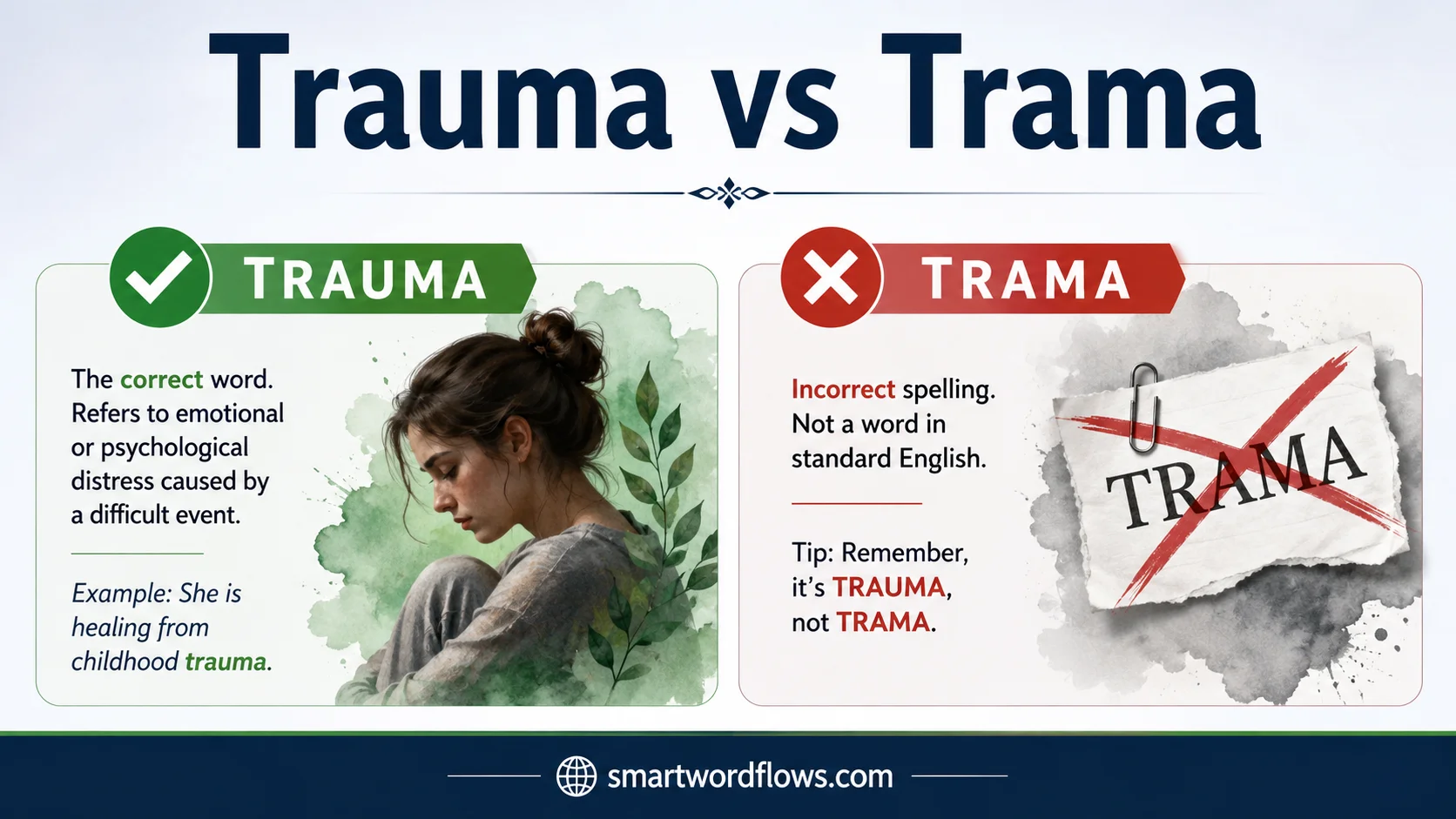

The Trauma vs Trama: Difference, Meaning, and Correct Usage Explained topic helps readers understand why these two words create confusion. Although they look and sound similar, they have completely different meanings. Trauma is a recognized English word that describes physical, emotional, or psychological injury caused by a distressing experience. Trama is an incorrect English spelling and is usually a misspelling. Learning the correct usage improves language, grammar, and writing accuracy.
A traumatic experience can affect a person’s mind, body, and emotions deeply. Trauma may result from an accident, loss, illness, stress, or major life changes. It can create a strong emotional impact and make situations difficult to handle. Using Trama instead of Trauma in writing creates a spelling mistake and may change the intended meaning. Understanding this difference supports clear communication.
Quick Answer
Trauma means a serious physical injury, emotional wound, or psychological distress caused by a harmful or frightening experience.
Trama is a specialized scientific term that refers to internal tissue or structural parts of certain organisms, especially fungi.
Use “trauma” when talking about injuries, pain, or emotional experiences. Use “trama” only in technical scientific contexts.
Examples:
- Correct: “The accident caused severe trauma.”
- Correct: “The patient received treatment for brain trauma.”
- Correct: “Scientists examined the mushroom’s trama under a microscope.”
- Incorrect: “The event caused emotional trama.”
Comparison Overview
The easiest way to understand trauma vs trama is to compare their meanings, uses, and contexts.
| Feature | Trauma | Trama |
| Meaning | Physical injury, emotional distress, or psychological harm | Internal tissue structure in biological organisms |
| Common Usage | Very common in everyday English | Rare and mostly technical |
| Main Fields | Medicine, psychology, personal communication | Biology, mycology, scientific research |
| Word Type | Noun | Noun |
| Origin | Greek word meaning “wound” | Latin/technical scientific usage |
| Example | “She experienced emotional trauma.” | “The mushroom trama was examined.” |
| Audience Familiarity | Most English speakers know this word | Mostly known by researchers and specialists |
In simple terms:
Trauma affects people. Trama describes structures.
If you are talking about someone’s pain, injury, fear, or emotional suffering, trauma is almost always the correct choice.
Main Differences Between Trauma vs Trama
The difference between trauma vs trama is not only spelling. Their meanings, purposes, and areas of use are completely different.
Meaning Difference Between Trauma and Trama
What Does Trauma Mean?
Trauma refers to a harmful experience that causes physical damage, emotional suffering, or psychological distress.
The word appears frequently in medicine and mental health because it describes serious events that can leave lasting effects.
There are two major types of trauma:
Physical Trauma
Physical trauma happens when the body experiences damage because of an external force.
Common causes include:
- Car accidents
- Falls
- Sports injuries
- Violence
- Burns
- Surgical complications
Examples:
- A person who suffers a severe head injury in a crash may experience head trauma.
- A broken bone caused by a fall is a form of physical trauma.
Medical professionals often use terms such as:
- Brain trauma
- Blunt trauma
- Chest trauma
- Spinal trauma
These terms describe the location or type of physical damage.
Emotional and Psychological Trauma
Trauma also describes deep emotional harm caused by frightening, painful, or overwhelming experiences.
Psychological trauma may result from:
- Natural disasters
- Abuse
- Loss of a loved one
- Serious accidents
- Violence
- Life-threatening situations
For example:
“After the earthquake, many survivors experienced emotional trauma.”
This does not mean the person has a physical wound. Instead, it describes the emotional impact of a difficult event.
What Does Trama Mean?
Unlike trauma, trama is not a word used in normal conversations.
It is mainly a scientific term used in biology, especially mycology, which is the study of fungi.
In fungi, trama refers to the inner tissue or flesh that makes up part of a mushroom’s structure.
Scientists study fungal trama because it helps them identify and classify different species.
For example:
- Researchers may examine the trama of a mushroom to understand its structure.
- A mycologist may compare trama patterns when identifying fungal species.
A casual English speaker will rarely need this word.
Origin and History of Trauma vs Trama
The History of the Word Trauma
The word trauma comes from the ancient Greek word traûma, meaning “wound” or “injury.”
Originally, it referred mainly to physical wounds. Over time, medical researchers and psychologists expanded its meaning.
Today, trauma covers both:
- Bodily injuries
- Emotional and psychological suffering
The development of psychology in the 20th century played a major role in making emotional trauma a widely recognized concept.
The Background of Trama
The word trama comes from technical scientific language.
It appears in biological descriptions, especially when scientists discuss internal structures of organisms.
Unlike trauma, trama never became a common everyday word because it serves a very specific scientific purpose.
Trauma vs Trama Examples in Sentences
Seeing examples makes the difference easier to remember.
Examples of Trauma
- “The athlete suffered knee trauma during the game.”
- “The accident caused serious physical trauma.”
- “Therapy helped her recover from childhood trauma.”
- “The doctor examined the patient for signs of brain trauma.”
- “The disaster left many people with emotional trauma.”
Examples of Trama
- “The scientist studied the mushroom’s trama structure.”
- “The fungal trama contained important identifying features.”
- “Researchers analyzed the trama using microscopic techniques.”
Notice the difference:
Trauma describes damage. Trama describes structure.
Why Do People Confuse Trauma and Trama?
Many people confuse these words because they share several similarities.
They Look Almost the Same
The spelling difference is very small:
- Trauma → T R A U M A
- Trama → T R A M A
The missing letter “u” completely changes the meaning.
They Sound Similar
Both words have similar pronunciation patterns, which makes them easy to mix up when writing.
Trama Looks Like a Spelling Error
Because trauma is so common, many readers assume “trama” is always a mistake.
However, that is not true.
Trama is correct when used in scientific contexts.
Simple Memory Trick to Remember Trauma vs Trama
A simple way to remember the difference:
Trauma has “au” because it is about a painful “ouch” experience.
Think:
- Trauma = hurt, harm, injury
- Trama = tissue, technical science
Another memory trick:
People experience trauma. Mushrooms have trama.
This quick association can prevent spelling mistakes.
Read More: Encorporate vs Incorporate Correct Usage
Common Mistakes When Using Trauma and Trama
Using Trama for Emotional Pain
Incorrect:
“The accident caused emotional trama.”
Correct:
“The accident caused emotional trauma.”
The person experienced emotional suffering, so trauma is the correct word.
Assuming Trama Is Always Wrong
Some writers automatically correct “trama” to “trauma.”
That can create another mistake.
Example:
Incorrect correction:
“Scientists studied the mushroom’s trauma.”
Correct:
“Scientists studied the mushroom’s trama.”
Scientific terms should remain accurate.
Confusing Trauma With Drama
Another common mistake is mixing up trauma and drama.
| Word | Meaning | Example |
| Trauma | Serious harm or distress | “The accident caused trauma.” |
| Drama | Conflict, excitement, or performance | “The movie was full of drama.” |
Drama may be emotional, but it does not mean injury or psychological harm.
How to Use Trauma Correctly in Different Contexts
Trauma in Medical Writing
Doctors use trauma when discussing injuries caused by external forces.
Examples:
- “The emergency department treated multiple trauma patients.”
- “The patient suffered severe abdominal trauma.”
Medical trauma categories include:
- Head trauma
- Bone trauma
- Internal trauma
- Soft tissue trauma
Trauma in Mental Health Discussions
Mental health professionals use trauma when discussing the effects of distressing experiences.
Common phrases include:
- Emotional trauma
- Childhood trauma
- Psychological trauma
- Traumatic experience
- Trauma recovery
Example:
“A supportive environment can help people recover from trauma.”
Trauma in Everyday Conversations
People often use trauma when describing difficult experiences.
Examples:
- “Moving away was emotionally traumatic for him.”
- “The experience caused lasting trauma.”
- “She is working through past trauma.”
However, the word should be used thoughtfully because trauma often refers to serious experiences.
How to Use Trama Correctly in Scientific Contexts
Trama in Mycology
Mycologists study fungi by examining different internal parts, including the trama.
The structure of fungal trama can help researchers identify species because different mushrooms have different tissue arrangements.
Scientists may examine:
- Tissue patterns
- Cell arrangements
- Structural features
- Spore-producing areas
Example Case Study: Mushroom Identification
Imagine a researcher discovers an unfamiliar mushroom in a forest.
The researcher examines:
- Cap shape
- Color
- Spores
- Internal trama structure
The trama provides additional clues that help classify the mushroom correctly.
Without studying these microscopic features, identifying some fungi would be much more difficult.
Trauma vs Trama vs Traumatic: Related Words Explained
Trauma
Trauma is the noun form.
Example:
“The accident caused emotional trauma.”
Traumatic
Traumatic is an adjective used to describe something that causes trauma.
Examples:
- “It was a traumatic experience.”
- “The patient had a traumatic injury.”
Traumatize
Traumatize is a verb meaning to cause trauma.
Example:
“The event traumatized many people.”
Does Trama Have Common Related Words?
No. Unlike trauma, trama does not have widely used everyday forms.
You usually encounter it only in specialized scientific writing.
Quick Guide: Which Word Should You Use?
| If You Mean | Correct Word |
| Emotional suffering | Trauma |
| Physical injury | Trauma |
| Psychological damage | Trauma |
| Medical injury | Trauma |
| Mushroom tissue | Trama |
| Scientific fungal structure | Trama |
A simple rule:
If a person is affected, use trauma. If a scientific specimen is being studied, trama may be correct.
FAQs:
1. What is the correct spelling, Trauma or Trama?
The correct spelling is Trauma. It is an English word used for physical injury, emotional pain, or psychological distress caused by a difficult experience. Trama is an incorrect spelling and should not be used in standard English writing.
2. What does Trauma mean?
Trauma refers to a deeply distressing or harmful experience that affects a person’s mind, body, or emotions. It can happen because of accidents, loss, illness, violence, stress, or major life events.
3. Why do people confuse Trauma and Trama?
People often confuse these two words because they have a similar spelling and pronunciation. However, only Trauma has a recognized meaning in English, while Trama is usually a spelling error.
4. How can Trauma affect a person?
Trauma can create emotional, mental, and physical effects. A person may experience stress, fear, sadness, anxiety, or difficulty coping after a painful or shocking event.
5. How can I remember the correct usage of Trauma?
Remember that Trauma contains “au” and is connected with injury or emotional suffering. Always use Trauma when describing a painful experience or its effects.
Conclusion
Understanding the difference between Trauma and Trama helps improve spelling accuracy, grammar, and communication skills. Trauma is the correct English word used for physical, emotional, and psychological harm, while Trama is an incorrect spelling. Using the right word ensures that your writing remains clear, accurate, and meaningful.