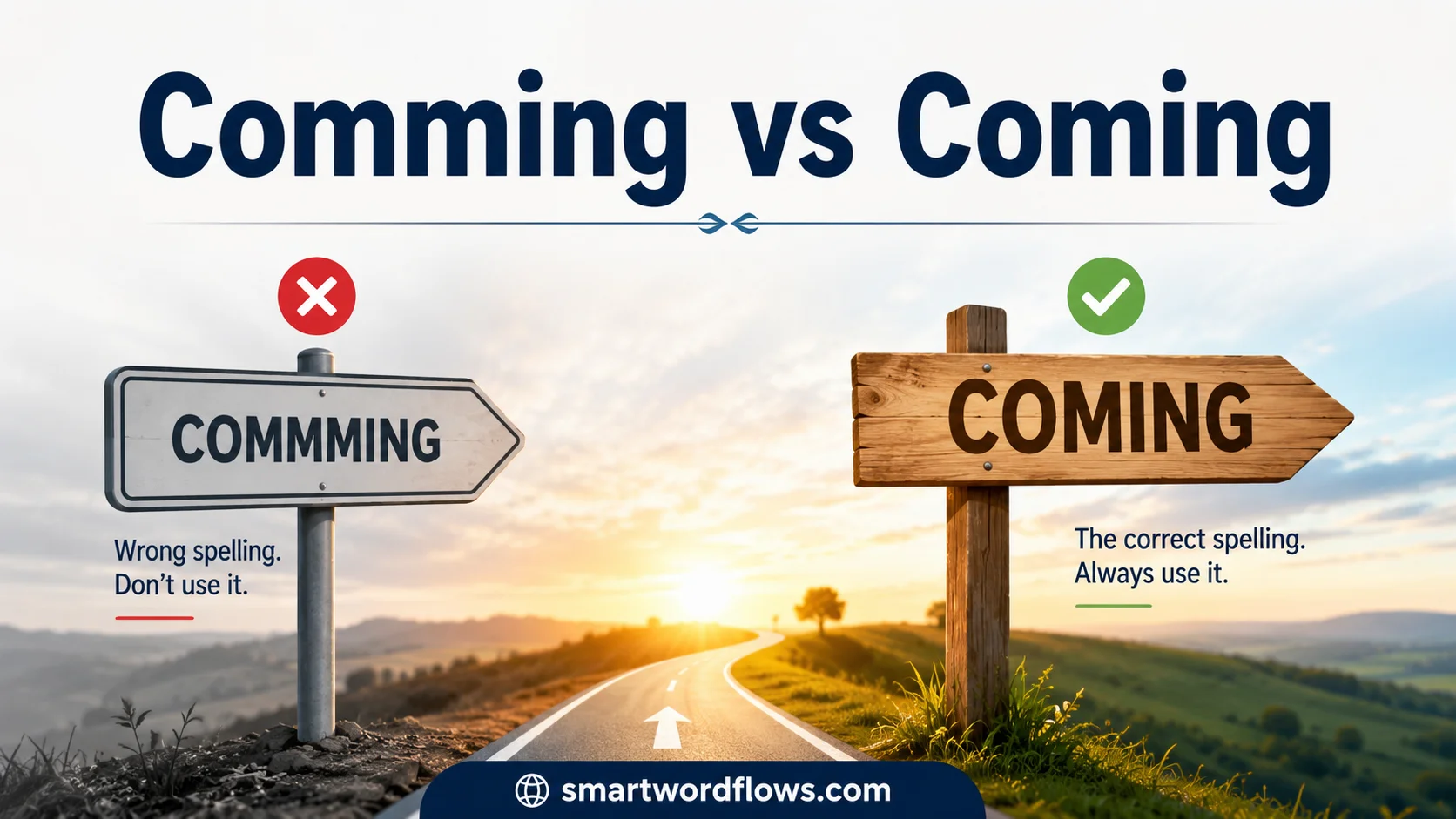

Understanding Comming vs Coming: Difference, Correct Spelling, and Correct Usage Explained helps clear spelling confusion in the English language. Many English learners, students, and professionals confuse these similar-looking words because of their same pronunciation and common usage. The correct spelling is coming with a single M, while comming is an incorrect spelling and common typo. Learning the correct usage, grammar rules, and standard form improves writing accuracy.
The word coming is a verb and present participle used in continuous tense, future plans, and everyday conversations. Following English spelling rules helps avoid writing errors and improves professional writing. Simple memory tips, practical examples, and grammar tips make English grammar easier. Correct word choice, natural English, and proper usage build better communication skills, vocabulary knowledge, and grammar confidence for effective language learning.
Quick Answer: Comming vs Coming
Coming is the correct spelling.
Comming is incorrect and considered a spelling mistake in standard English.
The word coming is the present participle form of the verb come. It can describe someone moving toward a place, something approaching in time, or an event that will happen soon.
Examples:
- She is coming to the meeting tomorrow.
- A new update is coming soon.
- She is comming to the meeting tomorrow.
The reason people confuse these words is that many English verbs double their final consonant before adding -ing, but come does not follow that pattern.
Comparison Overview: Comming vs Coming
| Word | Correct Spelling | Meaning | Example |
| Coming | Correct | The act of arriving, moving toward something, or something approaching | The train is coming soon. |
| Comming | Incorrect | A common spelling error with no standard meaning | “The event is comming soon” is wrong. |
The difference between these two forms is simple: coming exists in English, while comming does not.
Although comming may appear in online searches, comments, or informal writing, it usually happens because of typing mistakes or confusion about spelling rules.
Main Differences Between Comming vs Coming
The biggest difference between comming and coming is accuracy.
Coming Is a Correct English Word
The word coming comes from the verb come.
The verb come means:
- To move toward a person or place
- To arrive
- To happen in the future
- To appear or become available
When we add -ing to come, the silent e disappears:
Come + ing = Coming
Examples:
- I am coming home after work.
- The holidays are coming soon.
- A better opportunity is coming your way.
Comming Is a Misspelling
The spelling comming is incorrect because the letter m should not be doubled.
Some writers mistakenly think:
- run → running
- swim → swimming
- stop → stopping
Therefore:
- come → comming
But this logic does not work here.
The correct form is:
- come → coming
English spelling depends on the structure of each word, not only on one general rule.
What Does Coming Mean?
The word coming has several meanings depending on the context.
Coming as an Action of Moving Toward Someone
The most common use of coming describes movement toward a person, place, or location.
Examples:
- I am coming to your house tonight.
- She is coming downstairs.
- They are coming from New York tomorrow.
In these sentences, coming shows movement toward a destination.
Coming as Something Approaching in Time
People also use coming to talk about future periods or events.
Examples:
- The coming year will bring new challenges.
- The coming weeks will be very busy.
- Many changes are coming in the technology industry.
Here, coming means something that is approaching.
Coming as Future Arrival or Availability
Businesses often use coming to announce future launches.
Examples:
- New features are coming soon.
- Our online store is coming next month.
- A new movie is coming this summer.
This usage is especially common in marketing and entertainment.
Why Do People Write Comming Instead of Coming?
The confusion between comming vs coming happens for several reasons.
Confusion With Double Consonant Rules
English has many verbs that double their final consonant when adding -ing.
Examples:
| Base Verb | Correct -ing Form |
| Run | Running |
| Sit | Sitting |
| Plan | Planning |
| Stop | Stopping |
Because of these examples, some people assume every short verb follows the same pattern.
However, come is different.
Correct:
- Come → Coming
Incorrect:
- Come → Comming
Pronunciation Can Create Spelling Mistakes
Sometimes people spell words based on how they sound.
The pronunciation of coming contains a strong m sound, which may make some writers believe the word needs two m’s.
However, pronunciation and spelling do not always match perfectly in English.
For example:
- Write has a silent w
- Knife has a silent k
- Coming has only one m
English often requires memorizing certain spelling patterns.
Fast Typing and Online Writing Habits
Another reason comming appears frequently is simple typing mistakes.
People often type quickly on:
- Mobile phones
- Social media platforms
- Chat applications
- Comment sections
When a mistake gets repeated, it can start looking familiar even though it remains incorrect.
Grammar Rule Behind Come and Coming
Understanding the grammar rule makes this spelling easier to remember.
The verb come ends with a silent e.
When we add -ing, English usually removes the silent e.
Examples:
| Base Verb | Adding -ing | Correct Form |
| Come | Come + ing | Coming |
| Make | Make + ing | Making |
| Write | Write + ing | Writing |
| Take | Take + ing | Taking |
Notice that none of these words double the final consonant.
Read More: Grately vs Greatly: Differences, Correct Usage
When Do English Words Double Their Final Letter Before -ing?
The double consonant rule applies in specific situations.
Usually, a short verb doubles the final consonant when:
- It has one syllable.
- It ends with one vowel followed by one consonant.
- The final syllable receives stress.
Examples:
| Verb | Correct Form |
| Run | Running |
| Begin | Beginning |
| Admit | Admitting |
| Prefer | Preferring |
However, come does not fit this pattern.
That is why:
- Coming
- Comming
Coming vs Come: What Is the Difference?
Many learners also confuse come and coming.
Come
Come is the base form of the verb.
Examples:
- Please come inside.
- I want you to come with me.
- They come here every weekend.
Coming
Coming shows an ongoing action or something expected in the future.
Examples:
- She is coming now.
- The package is coming tomorrow.
- Winter is coming.
A simple way to remember:
Come = action in general
Coming = action happening or approaching
Coming vs Upcoming: Are They the Same?
Although these words look similar, they are not always interchangeable.
Coming
Coming has a broader meaning. It can describe movement, arrival, or future events.
Examples:
- The coming months will be difficult.
- He is coming to visit us.
Upcoming
Upcoming usually refers to planned future events.
Examples:
- The upcoming conference starts Monday.
- I am preparing for an upcoming interview.
Comparison:
| Word | Main Use | Example |
| Coming | Arrival or approaching | A storm is coming. |
| Upcoming | Planned future event | The upcoming exam is important. |
Common Mistakes With Coming and How to Fix Them
Mistake 1: Writing “Coming Soon” Incorrectly
Incorrect:
Our website is comming soon.
Correct:
Our website is coming soon.
The phrase coming soon is one of the most common places where people make this mistake.
Mistake 2: Adding an Extra M
Incorrect:
She is comming home.
Correct:
She is coming home.
Remember:
One m in coming.
Mistake 3: Applying Every Spelling Rule Automatically
Incorrect thinking:
“Running has two n’s, so coming should have two m’s.”
Correct thinking:
“Each verb follows its own spelling pattern.”
Learning examples is often more effective than trying to force every word into one rule.
Real-Life Examples of Coming Used Correctly
Everyday Conversations
- Are you coming to dinner tonight?
- I am coming in five minutes.
- They are coming over this weekend.
Business Communication
- Our new product is coming next month.
- More updates are coming soon.
- The company’s biggest changes are coming this year.
Entertainment and Media
- The new season is coming soon.
- A sequel is coming next year.
- A new episode is coming tonight.
Why Correct Spelling of Coming Matters
A single spelling mistake may seem small, but repeated errors can affect how readers view your writing.
Correct spelling helps you:
- Communicate clearly
- Build trust
- Maintain professionalism
- Avoid confusion
For example, a business website that says:
New products comming soon
looks less polished than:
New products coming soon
The message remains understandable, but the correct version creates a stronger impression.
How to Remember Coming Spelling Easily
Use this simple memory trick:
Come loses the “e” but keeps one “m.”
Think of it this way:
- Come → remove e → com
- Add ing → coming
Not:
- Comming
Another helpful reminder:
“Running runs with two n’s, but coming comes with one m.”
FAQs:
1. Is comming a correct spelling in English?
No, comming is not a correct English spelling. It is a common spelling mistake that happens because many people think the word follows a double-letter pattern. The correct spelling is coming with only one M.
2. Why is coming spelled with one M?
The word coming comes from the verb come. When adding -ing to verbs that end with a silent e, the final e is removed, but the remaining letters are not doubled. Therefore, come + ing = coming.
3. How can I remember the correct spelling of coming?
A simple memory tip is to remember that come already has one M, and adding -ing only removes the silent e. It does not add another m. Think of it as come → coming, not comming.
4. What is the meaning of the word coming?
Coming means moving toward a place, arriving, approaching, or happening in the future. For example, “She is coming home” means she is moving toward home, while “The coming year” refers to the next year.
5. Can I use coming in formal writing?
Yes, coming is completely acceptable in both formal and informal writing. It is commonly used in emails, reports, essays, conversations, and professional documents when referring to arrival, future events, or ongoing actions.
Conclusion
Understanding the difference between comming vs coming helps improve English spelling, grammar accuracy, and writing skills. The correct spelling is always coming, which is the present participle form of the verb “come” and is widely used in everyday communication. The word comming is not accepted in standard English and should be avoided in formal and informal writing. By practicing correct spelling rules, checking word forms, and using examples, English learners can prevent common mistakes and develop stronger language confidence.