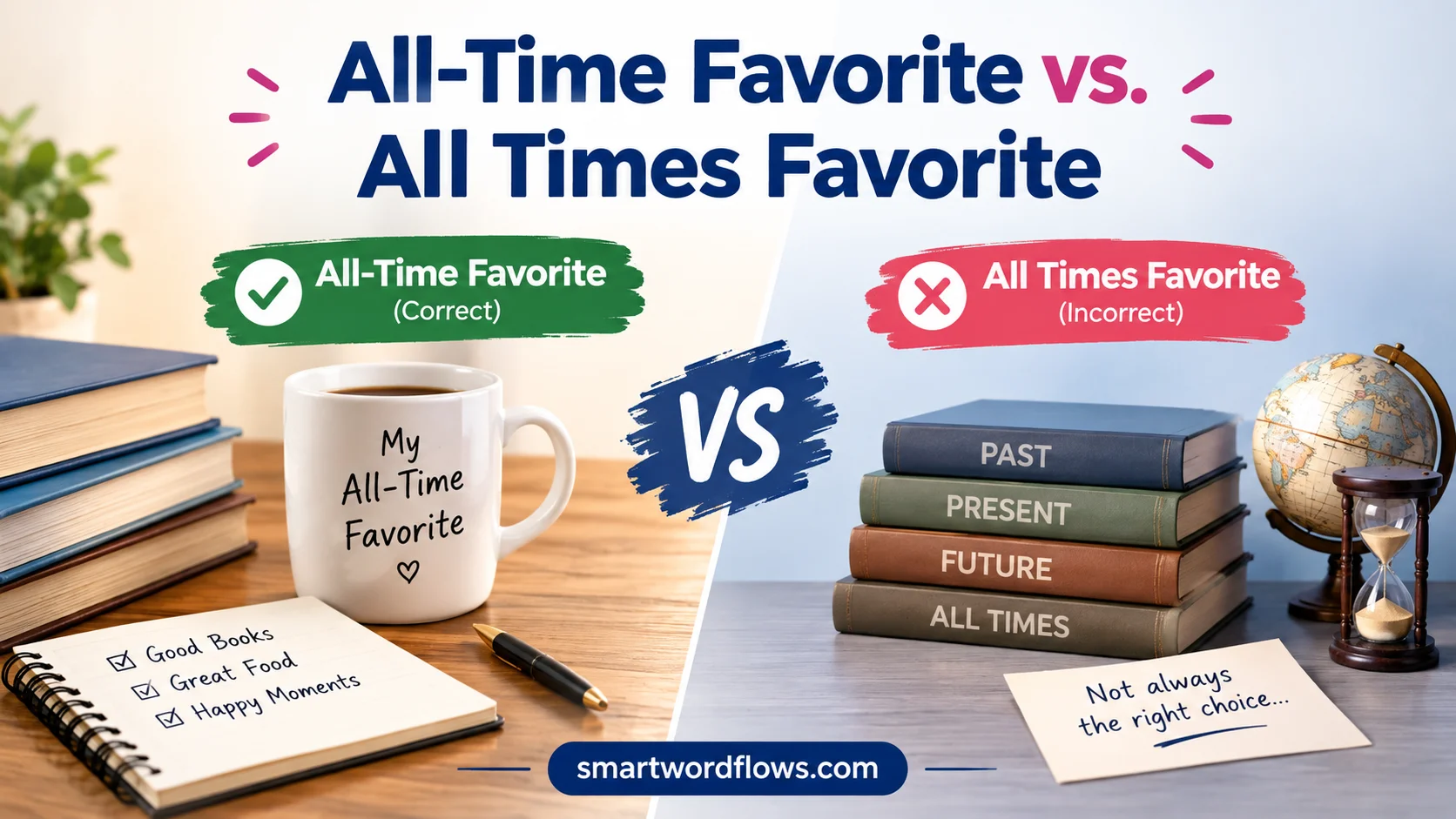

All-Time Favorite vs. All Times Favorite can confuse writers, but All-time favorite is the correct form in English grammar and standard English grammar. It is a hyphenated compound adjective that describes a noun. The grammar rule is simple: use All-time before a noun, such as all-time favorite or all-time record. The single hyphen joins the words into one adjective, while All times favorite is a common grammar mistake caused by spelling confusion.
This difference also matters in casual writing, professional writing, a caption, blog post, or text message. Many writers make this careless mistake because they think about years and experiences and choose a plural form. However, all time has a different phrase meaning and can work as an adverbial phrase after a verb, as in “the greatest of all time.” When the noun follows, use all-time; when the noun does not follow, all time can be correct. This improves writing clarity, sentence flow, and grammatical accuracy in everyday English.
Quick Answer
“All-time favorite” is correct. “All times favorite” is incorrect in standard English.
The expression all-time favorite means something you consider your favorite across your entire experience or among all the choices you’ve encountered.
For example:
- Correct: This is my all-time favorite movie.
- Correct: Chocolate cake is my all-time favorite dessert.
- Correct: She is one of my all-time favorite singers.
- Incorrect: This is my all times favorite movie.
You can also express the same basic idea with favorite of all time:
This is my all-time favorite book.
This is my favorite book of all time.
Both sentences are grammatically correct and communicate essentially the same preference.
The key point is simple: use “all-time favorite,” not “all times favorite.”
Comparison Overview
Before getting into the grammar, here’s a quick comparison of the expressions.
| Expression | Correct? | Meaning | Example |
| all-time favorite | Yes | A favorite above all others | This is my all-time favorite song. |
| favorite of all time | Yes | The favorite among all choices or experiences | This is my favorite song of all time. |
| all times favorite | No | Nonstandard construction | Avoid this form. |
| all-times favorite | No | Incorrect hyphenation for this expression | Avoid this form. |
| all time favorite | Commonly seen, but less polished in this compound use | Intended to mean all-time favorite | Use all-time favorite in edited writing. |
The distinction becomes clearer when you look at the role of each word.
In all-time favorite, the words all and time combine to create the compound modifier all-time. That compound then describes favorite.
In favorite of all time, the phrase of all time comes after favorite and functions differently.
At a Glance
Remember this pattern:
all-time + noun
- all-time favorite
- all-time great
- all-time record
- all-time high
Compare it with:
noun + of all time
- favorite of all time
- greatest of all time
- best of all time
- highest of all time
That parallel makes the difference much easier to remember.
Main Differences Between All-Time Favorite and All Times Favorite
The biggest difference is that all-time favorite follows the established compound-adjective pattern in English, while all times favorite doesn’t.
All-Time Favorite Uses Singular “Time”
The word time remains singular inside the compound all-time.
That’s true even though the phrase refers to a broad span of time or to every relevant point in someone’s experience.
For example:
My all-time favorite actor is Tom Hanks.
The phrase doesn’t mean that Tom Hanks is someone’s favorite during several separate “times.” Instead, all-time expresses an overall judgment extending across the relevant period.
That’s why changing time to times doesn’t preserve the grammar.
All-Time Favorite Usually Takes a Hyphen
When all-time directly modifies another word, the hyphen helps show that the two words belong together as a single modifier.
Consider:
She broke the all-time record.
Here, all-time describes record. The hyphen makes that relationship immediately clear.
The same structure appears in:
He became my all-time favorite player.
The hyphen connects all and time into the compound adjective all-time.
All Times Favorite Changes the Structure Incorrectly
The phrase all times can be grammatical in other contexts, but that doesn’t make all times favorite grammatical.
For example:
He arrived on time at all times.
Here, all times functions as an ordinary plural noun phrase. It isn’t modifying favorite.
When you want to describe a favorite that stands above your other favorites, English uses all-time favorite instead.
What Does “All-Time Favorite” Mean?
An all-time favorite is something you like more than other options when you consider your overall experience.
It can refer to almost anything that can become a personal favorite. A person might have an all-time favorite movie, song, meal, book, athlete, vacation destination, video game, or television series.
For example:
The Shawshank Redemption is one of my all-time favorite movies.
The speaker isn’t necessarily saying that the movie is their favorite at this exact moment. They’re placing it among the favorites they’ve had over a long period.
That’s an important nuance.
A current favorite can change quickly. An all-time favorite usually suggests a stronger and more lasting preference.
Examples of the Meaning
- My all-time favorite food is pizza.
- That novel remains one of my all-time favorite books.
- This is my all-time favorite vacation memory.
- She is still my all-time favorite tennis player.
- That song became an all-time favorite among the band’s fans.
The phrase can describe an individual preference or something widely regarded as a favorite.
Why Is “All-Time Favorite” Correct?
The grammar becomes easier once you recognize all-time as a compound adjective.
A compound adjective combines two or more words so they can work together as a modifier.
In all-time favorite, all-time modifies favorite.
You can think of the structure like this:
all-time → modifies → favorite
The two words in the compound work together to communicate one idea.
English contains many similar expressions:
- all-time high
- all-time low
- all-time record
- all-time best
- all-time great
- all-time favorite
This pattern isn’t unique to the word favorite. It reflects a wider and well-established construction.
Why “Time” Doesn’t Become “Times”
The phrase refers to an entire span or range rather than several individual occasions.
English commonly uses time in expressions that refer broadly to a period, history, or experience.
For example:
one of the greatest athletes of all time
Here, time remains singular.
Likewise:
my favorite movie of all time
When that idea becomes a compound modifier before another noun, it appears as:
my all-time favorite movie
The grammatical relationship stays connected even though the word order changes.
Why Is “All Times Favorite” Incorrect?
All times favorite looks tempting because English uses times in many other expressions. However, the plural noun doesn’t belong in this standard compound.
The phrase isn’t constructed as:
all + times + favorite
Instead, the standard expression is:
all-time + favorite
That distinction is small but important.
Incorrect Examples
These sentences use the nonstandard form:
- This is my all times favorite movie.
- Pizza is my all times favorite meal.
- She has always been my all times favorite singer.
- That remains my all times favorite book.
Correct Versions
Each sentence becomes correct when all-time replaces all times:
- This is my all-time favorite movie.
- Pizza is my all-time favorite meal.
- She has always been my all-time favorite singer.
- That remains my all-time favorite book.
The correction doesn’t require changing the meaning. It simply restores the standard compound form.
The Hyphen in “All-Time”
The hyphen deserves special attention because writers often wonder whether it’s necessary.
When all-time appears directly before a noun as a compound modifier, the hyphen is the standard choice.
For example:
an all-time favorite song
an all-time high price
an all-time record performance
The hyphen tells the reader that all and time work together.
Without the hyphen, all time can look like an ordinary phrase rather than a compound modifier.
All-Time vs. All Time
Compare these constructions:
| Form | Example | Function |
| all-time | my all-time favorite | Compound adjective |
| all time | favorite of all time | Part of a prepositional phrase |
The difference isn’t merely visual. The two forms occupy different grammatical positions.
A useful rule is:
Before a noun as a compound modifier, use “all-time.”
However, when the expression follows of, use the normal phrase all time:
This is my favorite movie of all time.
You don’t need to write:
This is my favorite movie of all-time.
That version isn’t the standard construction.
“All-Time Favorite” vs. “Favorite of All Time”
Both expressions are correct, but their structures differ.
All-Time Favorite
In:
This is my all-time favorite movie.
all-time functions as a compound modifier before favorite.
The structure looks like:
all-time + favorite + noun
Favorite of All Time
In:
This is my favorite movie of all time.
The structure changes.
Here, of all time follows the noun phrase and explains the broad comparison behind the preference.
The structure is:
favorite + noun + of all time
Which One Should You Use?
Use whichever fits the sentence naturally.
All-time favorite often sounds shorter and more conversational:
That restaurant is my all-time favorite.
Favorite of all time can sound slightly more expansive:
That restaurant is my favorite of all time.
Neither expression is inherently more correct.
The important point is to avoid all times favorite.
“All Time” Without a Hyphen: Is It Ever Correct?
Yes. All time without a hyphen is perfectly correct in the right grammatical structure.
The most familiar example is:
of all time
You’ll see this construction frequently when people compare something against everything that came before it.
Examples include:
- the greatest movie of all time
- the best-selling book of all time
- one of the fastest runners of all time
- the highest score of all time
- my favorite song of all time
The mistake happens when writers assume that because all-time is correct in one position, every occurrence of all time needs a hyphen.
That’s not how hyphenation works.
A Simple Test
Ask yourself whether all-time comes immediately before the noun as a combined modifier.
If it does, all-time is generally appropriate:
an all-time favorite
If the phrase appears in of all time, leave it open:
my favorite of all time
This simple test handles most situations.
All-Time as a Compound Adjective
The expression becomes even clearer when compared with other familiar compounds.
All-Time High
The company reached an all-time high in sales.
All-Time Record
The athlete set an all-time record.
All-Time Great
Many fans consider her an all-time great.
All-Time Favorite
This remains my all-time favorite performance.
These expressions share the same basic pattern.
The compound all-time establishes a comparison across the relevant span of time. The word that follows tells you what is being compared.
In all-time favorite, the comparison concerns preference.
In all-time high, the comparison concerns a high point.
In all-time record, the comparison concerns a record.
The grammar remains consistent.
Also Read This: Pent vs Pant: Usage and Difference Explained
All-Time Favorite in Different Contexts
One reason all-time favorite appears so often is its flexibility.
Movies and TV Shows
The Lord of the Rings is one of my all-time favorite movie series.
That sitcom remains my all-time favorite TV show.
The phrase works naturally when someone ranks entertainment choices across years of viewing.
Music
This is my all-time favorite song.
She has been one of my all-time favorite singers since childhood.
Music discussions often use the phrase when someone wants to distinguish a lasting favorite from something they happen to enjoy currently.
Food
Chocolate ice cream is my all-time favorite dessert.
That family recipe remains an all-time favorite at holiday dinners.
Food preferences can change frequently, which makes all-time favorite especially useful when you want to emphasize a long-standing choice.
Books
This remains my all-time favorite novel.
That author wrote one of my all-time favorite books.
The expression works for individual titles as well as broader reading preferences.
Sports and Athletes
Serena Williams is one of my all-time favorite athletes.
That was one of the all-time favorite moments among the team’s supporters.
Sports conversations often use all-time when comparing players, performances, records, and memorable moments across long periods.
Personal Experiences
The expression isn’t limited to entertainment or consumer choices.
You can say:
That trip remains one of my all-time favorite experiences.
Or:
Meeting my childhood hero was an all-time favorite memory.
In these cases, the phrase highlights emotional importance rather than simply ranking products or entertainment.
Common Mistakes With “All-Time Favorite”
Several versions appear online, especially in informal writing. Knowing which forms to avoid can prevent small errors from weakening otherwise polished content.
| Common Form | Recommended Form | Why |
| all times favorite | all-time favorite | All-time is the standard compound |
| all-times favorite | all-time favorite | The compound doesn’t use plural times |
| all time favorite | all-time favorite | The compound modifier normally takes a hyphen |
| all-time’s favorite | all-time favorite | The apostrophe doesn’t belong here |
| favorite of all-time | favorite of all time | Of all time stays open |
Mistake: “All Times Favorite”
This is the central error.
The plural times doesn’t form the standard compound adjective in this expression.
Mistake: “All-Time’s Favorite”
An apostrophe would suggest possession, which isn’t what the phrase expresses.
You aren’t talking about something belonging to all-time.
Therefore:
Wrong: all-time’s favorite
Right: all-time favorite
Mistake: “Favorite of All-Time”
When you use of all time, don’t transfer the hyphen from the compound adjective.
Correct:
She is my favorite singer of all time.
Not:
She is my favorite singer of all-time.
Examples of Correct and Incorrect Usage
Here are practical examples you can use as a quick reference.
Correct: This is my all-time favorite movie.
Incorrect: This is my all times favorite movie.
Correct: That song is my all-time favorite.
Incorrect: That song is my all times favorite.
Correct: He is one of my all-time favorite athletes.
Incorrect: He is one of my all times favorite athletes.
Correct: This is my favorite movie of all time.
Incorrect: This is my favorite movie of all-time.
Correct: Those are two of my all-time favorites.
Incorrect: Those are two of my all times favorites.
Notice something important in the last pair. Favorite can become plural when you’re talking about multiple favorites, but all-time doesn’t become all-times.
For example:
These are my all-time favorites.
That’s completely standard.
A Short Case Study: Choosing Between the Two Forms
Imagine you’re writing a movie review and want to describe a film you have loved for years.
You might write:
The Matrix is my all times favorite movie.
The meaning is understandable, but the construction isn’t standard.
Changing it to:
The Matrix is my all-time favorite movie.
fixes the problem immediately.
You could also restructure the sentence:
The Matrix is my favorite movie of all time.
Both corrected versions work.
This example shows why the distinction isn’t about meaning. All-time favorite and favorite of all time communicate the same central idea through different grammatical structures.
How to Remember the Correct Form
There’s a simple memory trick that works well.
Think of all-time as a single descriptive unit.
When you say:
all-time favorite
you’re essentially saying:
favorite across all time
You can also remember the related expression:
favorite of all time
If favorite of all time makes sense, the compact version is all-time favorite.
Memory Rule
Before “favorite”: all-time.
After “of”: all time.
So:
- all-time favorite
- favorite of all time
Not:
- all times favorite
- favorite of all-time
This rule is short enough to remember whenever the spelling starts to look uncertain.
Is “All-Time Favorite” Formal or Informal?
All-time favorite works comfortably in both everyday and polished general writing.
You can use it in conversations:
What’s your all-time favorite movie?
You can use it in reviews:
This is one of the director’s all-time favorite films.
You can use it in personal writing:
That beach remains one of my all-time favorite places.
You can also use it in professional or editorial writing when the context calls for a personal ranking.
The phrase isn’t slang. It’s an established English expression.
That said, some highly formal contexts may prefer a more precise phrase depending on the subject. A research paper, for example, might need a clearly defined comparison rather than a personal claim about an “all-time favorite.”
American English: “Favorite” vs. “Favourite”
For US English, the correct spelling is favorite.
British English commonly uses favourite.
The difference looks like this:
| US English | British English |
| favorite | favourite |
| all-time favorite | all-time favourite |
The grammar remains essentially the same. Only the spelling of favorite changes.
Since this article uses US English, all-time favorite is the preferred form.
Is “All-Time Favorite” Always Hyphenated?
When all-time acts as a compound modifier before a noun, the hyphen is the standard form:
my all-time favorite book
an all-time favorite character
her all-time favorite meal
However, don’t automatically insert a hyphen into of all time.
Correct:
my favorite book of all time
The position of the phrase determines the construction.
This is one of those small English details that becomes much easier once you stop treating punctuation as decoration. The hyphen helps show how words connect grammatically.
Quick Practice: Choose the Correct Phrase
Test yourself with these examples.
Question One
This is my ______ restaurant.
- all-time favorite
- all times favorite
Answer: all-time favorite
Question Two
That movie is my favorite movie ______.
- of all time
- of all-time
Answer: of all time
Question Three
She is one of my ______ authors.
- all-time favorite
- all times favorite
Answer: all-time favorite
Question Four
Those three songs are among my ______.
- all-time favorites
- all times favorites
Answer: all-time favorites
Question Five
He is considered one of the greatest players ______.
- of all time
- of all-time
Answer: of all time
The pattern should now look familiar. All-time works as a compound modifier, while of all time remains an open phrase.
Final Verdict: All-Time Favorite Is Correct
When choosing between all-time favorite and all times favorite, choose all-time favorite.
The standard form uses:
- singular time
- a hyphen between all and time
- favorite as the noun or adjective complement
The alternative favorite of all time is also correct and often provides a natural way to express the same idea.
The form all times favorite should be avoided in standard English because all times doesn’t form the established compound adjective used in this expression.
The Rule to Remember
All-time favorite is correct.
Favorite of all time is also correct.
All times favorite is not the standard form.
Once that pattern clicks, this particular spelling question becomes a piece of cake.
FAQs:
1. Is “All-time favorite” correct?
Yes. All-time favorite is the correct phrase. The hyphen is used because all-time works as an adjective describing a noun.
2. Is “All times favorite” correct?
No. All times favorite is generally considered incorrect in standard English. Use all-time favorite instead.
3. Why does “all-time” have a hyphen?
The hyphen joins “all” and “time” so they work together as one adjective before a noun. For example, “This is my all-time favorite movie.”
4. What is the difference between “all-time” and “all time”?
All-time is an adjective used before a noun, while all time is usually an adverbial phrase. For example, “my all-time favorite” and “the greatest of all time.”
5. Can I use “all-time favorite” in professional writing?
Yes. All-time favorite is grammatically correct and suitable for both casual and professional writing.
Conclusion:
All-time favorite is the correct choice, while all times favorite should be avoided. Remember the simple rule: use all-time before a noun, but use all time when the phrase stands on its own, such as “the greatest of all time.” This small hyphen can make your writing more accurate, clear, and professional.