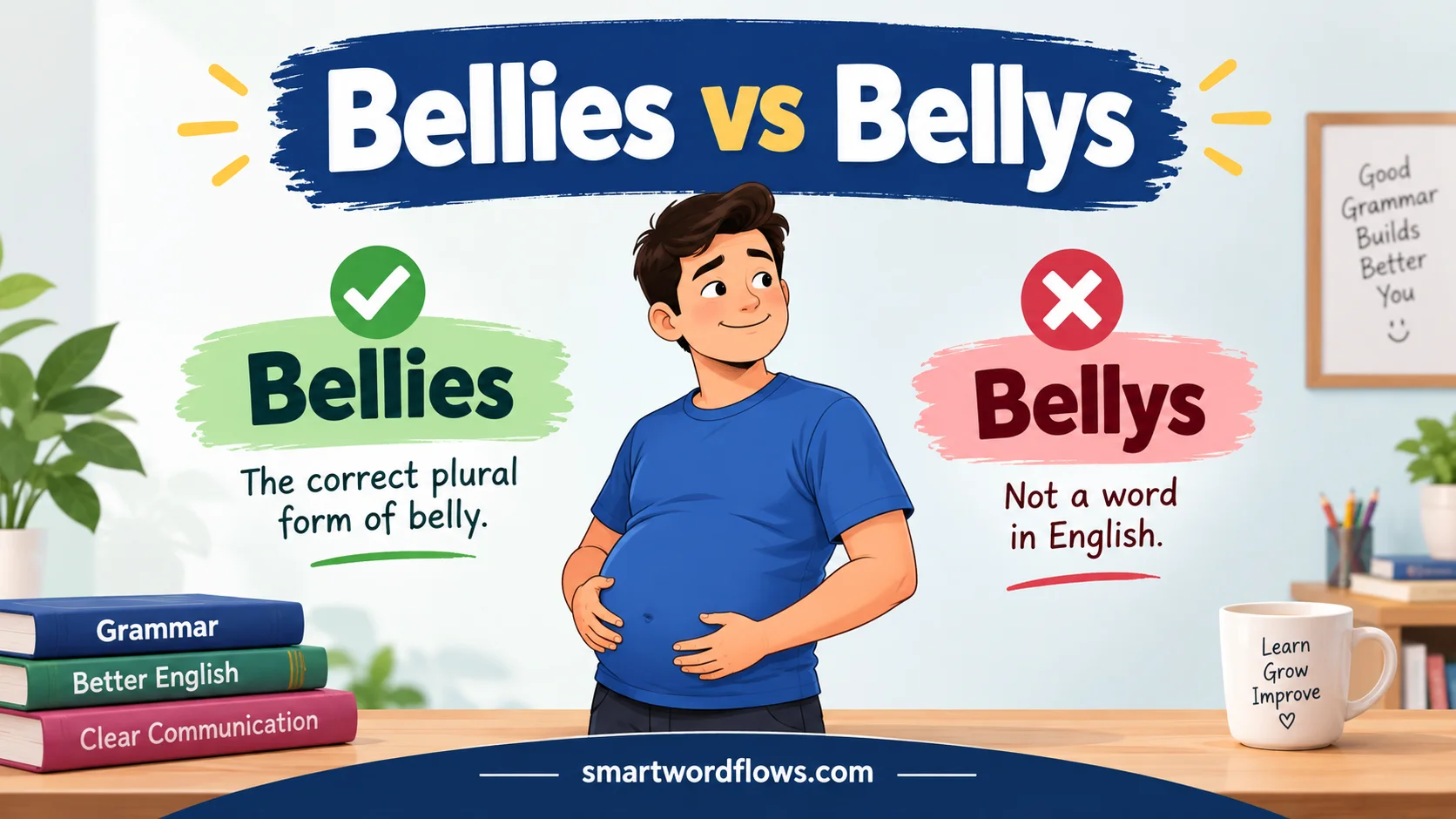

When choosing between Bellies vs Bellys, many writers hesitate because both forms look and sound similar. However, bellies is the correct plural spelling of belly, while bellys is incorrect. This common spelling mistake happens when people simply add -s to words ending in -y. Understanding this small but important English grammar rule can make your writing more accurate and natural.
The word bellies can describe more than one stomach or abdomen, whether you’re talking about people or animals. It also appears in everyday conversations, blogs, school assignments, and professional writing. The key is knowing when to change -y to -ies when forming a plural. Once you understand this pluralization rule, you can easily avoid the incorrect form bellys and use bellies confidently in different sentences and contexts.
Quick Answer
Bellies is correct. Bellys is incorrect in standard English.
The singular noun is belly, while its standard plural form is bellies.
The spelling change works like this:
belly → bellies
When a noun ends with a consonant + y, English normally changes the final y to i before adding -es.
For example:
- belly → bellies
- baby → babies
- city → cities
- family → families
- party → parties
So, if you’re writing about more than one belly, use bellies.
Correct: The children had full bellies after dinner.
Incorrect: The children had full bellys after dinner.
Bellys can still appear in usernames, brand names, business names, or other stylized forms. However, those special uses don’t change the standard English spelling.
Comparison Overview
The simplest way to understand bellies vs bellys is to compare their grammatical status and spelling.
| Word | Standard English? | Function | Example |
| belly | Yes | Singular noun | My belly hurts. |
| bellies | Yes | Plural noun | Their bellies were full. |
| belly’s | Yes | Singular possessive or contraction | The belly’s shape changed. |
| bellies’ | Yes | Plural possessive | The animals’ bellies were covered with fur. |
| bellys | No | Nonstandard spelling | Use bellies instead. |
The important point is that bellies and bellys aren’t two competing standard spellings with different meanings. One is the standard plural form, while the other generally represents a spelling mistake or a deliberate stylization.
Main Differences Between Bellies vs Bellys
The main difference between bellies vs bellys comes down to standard spelling and English pluralization rules.
Bellies is the accepted plural form of belly. It can describe the bellies of people, animals, or objects when the word belly refers to a rounded or lower part.
Belys, meanwhile, doesn’t follow the standard plural spelling pattern. In ordinary writing, it should be replaced with bellies.
| Difference | Bellies | Bellys |
| Spelling | Correct | Incorrect in standard English |
| Singular form | Belly | Belly |
| Plural form | Bellies | Not standard |
| Plural ending | -ies | -ys |
| Suitable for formal writing | Yes | No |
| Suitable for ordinary sentences | Yes | No |
This distinction matters in school assignments, professional writing, articles, emails, and everyday communication. A simple spelling correction can make your writing look much more polished.
Why Is “Bellies” the Correct Spelling?
The answer comes from a common English spelling rule involving nouns that end in consonant + y.
When the final y follows a consonant, English usually changes the y to i and adds -es to form the plural.
Since the word belly ends in l + y, it follows this rule:
belly → bellies
The word doesn’t simply receive an s.
That’s why bellys isn’t the standard plural form.
Consider these examples:
| Singular | Correct plural |
| belly | bellies |
| baby | babies |
| puppy | puppies |
| country | countries |
| lady | ladies |
| story | stories |
There’s a useful pattern hiding in all these examples. The final y changes because a consonant comes immediately before it.
The spelling formula
You can remember the rule this way:
Consonant + y → change y to i + es
So:
belly → bellies
This isn’t a special rule created just for the word belly. It’s part of a broader English spelling pattern.
Why Is “Bellys” Incorrect?
Bellys looks reasonable if you assume that every noun forms its plural by adding -s. English, however, has several pluralization patterns.
For words such as book, car, and house, adding -s works normally:
- book → books
- car → cars
- house → houses
The same approach doesn’t work with belly.
If you simply add -s, you get bellys. Standard English spelling instead changes the final y to i and adds -es.
Therefore:
- belly → bellies ✅
- belly → bellys ❌
The mistake often happens because the plural ending sounds familiar. English spelling, however, depends on the letters and the word’s established form rather than pronunciation alone.
What Does “Belly” Mean?
Belly is a common noun that usually refers to the front part of a person’s or animal’s body, especially the area around the abdomen.
In everyday American English, belly often sounds more casual and conversational than abdomen.
For example:
She rested her hand on her belly.
The word can also describe a rounded or bulging part of something that isn’t a person or animal.
For example, people can talk about the belly of a ship, the belly of a plane, or the rounded underside of certain objects. The exact meaning depends on context.
Belly can refer to:
- A person’s abdominal area
- An animal’s abdominal area
- A rounded section of an object
- A lower or inner part of something
- A person’s stomach area in casual speech
The word also appears in many familiar expressions, including belly laugh, bellyache, belly button, and beer belly.
What Does “Bellies” Mean?
Bellies simply means more than one belly.
It doesn’t represent a completely different word or concept. Instead, it is the regular plural form of the singular noun.
For example:
The babies had full bellies after feeding.
Here, bellies refers to the abdominal areas of multiple babies.
Likewise:
The puppies rolled onto their bellies.
In that sentence, each puppy has one belly, while the group has several bellies.
You can think of the relationship this way:
One belly = belly
Two or more = bellies
That simple distinction solves most questions about bellies vs bellys.
The Grammar Rule Behind “Bellies”
The spelling of bellies becomes much easier when you understand the difference between words ending in consonant + y and those ending in vowel + y.
Consonant + Y
When a noun ends in a consonant followed by y, the plural commonly changes y → i and adds -es.
Examples include:
- baby → babies
- berry → berries
- city → cities
- enemy → enemies
- family → families
- hobby → hobbies
- party → parties
The word belly belongs to this group.
belly → bellies
Vowel + Y
Words ending in a vowel followed by y generally keep the y and add -s.
Examples include:
- boy → boys
- day → days
- key → keys
- toy → toys
- journey → journeys
- monkey → monkeys
The difference becomes clearer when you place the words side by side.
| Ending | Singular | Plural |
| Consonant + y | belly | bellies |
| Consonant + y | baby | babies |
| Vowel + y | boy | boys |
| Vowel + y | toy | toys |
So don’t memorize bellies as an isolated spelling. Remember the rule behind it.
Bellies vs Bellys: Spelling Rule Examples
Several familiar words reinforce the same spelling pattern.
| Singular | Correct Plural | Common Incorrect Form |
| belly | bellies | bellys |
| baby | babies | babys |
| family | families | familys |
| story | stories | storys |
| city | cities | citys |
| party | parties | partys |
| puppy | puppies | puppys |
| hobby | hobbies | hobbys |
The repeated pattern makes the rule easier to spot.
Whenever you encounter an unfamiliar noun ending in consonant + y, pause before simply adding -s. Check whether the plural requires the y → i change.
How to Use “Bellies” in a Sentence
Once you know the spelling, using bellies correctly is straightforward.
- The children rubbed their bellies after eating a large meal.
- The puppies slept comfortably on their bellies beside their mother.
- Their bellies were full after the family dinner.
- The kittens exposed their tiny bellies while stretching in the sunlight.
- The hikers packed enough food to keep their bellies satisfied throughout the long journey.
Notice that bellies functions as an ordinary plural noun in each sentence.
The possessive form can also appear when something belongs to multiple people or animals:
The puppies’ bellies were covered with soft fur.
Here, the apostrophe belongs to puppies, while bellies remains the plural noun.
Common Expressions That Use “Belly” or “Bellies”
The word belly appears in numerous established expressions in American English.
Full belly
A full belly describes someone who has eaten enough food.
A warm meal gave everyone a full belly.
When you’re talking about several people, you can use the plural:
The hearty meal filled their bellies.
Belly laugh
A belly laugh means a deep, hearty laugh.
His ridiculous impression produced a genuine belly laugh.
The phrase doesn’t mean that someone’s belly itself performs the laughing. Instead, it emphasizes a particularly hearty or uncontrolled laugh.
Bellyache
Bellyache can mean a stomachache in informal English. It can also describe complaining, especially in the phrase bellyaching.
The child complained about a bellyache after dinner.
Belly button
A belly button is the informal term for the navel.
The baby had a tiny belly button.
Beer belly
A beer belly refers to a noticeably rounded abdomen, especially in casual speech.
He joked about developing a beer belly after years of weekend barbecues.
Belly up
Belly up can have several meanings depending on context. As an idiom, go belly up commonly means that a business or venture fails.
The small company went belly up after several difficult years.
These expressions show why understanding the basic word matters. Belly appears far beyond simple descriptions of anatomy.
Read More: All-Time Favorite vs. All Times Favorite: Which Is Correct?
Bellies in Different Contexts
The meaning of bellies shifts slightly depending on what you’re describing.
Human bodies
The most common use refers to the abdominal area of people.
The children lay on their bellies while watching the movie.
Animals
You can also use bellies naturally when discussing animals.
The kittens showed their white bellies while sleeping.
This usage often appears in descriptions of pets, wildlife, and farm animals.
Food and eating
People frequently use bellies when talking about hunger, meals, and fullness.
After several hours of hiking, everyone wanted something warm in their bellies.
This use sounds casual and expressive rather than clinical.
Objects
In some contexts, belly describes a rounded or bulging portion of an object. The plural bellies can therefore describe several such structures.
This meaning appears less often in everyday conversation, but it remains a legitimate use when the context supports it.
Bellies vs Belly’s: Don’t Confuse the Plural With the Possessive
One of the most common mistakes involves bellies and belly’s.
They don’t mean the same thing.
Bellies is the plural of belly.
Belly’s is usually the possessive form of the singular noun belly. It can also function as a contraction in certain sentences.
Compare these examples:
The babies rubbed their bellies.
Here, bellies means multiple bellies.
The belly’s shape looked unusual.
Here, belly’s indicates that something belongs to or relates to one belly.
The apostrophe makes an important grammatical difference.
Quick comparison
| Form | Meaning |
| belly | One belly |
| bellies | More than one belly |
| belly’s | Possessive form of one belly |
| bellies’ | Possessive form of multiple bellies |
Remember one simple point: apostrophes don’t normally create ordinary plurals.
Bellies vs Bellies’: Another Important Apostrophe Difference
The form bellies’ represents the possessive form of the plural noun bellies.
Consider:
The animals’ bellies were warm.
That sentence simply uses the plural noun.
Now consider:
The bellies’ rounded shapes were easy to notice.
Here, bellies’ means the rounded shapes belonging to or associated with multiple bellies.
The four forms can therefore be understood clearly:
- belly = one
- belly’s = belonging to one
- bellies = more than one
- bellies’ = belonging to more than one
This distinction becomes especially useful when you’re writing carefully edited content.
Is “Bellys” Ever Acceptable?
Although bellys isn’t the standard plural of belly, you may encounter the spelling in special circumstances.
For example, a person might deliberately use Bellys as part of a username, business name, product name, fictional name, or other stylized identity.
Proper names don’t always follow ordinary dictionary spelling rules. A company could choose an unusual spelling for branding purposes, just as businesses sometimes remove letters, add letters, or alter familiar words.
That doesn’t make bellys the standard plural of belly.
Think of it as the difference between a name and a dictionary word. A name can have a deliberately unusual spelling, while standard English still follows its normal grammatical rules.
Therefore, in ordinary writing:
Use “bellies.”
Common Mistakes With “Bellies”
Several errors tend to appear when people aren’t familiar with the consonant + y plural rule.
Writing “bellys”
This is the most direct mistake.
Incorrect: The children had full bellys.
Correct: The children had full bellies.
Writing “bellie”
Some writers mistakenly assume that changing y to ie creates the singular form.
It doesn’t.
The singular remains belly.
Correct: one belly
Correct: two bellies
Adding an apostrophe
An apostrophe doesn’t belong in the ordinary plural.
Incorrect: The babies rubbed their belly’s.
Correct: The babies rubbed their bellies.
Confusing “belly’s” with “bellies”
These forms serve different grammatical purposes.
Belly’s refers to one belly in a possessive construction.
Bellies refers to multiple bellies.
Assuming every Y-ending word follows the same rule
Not every word ending in y changes to ies.
That’s why boy → boys and toy → toys are useful comparisons. The letter immediately before the y determines which common spelling pattern applies.
How to Remember Bellies vs Bellys
Here’s an easy memory trick:
One belly becomes many bellies: change the Y to I and add ES.
You can connect belly with other familiar words:
- baby → babies
- puppy → puppies
- party → parties
- story → stories
- belly → bellies
Once you recognize the family resemblance, bellys starts looking as unusual as babys or partys.
A quick proofreading trick also helps. Whenever you see a plural noun ending in -ys, check whether its singular form ends in consonant + y.
If it does, the -ies spelling may be the standard form.
Bellies vs Bellys: Pronunciation
The standard word bellies contains two syllables and ends with the sound commonly heard in words such as cities and babies.
The pronunciation is roughly represented as /ˈbɛliz/ in American English.
The first syllable receives the primary stress.
The ending has a clear z sound rather than the sound you’d expect from simply attaching a silent spelling change. Listening to words such as babies and cities can help reinforce the same plural ending.
Pronunciation and spelling don’t always match perfectly in English. That’s one reason relying entirely on sound can lead to spelling mistakes.
Bellies vs Bellys in American English
In American English, bellies is the standard plural spelling of belly.
You should use it in ordinary writing, including:
- School assignments
- Business communication
- Articles
- Emails
- Reports
- Social media posts
- Creative writing
- Informal messages
The spelling doesn’t change simply because the context becomes casual.
For example, you might write:
The kids had full bellies after the barbecue.
The sentence remains correct whether you’re writing a text message or a published article.
Bellies vs Bellys: Examples in Real Sentences
Seeing the word in different sentences can make the distinction easier to remember.
Everyday Conversation
Let’s make sure the kids have full bellies before we leave.
Everyone’s bellies were growling after the long walk.
Those sandwiches should fill our bellies nicely.
These examples use bellies naturally in casual conversation.
Animals
The puppies slept peacefully with their bellies pressed against the blanket.
The kittens rolled onto their bellies after playing.
The puppies’ bellies looked round after their meal.
Animal-related examples are particularly useful because belly works naturally for many types of animals.
Descriptive Writing
The tiny creatures displayed pale bellies beneath their darker backs.
Several fish flashed their silver bellies as they turned together.
Here, the plural adds a clear visual detail to the description.
Informal Speech
We ate so much that our bellies hurt.
Nobody left the table with empty bellies.
The word has a friendly, everyday quality that makes it common in conversational writing.
A Simple Case Study: Why “Bellys” Looks Right at First
Imagine someone learns that the plural of book is books and the plural of chair is chairs.
They may naturally apply the same pattern to belly:
belly + s = bellys
At first glance, that looks logical.
However, English has a different spelling convention for nouns ending in consonant + y.
The correct transformation is:
belly → bellies
Now compare the pattern:
| First assumption | Actual English rule |
| Add -s to every noun | Different nouns follow different plural rules |
| belly + s | belly changes before the ending |
| bellys | bellies |
| y stays unchanged | y changes to i |
This small example explains why the incorrect spelling can feel intuitive. The problem isn’t that the writer doesn’t understand plurals. The problem comes from applying the wrong plural pattern.
Bellies vs Bellys: When Proofreading Matters
Spelling mistakes become more noticeable when a word appears repeatedly throughout a document.
Suppose a health article contains bellys several times. Even if readers understand the meaning, the repeated error can make the writing look careless.
The correction is simple:
Replace “bellys” with “bellies” when you’re using the standard plural form.
However, don’t automatically change a deliberately styled proper name. If Bellys appears as the official spelling of a particular name, changing it could create a different name.
Context matters.
Facts About the Word “Belly”
Here are several useful language facts worth remembering:
- Belly is a noun in its most common use.
- Bellies is its standard plural form.
- The plural changes y → i before -es.
- The same spelling pattern appears in baby → babies and story → stories.
- Belly’s and bellies’ are possessive forms, not ordinary plurals.
- Bellys isn’t the standard plural spelling.
- Belly can describe humans, animals, and certain rounded parts of objects.
- The word frequently appears in informal expressions and compound terms.
These facts give you more than the spelling answer. They show how the word behaves within the broader English system.
Bellies vs Bellys: A Final Grammar Check
Before you finish writing, use this quick checklist.
Ask yourself:
- Am I talking about one belly?
- Am I talking about two or more bellies?
- Am I showing possession?
- Am I using a special name or brand spelling?
If you’re simply talking about more than one belly, the answer is easy:
Use bellies.
If you’re showing possession, check whether you need belly’s or bellies’ instead.
If you’re dealing with a brand or proper name, preserve its official spelling.
FAQs :
1. Is “bellies” or “bellys” correct?
Bellies is the correct spelling. It is the plural form of belly. The spelling bellys is incorrect in standard English.
2. Why does “belly” become “bellies”?
When a singular noun ends in a consonant + y, the y usually changes to ies when making it plural. Therefore, belly becomes bellies.
3. What does “bellies” mean?
Bellies is the plural of belly and refers to more than one stomach or abdomen. It can describe humans, animals, or be used in casual expressions.
4. Is “bellys” ever correct?
No. Bellys is not considered a standard English plural spelling. If you need the plural form of belly, always use bellies.
5. Can I use “bellies” in formal writing?
Yes. Bellies is a standard English word and can be used in formal and informal writing, including articles, school assignments, reports, and everyday communication.
Conclusion :
The difference between Bellies vs Bellys is easy to understand once you remember the pluralization rule. Bellies is the correct plural form of belly, while bellys is an incorrect spelling. Whenever you need to refer to more than one belly, choose bellies for clear and correct English writing.