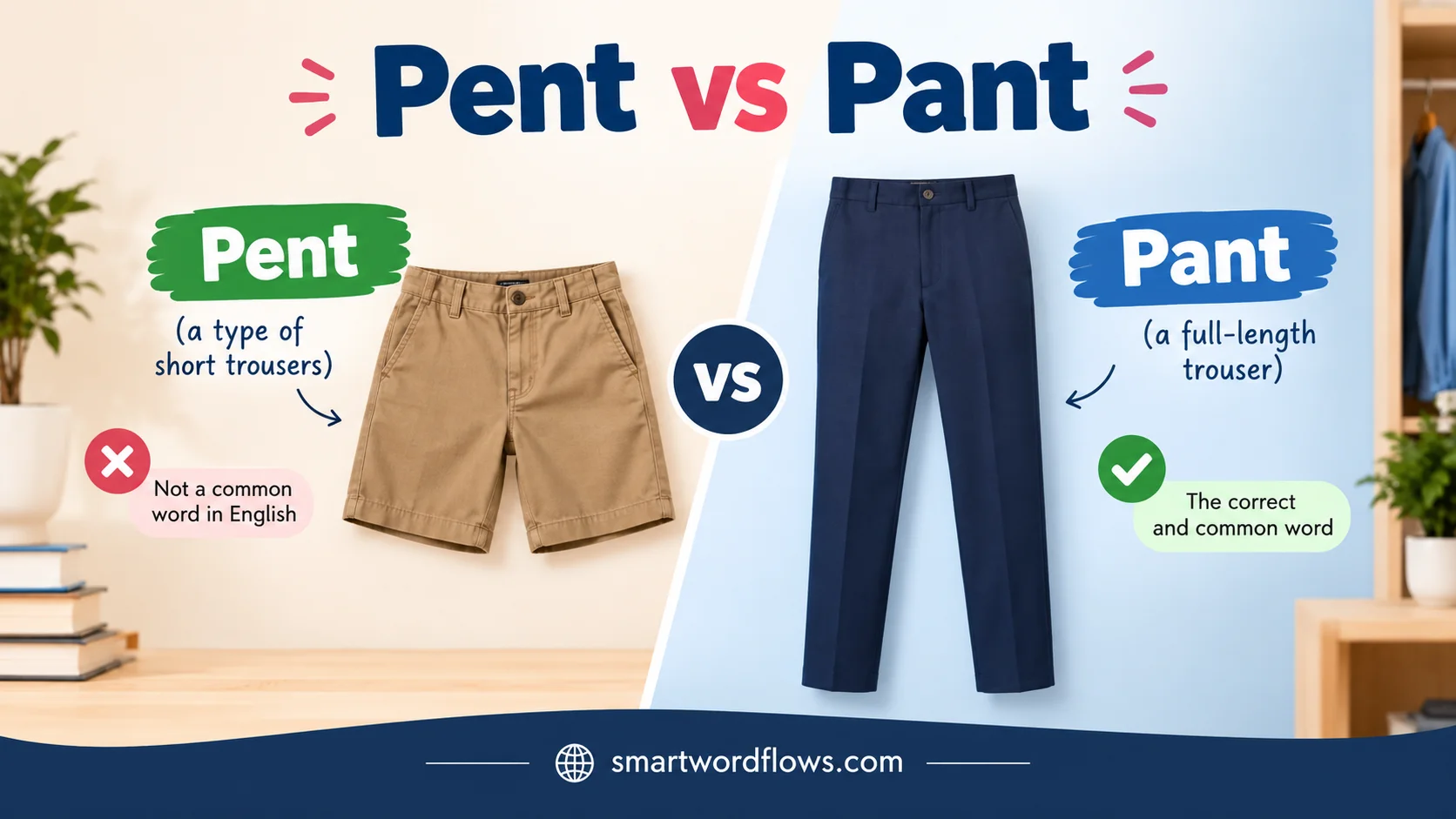

Pent vs Pant can be confusing because both words look similar, but their meaning, grammar, and usage are different. Pent is an old verb and the past tense of pen, meaning to enclose or confine something inside. It can describe a confined, restrained, or locked condition. The phrase pent-up often relates to hidden emotions or feelings. Pants, however, usually means clothing or trousers worn by men and women to cover the lower body.
In everyday English writing, pants can also work as a verb meaning to pull someone’s pants down or forcibly remove them. As an adjective, pants can describe something of inferior quality or rubbish. These words share some similarities, including the letter P, related vowels, and a close sound, but their difference is clear from the context. Learning these words through simple examples can help every writer, student, and blogger avoid common mistakes and choose the right form.
Quick Answer
The simplest way to remember pent vs pant is this:
- Pent means confined, enclosed, or restrained. It commonly appears in pent-up, as in “pent-up frustration.”
- Pant means to breathe quickly and heavily, usually because of exercise, heat, fear, excitement, or exhaustion.
- Pent can also function as a past participle of pen when pen means to confine or enclose.
- Pant functions mainly as a verb and noun.
- Pent and pant aren’t interchangeable because they express completely different ideas.
For example:
She struggled to release years of pent-up anger.
Here, pent-up means the anger had been contained or suppressed.
The dog began to pant after running across the yard.
Here, pant describes the dog’s heavy breathing.
Comparison Overview
| Feature | Pent | Pant |
| Core meaning | Confined, enclosed, restrained | Breathe heavily or rapidly |
| Main grammatical role | Past participle/adjective | Verb and noun |
| Related verb | Pen | Pant |
| Common expression | Pent-up emotions | Pant after running |
| Typical context | Feelings, confinement, literary writing | Exercise, heat, exhaustion, animals |
| Modern frequency | Less common | Common |
| Example | “His pent-up frustration erupted.” | “He began to pant after the race.” |
The biggest distinction is semantic rather than grammatical. Pent describes containment, while pant describes breathing.
That difference gives you a reliable way to choose the right word even when you’re writing quickly.
Main Differences Between Pent vs Pant
The main difference between pent and pant comes down to what each word describes.
Pent connects to the idea of something being kept inside. It can describe physical confinement, although modern English uses it especially often in figurative expressions involving emotions and feelings.
Pant, on the other hand, describes an action involving breathing. When someone pants, they take quick, heavy breaths. Dogs commonly pant after physical activity or when they’re trying to cool themselves.
Consider these two sentences:
- “He expressed his pent-up frustration.”
- “He began to pant after climbing the stairs.”
The first sentence concerns emotion that has been held back. The second concerns physical breathing.
The Key Difference in One Line
Pent = confined or held in.
Pant = breathe heavily.
That short distinction handles most everyday cases.
What Does “Pent” Mean?
Pent means confined, enclosed, restrained, or held within limits. The word comes from the verb pen, when pen means to confine someone or something within a particular place or boundary.
For example, a farmer might pen animals inside an enclosure. The past participle can appear as pent in certain uses.
The word also developed a strong figurative use. Instead of physically containing an animal or person, English speakers can describe emotions, energy, frustration, resentment, or feelings as pent-up.
In that expression, something has remained inside instead of finding an outlet.
Imagine shaking a bottle of soda and keeping the cap firmly closed. Pressure builds inside. The idea behind pent-up emotion works in a similar metaphorical way.
What Does “Pent” Mean in “Pent-Up”?
Pent-up describes something that has remained contained, restrained, or unexpressed for a period of time.
Common examples include:
- pent-up anger
- pent-up frustration
- pent-up emotions
- pent-up feelings
- pent-up energy
- pent-up resentment
- pent-up excitement
For instance:
“After months of silence, she finally expressed her pent-up frustration.”
The frustration didn’t suddenly appear. It had existed for some time and remained unexpressed.
Examples of “Pent”
- His pent-up anger eventually became impossible to hide.
- The children released their pent-up energy during the afternoon game.
- Years of pent-up resentment affected their relationship.
- She finally found a healthy outlet for her pent-up emotions.
- The speech gave him an opportunity to express his pent-up feelings.
These examples show why pent often appears alongside an emotion or another abstract noun.
What Does “Pant” Mean?
Pant means to breathe rapidly and heavily, usually because of physical exertion, heat, fear, excitement, or another demanding condition.
A person may pant after sprinting up a hill. A dog may pant after playing outside on a hot day. Someone frightened may also pant during an intense moment.
Unlike pent, which often describes a condition of containment, pant describes an observable action or physical response.
The word works as both a verb and a noun.
As a verb:
“The runner began to pant.”
As a noun:
“Her rapid panting showed how exhausted she was.”
The noun form often refers to the act or sound of breathing heavily.
Examples of “Pant”
- The runner began to pant after the final sprint.
- The dog was panting heavily after chasing the ball.
- He stopped for a moment because he was starting to pant.
- The horse continued to pant after the steep climb.
- Her heavy panting gradually slowed as she recovered.
These examples all involve breathing, which makes the distinction from pent straightforward.
Pent as the Past Participle of “Pen”
One reason pent can seem unusual is that its connection to pen isn’t always obvious.
The verb pen has several meanings in English. The familiar noun refers to a writing instrument, but the verb pen can also mean to confine or enclose.
For example, a person can pen animals in a fenced area.
In this sense, pent can function as a past participle:
“The sheep were pent within the enclosure.”
However, this construction sounds formal, old-fashioned, or literary to many modern readers.
Modern writers usually encounter pent in compounds such as pent-up rather than in ordinary sentences describing physical confinement.
Pen and Pent Are Connected
The relationship can be understood like this:
pen → pent
Here, pen means to confine, not to write with a pen.
That’s an important distinction because the word pen itself has several unrelated meanings.
An Important Grammar Point
Don’t assume that pent is the simple past tense of pen in every context.
Modern English can use penned as the past form and past participle of pen, particularly when pen means to write or compose.
For example:
“She penned a thoughtful letter.”
Here, penned means wrote.
That meaning has nothing to do with pent-up.
How to Use “Pent-Up” Correctly
If you’re learning the difference between pent vs pant, mastering pent-up will probably give you the most practical benefit.
Pent-up means held inside, restrained, suppressed, or prevented from being expressed.
The expression commonly describes emotions or psychological pressure.
Common “Pent-Up” Collocations
| Expression | Meaning |
| Pent-up anger | Anger that has remained unexpressed |
| Pent-up frustration | Frustration that has built up without release |
| Pent-up emotions | Feelings that someone hasn’t openly expressed |
| Pent-up resentment | Long-held bitterness or dissatisfaction |
| Pent-up energy | Energy that hasn’t had an outlet |
| Pent-up excitement | Strong excitement held back temporarily |
The phrase doesn’t necessarily imply that someone consciously hides an emotion. Instead, it often suggests that the emotion has accumulated because circumstances prevented expression or release.
For example:
“The team celebrated loudly after releasing weeks of pent-up excitement.”
The excitement had built over time. The celebration provided an outlet.
Is “Pent-Up” Hyphenated?
Yes, pent-up is normally hyphenated when it functions as a compound adjective before a noun.
For example:
- pent-up anger
- pent-up frustration
- pent-up emotion
The hyphen helps show that the two words work together as one descriptive unit.
How to Use “Pant” Correctly
Pant works differently because it describes breathing rather than containment.
As a verb, it can appear in several forms:
- pant
- panted
- panting
For example:
“The athlete panted after finishing the race.”
“The dogs were panting in the heat.”
“He began to pant after carrying the heavy boxes upstairs.”
The word commonly appears with descriptions of speed, intensity, cause, or physical effort.
Common Situations Involving Panting
You might use pant when describing:
- intense exercise
- running
- climbing
- physical exhaustion
- hot weather
- animals cooling themselves
- fear or anxiety
- intense excitement
- strenuous physical effort
The surrounding context usually makes the meaning immediately clear.
Pent vs Pant in Sentences
Seeing the words together can make the distinction stick.
| Sentence | Correct Word | Why |
| “She struggled with years of ___ frustration.” | pent-up | The frustration remained contained. |
| “The dog began to ___ after running.” | pant | The dog was breathing heavily. |
| “His ___ emotions finally came out.” | pent-up | The emotions had been held inside. |
| “The athlete continued to ___ after the race.” | pant | The athlete was breathing heavily. |
| “They released their ___ energy at the concert.” | pent-up | The energy had been held back. |
Notice how the surrounding noun or action gives you the answer.
Frustration, emotions, resentment, and energy often point toward pent-up.
Running, breathing, exhaustion, and heat often point toward pant.
Common Confusion Between Pent and Pant
The confusion usually comes from visual similarity. Both words have four letters and begin with p. Their final consonants also match.
The middle vowel creates the crucial difference.
That small spelling change matters because English often uses different vowel sounds to distinguish words that otherwise look nearly identical.
Another source of confusion comes from the phrase pent-up. Someone who hasn’t encountered the word before may wonder whether it connects to pant.
It doesn’t.
Pent-up comes from the idea of something being pent or confined. Pant describes heavy breathing.
A Useful Context Test
When you’re unsure, ask yourself:
Is something being held inside, or is something breathing heavily?
If something is contained, choose pent.
If someone or something is breathing heavily, choose pant.
It’s a simple test, but it works remarkably well.
Read This: Bearable vs Bareable: Which Spelling Is Correct?
Pent vs Pant: Which Word Should You Use?
Choosing between pent and pant becomes easy once you focus on meaning rather than spelling.
Use pent when you need to describe something confined, restrained, or held back.
Use pant when you need to describe heavy or rapid breathing.
Choose “Pent” When:
- You’re describing something contained or confined.
- You’re using the established expression pent-up.
- You’re talking about suppressed emotions or feelings.
- You’re describing held-back energy or frustration.
- You’re writing in a formal or literary context where pent means confined.
Choose “Pant” When:
- Someone is breathing heavily.
- An animal is breathing rapidly.
- Physical exertion causes heavy breathing.
- Heat causes an animal or person to breathe heavily.
- You need the noun describing heavy breathing.
The Two-Second Decision
Held inside? → PENT
Breathing heavily? → PANT
That’s the core rule worth remembering.
Common Mistakes to Avoid
Several mistakes can make pent vs pant confusing in your writing.
Mistake: Using “Pant” in “Pent-Up”
The correct expression is pent-up anger, not pant-up anger.
For example:
❌ “He finally expressed his pant-up frustration.”
✅ “He finally expressed his pent-up frustration.”
The first version incorrectly connects heavy breathing with emotional restraint.
Mistake: Treating “Pent” as a Variant of “Pant”
Pent isn’t an alternative spelling of pant.
They come from different words and carry different meanings.
Mistake: Assuming “Pent” Always Describes Emotions
Although pent-up emotions is extremely common, pent isn’t limited to feelings.
It can describe confinement or enclosure in more formal or literary usage.
Mistake: Confusing “Pen” With “Pen”
English makes this particularly interesting because pen can refer to a writing instrument or an act of confinement.
Compare:
“She penned an article.”
with:
“The animals were pent inside the enclosure.”
The first concerns writing. The second concerns confinement.
Pent vs Pant: Examples in Different Contexts
Context provides one of the strongest clues when distinguishing these words.
Emotional Context
When emotions remain unexpressed, pent-up fits naturally.
“He carried years of pent-up resentment.”
“The conversation helped her release pent-up frustration.”
The phrase suggests that the feeling accumulated over time.
Physical Activity
When someone breathes heavily after exertion, pant is the natural choice.
“She began to pant after running several miles.”
The word describes the physical response to demanding activity.
Animal Context
Pant appears frequently when writers describe dogs, horses, and other animals breathing rapidly.
“The dog started panting after playing outside.”
In animals, panting can have specific physiological functions. For dogs, for example, panting plays an important role in heat regulation.
Literary or Formal Context
Pent appears more naturally in formal or literary writing than in casual conversation.
A writer might describe someone as having pent emotions or something as being pent within boundaries.
However, modern readers are much more likely to encounter pent-up than standalone pent.
Is “Pent” Still Common in Modern English?
Pent remains a valid English word, but its everyday use is relatively limited.
Most modern readers recognize it through the compound adjective pent-up.
Expressions such as pent-up anger and pent-up frustration remain natural and widely understood.
Standalone uses can sound more formal or literary.
That doesn’t make them incorrect. It simply means the word has a narrower role in contemporary English than many common verbs.
This distinction matters because a word can be grammatically valid without being common in casual speech.
For practical writing, pent-up is the form you’re most likely to need.
Is “Pant” Common in Modern English?
Pant is a common modern English word, especially in descriptions of exercise, exhaustion, heat, and animal behavior.
It functions naturally in everyday conversation:
“I’m so tired that I can barely stop panting.”
Writers also use it in fiction because panting can communicate fear, urgency, exhaustion, or excitement without directly stating those emotions.
The noun appears as well:
“His panting grew louder as he climbed the stairs.”
So while pent has a fairly specialized modern role, pant remains an active and versatile word.
Pent vs Pant: Grammar Guide
| Form | Pent | Pant |
| Base verb | pen | pant |
| Simple past | penned/pent, depending on sense and usage | panted |
| Past participle | penned/pent, depending on sense | panted |
| Present participle | penning | panting |
| Common adjective | pent-up | panting |
The forms deserve careful attention because pen has multiple meanings.
When pen means write, the regular modern form is generally penned:
“The author penned three novels.”
When pen means confine, pent can occur as the past participle:
“The animals were pent within the enclosure.”
Meanwhile, pant follows the regular pattern:
pant → panted → panting
There is no relationship between the conjugation of pant and the word pent.
A Case Study: Pent vs Pant in Real Writing
Consider this short passage:
“After the final whistle, the exhausted players began to pant. They had spent months preparing for the tournament, carrying pent-up excitement into the final match.”
Both words work perfectly in the same paragraph because they describe completely different things.
Pant describes the players’ physical condition.
Pent-up describes the excitement they had held inside during the long preparation.
Now replace the words incorrectly:
“The exhausted players began to pent.”
That doesn’t work because pent doesn’t mean breathe heavily.
Likewise:
“They carried pant-up excitement.”
That doesn’t work because pant doesn’t mean contained or suppressed.
This example demonstrates an important writing principle: similar spelling doesn’t create interchangeable meaning.
Pent vs Pant: Pronunciation Difference
The pronunciation difference centers on the vowel sound.
In standard American English, pent has the vowel sound found in words such as send and ten.
Pant has the vowel sound found in words such as hand and land.
That distinction can be useful when speaking because the words can sound noticeably different even though their spelling looks similar.
For learners, practicing the pair aloud can help:
- pent → rhymes with sent
- pant → rhymes with can’t in many American English accents
Regional accents can affect the exact vowel quality. The spelling distinction, however, remains the same.
Memory Trick: How to Remember Pent vs Pant
Here’s an easy mental shortcut:
PENT = PRESSED IN
Think of something being pressed into a confined space.
That connection helps with:
- pent-up anger
- pent-up feelings
- pent-up energy
- pent-up resentment
PANT = PHYSICAL BREATHING
Think of someone finishing a sprint and struggling to catch their breath.
That points toward pant.
You can remember the whole distinction with one sentence:
Pent is about what’s held in; pant is about what’s breathed out.
It’s not a grammar rule. It’s simply a useful memory hook.
Pent vs Pant: Synonyms and Related Words
Understanding related words can strengthen the distinction.
Synonyms for Pent
Depending on the context, pent can relate to:
- confined
- enclosed
- contained
- restrained
- held back
- suppressed
- imprisoned
These words all connect with the basic concept of limitation or containment.
Synonyms for Pant
Depending on context, pant can relate to:
- gasp
- breathe heavily
- heave
- puff
- catch one’s breath
These words concern breathing or physical exertion, although they aren’t perfect substitutes in every sentence.
For example, gasp can suggest a sudden intake of breath. Pant more often suggests repeated, rapid, heavy breathing.
Pent vs Pant: Final Comparison
The pent vs pant distinction is simple once you separate their meanings.
Pent connects with confinement. Its most familiar modern use appears in pent-up, which describes emotions, energy, frustration, or other things held inside.
Pant connects with heavy breathing. People and animals can pant after exercise, during heat, or under intense physical or emotional strain.
Remember these two lines:
- Pent = confined or held back
- Pant = breathe heavily
The words may look nearly identical, but their meanings aren’t close. When you focus on what the sentence actually describes, choosing the correct word becomes much easier.
FAQs:
1. Is “pent” a correct word?
Yes, pent is a correct word. It is the past tense or past participle of pen, meaning to confine or enclose.
2. What does “pants” mean?
Pants usually means clothing or trousers worn to cover the lower part of the body and legs.
3. What does “pent-up” mean?
Pent-up describes emotions or feelings that have been held inside and not expressed openly.
4. Are “pent” and “pants” interchangeable?
No. Pent and pants have different meanings and uses, so you should choose the correct word based on the context.
5. How can I remember the difference between pent and pants?
Remember pent as something confined or held inside, while pants are everyday clothing worn on your legs.
Conclusion:
Understanding Pent vs Pant becomes easier when you remember their different meanings and uses. Pent relates to being confined, while pants usually refers to clothing or trousers. Using the right word in the correct context will make your English writing clearer and help you avoid common mistakes.