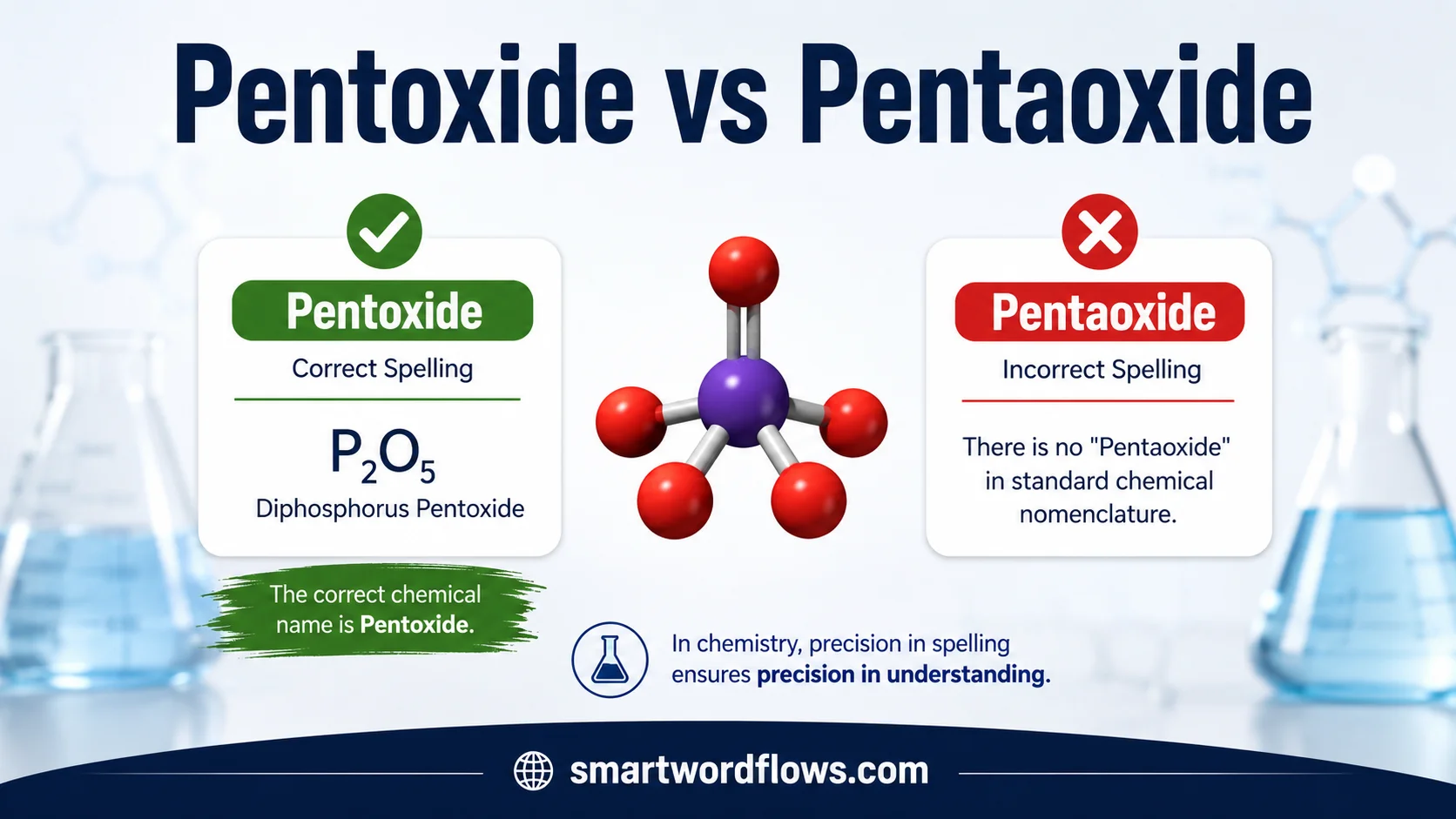

Pentoxide vs Pentaoxide can confuse readers because both terms appear in chemistry and scientific writing. The main difference is their meaning, usage, and terminology. Pentoxide generally describes a chemical compound containing five oxygen atoms with another element. The term is common in textbooks, research papers, and modern scientific usage. Understanding these key differences improves clarity, prevents spelling mistakes, and helps writers use the correct chemical term when explaining compounds and their practical uses.
For example, phosphorus pentoxide is a white crystalline solid used as a dehydrating agent, while vanadium pentoxide is a yellow to orange powder used in ceramics and as a catalyst in chemical reactions. Pentaoxide can also appear in chemical terminology. Carbon pentaoxide and carbon pentoxide describe an unstable molecular oxide of carbon studied at cryogenic temperatures. Its structure includes a five-membered ring, carbon, oxygen atoms, and a double bond.
Quick Answer
Pentoxide and pentaoxide can refer to the same stoichiometric naming idea: an oxide containing five oxygen atoms in the name’s indicated composition.
The difference comes from nomenclature convention:
- Pentoxide is the familiar form used in many general chemistry textbooks and educational resources.
- Pentaoxide follows the more literal retention of the penta- prefix.
- Modern IUPAC guidance for compositional inorganic nomenclature states that the final vowels of multiplicative prefixes should not be elided, except for the special case of monoxide.
- Therefore, calling pentaoxide simply “wrong” is too broad.
- Likewise, calling pentoxide a completely different chemical substance would be incorrect.
- For example, introductory chemistry commonly names N₂O₅ as dinitrogen pentoxide, while IUPAC’s compositional approach permits the form dinitrogen pentaoxide. OpenStax specifically lists N₂O₅ as dinitrogen pentoxide.
The easiest way to remember the issue is this:
Pentoxide is the familiar traditional form. Pentaoxide reflects the full penta- prefix in systematic compositional nomenclature.
The chemical formula, not the presence or absence of the letter a, determines the actual elemental composition.
Comparison Overview
| Feature | Pentoxide | Pentaoxide |
| Basic formation | penta + oxide with vowel elision | penta + oxide with vowel retained |
| Meaning of penta- | Five | Five |
| Refers to a separate class of compounds? | No | No |
| Common in introductory chemistry | Very common | Less common |
| Consistent with traditional textbook naming | Yes | Not usually |
| Consistent with modern IUPAC compositional guidance | Alternative/traditional usage | Yes |
| Example associated with N₂O₅ | Dinitrogen pentoxide | Dinitrogen pentaoxide |
| Does the spelling change the formula? | No | No |
| Should the two be treated as different substances? | No | No |
The table reveals the main point: this isn’t a contest between two chemical substances. It’s primarily a question of how a chemical name is constructed.
IUPAC’s Red Book explains that inorganic nomenclature contains several systems, including compositional, substitutive, and additive nomenclature. It also warns that different systems can generate alternative names for the same chemical entity.
Main Differences Between Pentoxide vs Pentaoxide
The biggest difference between pentoxide vs pentaoxide lies in the treatment of the final a in penta-.
Pentoxide Uses Vowel Elision
In traditional introductory nomenclature, the final vowel of a numerical prefix is often dropped when it creates an awkward sequence of vowels.
That produces:
penta- + oxide → pentoxide
This convention appears clearly in general chemistry teaching. OpenStax explains that when two vowels occur next to each other, the a in a Greek prefix is usually dropped. It gives dinitrogen pentoxide as the name for N₂O₅.
This is the form many students encounter first.
Pentaoxide Retains the Prefix
Modern IUPAC compositional nomenclature takes a different approach. The IUPAC Red Book states that the final vowels of multiplicative prefixes should not be elided. It gives examples such as tetraoxide and specifically explains that monoxide is a special exception because of established usage.
Under that system:
penta- + oxide → pentaoxide
So the spelling isn’t merely a typo. It can reflect a different nomenclature convention.
The Difference Does Not Create a New Compound
This point deserves emphasis.
Changing pentoxide to pentaoxide doesn’t add or remove an oxygen atom. The word’s spelling doesn’t alter the molecular structure.
For example:
N₂O₅
can be described using the familiar name dinitrogen pentoxide. NIST lists N₂O₅ as dinitrogen pentoxide and also records dinitrogen pentaoxide among its other names.
That’s strong evidence that the two forms aren’t being treated as two unrelated substances.
What Does Pentoxide Mean in Chemistry?
To understand pentoxide, start with the prefix penta-.
The prefix comes from the Greek numerical system used in chemical nomenclature and represents five. General chemistry nomenclature uses prefixes such as mono-, di-, tri-, tetra-, penta-, hexa-, and hepta- to communicate the number of atoms represented in a molecular compound’s name.
The word oxide indicates the oxygen-containing element in the compound’s name.
So in a name such as:
dinitrogen pentoxide
the parts communicate composition:
- di- = two
- nitrogen = nitrogen atoms
- penta- = five
- oxide = oxygen component
The resulting formula is:
N₂O₅
That doesn’t mean the word pentoxide identifies one unique chemical. Instead, it describes a naming component. You need the complete name or formula to identify the substance.
For example, dinitrogen pentoxide and phosphorus pentoxide aren’t the same compound. Both contain the naming element pentoxide, yet their other elements differ.
Why Is It Pentoxide Instead of Pentaoxide?
The answer depends on which nomenclature tradition you’re using.
The Traditional Textbook Rule
Many introductory chemistry courses teach a spelling adjustment when a numerical prefix ending in a vowel comes before another word beginning with a vowel.
That produces familiar forms such as:
- tetra + oxide → tetroxide
- penta + oxide → pentoxide
- hexa + oxide → hexoxide
OpenStax explicitly describes this vowel-dropping convention and lists dinitrogen pentoxide and dinitrogen tetroxide among its examples.
This convention makes the names easier to pronounce and is deeply established in chemistry education.
The Modern IUPAC Approach
IUPAC’s compositional nomenclature takes a more systematic route.
The 2005 Nomenclature of Inorganic Chemistry states that the final vowels of multiplicative prefixes should not be elided, with monoxide recognized as an allowed exception because of general usage. Its examples include dinitrogen tetraoxide rather than the more familiar dinitrogen tetroxide.
The IUPAC brief guide makes the point even more directly by stating that there is no elision of vowels, giving pentaoxide as an example.
This is why a scientifically careful article shouldn’t claim that pentaoxide is always wrong.
It isn’t.
The better conclusion is that pentoxide is the traditional and widely taught form, while pentaoxide is consistent with the modern IUPAC compositional convention.
Understanding the Prefix Penta-
The prefix penta- is one member of a larger family of multiplicative prefixes.
| Number | Prefix | Familiar oxide example |
| 1 | mono- | monoxide |
| 2 | di- | dioxide |
| 3 | tri- | trioxide |
| 4 | tetra- | tetroxide / tetraoxide under IUPAC compositional usage |
| 5 | penta- | pentoxide / pentaoxide |
| 6 | hexa- | hexoxide / hexaoxide under applicable naming conventions |
| 7 | hepta- | heptoxide / heptaoxide under applicable conventions |
| 8 | octa- | octoxide / octaoxide under applicable conventions |
| 9 | nona- | nonoxide / nonaoxide under applicable conventions |
| 10 | deca- | decaoxide |
The table highlights an important lesson: chemical naming conventions don’t always behave exactly like ordinary English word formation.
For a student, memorizing isolated words can become frustrating. Understanding the naming system is much more useful.
IUPAC’s inorganic nomenclature guide explains that multiplicative prefixes indicate how many entities occur in a compound. It also emphasizes that agreed nomenclature helps scientists communicate chemical information and supports database searching, regulation, and safety-related communication.
Dinitrogen Pentoxide vs Dinitrogen Pentaoxide
The clearest case study is N₂O₅.
Chemical Formula
N₂O₅
The formula contains:
- 2 nitrogen atoms
- 5 oxygen atoms
Under the familiar textbook naming system, the compound is:
dinitrogen pentoxide
The name breaks down neatly:
di + nitrogen + penta + oxide
The traditional vowel-elision convention changes the final portion to:
pentoxide
OpenStax uses exactly this name for N₂O₅.
The NIST Perspective
The NIST Chemistry WebBook identifies the compound as dinitrogen pentoxide, gives the formula N₂O₅, and reports a molecular weight of 108.0104. NIST also lists dinitrogen pentaoxide among its other names.
That distinction is valuable because it shows how chemical databases can preserve multiple names associated with the same compound.
So if you encounter:
dinitrogen pentoxide
or
dinitrogen pentaoxide
you shouldn’t immediately assume that you’ve discovered two different nitrogen oxides.
You haven’t.
The formula N₂O₅ tells you what substance is being represented.
Read More: Dysregulated vs Disregulated: Correct Usage Explained
Phosphorus Pentoxide vs Phosphorus Pentaoxide
Phosphorus provides another useful case because its naming history introduces an additional wrinkle.
The compound commonly called phosphorus pentoxide is associated with the formula P₂O₅, but the actual molecular formula of the molecular species is often represented as P₄O₁₀.
PubChem records phosphorus pentoxide with P₂O₅ or P₄O₁₀ and explains that the molecular formula is P₄O₁₀ while P₂O₅ is commonly used as the empirical formula.
This is a perfect example of why chemical names and formulas require context.
P₂O₅ Is an Empirical Formula
An empirical formula gives the simplest whole-number ratio of atoms.
For phosphorus pentoxide:
P₄O₁₀ → P₂O₅
Both formulas describe the same elemental ratio.
Divide the subscripts in P₄O₁₀ by 2:
P₄O₁₀ → P₂O₅
The result is the empirical formula.
P₄O₁₀ Gives the Molecular Composition
When discussing the molecular species, P₄O₁₀ provides the fuller molecular formula.
This distinction prevents a common mistake: assuming that the number in a familiar chemical name must directly correspond to the simplest formula.
Chemistry has plenty of these little traps.
The good news is that once you understand empirical versus molecular formulas, they stop being traps and start becoming useful clues.
Is Pentaoxide a Real Chemical Term?
Yes, pentaoxide is a real chemical naming form.
The claim that it is simply an incorrect spelling doesn’t hold up under closer examination.
IUPAC’s own inorganic nomenclature guide explicitly states that vowels in multiplicative prefixes are not elided and gives pentaoxide as an example.
NIST also lists dinitrogen pentaoxide as another name for N₂O₅.
PubChem likewise records diphosphorus pentaoxide and phosphorus pentaoxide among names associated with phosphorus pentoxide.
Therefore, the scientifically accurate answer is more nuanced:
Pentaoxide is not merely a spelling mistake. It is a valid form within a nomenclature approach that retains the final vowel of the multiplicative prefix.
At the same time, pentoxide remains extremely familiar and widely used, especially in educational chemistry.
Is Pentoxide Also Correct?
Yes.
There is extensive legitimate use of pentoxide in chemistry.
OpenStax uses dinitrogen pentoxide for N₂O₅.
NIST’s primary name for N₂O₅ is also dinitrogen pentoxide.
So a student who writes dinitrogen pentoxide isn’t making a chemical error simply because IUPAC’s compositional recommendations preserve the vowel in pentaoxide.
The key is to understand which naming convention your course, reference, journal, or database expects.
Pentoxide vs Pentaoxide in Scientific Writing
When writing for a general chemistry audience, pentoxide is often the most recognizable form.
For example:
Dinitrogen pentoxide (N₂O₅) is a nitrogen oxide containing two nitrogen atoms and five oxygen atoms.
That wording will be immediately familiar to most chemistry students.
If you’re writing specifically within an IUPAC compositional nomenclature framework, however, dinitrogen pentaoxide may be the more appropriate form because the modern IUPAC rule retains the vowel.
The best practice is therefore simple:
- Follow your instructor’s naming convention in coursework.
- Follow the nomenclature standard required by a journal or scientific organization.
- Use the exact chemical formula when ambiguity matters.
- Don’t treat a spelling variation as evidence of a different substance.
- When writing for a broad audience, prefer the form that matches the convention your readers are likely to recognize.
IUPAC emphasizes that several nomenclature systems exist and that names should be chosen according to the appropriate system and context.
How to Name N₂O₅ Step by Step
Let’s turn the theory into a practical method.
Identify the Elements
N₂O₅ contains:
- Nitrogen
- Oxygen
Because it contains two different elements, it is a binary compound.
Count the Nitrogen Atoms
There are 2 nitrogen atoms.
The prefix for two is:
di-
Therefore:
dinitrogen
Count the Oxygen Atoms
There are 5 oxygen atoms.
The multiplicative prefix for five is:
penta-
Apply the Naming Convention
Traditional textbook form:
penta + oxide → pentoxide
Therefore:
dinitrogen pentoxide
IUPAC compositional form:
penta + oxide → pentaoxide
Therefore:
dinitrogen pentaoxide
Both forms communicate the same stoichiometric composition in this context.
Why Chemical Formulas Matter More Than Spelling Variations
Imagine two labels on laboratory containers:
Dinitrogen pentoxide
and
Dinitrogen pentaoxide
The difference in spelling doesn’t magically change the atoms inside the container.
The formula provides a much stronger chemical identifier:
N₂O₅
NIST assigns N₂O₅ a CAS Registry Number of 10102-03-1 and an IUPAC Standard InChI, providing identifiers that are far more precise than a simple spelling comparison.
This illustrates an important principle in scientific communication:
Names are labels. Formulas and structural identifiers carry the chemical information.
A name can have synonyms. A formula can represent composition. A structural identifier can provide even greater precision.
Common Mistakes With Pentoxide and Pentaoxide
Assuming Pentaoxide Is Always Wrong
This is the biggest mistake.
Modern IUPAC guidance explicitly retains the vowel in multiplicative prefixes in compositional nomenclature and gives pentaoxide as an example.
Assuming Pentoxide Is Outdated or Incorrect
That conclusion goes too far in the opposite direction.
Pentoxide remains a widely used chemical name. OpenStax and NIST both demonstrate its legitimate use.
Thinking They Represent Different Compounds
They don’t represent different compounds simply because one includes an a.
For N₂O₅, both naming forms can identify the same chemical composition.
Forgetting That Naming Systems Differ
Chemical nomenclature isn’t one giant rulebook where every historical and modern convention behaves identically.
IUPAC itself describes multiple nomenclature systems. Different systems can produce alternative names for the same molecular entity.
Confusing P₂O₅ With P₄O₁₀
This mistake occurs especially with phosphorus pentoxide.
P₂O₅ is the empirical formula, while P₄O₁₀ represents the molecular formula commonly associated with molecular phosphorus pentoxide. PubChem records both forms.
Pentoxide vs Pentaoxide: A Practical Naming Guide
| Situation | Recommended approach |
| General chemistry textbook | Pentoxide is commonly expected |
| Introductory chemistry assignment | Follow the course’s naming convention |
| Modern IUPAC compositional nomenclature | Pentaoxide follows the no-elision rule |
| Chemical database search | Search both forms when necessary |
| Scientific identification | Include the chemical formula |
| Research writing | Follow the journal’s nomenclature requirements |
| Comparing the two words | Treat them as nomenclature variants, not automatically different substances |
IUPAC’s official Red Book is the strongest reference when formal inorganic nomenclature is the focus. The organization describes the Red Book as its authoritative guide for inorganic nomenclature.
A Closer Look at “Pentoxide” as a Naming Pattern
The word becomes easier to understand when you separate its linguistic history from its modern chemical use.
Penta- carries the numerical meaning.
Oxide identifies the oxygen-based component.
The traditional form then compresses the two vowels:
penta + oxide → pentoxide
Modern IUPAC compositional nomenclature avoids that compression:
penta + oxide → pentaoxide
It’s similar to seeing two roads leading to the same destination. The route differs, but the destination can remain identical.
That analogy also explains why chemistry students sometimes encounter conflicting-looking names in different resources.
One source may favor traditional classroom terminology. Another may follow formal systematic nomenclature.
Neither situation automatically means the chemistry itself has changed.
Case Study: N₂O₅
N₂O₅ is especially useful because several reputable sources illustrate the naming issue.
Formula: N₂O₅
Molar mass: 108.0104 g/mol
CAS Registry Number: 10102-03-1
Common textbook name: dinitrogen pentoxide
Recorded alternative: dinitrogen pentaoxide
NIST provides the formula, molecular weight, CAS number, structure information, and alternative naming information for the compound.
OpenStax uses N₂O₅ as an example of the traditional vowel-elision rule and names it dinitrogen pentoxide.
Together, these sources demonstrate why the simplistic statement “pentaoxide is wrong” doesn’t tell the whole story.
Case Study: Phosphorus Pentoxide
Phosphorus pentoxide shows another side of chemical naming.
The substance is commonly represented by the empirical formula:
P₂O₅
Yet its molecular formula is:
P₄O₁₀
PubChem lists both formulas and records several names, including phosphorus pentoxide, diphosphorus pentoxide, and phosphorus pentaoxide.
This case demonstrates three important chemistry lessons:
- A common chemical name may not reveal the full molecular formula.
- Empirical and molecular formulas can differ.
- A compound can have more than one recognized name.
That is why chemical nomenclature should be understood as a structured system rather than treated like ordinary spelling.
Pentoxide vs Pentaoxide: What Should Students Write?
If you’re taking an introductory chemistry class, the safest choice is usually the convention your textbook and instructor use.
If your textbook says:
dinitrogen pentoxide
use that form in your assignment.
If you’re specifically asked to apply modern IUPAC compositional nomenclature, use the relevant IUPAC rules. Under those rules, dinitrogen pentaoxide follows the stated principle that multiplicative prefix vowels aren’t normally elided.
The important thing isn’t blindly memorizing one spelling.
It’s knowing why the forms differ.
FAQs
1. What is the difference between pentoxide and pentaoxide?
Pentoxide is the more common and standard term used for chemical compounds containing five oxygen atoms. Pentaoxide can also appear in scientific terminology, but it is much less common.
2. Is pentoxide the correct spelling?
Yes, pentoxide is the standard spelling commonly used in chemistry. Examples include phosphorus pentoxide and vanadium pentoxide.
3. What is phosphorus pentoxide used for?
Phosphorus pentoxide is commonly used as a dehydrating agent because it has a strong ability to remove water from substances.
4. What is vanadium pentoxide used for?
Vanadium pentoxide is used in ceramics and as a catalyst in several chemical reactions. It is typically recognized by its yellow to orange appearance.
5. Can pentaoxide be used in chemical terminology?
Yes, pentaoxide can appear in some chemical terminology, including discussions of unusual compounds such as carbon pentaoxide. However, pentoxide is generally the more familiar and widely used form.
Conclusion
In conclusion, pentoxide is the preferred and more widely recognized term in modern chemistry and scientific writing. It commonly refers to compounds containing five oxygen atoms, with examples such as phosphorus pentoxide and vanadium pentoxide. Although pentaoxide can appear in specialized chemical contexts, it is less common. Understanding the difference helps writers avoid spelling mistakes, use accurate chemical terminology, and communicate scientific information more clearly.