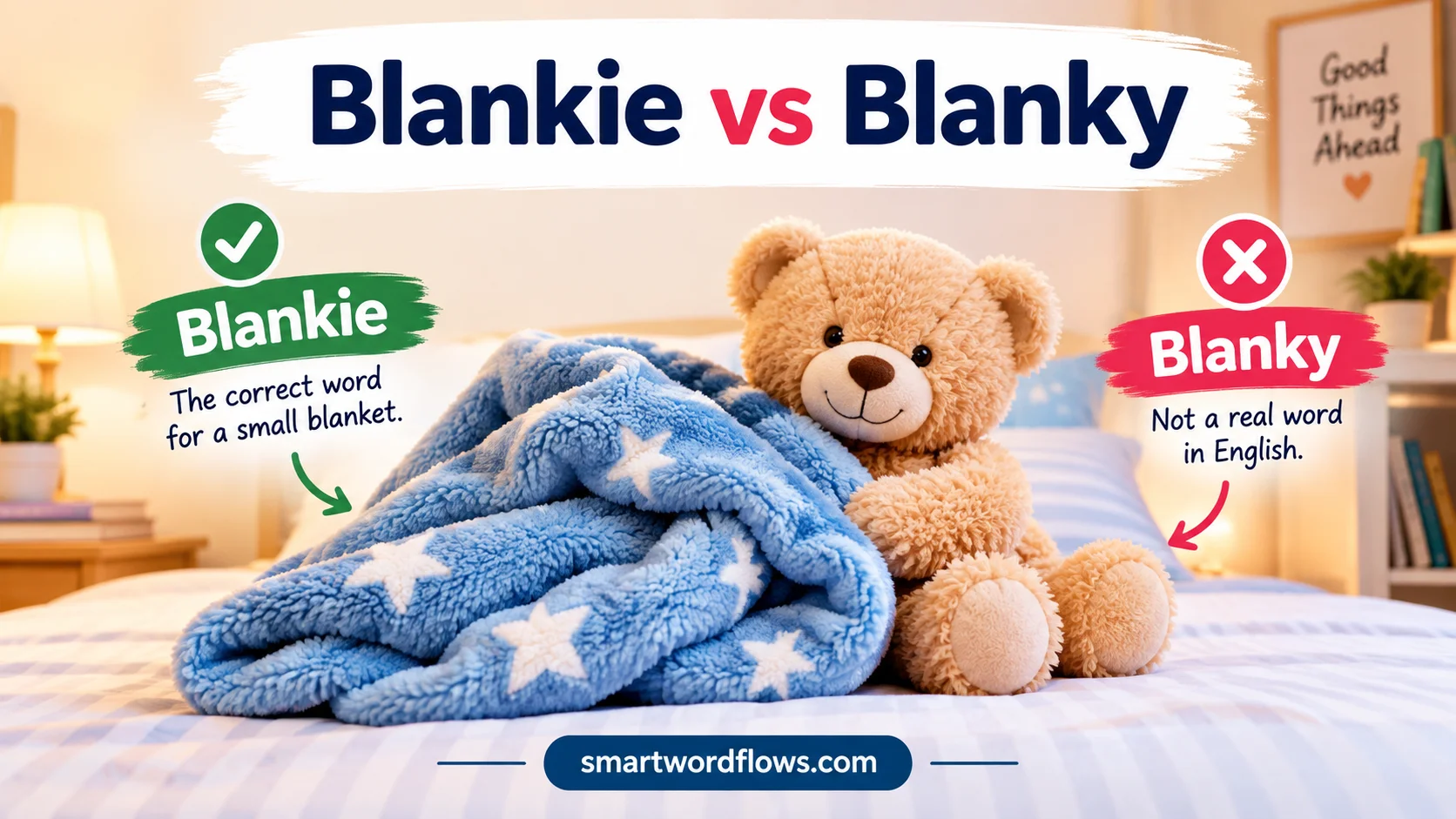

Blankie vs Blanky can be confusing when choosing a word for a child’s comfort blanket. Blankie is the preferred spelling and a common form in American English, while blanky is a recognized informal form in British English. Both are affectionate, informal words for a soft, cozy, and comforting blanket. The main spelling difference is simply the ending, so your audience, context, and regional preference can guide your choice.
Blankey is another alternative spelling used in casual writing, parenting, and baby talk. These forms have nearly the same meaning, pronunciation, and usage, but blankie remains the safest spelling for most American readers. Dictionaries recognize related forms, and their popularity can vary by region. For everyday writing, casual speech, and talking about a child’s favorite blanket, blankie sounds natural. In formal English, simply use blanket as the standard word.
Quick Answer
Blankie and blanky generally refer to the same basic thing: a child’s comfort blanket.
The main difference is spelling and usage, rather than meaning.
- Blankie is the more established spelling in American English.
- Blanky is an informal alternative found in some varieties of English and personal or family speech.
- Blankey is another variant that you may occasionally encounter.
- None of these terms normally refers to a completely different type of blanket.
- Blankie is the safest choice when writing for a broad US audience.
If you’re writing a sentence such as “The baby needs her favorite ___,” blankie will generally sound more familiar to American readers.
Comparison Overview
| Feature | Blankie | Blanky | Blankey |
| Basic meaning | A child’s blanket or comfort blanket | Usually the same | Usually the same |
| Tone | Informal and affectionate | Informal and childlike | Informal and variant |
| Common context | Children, parents, families | Family and regional speech | Less common variant |
| American English | Strong choice | Less standard as a default | Less common |
| Formal writing | Not usually appropriate | Not usually appropriate | Not usually appropriate |
| Pronunciation | Usually “BLANG-kee” | Usually similar | Usually similar |
| Refers to a blanket? | Yes | Yes, in this usage | Yes |
| Best general US choice | Blankie | Usually not | Usually not |
The key point is simple: the words overlap heavily in meaning. The bigger difference lies in which spelling feels natural to a particular speaker or audience.
Main Differences Between Blankie vs Blanky
The blankie vs blanky difference comes down to several practical factors.
Spelling
The most obvious distinction is the ending.
- Blankie ends in -ie.
- Blanky ends in -y.
This small spelling change doesn’t necessarily create a new meaning. English frequently develops multiple informal forms for familiar objects, particularly words used around children.
Dictionary status
Blankie has strong dictionary recognition. Merriam-Webster defines it as a child’s blanket and gives its first known use as 1899. Cambridge Dictionary also recognizes blankie as an informal noun and labels it mainly US usage.
Blanky appears as an alternative form in dictionary resources, but it doesn’t have exactly the same prominence or regional labeling as blankie.
Regional preference
For a general American English audience, blankie is usually the more natural choice.
In other varieties of English, particularly informal or family settings, you may encounter blanky more often.
Tone
Both forms have a warm, affectionate quality. They’re not the sort of words you’d normally choose in a technical report.
Compare:
“The child carried her blankie everywhere.”
with:
“The child carried her blanky everywhere.”
Both sentences are easy to understand. The first simply feels more familiar to many American readers.
What Does Blankie Mean?
Blankie is an informal noun for a child’s blanket, especially a blanket that has become personally meaningful to the child.
It isn’t necessarily a special material or size. A blankie could be:
- A small fleece blanket
- A knitted blanket
- A receiving blanket
- A worn piece of fabric
- A regular household blanket that a child has adopted as a favorite
The emotional connection often matters more than the physical characteristics.
A child might sleep with the same blanket every night, take it on road trips, carry it around the house, or become upset when it disappears into the laundry basket. In that situation, calling it a blankie emphasizes its familiar and comforting role.
Blankie examples
- “Where’s your blankie?”
- “We need to wash her blankie tonight.”
- “He won’t go to bed without his blankie.”
- “She brought her favorite blankie on vacation.”
- “The daycare asked parents to label each child’s blankie.”
Notice how naturally the word fits everyday family conversation.
What Does Blanky Mean?
Blanky can also refer to a child’s favorite blanket or comfort blanket. Its meaning overlaps substantially with blankie.
The difference isn’t usually about the object itself. Instead, blanky can reflect a particular family’s vocabulary, regional speech pattern, or informal preference.
Children often develop their own names for familiar objects. Parents may adopt those names, and eventually the words become part of everyday family language.
For example, one family might say:
“Go get your blankie.”
Another might naturally say:
“Go get your blanky.”
The intended object remains the same.
Is blanky a misspelling?
Not necessarily.
Calling blanky an outright spelling mistake oversimplifies the issue. Informal English contains many variants that don’t follow one universally enforced spelling system.
If you’re editing a formal article for a US audience, blankie is generally the safer choice. However, if you’re quoting a speaker, writing realistic dialogue, or preserving a family’s wording, blanky may be perfectly appropriate.
Is Blankie or Blanky the Correct Spelling?
If your question is specifically about American English, choose blankie when you want the most broadly recognizable form.
That doesn’t mean blanky suddenly becomes meaningless. It simply means that blankie is the stronger default for general US writing.
Think about the difference between a dictionary-standard choice and a personal nickname. A family might call a particular blanket “Blinky,” “Blanky,” or something completely different. Informal vocabulary has room for that creativity.
A useful rule
Writing general American English? Use “blankie.”
Preserving someone’s personal or regional wording? Keep “blanky” if that’s the form they use.
This approach avoids treating informal language as though it follows the same rules as scientific terminology.
Why Does Blankie Have an “-ie” Ending?
The spelling of blankie makes sense when you look at how English creates affectionate forms.
The word combines blanket with the diminutive or affectionate ending -ie. Merriam-Webster gives its etymology as blanket + -ie.
English speakers have long used endings such as -ie, -y, and -ey to create familiar or affectionate forms.
Examples include:
- dog → doggie
- kitten → kitty
- sweet → sweetie
- aunt → auntie
- blanket → blankie
These forms often make a word sound smaller, softer, friendlier, or more child-oriented.
Of course, not every word ending in -ie carries exactly the same historical meaning. English word formation is messy in the best possible way. Usage grows through families, communities, children’s speech, and popular culture rather than following a single master plan.
Blankie Word History and First Known Use
The history of blankie is particularly interesting because the word feels modern and child-centered, yet dictionary evidence places its first known use much earlier than many people might expect.
Merriam-Webster records the first known use of “blankie” as 1899.
That date doesn’t mean someone necessarily invented the word on January 1, 1899. “First known use” means the dictionary has documented evidence from that period. The spoken form could have existed earlier.
The development also fits a larger pattern in English. Familiar household objects often acquire affectionate names, especially when children develop strong attachments to them.
A plain blanket can become a child’s blankie once it becomes part of a bedtime routine, travel ritual, or source of comfort.
Blankie vs Blanky in American English
American English strongly favors blankie when discussing this particular children’s term.
That makes sense because blankie has established dictionary recognition and a familiar sound pattern for American speakers.
You’ll commonly see it in contexts involving:
- Parenting
- Child development
- Bedtime routines
- Daycare
- Family conversations
- Children’s literature
- Casual social media posts
- Family travel
The word also carries a particular emotional flavor. Saying “his blanket” describes the object. Saying “his blankie” can suggest that the blanket has a special place in the child’s world.
That subtle difference matters.
Example
Compare these sentences:
“The toddler sleeps with a blanket.”
This is neutral.
“The toddler sleeps with his blankie.”
This feels more personal. You immediately imagine a particular beloved object.
Blankie vs Blanky in British English
Regional English deserves some attention because vocabulary doesn’t stop at national borders.
Words that sound completely ordinary in one variety of English may feel unusual in another. Informal vocabulary is especially flexible.
Blanky has recognition in British usage, while blankie is commonly identified as mainly US English by Cambridge Dictionary.
This doesn’t create a strict language border. English speakers travel, communicate online, watch the same shows, and borrow expressions constantly.
As a result, you’ll sometimes encounter one form outside the region where it is most strongly associated.
The practical lesson is straightforward: don’t judge the spelling without considering the speaker’s variety of English.
How Do You Pronounce Blankie and Blanky?
Blankie is generally pronounced roughly like:
BLANG-kee
The first syllable sounds like the beginning of blanket, while the ending sounds like -kee.
A dictionary-style pronunciation is approximately /ˈblæŋ.ki/.
Blanky is generally easy to understand because the pronunciation remains close to the same basic sound pattern.
Why pronunciation matters
Because these words are usually spoken in casual settings, listeners rarely struggle to identify the intended meaning.
Context does most of the work.
If a parent says, “Where’s your blanky?” while getting a child ready for bed, the meaning is obvious even if the listener normally uses blankie.
Read More: Sponser vs Sponsor: Difference, Correct Spelling, and Usage
Blankie vs Blanky Example Sentences
Seeing the words in real sentences makes the distinction easier.
Blankie in everyday sentences
- “My son takes his blankie everywhere.”
- “Her blankie needs to go through the wash.”
- “We packed his favorite blankie for the hotel.”
- “The baby fell asleep while holding her blankie.”
- “She left her blankie at Grandma’s house.”
Blanky in everyday sentences
- “He won’t sleep unless he has his blanky.”
- “Did you bring the baby’s blanky?”
- “She carried her blanky into the living room.”
- “His old blanky is still his favorite.”
- “The toddler hugged his blanky during the car ride.”
The sentences demonstrate an important point: the meaning stays remarkably stable despite the spelling change.
Blankie, Blanky, or Blankey: What’s the Difference?
You may also see blankey, which adds another spelling to the mix.
These three forms can be summarized like this:
| Word | General use |
| Blankie | Established informal term for a child’s blanket |
| Blanky | Informal alternative used in some contexts and varieties |
| Blankey | Variant spelling that also occurs |
Cambridge recognizes blankey as another form of blankie.
The presence of several spellings isn’t unusual for informal vocabulary. Spoken language comes first, while spelling often follows later. When people hear a word rather than read it, different writers can naturally choose different spellings.
That’s one reason children’s vocabulary produces so many variations.
What Is the Plural of Blankie?
The standard plural form is blankies.
Singular
“The baby has one blankie.”
Plural
“The daycare keeps several blankies available.”
The spelling changes from blankie to blankies, replacing the final -ie with -ies.
For blanky, the plural can also appear as blankies when writers treat it as a noun referring to blankets.
More examples
- “We washed all the blankies.”
- “The twins each have their own blankie.”
- “These blankies belong in the nursery.”
Is Blankie Formal English?
No. Blankie is informal English.
That’s not a criticism. Informal words serve a useful purpose. They can communicate warmth, familiarity, and emotion in ways that neutral vocabulary sometimes can’t.
You might use blankie in:
- Family conversations
- Children’s stories
- Parenting content
- Text messages
- Casual blogs
- Social media
- Dialogue
You’d usually choose blanket or comfort blanket in more formal contexts.
Compare the tone
Informal:
“The child brought her blankie to bed.”
Neutral:
“The child brought her blanket to bed.”
More descriptive:
“The child brought her comfort blanket to bed.”
The best choice depends on what you’re trying to communicate.
Blankie vs Security Blanket
A blankie and a security blanket can overlap, but they’re not exact synonyms.
A blankie describes the familiar blanket itself.
A security blanket emphasizes the blanket’s role in providing emotional comfort or reassurance.
For example, a child might have a blanket that they call their blankie. If that blanket helps them feel calm when they’re tired, traveling, or separated from familiar surroundings, it may also function as a security blanket.
The two terms highlight different aspects of the same object.
| Term | What it emphasizes |
| Blankie | The familiar child’s blanket |
| Comfort blanket | The blanket’s comforting role |
| Security blanket | Emotional reassurance and security |
| Blanket | The general physical object |
This distinction is useful because not every blanket called a blankie necessarily serves as a psychological comfort object.
Why Do Children Become Attached to a Blankie?
A favorite blanket can become part of a child’s routine through repetition and familiarity.
Bedtime provides a good example. A child may associate the same blanket with:
- Falling asleep
- Parent-child routines
- Stories
- Quiet time
- Familiar smells
- Home
- Travel
- Comfort after stressful moments
Over time, the blanket can become a powerful cue for relaxation.
This doesn’t mean every child needs a blankie. Children differ widely in how they form attachments to familiar objects.
One child might love a blanket. Another might prefer a stuffed animal. Someone else might become attached to a particular pillow, toy, or piece of clothing.
The word blankie simply gives that familiar blanket a warm, child-centered name.
Common Mistakes With Blankie and Blanky
Assuming blanky is always wrong
This is the biggest mistake.
Blanky does occur as an informal form. Calling it universally incorrect ignores real language usage.
Assuming blankie is a formal word
It’s not. Although dictionaries recognize blankie, the word remains informal and affectionate.
Treating the two words as different objects
Usually, they aren’t.
If someone says blankie and another person says blanky, both may be talking about the same kind of beloved child’s blanket.
Ignoring regional English
American, British, Canadian, Australian, and other varieties of English don’t always choose the same informal vocabulary.
Confusing “correct” with “preferred”
A form can be legitimate while still being less suitable for a particular audience.
For general American writing, blankie is the better default.
When Should You Use Blankie Instead of Blanky?
Use blankie when you’re writing for a broad American audience and want the most familiar choice.
Choose blankie when:
- You’re writing a US parenting article.
- You’re describing a child’s favorite blanket.
- You’re writing general web content.
- You’re creating a children’s story for American readers.
- You want an established informal term.
- You aren’t trying to reproduce someone’s unique speech.
Choose blanky when:
- You’re quoting someone who uses that spelling.
- You’re writing dialogue with a specific family voice.
- You’re intentionally reflecting regional usage.
- The surrounding content already uses blanky consistently.
Consistency matters, too. If an article chooses blankie, switching randomly between blankie and blanky can make the writing look careless.
Case Study: Why Context Changes the Best Choice
Imagine two writers describing the same situation.
Writer A: American parenting article
“Your toddler may want to take their blankie everywhere.”
Here, blankie works naturally because the article targets a broad US audience.
Writer B: Character dialogue
“I can’t sleep without my blanky.”
If the character consistently uses blanky, changing the spelling to blankie could make the dialogue less authentic.
The lesson is bigger than this one word: language choices should match the speaker, audience, and purpose.
Blankie vs Blanky: Which One Should You Use?
For most American readers, blankie is the clear practical choice.
Use blankie when you want a familiar, established informal term for a child’s favorite blanket.
Use blanky when the context calls for that particular variant.
Neither choice needs to become a grammar emergency. This is informal vocabulary, and informal vocabulary naturally allows variation.
FAQs:
1. Is blankie or blanky correct?
Both blankie and blanky are recognized informal forms. Blankie is more common in American English, while blanky is also used in British English.
2. Is blankey a correct spelling?
Yes, blankey is an alternative spelling. However, it’s less common than blankie, so blankie is usually the safer choice.
3. What does blankie mean?
Blankie is an affectionate, informal word for a blanket, especially a child’s favorite comfort blanket or soft comfort item.
4. What is the difference between blankie and blanky?
The main difference is spelling and regional usage. Both words have essentially the same meaning and are commonly used in casual speech and parenting contexts.
5. Which spelling should I use?
Use blankie if you want the most familiar choice, especially in American English. You can use blanky when writing for a British English audience.
Conclusion:
Choosing between blankie, blanky, and blankey is mostly a matter of spelling, preference, and regional usage rather than meaning. Blankie is generally the safest and most familiar choice, particularly in American English.
Blanky is also a recognized informal form and may feel more natural in British English, while blankey appears as an alternative spelling. All three forms can describe a child’s favorite comfort blanket in casual, affectionate language. If you’re writing for a general audience and want the clearest option, blankie is the best choice.