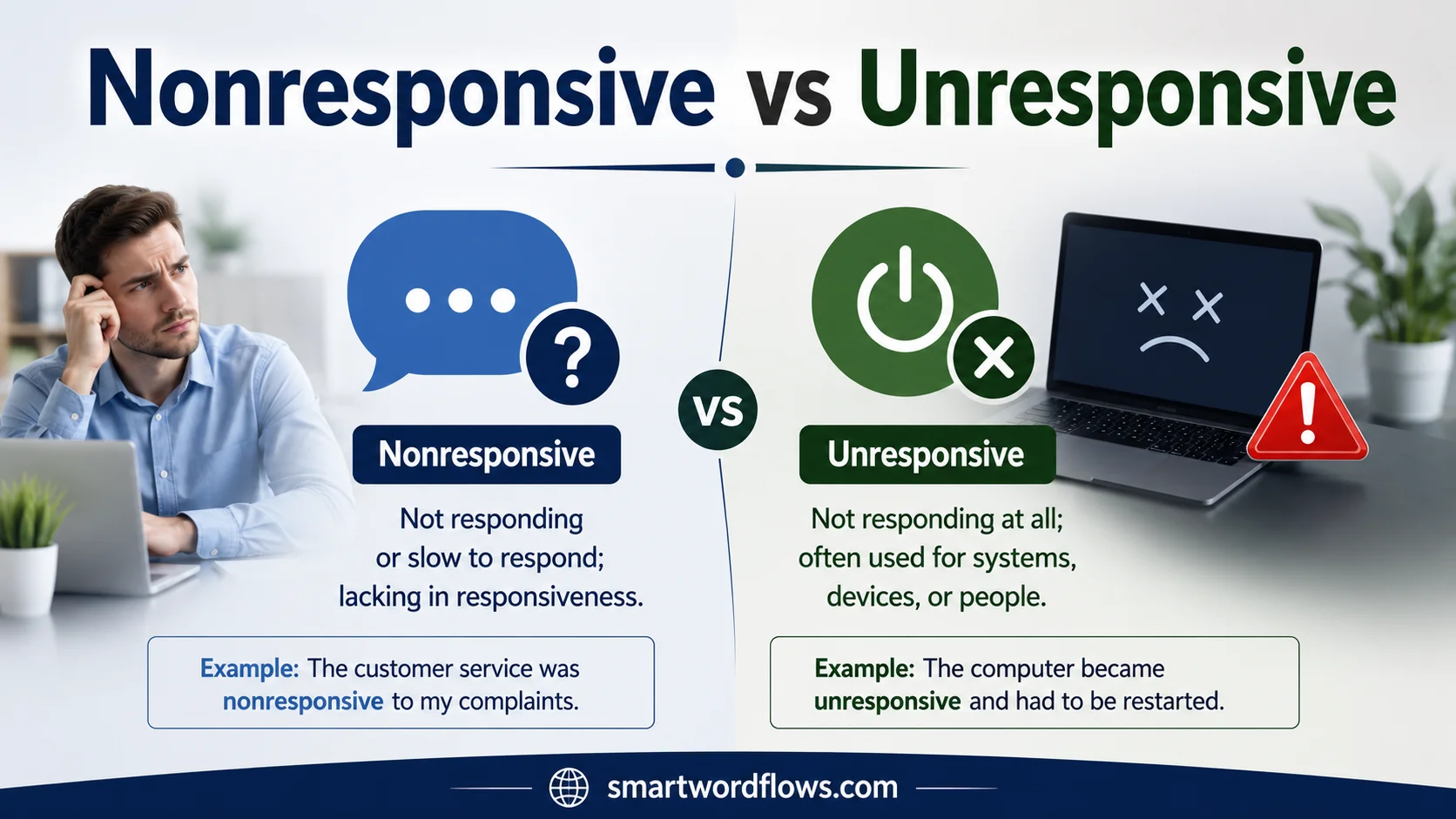

Understanding Nonresponsive vs Unresponsive helps you choose the correct word in different situations. Unresponsive usually describes a person who does not react to sound, action, or situations, especially in medical contexts. A patient who has fainted, lost consciousness, or shows no reaction may be called unresponsive. In contrast, nonresponsive has a broader meaning and can describe people, devices, computers, or systems that fail to respond. Understanding this subtle difference makes your writing more clear, precise, and professional.
The difference becomes easier through real-life examples and context. A frozen phone that does not respond after tapping the screen several times is nonresponsive, while a person who does not react to doctors may be unresponsive. These terms can sometimes act as synonyms, but their usage depends on the subject and situation. To use correctly each word, notice whether you are describing a person’s reaction or a device or system’s failure. This simple approach helps you choose confidently and avoid the wrong word.
Quick Answer
Nonresponsive and unresponsive are closely related adjectives, and both can mean “not responding.” The main difference is usually one of focus and context.
- Nonresponsive often emphasizes a failure to respond to a specific request, treatment, stimulus, question, or intervention.
- Unresponsive often emphasizes a more general lack of reaction or response.
- Unresponsive is very common when describing frozen software, devices, or people who aren’t reacting.
- Nonresponsive frequently appears in technical, professional, medical, and administrative language when the writer wants to identify what the subject failed to respond to.
- Both can describe people, systems, devices, treatments, and organizations.
- Neither word automatically means unconscious, uncooperative, or broken.
For example:
The patient was nonresponsive to the medication.
This focuses on the medication and the patient’s lack of response to it.
The patient was unresponsive to the nurse’s questions.
This focuses on the patient’s failure to react or answer.
The words overlap, but the object of the response often tells you which one fits better.
Comparison Overview
| Feature | Nonresponsive | Unresponsive |
| Basic meaning | Failing to respond | Not responding or reacting |
| Main emphasis | Often a specific response that didn’t occur | Often a general lack of response |
| Common with people | Yes | Yes |
| Common with technology | Yes | Very common |
| Common with medical situations | Yes | Very common |
| Common with treatments | Especially useful | Also possible |
| Common with requests | Very natural | Also natural |
| Tone | Often neutral or technical | Often more direct |
| Means unconscious? | No | No |
| Means uncooperative? | No | No |
| Example | The patient was nonresponsive to treatment. | The patient was unresponsive to verbal stimuli. |
The difference isn’t an absolute grammatical rule. English has plenty of overlap between these adjectives. Instead, think of the distinction as a difference in emphasis.
Nonresponsive often answers the question, “What didn’t this person or thing respond to?”
Unresponsive often answers the question, “Is this person or thing responding at all?”
That simple distinction will help you make the right choice in most situations.
Main Differences Between Nonresponsive vs Unresponsive
The most important difference between nonresponsive vs unresponsive is the way each word frames the missing response.
1. Nonresponsive Often Points to a Specific Stimulus or Request
When you use nonresponsive, you often have a particular thing in mind.
Consider these examples:
- The customer was nonresponsive to repeated requests.
- The patient was nonresponsive to treatment.
- The software was nonresponsive to the command.
- The witness was nonresponsive to the questions.
- The organization remained nonresponsive to the complaint.
In each case, the sentence identifies something that should have produced a response.
That makes nonresponsive particularly useful when precision matters.
2. Unresponsive Often Describes a General Lack of Reaction
Unresponsive can describe someone or something that simply isn’t reacting.
For example:
- The computer became unresponsive.
- The patient was unresponsive.
- The child appeared unresponsive to the noise.
- The device became unresponsive after the update.
- The customer remained unresponsive.
Here, the central idea is the absence of a response rather than the particular thing that failed to trigger one.
3. Unresponsive Is Especially Natural for Frozen Technology
If your laptop suddenly stops reacting when you click a button, most speakers would naturally say:
“My computer is unresponsive.”
You could say:
“My computer is nonresponsive.”
The second sentence isn’t necessarily grammatically wrong. It simply sounds more technical or less natural in ordinary conversation.
The same pattern appears with:
- apps
- websites
- browsers
- touchscreens
- operating systems
- software interfaces
- electronic devices
For everyday technology problems, unresponsive is usually the more natural choice.
4. Nonresponsive Often Works Well in Technical Contexts
Technical writing frequently needs to identify a specific failure.
For example:
“The device was nonresponsive to the input signal.”
This sentence tells you exactly what happened. The device didn’t react to the input signal.
Compare it with:
“The device was unresponsive.”
The second sentence tells you that the device isn’t reacting, but it doesn’t identify what triggered the expected response.
Neither sentence is inherently better. The first simply provides more specific information.
5. Medical Context Can Change the Meaning and Importance
Medical language requires particular care.
Unresponsive commonly describes a person who doesn’t respond appropriately to verbal or physical stimuli. However, calling someone “unresponsive” doesn’t automatically establish why they’re unresponsive.
For example:
“The patient was unresponsive to verbal stimuli.”
This describes an observed lack of response.
By contrast:
“The patient was nonresponsive to the treatment.”
This describes a lack of therapeutic response.
The distinction is important because the patient and the treatment are different parts of the situation.
A person can be responsive to a healthcare professional while being nonresponsive to a particular treatment. Likewise, someone can be unresponsive in a particular situation without the statement establishing unconsciousness.
What Does Nonresponsive Mean?
Nonresponsive means failing to respond when a response is expected or relevant.
The word combines non-, meaning “not,” with responsive, meaning capable of or inclined to respond.
In practical use, nonresponsive often suggests that a response was expected but didn’t happen.
Common Uses of Nonresponsive
You can use nonresponsive to describe:
- A customer who doesn’t reply to messages
- A patient who doesn’t respond to treatment
- A system that doesn’t react to a particular command
- A person who doesn’t answer questions
- An organization that doesn’t address a complaint
- A treatment that produces little or no desired effect
- A process that doesn’t react to an input
Consider the sentence:
“The company remained nonresponsive to the complaint.”
The sentence doesn’t necessarily mean the company is incapable of responding. It means the company failed to respond to that particular complaint.
That distinction matters.
Examples of Nonresponsive in Sentences
- The client has been nonresponsive to our emails.
- The treatment proved nonresponsive to the patient’s condition.
- The device was nonresponsive to the control signal.
- The department remained nonresponsive to repeated requests.
- The software became nonresponsive to user input.
- The patient was nonresponsive to the medication.
- The organization appeared nonresponsive to public concerns.
- The system was nonresponsive to the command.
Notice how often to + noun follows the adjective. This construction makes the target of the missing response clear.
What Does Unresponsive Mean?
Unresponsive means not responding, reacting, or showing the expected reaction.
It can describe both people and things.
For example:
“The application is unresponsive.”
The application isn’t reacting to commands.
You might also say:
“The patient is unresponsive.”
Here, the meaning concerns the person’s lack of observable response.
The word therefore has a broad range of uses. Context determines whether you’re talking about communication, physical reaction, technology, or another kind of response.
Examples of Unresponsive in Sentences
- The website became unresponsive during checkout.
- The patient remained unresponsive.
- The phone screen was unresponsive to touch.
- The employee seemed unresponsive during the discussion.
- The software became unresponsive after the update.
- The witness was unresponsive to repeated questions.
- The machine became unresponsive after overheating.
- The child appeared unresponsive to the sound.
Nonresponsive vs Unresponsive in Everyday Communication
Everyday communication provides some of the clearest examples of the distinction.
Imagine that you’ve sent someone three messages about an appointment and received nothing back.
You could say:
“She’s been unresponsive.”
This sounds natural and focuses on her overall lack of communication.
You could also say:
“She’s been nonresponsive to my messages.”
This sounds more specific. It identifies the messages as the thing she hasn’t responded to.
Which Sounds More Natural?
In casual conversation, unresponsive often sounds more natural when you’re describing the general behavior.
In more formal writing, nonresponsive can help identify a specific failure.
| Situation | Natural wording |
| General lack of communication | He has been unresponsive. |
| Failure to answer emails | He has been nonresponsive to my emails. |
| Failure to answer a specific question | She was unresponsive to the question. |
| General lack of reaction | She seemed unresponsive. |
Nonresponsive vs Unresponsive in Professional Writing
Professional writing requires careful wording because the wrong adjective can sound unnecessarily harsh.
Suppose a supplier hasn’t replied to several requests.
You could write:
“The supplier has been unresponsive.”
That’s clear and relatively direct.
You could write:
“The supplier has been nonresponsive to our recent requests.”
This version is more specific and documents what the supplier failed to address.
For formal correspondence, the second version can be useful because it identifies the exact issue rather than making a broad judgment about the supplier.
Better Professional Examples
Instead of:
“The department is unresponsive.”
Consider:
“The department has not responded to our requests for the required documentation.”
The second sentence is more concrete. It describes an action rather than simply attaching a label.
Similarly:
“The vendor has been nonresponsive to repeated requests for an updated invoice.”
This wording makes the problem easy to understand and document.
Read More: Maintained vs Maintenanced: Differences Explained
Nonresponsive vs Unresponsive in Customer Service
Customer service creates another useful distinction.
A customer might be:
- unresponsive to phone calls
- nonresponsive to email requests
- unresponsive after receiving several reminders
- nonresponsive to a proposed solution
Both words can work, but the sentence becomes more precise when you identify the expected response.
For example:
“The customer has been nonresponsive to our requests for additional information.”
This tells the reader exactly what hasn’t happened.
Meanwhile:
“The customer has been unresponsive.”
This is shorter and broader.
If the sentence appears in an internal case note, the specific version is usually more useful.
Nonresponsive vs Unresponsive in Technology
Technology is one area where unresponsive has become especially common.
When a program stops reacting to clicks or keyboard commands, people routinely say:
“The app is unresponsive.”
The same applies to:
- unresponsive screen
- unresponsive keyboard
- unresponsive website
- unresponsive browser
- unresponsive device
- unresponsive application
Why “Unresponsive” Works So Well for Devices
A device is expected to react to user input.
You click a button. Nothing happens.
You tap the screen. Nothing happens.
You type a command. The application doesn’t react.
Calling the device unresponsive captures that situation neatly.
For example:
“The touchscreen became unresponsive after several minutes of use.”
You could use nonresponsive, but the familiar everyday expression is generally unresponsive.
Nonresponsive in Technical Documentation
Technical documentation may use nonresponsive when the writer wants to describe a specific input relationship.
For example:
“The controller becomes nonresponsive to keyboard input when the connection is interrupted.”
This sentence identifies the exact type of input that fails.
That’s useful diagnostic information.
Nonresponsive vs Unresponsive in Medicine
Medical contexts deserve special attention because precision matters.
The adjective unresponsive commonly describes a person who doesn’t respond appropriately to attempts at communication or stimulation.
For example:
“The patient was unresponsive to verbal stimuli.”
The sentence describes an observed response, not the underlying cause.
Nonresponsive can also describe a failure to respond to a treatment or intervention.
For example:
“The condition was nonresponsive to conventional therapy.”
Here, the focus isn’t whether the person is conscious. The focus is whether the condition responded to treatment.
A Critical Distinction
Compare these statements:
The patient was unresponsive.
and
The patient was nonresponsive to treatment.
They describe very different things.
The first concerns the person’s observable responsiveness.
The second concerns the effectiveness of an intervention.
That difference makes word choice more than a matter of style.
Nonresponsive Does Not Mean Unconscious
This is an important point.
Unresponsive and unconscious aren’t perfect synonyms.
“Unconscious” describes a state of lost awareness or consciousness. “Unresponsive” describes a lack of observable response.
A person may be unable to respond for several different reasons. Therefore, the word unresponsive shouldn’t automatically be replaced with unconscious.
In medical writing, describe what is actually known rather than assuming the cause.
Nonresponsive vs Unresponsive vs Uncooperative
These three words can sound similar in some situations, but they describe different ideas.
Nonresponsive
A person or thing fails to respond.
“The customer was nonresponsive to our requests.”
Unresponsive
A person or thing doesn’t react or answer.
“The customer remained unresponsive.”
Uncooperative
A person refuses or fails to cooperate with an expected activity.
“The witness was uncooperative during the investigation.”
The difference is subtle but important.
Someone can be unresponsive without being uncooperative.
For example, a person might be unable to answer a question. Calling that person “uncooperative” would suggest unwillingness, which may not be true.
Nonresponsive vs Unresponsive vs Unconscious
These terms should also remain separate.
| Word | Core idea |
| Nonresponsive | Failing to provide an expected response |
| Unresponsive | Not responding or reacting |
| Uncooperative | Not cooperating or refusing to cooperate |
| Unconscious | Not conscious or aware |
Consider this example:
“The patient was unresponsive.”
That statement doesn’t necessarily explain why.
Compare:
“The patient was unconscious.”
This makes a more specific claim about consciousness.
Good writing avoids making a stronger claim than the available information supports.
“Nonresponsive to” vs “Unresponsive to”
Both constructions are grammatically valid.
Nonresponsive to
Nonresponsive to is particularly useful when the sentence identifies a specific stimulus, request, treatment, or input.
Examples:
- nonresponsive to treatment
- nonresponsive to medication
- nonresponsive to requests
- nonresponsive to commands
- nonresponsive to therapy
- nonresponsive to questions
Unresponsive to
Unresponsive to can also identify a specific stimulus or target.
Examples:
- unresponsive to verbal commands
- unresponsive to questions
- unresponsive to treatment
- unresponsive to external stimuli
- unresponsive to touch
- unresponsive to repeated attempts at contact
There isn’t a grammatical rule saying one must always follow a particular noun.
The distinction is primarily semantic and contextual.
Nonresponsive vs Unresponsive: Examples Side by Side
Here are several examples that show how the words behave in real sentences.
| Nonresponsive | Unresponsive | Difference |
| The customer was nonresponsive to our emails. | The customer was unresponsive. | The first identifies the emails. |
| The treatment was nonresponsive to the condition. | The treatment was unresponsive. | The first is more specific and usually more natural for treatment response. |
| The device was nonresponsive to the signal. | The device was unresponsive. | The first identifies the failed input. |
| The employee was nonresponsive to the request. | The employee was unresponsive to the request. | Both work with little difference. |
| The application was nonresponsive to keyboard input. | The application was unresponsive. | The first provides technical detail. |
| The patient was nonresponsive to the medication. | The patient was unresponsive. | These sentences describe different aspects of the situation. |
| The organization was nonresponsive to the complaint. | The organization was unresponsive. | The first identifies the specific issue. |
The table shows why context matters more than memorizing a rigid rule.
Case Study: Choosing the Right Word in a Workplace Email
Imagine a project manager waiting for documents from a supplier.
The manager could write:
“The supplier is unresponsive.”
That’s understandable. However, the statement leaves out useful information.
A stronger professional sentence would be:
“The supplier has been nonresponsive to our last three requests for the revised invoice.”
Why is this better?
It tells the reader:
- Who failed to respond.
- What they failed to respond to.
- How many times the team requested a response.
- Which document remains outstanding.
The word nonresponsive works well here because the sentence focuses on a specific failure to respond.
Case Study: A Frozen Application
Now imagine that a graphic design application stops reacting to clicks.
A user might say:
“The application is unresponsive.”
That sounds completely natural.
The user doesn’t necessarily need to identify a particular command. The problem is broader: the application has stopped reacting.
A technical report could be more specific:
“The application became nonresponsive to mouse and keyboard input.”
Both versions describe the same general problem. The second provides more diagnostic detail.
Case Study: Treatment Response
Consider a clinical research context in which a treatment produces no meaningful improvement.
A researcher might write:
“The condition was nonresponsive to the treatment.”
The focus here is the treatment response.
Calling the patient “unresponsive” would communicate something different:
“The patient was unresponsive.”
That sentence concerns the patient’s observable responsiveness rather than the effectiveness of the treatment.
This example shows why substituting synonyms without considering context can change the meaning.
Common Mistakes With Nonresponsive and Unresponsive
Mistake 1: Assuming They’re Always Interchangeable
Although the words overlap, they don’t always communicate the same thing.
“The patient was unresponsive.”
isn’t necessarily equivalent to:
“The patient was nonresponsive to treatment.”
The second sentence introduces a specific treatment response.
Mistake 2: Using “Uncooperative” as a Synonym
Someone who doesn’t respond isn’t necessarily refusing to cooperate.
Unresponsive describes behavior or reaction.
Uncooperative suggests a lack of willingness to cooperate.
Don’t use one when you actually mean the other.
Mistake 3: Treating “Unresponsive” as a Synonym for “Unconscious”
An unresponsive person may require urgent attention, but the adjective itself doesn’t establish the cause or state of consciousness.
Use precise language, especially in medical or emergency contexts.
Mistake 4: Calling Every Frozen Device “Nonresponsive”
The word isn’t wrong in every technical context. However, unresponsive is usually the more natural everyday description.
“My laptop is unresponsive.”
sounds more conversational than:
“My laptop is nonresponsive.”
Mistake 5: Using Labels Instead of Facts
In professional writing, a specific description often beats a broad label.
Instead of:
“The department is unresponsive.”
You might write:
“The department hasn’t replied to the two requests sent on Tuesday and Thursday.”
The second version gives the reader something actionable.
How to Choose Between Nonresponsive and Unresponsive
Use this quick decision process.
Choose “Nonresponsive” When:
- You want to identify a specific request or stimulus.
- You’re discussing a treatment or intervention.
- You’re writing technical or administrative documentation.
- You need to describe a failure to respond to a particular input.
- You want to emphasize the expected response.
Examples:
- nonresponsive to treatment
- nonresponsive to requests
- nonresponsive to input
- nonresponsive to medication
- nonresponsive to commands
Choose “Unresponsive” When:
- You’re describing a general lack of reaction.
- You’re talking about a frozen computer or application.
- You’re describing a person’s lack of response.
- You want natural everyday wording.
- The specific target of the response isn’t important.
Examples:
- unresponsive computer
- unresponsive application
- unresponsive patient
- unresponsive device
- unresponsive person
Synonyms for Nonresponsive and Unresponsive
The best synonym depends on what you actually mean.
Alternatives for Nonresponsive
- Not responding
- Failing to respond
- Inactive
- Unreactive
- Nonreactive
- Unreceptive
- Not answering
- Failing to react
Alternatives for Unresponsive
- Not responding
- Unreactive
- Inactive
- Silent
- Uncommunicative
- Unreactive to stimuli
- Not answering
- Failing to react
Be careful, though. These aren’t perfect replacements.
For example, silent describes a lack of speech or sound. It doesn’t necessarily mean someone is unresponsive. Likewise, uncommunicative concerns communication and doesn’t necessarily describe a physical response.
Quick Facts About Nonresponsive vs Unresponsive
- Nonresponsive is formed with the prefix non- plus responsive.
- Unresponsive uses the prefix un- plus responsive.
- Both words function primarily as adjectives.
- Both can describe people and things.
- Both can occur with the preposition to.
- Unresponsive is especially common in descriptions of frozen software and devices.
- Nonresponsive is useful when a specific request, treatment, stimulus, or input matters.
- Unresponsive does not automatically mean unconscious.
- Nonresponsive does not automatically mean uncooperative.
- Context often determines which word sounds more precise.
FAQs:
1. What is the difference between Nonresponsive and Unresponsive?
Unresponsive usually describes a person who does not react to something, especially in medical situations. Nonresponsive is broader and can describe people, devices, computers, or systems that fail to respond.
2. Is Nonresponsive or Unresponsive correct?
Both words are correct, but the best choice depends on the context. Use unresponsive mainly for a person showing no reaction, while nonresponsive is commonly used for devices, systems, and communication.
3. Can Nonresponsive describe a person?
Yes. Nonresponsive can describe a person who does not respond, but unresponsive is often more natural when referring to someone who shows no reaction.
4. Is a frozen phone Nonresponsive or Unresponsive?
A frozen phone is usually described as nonresponsive because the device fails to react to taps, commands, or other input.
5. Is an unconscious person Unresponsive?
Yes. An unconscious person may be described as unresponsive when they do not react to sounds, touch, or other attempts to get a response.
Conclusion
Understanding Nonresponsive vs Unresponsive becomes easier when you focus on the subject and context. Use unresponsive mainly for people who show little or no reaction, particularly in medical situations. Use nonresponsive for devices, computers, systems, and other situations where something fails to respond. Remembering this simple distinction can make your writing clearer, more precise, and professional.