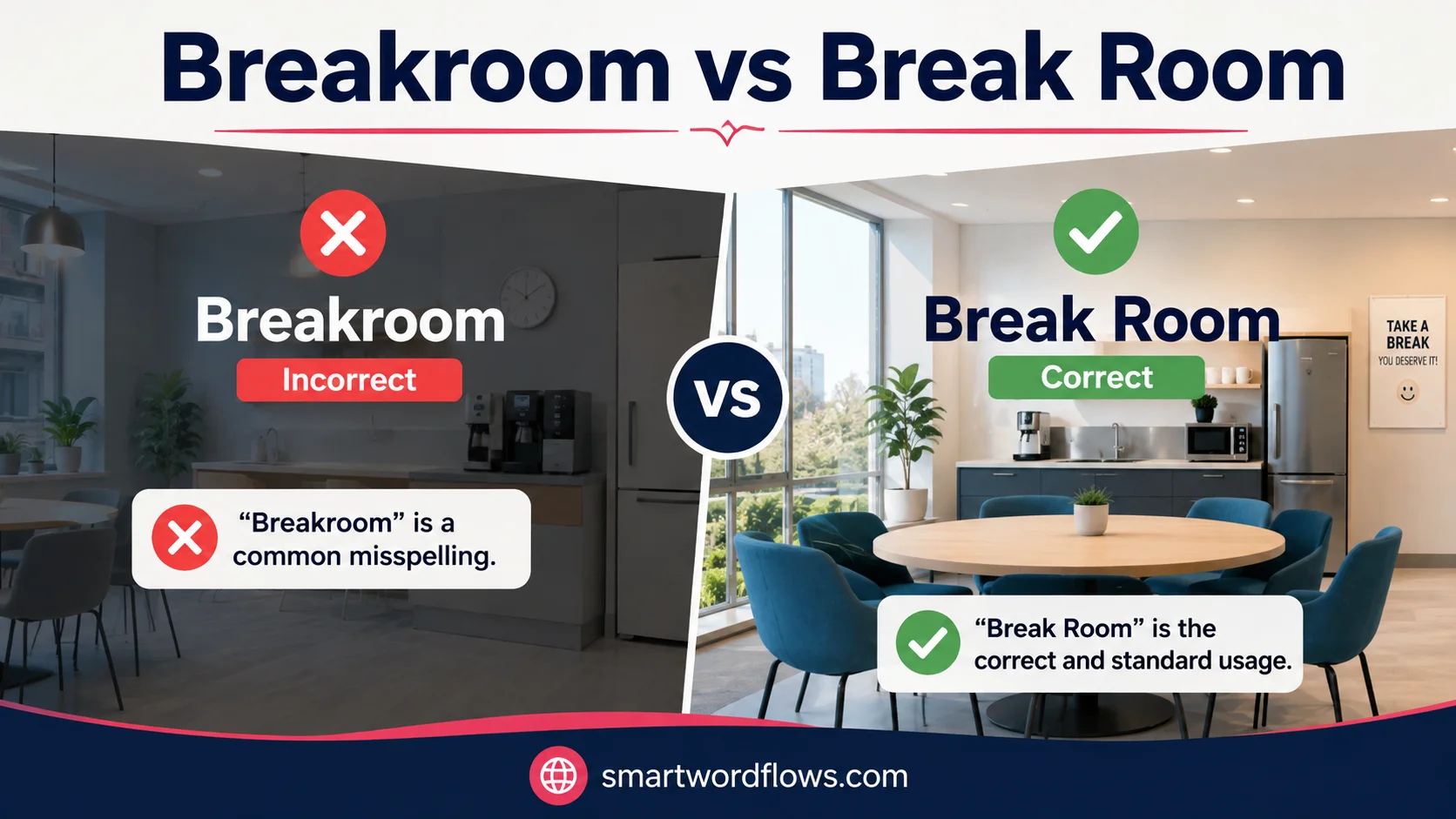

Breakroom vs Break Room can be confusing, especially in workplace writing. Both forms are used in American English, and both refer to a space where employees can relax, eat, drink coffee, or take a short break. However, break room is generally the more common and preferred form in formal and professional writing. Knowing this small spelling difference can help you write clearer emails, policies, and workplace documents.
The closed form, breakroom, is also accepted and appears regularly in modern workplace communication. You may find it on office signs, websites, employee handbooks, and other everyday materials. Although the two forms share the same meaning, editorial preferences can vary. In this guide, you’ll learn their meaning, usage, grammar, and examples, so you can confidently choose the appropriate form for your writing.
Quick Answer
“Break room” is the safest choice in general American English when you need a broadly accepted spelling. It clearly identifies a room where employees or other workers can take a break, eat, drink, or relax briefly during the workday.
However, “breakroom” is also a real and established spelling. You’ll commonly see it in workplace materials, business communication, office software, job-related content, and company documents.
The two forms generally have the same meaning:
- Break room: The traditional open compound spelling.
- Breakroom: A closed compound spelling used in modern English.
- Break-room: A hyphenated form that isn’t normally necessary when the phrase functions as a noun.
For example:
Please keep the break room clean.
The same sentence can appear as:
Please keep the breakroom clean.
The meaning doesn’t change.
If you’re writing for a general audience and don’t have a specific style guide to follow, “break room” is the safer default. If your employer, publication, or organization consistently uses “breakroom,” it’s reasonable to follow that established style.
Comparison Overview
The easiest way to understand breakroom vs break room is to compare how each form functions in everyday writing.
| Feature | Break room | Breakroom |
| Basic meaning | A room where people take breaks | A room where people take breaks |
| Word form | Open compound | Closed compound |
| Common in US English | Yes | Yes |
| Meaning difference | None in ordinary workplace use | None in ordinary workplace use |
| Best general-purpose choice | Yes | Acceptable |
| Common workplace usage | Very common | Very common |
| Usually hyphenated? | No | No |
| Works as a noun | Yes | Yes |
| Main issue | Two words may look less compact | Some style guides may prefer the open form |
The important point is simple: you’re choosing between two spellings of essentially the same compound noun.
English contains many compounds that can appear in different forms. Words and phrases can remain open, become hyphenated, or eventually become closed as usage develops. That doesn’t mean every possible spelling becomes standard. Established usage matters.
Main Differences Between Breakroom vs Break Room
The biggest difference between breakroom and break room is their written form, not their meaning.
Break Room Is an Open Compound
Break room contains two separate words that work together as one noun phrase.
- Break describes the purpose of the room.
- Room identifies the physical space.
In a sentence such as:
The employees went to the break room after the meeting.
The phrase acts as a single idea even though it contains two words.
This type of construction is called an open compound. English uses open compounds extensively, especially when readers can easily understand the relationship between the words.
Breakroom Is a Closed Compound
Breakroom combines the same two elements into one word.
Instead of:
break + room
you have:
breakroom
The meaning remains essentially identical. The closed spelling simply treats the compound as one lexical unit.
You’ll encounter this form particularly often in modern workplace contexts. Companies may use it in employee portals, internal documents, facility descriptions, and office-related terminology.
Neither Form Usually Needs a Hyphen
When you’re using the term as a noun, the standard choices are generally:
- break room
- breakroom
A hyphen isn’t normally necessary:
- break-room — generally unnecessary as the noun
For example:
The new break room is on the second floor.
You don’t normally need:
The new break-room is on the second floor.
The hyphen becomes relevant only if a particular style or grammatical construction specifically calls for one.
What Does “Break Room” Mean?
A break room is a designated workplace area where employees can step away from their regular duties for a short period.
People might use a break room to:
- Drink coffee or water
- Eat a snack
- Have lunch
- Sit and relax
- Talk with coworkers
- Store food in a refrigerator
- Heat food in a microwave
- Take a scheduled work break
A break room doesn’t have to be fancy. In one workplace, it might be a small room with a table, refrigerator, microwave, and coffee maker. In another, it could resemble a comfortable employee lounge with couches and kitchen facilities.
The essential idea is the same: it’s a shared space intended for employees to take breaks or spend time away from their normal workstations.
Examples of “Break Room”
- Please put your dishes in the sink after using the break room.
- The manager installed a new coffee machine in the break room.
- I’ll meet you in the break room after my afternoon shift.
- Employees should keep personal food labeled inside the break room refrigerator.
- The company renovated the break room to give workers a more comfortable place to relax.
What Does “Breakroom” Mean?
Breakroom has the same basic meaning as break room when it refers to a workplace space.
The closed spelling doesn’t create a new type of room. It simply combines the two elements into one written word.
For example:
The breakroom is next to the main conference room.
This tells the reader exactly the same thing as:
The break room is next to the main conference room.
The choice often comes down to house style, dictionary preference, editorial convention, or personal writing habits.
Examples of “Breakroom”
- The breakroom has a new refrigerator for employees.
- Please don’t leave uncovered food in the breakroom.
- The supervisor posted the schedule outside the breakroom.
- We added comfortable chairs to the breakroom last month.
- Employees can store their lunches in the breakroom refrigerator.
Why Are Break Room and Breakroom Both Used?
English doesn’t freeze every compound noun into one permanent spelling. Instead, compound words often develop through usage.
Consider how English handles combinations such as:
- coffee shop
- website
- ice cream
- notebook
- post office
- schoolhouse
Some compounds stay open. Others become closed. Some use a hyphen in certain constructions.
This happens because English spelling reflects usage, history, pronunciation, grammar, and editorial conventions.
A compound such as break room is easy for readers to understand because both words retain their ordinary meanings. Over time, frequent workplace use has also encouraged the closed form breakroom.
That doesn’t mean one form suddenly makes the other obsolete.
Instead, both forms can coexist.
Is Breakroom One Word or Two?
Breakroom is one word. Break room is two words.
That’s the simplest grammatical distinction.
When written as break room, the phrase remains an open compound noun.
When written as breakroom, the compound becomes a closed noun.
You can see the difference clearly here:
The break room needs new chairs.
The breakroom needs new chairs.
Both sentences describe the same physical space.
The spelling changes, but the meaning and grammatical function remain essentially the same.
Which Spelling Is More Correct in American English?
If you’re asking which spelling provides the safest general choice, use break room.
Why?
Because the open spelling is highly familiar, transparent, and widely recognized. A reader immediately understands that it means a room for taking a break.
That makes it especially useful in:
- Formal documents
- General articles
- Educational materials
- Business writing
- Employee policies
- Professional emails
- Public-facing websites
However, calling breakroom incorrect would be too broad.
The closed form appears in legitimate American workplace usage. If an organization consistently calls the space a breakroom, changing every occurrence to break room may actually make the document less consistent with that organization’s established terminology.
The Practical Rule
When there is no style preference, choose “break room.”
When an organization has an established style, follow that style consistently.
That’s a much more useful rule than claiming one spelling is universally right and the other is universally wrong.
Break Room or Breakroom in the Workplace
Workplace writing creates a particularly interesting situation because businesses often develop their own terminology.
A company might label its employee area:
BREAK ROOM
Another organization might use:
BREAKROOM
Neither sign creates a different meaning.
Employee Handbooks
For an employee handbook, consistency matters more than switching between forms.
For example, if the handbook uses break room throughout the document, maintain that spelling:
Employees must clean the break room after preparing food.
Don’t suddenly switch to:
Employees must clean the breakroom after preparing food.
unless there’s a deliberate reason.
Company Emails
In an informal workplace email, either form may work naturally:
The coffee supplies are in the break room.
Or:
The coffee supplies are in the breakroom.
Your main goal is clear communication.
Workplace Policies
Formal policies should generally follow the organization’s established editorial style.
For example:
Employees may use the break room during scheduled rest periods.
This wording is clear and professional.
If your company officially uses breakroom, then this version can also work:
Employees may use the breakroom during scheduled rest periods.
Break Room or Breakroom in Formal Writing
Formal writing requires a little more care because readers may expect consistency with a particular style guide.
If you’re writing an academic paper, professional report, publication, or corporate document, check the relevant style rules when available.
When no house style exists, break room is a dependable general-purpose choice.
The reason isn’t that breakroom is inherently unprofessional. Instead, the open form is immediately recognizable and avoids unnecessary debate over compound-word treatment.
A polished document should never make readers stop and wonder whether inconsistent spelling represents two different concepts.
Break Room or Breakroom on Signs and Labels
Signs present a slightly different challenge.
A workplace may choose:
BREAK ROOM
because the two-word phrase is visually straightforward.
Another may choose:
BREAKROOM
because the organization treats the term as one closed compound.
Both are understandable.
For signage, clarity, consistency, and alignment with the organization’s existing terminology matter most.
If every other facility sign uses closed compounds, introducing a different convention for this one sign may look odd. Likewise, if the organization already uses BREAK ROOM throughout its facilities, changing one sign isn’t necessary.
Is Break Room Hyphenated?
Usually, no.
When you’re using the expression as a noun, the normal choices are break room and breakroom.
For example:
The break room is located near the cafeteria.
The hyphenated version:
The break-room is located near the cafeteria.
is generally unnecessary.
Why Doesn’t It Need a Hyphen?
Hyphens often help readers understand compound modifiers that appear before another noun.
For example:
a well-known author
The hyphen helps show that well-known works together as an adjective.
But break room normally functions directly as a noun. There’s no similar need to join the words with a hyphen.
The same principle explains why you shouldn’t automatically hyphenate every pair of words that work together.
Also Read This: Noteable vs Notable: Correct Spelling and Usage
Break Room as a Noun
Break room functions as a compound noun.
It can appear in different parts of a sentence.
Subject
The break room needs new furniture.
Here, break room acts as the subject.
Object
The manager renovated the break room.
Here, it functions as the object of the verb renovated.
Possessive
The break room’s refrigerator needs repair.
The possessive form adds ‘s to the final word of the compound.
These examples demonstrate that the phrase behaves naturally as a single noun even though it contains two separate words.
Breakroom as a Noun
The closed form works in the same grammatical ways.
Subject
The breakroom needs better lighting.
Object
The company renovated the breakroom.
Possessive
The breakroom’s refrigerator is full.
Again, the grammar doesn’t change simply because the spelling changes.
Break Room vs. Breakroom: Examples in Real Sentences
Seeing the two forms side by side makes the issue much easier to understand.
| Meaning | Open Form | Closed Form |
| Location | The break room is downstairs. | The breakroom is downstairs. |
| Meeting place | Let’s meet in the break room. | Let’s meet in the breakroom. |
| Cleaning | The break room needs cleaning. | The breakroom needs cleaning. |
| Furniture | We bought chairs for the break room. | We bought chairs for the breakroom. |
| Food | Her lunch is in the break room refrigerator. | Her lunch is in the breakroom refrigerator. |
The takeaway is straightforward: the meaning remains the same in ordinary workplace contexts.
Common Mistakes With Break Room and Breakroom
Using “Break-Room” Without a Reason
One of the most common mistakes is adding a hyphen simply because the words form a compound.
In ordinary noun usage, break room doesn’t normally require one.
Treating Breakroom as Automatically Wrong
It’s tempting to assume that anything written differently from the familiar form must be incorrect.
That’s not how English works.
Breakroom appears in established modern usage, especially in workplace contexts. It’s better to recognize the variation than to label it an error without considering context.
Switching Between Forms
Consistency matters.
A document that uses break room, breakroom, and break-room interchangeably can look poorly edited.
Choose an appropriate form and stick with it.
Confusing a Break With a Break Room
A break refers to a period when someone stops working.
A break room refers to a physical place.
For example:
I have a 15-minute break at 10:00.
I’ll spend my break in the break room.
The concepts connect, but they aren’t interchangeable.
Break Room vs. Breakroom vs. Lunchroom
These terms overlap, although they aren’t always identical.
Break Room
A break room generally provides employees with a place to take short breaks, eat snacks, drink beverages, or relax.
Breakroom
Breakroom carries the same basic meaning as break room.
The difference is spelling rather than function.
Lunchroom
A lunchroom specifically emphasizes eating lunch or meals.
Depending on the workplace, a lunchroom may serve the same practical function as a break room.
For example, a factory might call its employee eating area a lunchroom, while an office might call a similar space a break room.
Break Room vs. Employee Lounge
An employee lounge can sound broader or more recreational than a break room.
A break room usually emphasizes taking scheduled breaks and handling everyday workplace needs, such as eating or making coffee.
An employee lounge may emphasize comfort and relaxation.
For instance:
Employees can eat lunch in the break room.
Employees can relax in the employee lounge.
The distinction isn’t absolute. Many workplaces use these terms interchangeably.
A Practical Case Study: Choosing a Spelling for an Employee Handbook
Imagine a company is preparing a 40-page employee handbook.
The editor initially uses break room in the safety section:
Keep the break room clean and free of hazards.
Later, another writer adds breakroom to the facilities section:
Food must be labeled before being placed in the breakroom refrigerator.
Neither sentence creates a serious language problem. However, the handbook now contains two spellings for the same term.
The editor has three sensible options:
- Use “break room” throughout because it works well as a general-purpose form.
- Use “breakroom” throughout if that is the company’s established terminology.
- Follow a specific organizational or editorial style guide if one governs the handbook.
What the editor shouldn’t do is assume that the difference changes the meaning.
This small example highlights a larger lesson about professional writing: consistency often matters more than choosing between two accepted usage patterns.
How to Choose Between Break Room and Breakroom
When you’re unsure, use this quick decision process.
Choose “Break Room” When:
- You’re writing for a general American audience.
- No house style specifies another form.
- You’re writing a formal document.
- You want the most immediately transparent spelling.
- You’re unsure which form your readers expect.
Choose “Breakroom” When:
- Your organization already uses breakroom.
- A publication’s style permits or prefers it.
- You’re matching existing workplace terminology.
- You’re editing content where the closed spelling appears consistently.
- The audience regularly uses the closed form.
Always Remember
Don’t alternate between spellings without a reason.
Consistency makes writing look deliberate and polished.
How to Remember the Difference
Here’s an easy memory trick:
Break room = two familiar words describing a room for a break.
Think of it literally:
break + room = room for a break
If you’re writing something general and aren’t sure what to choose, break room is a reliable default.
If you encounter breakroom, don’t assume you’ve found a spelling mistake. The closed form has established usage too.
Here are 5 FAQs and a concise conclusion you can add to the article:
FAQs:
1. Is “break room” or “breakroom” correct?
Both break room and breakroom are accepted forms. However, break room is generally preferred in formal American English.
2. What does “break room” mean?
A break room is a designated workplace area where employees can relax, eat, drink coffee, or take a short break.
3. Is “breakroom” one word?
Yes. Breakroom is a recognized closed compound and is commonly used in modern workplace communication.
4. Which form should I use in professional writing?
For professional documents, emails, and formal writing, break room is usually the safest and most widely accepted choice.
5. Do “breakroom” and “break room” have different meanings?
No. Both forms generally have the same meaning. The main difference is spelling and usage preference.
Conclusion:
Both breakroom and break room are valid ways to describe a workplace area where people take a break. While breakroom appears frequently in modern writing, break room is typically the safer choice for formal and professional American English. When in doubt, use break room for clear and conventional writing.