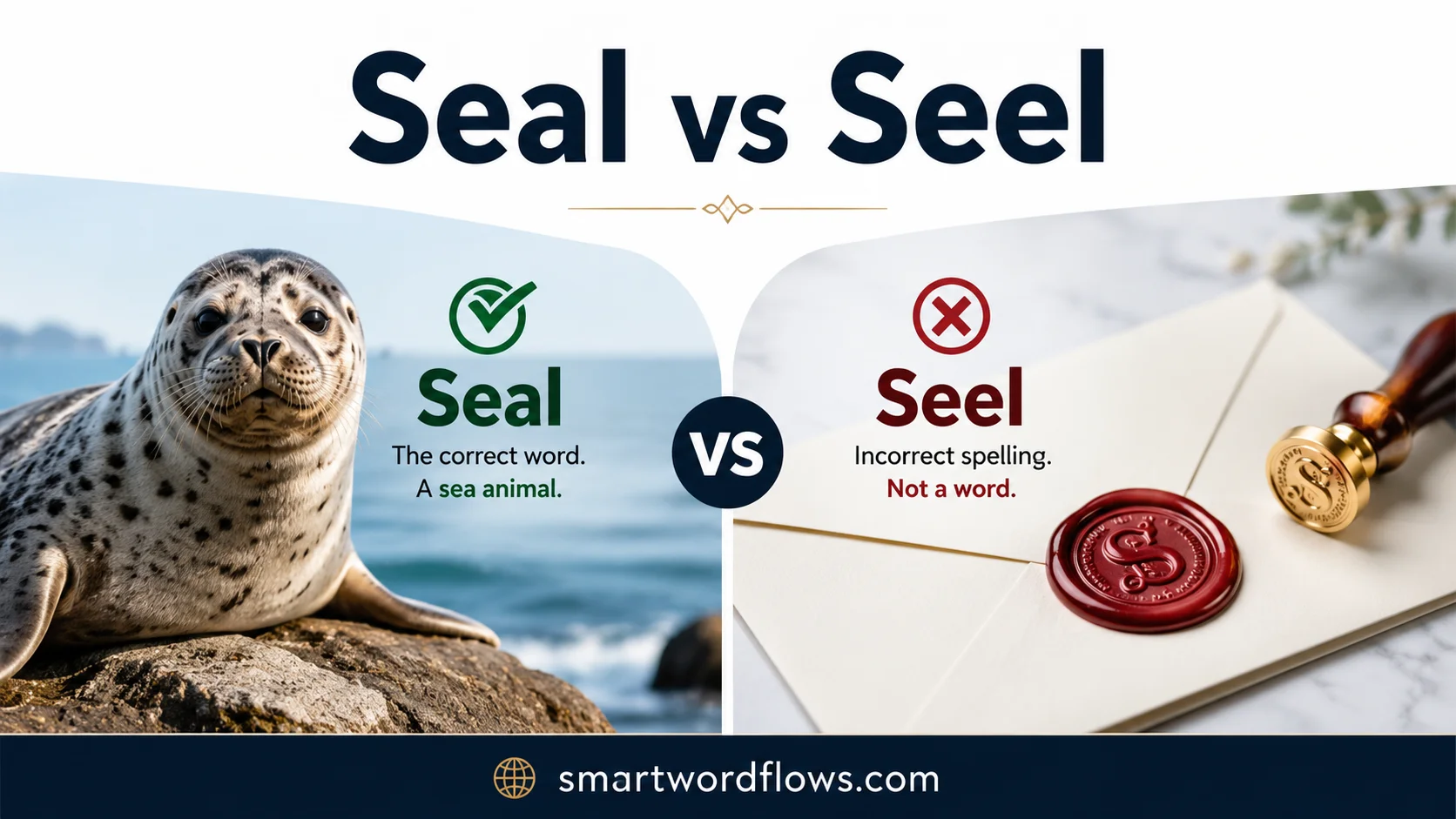

Seal and Seel create common word confusion in English because both look similar and have the same pronunciation. Many learners search for the correct spelling, meaning, and definition of these words. The correct seal spelling belongs to a valid word with clear seal meaning and seal definition, while seel is often a common misspelling in modern usage. Understanding this difference improves writing accuracy, clarity, and proper word choice.
When comparing Seal vs Seel, writers may face hesitation because of similar-sounding words, unclear spelling patterns, and confusion during fast typing. A strong understanding of grammar, vocabulary, and word usage rules helps avoid mistakes. Through linguistic analysis, examples, and correct usage, learners can understand when to use seal and improve their writing skills.
Quick Answer
Seal is the common modern word. Use it when you mean to close, secure, certify, or mark something. It is also the name of a sea animal.
Seel is a rare old word. It usually appears in historical or literary contexts and refers to closing or covering a bird’s eyes, especially in falconry.
A simple rule helps here: if you are writing for everyday English, seal is almost always correct.
Comparison Overview
The fastest way to understand the seal vs seel difference and correct usage is to compare them side by side.
| Word | Part of Speech | Core Meaning | Common in Modern English? | Example |
| Seal | Verb, noun | To close tightly, make official, or name a sea animal | Yes | “Please seal the envelope.” |
| Seel | Verb | To close or cover the eyes, especially in older usage | No | “The falconer would seel the bird.” |
Here is the practical takeaway:
- Seal is active, useful, and modern.
- Seel is specialized, rare, and historical.
- In business writing, schoolwork, messaging, and general content, seal is usually the right choice.
Main Differences Between Seal vs Seel Difference and Correct Usage
The main differences come down to meaning, frequency, and context.
Seal is common and flexible
The word seal shows up in everyday life all the time. You use it for packages, contracts, jars, windows, documents, and even wildlife.
Examples:
- Seal the box before shipping it.
- The deal was sealed with a handshake.
- A seal swam near the shore.
- The bottle has a tight seal.
Seel is rare and specialized
The word seel belongs to a much narrower space. It is mostly seen in old texts, especially those related to falconry or literature.
Examples:
- The old manuscript described how falconers would seel a bird.
- The poet used seel as a symbol of blindness.
Seal is useful in modern communication
If you are writing an email, essay, blog, report, or social post, seal is the word you probably want. It is clear, familiar, and accepted in all standard forms of English.
Seel is mostly for historical or literary writing
You would only use seel when you are deliberately writing about an older practice or when you are quoting an old source. In normal conversation, it would sound strange.
What Seal Means in Real Life
The word seal has several meanings, and that is one reason it stays so common. It is a small word with a lot of work to do.
Seal as a verb: to close tightly
One of the most common uses of seal is to close something so air, water, dust, or other elements cannot get in.
Examples:
- Seal the envelope before you mail it.
- Workers sealed the crack in the wall.
- The lid seals the jar tightly.
This meaning appears in homes, offices, factories, and shipping.
Seal as a verb: to make official
Seal also means to finish or confirm something in a formal way.
Examples:
- The two companies sealed the agreement.
- Their partnership was sealed after weeks of talks.
- The judge sealed the court file.
This use is common in legal, business, and formal settings.
Seal as a noun: a marine animal
A seal is also a sea mammal. It has flippers, lives near water, and often appears in colder coastal regions.
Examples:
- The seal rested on the rocks.
- Visitors watched the seals on the ice.
Seal as a noun: an official mark
A seal can also mean a stamp, emblem, or mark of authority.
Examples:
- The certificate bears the university seal.
- The envelope had an official seal.
That is why the word appears in so many different contexts.
What Seel Means and Why It Is Rare
Now let’s look at seel. This is where many people get confused, because the spelling is so close to seal.
Seel in historical usage
Seel is an old verb. It refers to closing or covering the eyes of a bird, especially in falconry. Falconers used the practice during training or handling.
This is not a word you would use in everyday speech. It belongs to a historical world.
Seel in literary writing
Writers sometimes use seel in older or poetic language to suggest blindness, ignorance, or the shutting out of truth.
Example:
- The poet used seel to suggest the character’s blind state of mind.
That said, this is not a common word in modern writing. Most readers would not expect it, and many would mistake it for a typo.
Why you should be careful with seel
If you use seel in a normal email or article, readers may think it is an error. That can hurt clarity. Unless you are writing about falconry, history, or a literary text, seal is the safer and stronger choice.
Seal vs Seel Difference and Correct Usage in Pronunciation
A lot of confusion comes from how the words sound.
Both words are usually pronounced the same way: /siːl/.
That means they sound identical in speech. The difference is not in pronunciation. It is in spelling and meaning.
| Word | Pronunciation | Notes |
| Seal | /siːl/ | Common and modern |
| Seel | /siːl/ | Rare and old-fashioned |
Because they sound alike, people often write the wrong one by accident. That is why spelling matters so much here.
Seal vs Seel Examples in Sentences
Examples help the difference stick faster than a long explanation.
Sentences with seal
- Please seal the envelope before you leave.
- The contractor sealed the leak in the pipe.
- The deal was sealed after a long meeting.
- The official seal appeared on the certificate.
- A seal was lying on the beach.
Sentences with seel
- The falconer would seel the hawk during training.
- The old text used seel to describe the bird’s covered eyes.
Notice the pattern. Seal works in everyday life. Seel belongs to a rare, narrow context.
Common Mistakes People Make
This is where many writers slip up.
Using seel when they mean seal
This is the most common mistake. Since the words sound the same, some people type seel when they really want seal.
Incorrect:
- Please seel the letter.
Correct:
- Please seal the letter.
Using seal when they mean seel in historical writing
This is less common, but it can happen in academic or literary discussions. If you are quoting an old source about falconry, double-check the original word.
Assuming seel is a typo every time
That is not always true. Seel is a real word. It is just rare. So the right move is not to assume it is fake. The right move is to check the context.
Read More: Dysregulated vs Disregulated: Correct Usage Explained
When to Use Seal
Use seal in all of these situations:
- Closing packages, bottles, envelopes, or containers
- Making a deal or agreement official
- Protecting something from air, water, or damage
- Talking about official marks, stamps, or emblems
- Referring to the sea animal
Here is a simple rule:
If the meaning is about closing, securing, confirming, or marking, seal is likely correct.
A useful memory trick
Think of seal as the word that helps you keep things shut, official, or secure.
That works for:
- a sealed box
- a sealed agreement
- a seal on a document
- a seal in the ocean
When to Use Seel
Use seel only in narrow cases.
Use seel in historical writing
If you are discussing falconry, old manuscripts, or archaic vocabulary, seel may be correct.
Example:
- The falconer would seel the bird’s eyes before training.
Use seel in literary analysis
If a writer uses the term intentionally for style or symbolism, then seel can appear in quotations or commentary.
Example:
- The poem uses seel to suggest a forced blindness.
Do not use seel casually
In normal communication, it can confuse readers. Most of the time, it will sound like an error. That is why it is safer to avoid it unless the context truly calls for it.
Seal vs Seel Correct Usage in Context
Here is a simple context guide.
| Situation | Best Word | Why |
| Mailing a letter | Seal | Common action of closing an envelope |
| Making a business deal official | Seal | Standard idiom |
| Talking about a sea mammal | Seal | Correct animal name |
| Writing about falconry history | Seel | Rare but correct historical term |
| Describing a document stamp | Seal | Official mark |
This table makes the rule easy to apply. Most of the time, seal wins.
A Closer Look at Word Forms
It also helps to know how each word changes in different forms.
Seal word forms
- seal
- sealed
- sealing
- seals
Examples:
- She sealed the bag.
- They are sealing the road.
- The seal on the jar was broken.
Seel word forms
- seel
- seeled
- seeling
These forms are extremely rare in modern use. You are unlikely to need them outside historical writing.
Quick Case Studies
A few realistic examples show how the right word depends on context.
Case study: a student essay
A student writes, “The company seel the contract.”
That is incorrect. The student meant sealed.
Why? Because contracts are finalized, not “seeled.” In modern business English, seal is the correct verb.
Case study: a history assignment
A writer is discussing falconry in medieval Europe and writes, “Falconers often seel the bird during training.”
That may be correct, because the context is historical and specialized.
Why? Because the term belongs to older vocabulary connected to bird handling.
Case study: social media caption
Someone captions a photo of a package with, “Time to seel this box.”
That will likely look wrong to most readers. The correct word is seal.
Why? Because the action is simple packaging, which uses the common modern verb.
A Few Clear Quotes to Remember
These are original takeaways you can keep in mind:
“Seal belongs in daily English. Seel belongs in old pages.”
“If you are closing, securing, or confirming something, seal is almost always the word you need.”
“Seel is real, but rare.”
Those lines are easy to remember because they match actual usage.
Why Seal Appears More Often Than Seel
The reason is simple: seal covers more ground.
It can mean:
- to close
- to protect
- to confirm
- to mark
- to name an animal
That versatility makes it valuable in modern English. Seel is narrower, older, and tied to specific historical usage. Language tends to keep the words people need often. That is why seal stays active while seel stays in the background.
Seal vs Seel Difference and Correct Usage in Everyday Writing
Here is the practical advice you can trust:
- Use seal for almost everything.
- Use seel only when the context is historical, literary, or about falconry.
- If you are unsure, choose seal.
- When proofreading, watch for accidental swaps because both words sound alike.
Easy checklist
Before you write the word, ask:
- Am I talking about closing or securing something?
- Am I talking about an official mark or a marine animal?
- Am I reading or quoting an old text about birds?
If the answer is yes to the first two, use seal. If the answer is yes to the third, seel may be correct.
FAQs:
1. What is the correct spelling, seal or seel?
The correct spelling is seal. It is a valid English word with different meanings, such as closing something tightly, confirming an agreement, or referring to a marine animal. Seel is generally considered a misspelling in modern English.
2. What is the meaning of seal?
The word seal means to close, protect, or secure something so that it cannot be opened easily. It can also mean an official mark or symbol used for authentication. In another context, a seal is an animal that lives in oceans.
3. Is seel a real English word?
Yes, seel exists as an old or specialized word, mainly used in historical contexts, such as describing the action of stitching or closing a bird’s eyes. However, it is rarely used in everyday English and is often a spelling mistake for seal.
4. Why do people confuse seal and seel?
People confuse seal vs seel because both words have similar spelling patterns and the same pronunciation. Fast typing, unclear spelling rules, and limited vocabulary knowledge can lead to this common mistake.
5. How can I remember the difference between seal and seel?
Remember that seal is the common spelling used in daily writing. Think of examples like seal a package, seal an agreement, or a sea animal called a seal. Use seel only when referring to its rare historical meaning.
Conclusion
Understanding the difference between seal and seel helps improve spelling accuracy and effective communication. While seal is the correct and commonly used word in modern English, seel is rarely found outside specific historical meanings. Learning proper word usage, definitions, and spelling patterns reduces confusion and helps writers choose the right word with confidence.