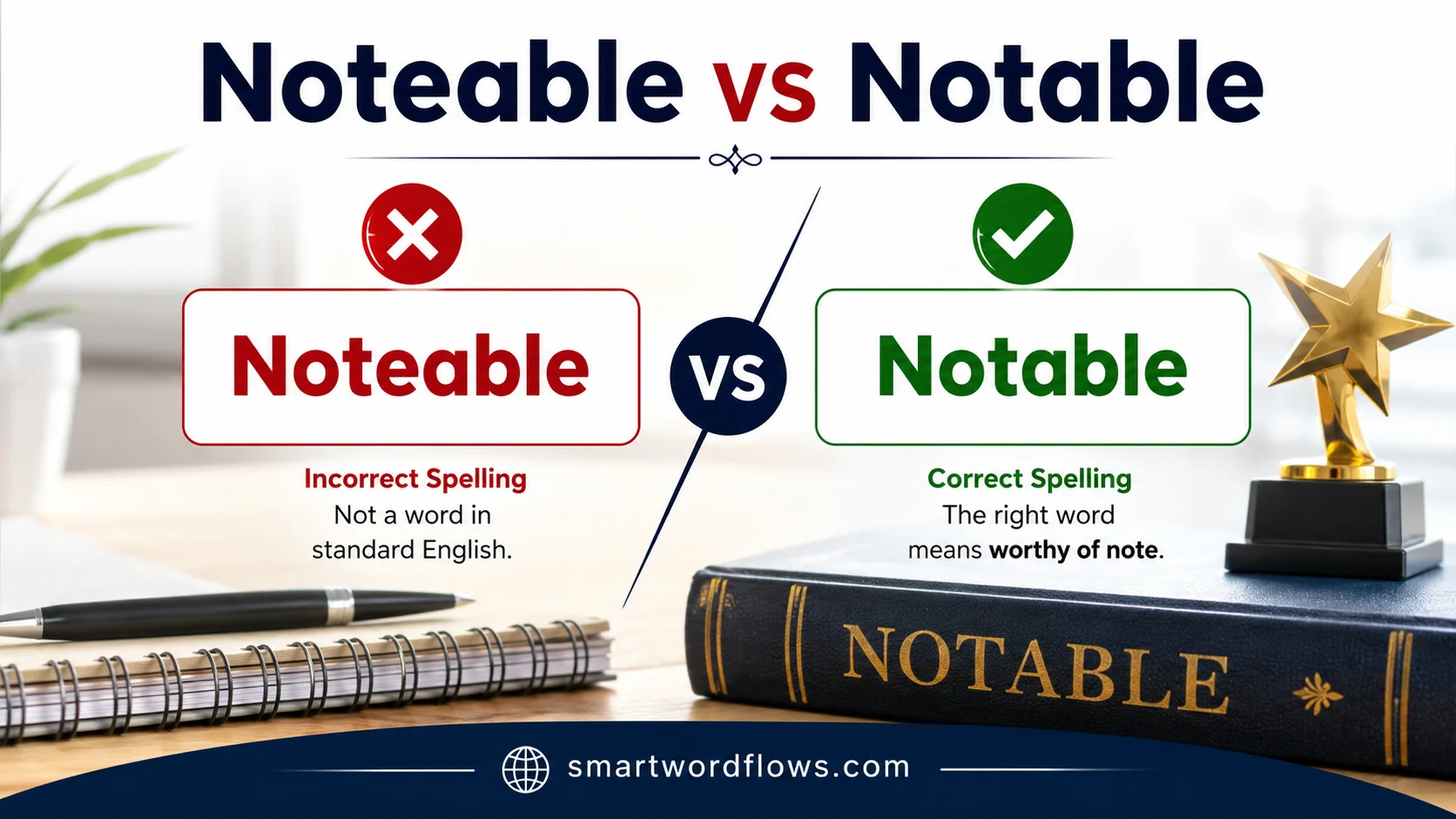

Noteable vs Notable is a common spelling confusion that can make even careful writers hesitate. Notable is the correct spelling and means worthy of attention, important, or remarkable. “Noteable” may seem logical because it resembles the word “note,” but it’s considered an incorrect spelling. Knowing this difference helps you avoid mistakes and write with greater confidence, clarity, and accuracy in everyday English.
The word notable can describe a person, event, achievement, or feature that deserves special attention. For example, you might call a scientist notable because of an important discovery or describe a notable achievement that stands out from others. It’s also useful to distinguish notable from noticeable, which means easy to see, recognize, or observe. Understanding these related meanings makes it easier to choose the right word for each context.
Quick Answer
Notable is the correct standard spelling.
Noteable is generally considered a misspelling of notable in standard English. Although noteable may look logical because it resembles note + able, English does not form this particular word that way.
The correct word is:
Notable = worthy of attention, remarkable, significant, prominent, or well-known.
For example:
- She made a notable contribution to the project.
- The study revealed a notable difference between the two groups.
- He is a notable figure in modern literature.
The incorrect form would be:
- ❌ She made a noteable contribution.
- ✅ She made a notable contribution.
If you’re deciding between noteable vs notable, choose notable.
Comparison Overview
The easiest way to understand the difference is to place both spellings side by side.
| Feature | Notable | Noteable |
| Standard spelling | ✅ Yes | ❌ No |
| Commonly accepted English word | ✅ Yes | ❌ Generally a misspelling |
| Part of speech | Adjective | — |
| Main meaning | Worthy of attention or remarkable | — |
| Common use | Formal and informal writing | Usually appears as a spelling error |
| Example | a notable achievement | ❌ a noteable achievement |
| Recommended in professional writing | ✅ Yes | ❌ No |
The important point is simple: there isn’t a standard spelling choice between these two forms. One is established English usage, while the other is normally an error.
At a Glance
Correct: notable
Incorrect: noteable
Pronunciation: commonly pronounced approximately NOH-tuh-buhl
Part of speech: adjective
Common meanings: remarkable, significant, worthy of attention, prominent, or well-known
Main Differences Between Noteable vs Notable
The biggest difference between noteable vs notable is correctness.
Notable is an established English adjective. It describes something or someone that deserves attention because of importance, quality, achievement, distinction, or recognition.
Noteable, on the other hand, is usually what happens when someone applies a seemingly logical spelling pattern to the word. Because note is a familiar English word and -able is a common suffix, noteable can look perfectly reasonable at first glance.
It isn’t the standard spelling, though.
Notable Is the Standard Word
The word notable has several related meanings, all connected to the idea of being worthy of notice.
For example:
- a notable achievement means an achievement worth recognizing.
- a notable difference means a difference significant enough to attract attention.
- a notable scientist means a scientist who has achieved recognition or distinction.
- a notable increase means an increase large or important enough to stand out.
The exact meaning depends on context.
Noteable Is Usually a Spelling Error
The form noteable generally results from adding an extra e after not.
That extra letter makes the word look connected directly to note, but the standard spelling is simply:
not + able → notable
You don’t need to preserve the full spelling of note when writing notable.
Why the Mistake Looks Natural
English spelling contains many words that use -able, which makes the error understandable.
Consider words such as:
- readable
- comfortable
- noticeable
- changeable
- avoidable
A writer might naturally assume that note becomes noteable. However, spelling patterns in English have plenty of exceptions and historical irregularities.
That’s why notable needs to be learned as its standard form rather than reconstructed from note.
What Does “Notable” Mean?
Notable is an adjective used for something or someone that deserves attention because it is important, remarkable, distinguished, unusual, or well-known.
The word doesn’t always mean famous. That’s one of its common uses, but it has a broader meaning.
For instance, a notable improvement doesn’t have to be famous. It simply means the improvement is significant enough to notice.
Likewise, a notable difference doesn’t mean a difference is famous. It means the difference is sufficiently clear or important to deserve attention.
Notable Meaning “Worthy of Attention”
One of the most useful meanings of notable is worthy of notice.
Consider this sentence:
There was a notable improvement in the team’s performance.
Here, notable tells the reader that the improvement wasn’t trivial. It was significant enough to stand out.
More examples include:
- The report contains several notable findings.
- A notable change appeared after the new policy took effect.
- Her progress during the semester was notable.
Notable Meaning “Remarkable”
Notable can also describe something that stands out because of its quality, scale, or achievement.
For example:
- He showed notable patience during the difficult negotiation.
- The company achieved notable growth within two years.
- Her performance was notable for its consistency.
In these sentences, the word highlights something that deserves special attention.
Notable Meaning “Well-Known or Distinguished”
When referring to a person, notable can mean well-known, respected, prominent, or distinguished.
For example:
- The conference attracted several notable researchers.
- She became a notable voice in environmental journalism.
- The museum features works by notable artists.
This meaning often appears in biographies, historical writing, journalism, and academic material.
Why Is “Noteable” Incorrect?
The confusion comes largely from the visual relationship between note and notable.
At first glance, someone might reason:
note + able = noteable
That reasoning makes sense on the surface. However, the established word is notable, without the extra e.
English has many words whose spelling doesn’t follow the exact pattern a writer might expect from combining two visible parts.
For that reason, it’s better to remember notable as its own standard spelling.
Correct and Incorrect Forms
| Incorrect | Correct |
| ❌ noteable achievement | ✅ notable achievement |
| ❌ noteable difference | ✅ notable difference |
| ❌ noteable increase | ✅ notable increase |
| ❌ noteable person | ✅ notable person |
| ❌ noteable result | ✅ notable result |
If a spelling checker highlights noteable, replace it with notable unless you’re dealing with a specific proper name that intentionally uses the unusual spelling.
How Do You Spell “Notable” Correctly?
The correct spelling is:
N-O-T-A-B-L-E
The incorrect version adds an unnecessary e:
N-O-T-E-A-B-L-E
A useful visual reminder is:
NOTABLE ✅
NOTEABLE ❌
One simple way to remember the spelling is to avoid thinking of the word as note + able. Instead, memorize notable as a complete word.
You can also connect it with related words such as:
- notably
- notability
- noted
The common spelling pattern helps reinforce the form not- rather than note-.
Notable Pronunciation
Notable is commonly pronounced approximately:
NOH-tuh-buhl
The exact sound can vary slightly by accent, but the spelling doesn’t normally produce a separate pronunciation for the incorrect form noteable.
The first syllable carries the main stress:
NO-ta-ble
This matters because pronunciation and spelling sometimes reinforce each other. If you hear the word spoken naturally, it doesn’t strongly suggest that an extra e belongs in the written form.
Is “Notable” Pronounced Like “Note-able”?
Not exactly.
Although notable visually resembles something that could be pronounced note-able, standard pronunciation treats it as the established word notable.
This is another reason not to construct its spelling mechanically from the word note.
How to Use “Notable” in a Sentence
Notable works as an adjective, so it usually describes a noun or a quality associated with a noun.
You can use it before a noun:
The researchers made a notable discovery.
You can also use it after a linking verb:
The difference was notable.
Another common structure uses notable for:
The region is notable for its historic architecture.
These patterns give you flexibility without making your writing sound forced.
“Notable” Before a Noun
This is one of the most common sentence patterns.
Examples include:
- a notable achievement
- a notable event
- a notable increase
- a notable difference
- a notable writer
- a notable feature
- a notable contribution
- a notable discovery
For example:
The scientist received recognition for a notable contribution to medical research.
“Notable” After a Linking Verb
You can also place notable after verbs such as was, is, and became.
Examples:
The improvement was notable.
Her absence was especially notable during the final meeting.
The change became notable after several months.
This structure works particularly well when the thing being described has already been established in the conversation or writing.
“Notable for” and Related Patterns
The phrase notable for means that something deserves attention because of a particular characteristic.
For example:
The city is notable for its historic architecture.
Other examples include:
The book is notable for its clear writing style.
The company is notable for its focus on customer service.
The region is notable for its diverse wildlife.
This construction is especially useful in descriptive and informative writing.
Read This: Unkept vs Unkempt: Difference and Usage Explained
Examples of “Notable” Used Correctly
Seeing the word in different contexts makes its meaning much easier to understand.
- The team made notable progress during the second half of the season.
- Her research produced several notable findings that attracted further attention.
- The report identified a notable difference between the two groups.
- He became a notable figure in the technology industry after launching the company.
- The building is notable for its distinctive architectural design.
- The latest version includes several notable improvements over the previous release.
- She made a notable contribution to the community project.
- The region has several notable historical landmarks worth visiting.
- His performance showed a notable increase in confidence.
- The author is known for several notable works of contemporary fiction.
- One notable feature of the application is its simple interface.
- The researchers observed a notable change in the results.
- Several notable scholars attended the academic conference.
- The discovery represented a notable moment in the history of the field.
- Her ability to explain complex ideas in simple language was particularly notable.
- The company reported a notable increase in customer satisfaction.
- The museum contains paintings by several notable artists.
- His absence was notable because he usually attended every meeting.
Common Mistakes With “Notable”
Spelling isn’t the only area where people can stumble. Notable also gets confused with several similar-looking or related words.
Writing “Noteable” Instead of “Notable”
This remains the most common mistake in the specific noteable vs notable debate.
Incorrect:
❌ The report showed a noteable increase.
Correct:
✅ The report showed a notable increase.
The difference is only one letter, but the correct version matters in polished writing.
Confusing “Notable” With “Noticeable”
Notable and noticeable look similar, but they don’t always communicate the same idea.
Notable generally means worthy of attention, significant, remarkable, or distinguished.
Noticeable generally means easy to see, hear, feel, detect, or recognize.
Compare these sentences:
The company experienced a notable increase in revenue.
This emphasizes the importance or significance of the increase.
There was a noticeable change in his voice.
This emphasizes that the change was easy to detect.
The two words overlap in some contexts, but they aren’t interchangeable in every sentence.
Confusing “Notable” With “Noted”
Noted can mean well-known, respected, or recognized, especially when describing people.
For example:
She is a noted historian.
Notable can also describe a recognized person:
She is a notable historian.
These sentences are close in meaning, although the choice can affect the tone slightly.
Noted often sounds more directly connected to reputation or professional recognition. Notable can emphasize the person’s distinction or importance.
Using “Notable” When Another Word Is More Precise
Sometimes notable works perfectly, but another word gives the reader a sharper picture.
For example:
- important emphasizes importance.
- remarkable emphasizes something unusual or impressive.
- significant emphasizes importance or measurable impact.
- noticeable emphasizes something that can easily be detected.
- famous emphasizes public recognition.
- prominent emphasizes position, influence, or visibility.
Good writing isn’t about choosing the fanciest synonym. It’s about choosing the word that fits the intended meaning.
Notable vs Noticeable: What’s the Difference?
This distinction deserves special attention because notable and noticeable are frequently confused.
| Word | Core Meaning | Example |
| Notable | Worthy of attention or significant | She made a notable contribution. |
| Noticeable | Easy to detect or observe | There was a noticeable change in his voice. |
A helpful test is to ask:
Does the sentence emphasize significance or detectability?
If something deserves attention because it matters, notable may fit better.
If something stands out because you can easily perceive it, noticeable may be more appropriate.
Example Comparison
Consider a business report:
The company experienced a notable increase in sales.
This suggests that the increase was significant or worth highlighting.
Now consider:
The company experienced a noticeable change in customer behavior.
This focuses more on the fact that observers could clearly detect the change.
The difference can be subtle, but context makes the intended meaning clearer.
Notable vs Noted: What’s the Difference?
Both notable and noted can describe people who have achieved recognition.
| Word | Typical Meaning | Example |
| Notable | Worthy of attention, distinguished, or important | She is a notable researcher. |
| Noted | Well-known or respected for a particular achievement or field | She is a noted researcher. |
In many cases, both can work.
However, noted often carries a strong sense of established recognition, while notable has a wider range of meanings.
For objects, events, changes, and results, notable is often the more natural choice.
For example:
The study produced notable results.
You wouldn’t normally replace notable with noted here because the intended meaning is that the results were significant or worthy of attention.
Is “Noteable” Ever Correct?
In standard English writing, noteable is generally not considered the correct spelling of the adjective notable.
However, unusual spellings can appear in proper names, product names, usernames, business names, titles, or other branded contexts. A name may intentionally use a spelling that differs from standard dictionary usage.
That doesn’t make noteable the standard spelling of the English adjective.
Therefore, if you’re writing a normal sentence, use:
notable
For example:
The researcher made a notable discovery.
Not:
❌ The researcher made a noteable discovery.
When a word appears in a specific brand or proper name, preserve the official spelling of that name. Ordinary English usage is a different matter.
Is “Notable” Formal or Informal?
Notable works in both formal and everyday English.
You can use it in an academic paper:
The study produced several notable findings.
You can use it in business writing:
The company achieved notable growth this year.
You can use it in journalism:
The event attracted several notable guests.
You can also use it in everyday conversation:
One notable thing about the restaurant was its incredibly friendly service.
That flexibility makes notable a useful word when you want to highlight something without sounding overly dramatic.
Where “Notable” Works Especially Well
The word commonly appears in:
- Academic writing
- Business reports
- News articles
- Biographies
- Historical writing
- Professional profiles
- Reviews
- Research summaries
- General conversation
Its tone usually falls somewhere between ordinary description and formal analysis.
Synonyms for “Notable”
The best synonym depends on what you mean by notable.
When “Notable” Means Worth Noticing
Useful alternatives include:
- Remarkable
- Significant
- Striking
- Distinctive
- Outstanding
Example:
The report identified a notable difference.
Possible alternatives:
The report identified a significant difference.
The report identified a striking difference.
The best option depends on the exact emphasis you want.
When “Notable” Means Famous or Distinguished
Consider:
- Well-known
- Renowned
- Distinguished
- Celebrated
- Eminent
- Prominent
For example:
The museum displayed works by notable artists.
You could write:
The museum displayed works by renowned artists.
However, renowned suggests a stronger level of fame than notable.
When “Notable” Means Important
Possible alternatives include:
- Important
- Significant
- Meaningful
- Substantial
- Considerable
For example:
The company recorded a notable increase in revenue.
A more precise alternative might be:
The company recorded a significant increase in revenue.
Again, context determines which word sounds most natural.
How to Remember the Correct Spelling of “Notable”
The simplest memory trick is:
Remember “notable,” not “noteable.”
Think of the word as:
NOT + ABLE
rather than:
NOTE + ABLE
That keeps the extra e out of the spelling.
Correct Spelling Memory Check
When you’re unsure, write these two forms mentally:
notable ✅
noteable ❌
Then remember that notable is the form used when describing something as remarkable, significant, worthy of attention, or distinguished.
A quick sentence can reinforce the spelling:
That was a notable achievement.
If you can remember that sentence, you can usually remember the spelling.
Notable in Academic and Professional Writing
In academic and professional settings, small spelling mistakes can distract readers from otherwise strong ideas.
Using notable correctly helps writing sound polished without making it unnecessarily complicated.
For example, compare:
❌ The researchers observed a noteable difference in the results.
with:
✅ The researchers observed a notable difference in the results.
The second sentence follows standard spelling and reads naturally in a research context.
Examples in Academic Writing
The study produced several notable findings that require further investigation.
Researchers observed a notable variation between the experimental groups.
The paper makes a notable contribution to existing scholarship.
Examples in Business Writing
The company achieved notable growth during the second quarter.
The report highlights several notable changes in customer behavior.
The new strategy produced notable improvements in response times.
Examples in Professional Profiles
She has made notable contributions to the field of software development.
He is a notable expert in renewable energy policy.
These examples show why notable is useful: it draws attention to something important without requiring exaggerated language.
A Practical Case Study: Choosing Between “Notable” and “Noticeable”
Imagine that a company launches a new customer-support system.
After six months, customer satisfaction rises significantly.
A report might say:
The company recorded a notable improvement in customer satisfaction.
Here, notable works because the improvement has meaningful importance.
Now imagine employees begin responding to customers more quickly, and customers can clearly see the difference.
A report might say:
Customers reported a noticeable improvement in response times.
Here, noticeable emphasizes the fact that people could clearly perceive the change.
The lesson is straightforward:
Notable focuses on significance. Noticeable focuses on detectability.
That distinction can make professional writing much more precise.
Common “Notable” Word Combinations
Learning common combinations can make the word easier to use naturally.
Common Phrases With Notable
- notable achievement
- notable difference
- notable improvement
- notable increase
- notable decrease
- notable contribution
- notable discovery
- notable figure
- notable feature
- notable event
- notable example
- notable change
- notable result
- notable work
- notable person
These combinations appear frequently because notable works well when you want to signal that something deserves closer attention.
Facts About “Notable”
Here are the key facts to remember:
- Notable is the standard spelling.
- Noteable is generally a misspelling.
- Notable functions as an adjective.
- It can mean worthy of attention.
- It can mean remarkable or significant.
- It can describe someone who is well-known or distinguished.
- It can describe an event, achievement, change, result, feature, or contribution.
- Notable works in both formal and informal writing.
- Noticeable has a different emphasis because it generally refers to something that can be readily detected.
- Noted overlaps with notable but often emphasizes established recognition or reputation.
FAQs:
1. Is “Noteable” a correct spelling?
No. Noteable is an incorrect spelling. The correct form is notable.
2. What does “notable” mean?
Notable means worthy of attention, important, remarkable, or well-known.
3. What is an example of “notable”?
“She made a notable contribution to the project.” Here, notable means important or worthy of recognition.
4. Is “noticeable” the same as “notable”?
No. Noticeable means easy to see or recognize, while notable means worthy of attention or importance.
5. How can I remember the correct spelling?
Remember that the correct word is notable, without the extra “e” before “able.”
Conclusion:
The correct spelling is notable, not “noteable.” Use notable when describing something important, remarkable, or worthy of attention. Learning this simple distinction will help you avoid spelling mistakes and make your English writing more polished and professional.