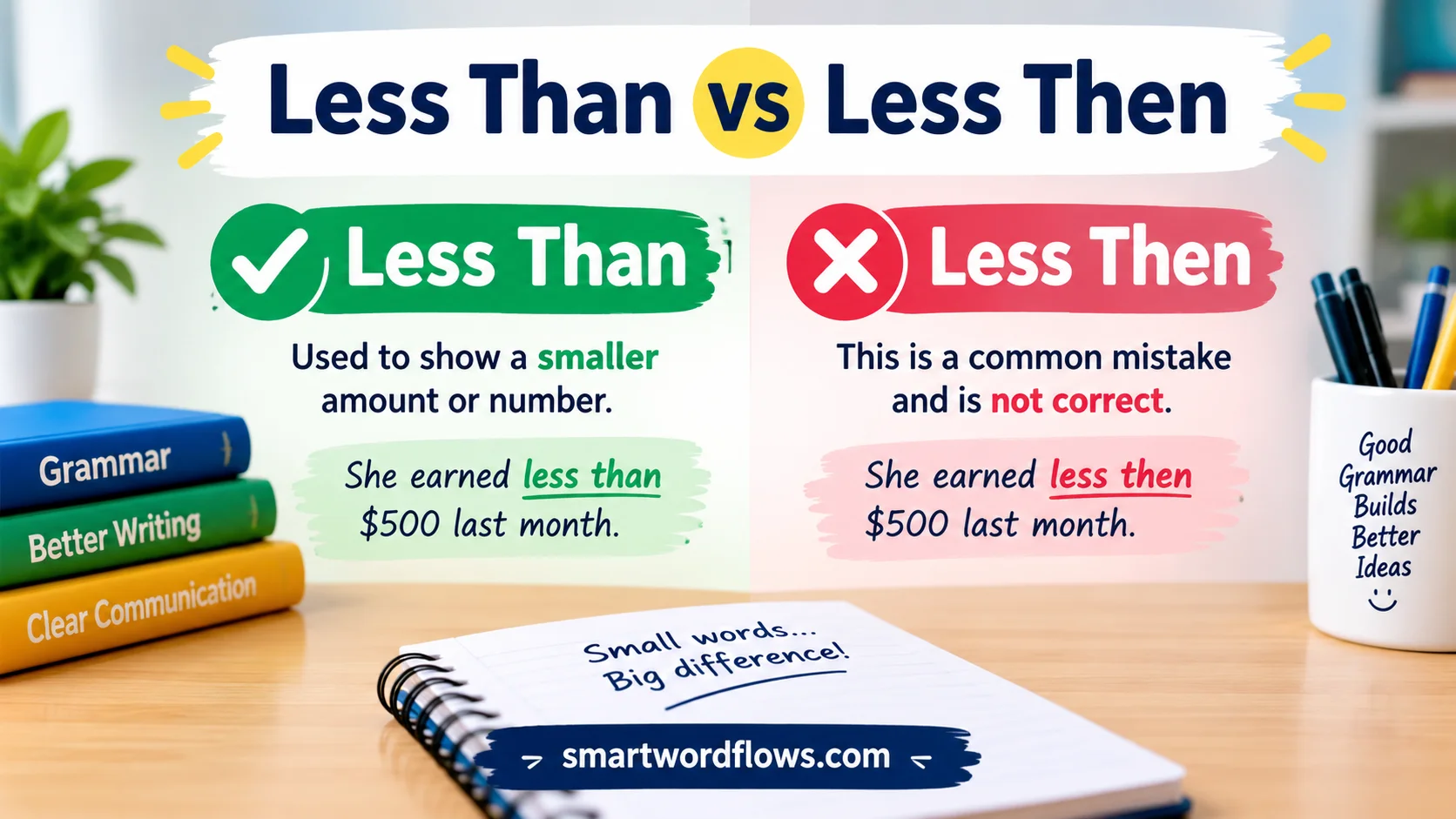

Less Than vs Less Then is a common English confusion because both expressions sound similar. However, less than is the correct phrase when making comparisons involving numbers, amounts, quantities, or values. It shows that one thing has a smaller amount than another. For example, “Five is less than ten” uses the phrase correctly. In contrast, less then is generally an incorrect spelling when you mean comparison. Learning this simple difference can help you avoid mistakes in everyday writing, schoolwork, and professional communication.
The word then has a different meaning and usually relates to time, sequence, or what happens next. For example, “Finish your work, then go home” shows an order of events. Meanwhile, than is commonly used after comparative words and helps explain differences between two things. Understanding the distinction between less than and less then becomes easier when you remember their roles. Use than for comparisons and then for sequence or time. This small grammar rule can make your writing more accurate and natural.
Quick Answer
The correct phrase for a comparison is less than.
Use less than when you mean that something has a smaller amount, number, value, measurement, degree, or duration than something else.
Examples:
- The meeting lasted less than an hour.
- She spent less than $30.
- The package weighs less than five pounds.
- Eight is less than ten.
- His response was less than helpful.
Then has a different job. It commonly refers to a particular time, the next event in a sequence, or a consequence.
Examples:
- I lived there then.
- Finish your homework, then watch TV.
- If you’re ready, then we can leave.
Therefore:
Less than = comparison
Then = time, sequence, or consequence
The spelling “less then” is normally incorrect when you mean “a smaller amount than.”
Comparison Overview
The easiest way to understand less than vs less then is to compare their meanings and grammatical roles.
| Expression | Main function | Example |
| less than | Makes a comparison | The car costs less than $20,000. |
| than | Introduces a comparison | She is taller than her brother. |
| then | Shows time | Things were different then. |
| then | Shows sequence | Eat breakfast, then leave. |
| then | Shows consequence | If that’s true, then we should go. |
| less then | Usually an incorrect spelling in comparisons | ❌ It costs less then $50. |
The critical difference comes down to than versus then.
When your sentence compares one thing with another, choose than. When your sentence talks about what happened at a particular time, what happens next, or what follows from a condition, choose then.
Main Differences Between Less Than vs Less Then
The biggest difference between less than vs less then lies in the words than and then.
Than is primarily a comparative word. It connects two things that differ in amount, degree, quality, size, or another measurable or observable way.
Then, by contrast, doesn’t introduce a comparison. It commonly establishes a relationship involving time, order, or consequence.
Consider these sentences:
- The blue bag costs less than the red bag.
- Buy the blue bag, then put it in the car.
The first sentence compares two prices. The second sentence puts two actions in order.
A Simple Difference Table
| Feature | Less Than | Then |
| Comparison | Yes | No |
| Time reference | No | Yes |
| Sequence | No | Yes |
| Consequence | No | Yes |
| Mathematical comparison | Yes | No |
| Typical meaning | Smaller than | At that time / next / in that case |
This distinction remains consistent even when the sentences become more complicated.
What Does “Less Than” Mean?
Less than is a comparative expression that indicates a smaller quantity, amount, value, degree, or measurement.
You can use it with both concrete and abstract ideas. For instance, you might compare the price of two products, the duration of two activities, or the quality of two performances.
Consider:
- The blue shirt costs less than the black shirt.
- The journey takes less than three hours.
- This solution requires less than half the effort.
- The result was less than impressive.
In each example, less than establishes a comparison.
Less Than in Mathematics
In mathematics, less than describes a value that falls below another value.
For example:
4 is less than 9.
The mathematical symbol is:
4 < 9
The symbol < means that the number on the left has a smaller value than the number on the right.
More examples include:
- 2 < 7
- 15 < 20
- 0.5 < 1
- −3 < 2
The phrase also appears in algebra:
- x < 10
- y < 100
- n < 50
If you read x < 10 aloud, you would say, “x is less than ten.”
Less Than With Time
People frequently use less than when describing how long something takes.
For example:
- The repair took less than two hours.
- The movie runs for less than 90 minutes.
- I’ll be there in less than ten minutes.
- The application takes less than five minutes to complete.
Here, less than compares a duration with a specific amount of time.
Less Than With Money
You can also use less than to compare prices, expenses, salaries, budgets, and other monetary values.
Examples include:
- The jacket costs less than $100.
- We completed the project for less than $5,000.
- She spent less than $20 on lunch.
- The subscription costs less than $10 per month.
Notice that than remains correct regardless of the currency or numerical value.
Less Than With Measurements
The expression works naturally with physical measurements.
You might say:
- The package weighs less than five pounds.
- The building is less than 100 feet tall.
- The lake is less than two miles away.
- The temperature dropped to less than 32°F.
- The cable is less than 20 feet long.
The measurement doesn’t matter. The comparison does.
Less Than With Qualities and Degrees
Less than doesn’t always compare numbers.
It can also express a lower degree of a quality or condition.
Examples include:
- His explanation was less than clear.
- The outcome was less than ideal.
- Her performance was less than impressive.
- The response was less than satisfactory.
This construction can sometimes carry a subtle negative meaning. For example, saying that someone’s explanation was less than clear politely suggests that the explanation wasn’t very clear.
What Does “Then” Mean?
Then usually relates to time, sequence, or consequence.
Unlike than, it doesn’t compare two things.
One common use refers to a specific time, especially a time already mentioned or understood from context.
For example:
- I didn’t know her then.
- Things were different then.
- We lived in Chicago then.
- He was working there then.
In these sentences, then means something close to “at that time.”
Then for Sequence
Another major use of then shows that one event follows another.
For example:
- First, read the instructions. Then, begin the exercise.
- She finished breakfast and then went to work.
- Turn left at the corner and then continue straight.
- Check the address, then send the package.
Here, then helps the reader understand the order of events.
Then for Consequences
You can also use then to express a consequence or result.
This often appears in an if-then construction.
For example:
- If the weather improves, then we’ll go outside.
- If you finish early, then you can leave.
- If the price increases, then customers may look elsewhere.
In these sentences, then introduces the result that follows the condition.
Why Do People Confuse “Than” and “Then”?
The confusion usually comes from similar pronunciation and spelling.
When people speak quickly, than and then can sound very similar. That similarity becomes especially noticeable in casual conversation.
Typing habits create another problem. Because the two words differ by only one letter, it’s easy to hit the wrong key without noticing.
The mistake can also become habitual. If someone frequently sees “less then” written incorrectly online, the incorrect version may start to look familiar.
However, familiarity doesn’t make the usage correct.
A useful rule is much more reliable than trying to remember how the words sound:
Ask yourself what the sentence is doing.
If it compares two things, use than.
If it describes what happens next, refers to a past time, or introduces a consequence, use then.
When to Use “Less Than”
You should use less than whenever you want to indicate that one thing has a smaller amount, value, degree, measurement, or duration than another.
Less Than With Numbers
Use it whenever one numerical value falls below another.
Examples:
- Seven is less than twelve.
- The score was less than 50 points.
- The temperature stayed less than 20 degrees.
- The company hired less than 100 employees.
- The final number was less than expected.
Less Than With Time
This construction frequently appears in schedules and everyday conversation.
Examples:
- The appointment lasted less than an hour.
- I’ll arrive in less than fifteen minutes.
- The process takes less than ten minutes.
- The store is less than a mile away.
- The course takes less than six months to complete.
Less Than With Money
Money comparisons also require than.
Examples:
- The meal cost less than $25.
- The repair was less than $500.
- The phone costs less than $300.
- We spent less than our original budget.
- The ticket was less than I expected.
Less Than With Degrees or Qualities
You can use the phrase when describing something that falls below an expected standard.
Examples:
- The service was less than excellent.
- His answer was less than convincing.
- The results were less than satisfactory.
- The explanation was less than helpful.
- The situation became less than comfortable.
When to Use “Then”
Use then when you aren’t making a comparison.
Then for Past Time
Then can point to a particular period in the past.
Examples:
- I was younger then.
- She lived in Boston then.
- We didn’t understand the problem then.
- Things looked very different then.
Then for the Next Action
Use then when one action follows another.
Examples:
- Pack your bag, then lock the door.
- Read the question, then choose your answer.
- Finish the report, then send it to the manager.
- Turn off the oven, then leave the kitchen.
Then for a Result
In conditional statements, then can introduce the result.
Examples:
- If you need help, then call the office.
- If the machine stops, then press the reset button.
- If demand rises, then prices may increase.
Also Read This: Chris’s vs. Chris’: Complete Guide and Explanations
Is “Less Then” Ever Correct?
The phrase “less then” is generally incorrect when you’re trying to write the comparative expression “less than.”
For example:
❌ The box weighs less then ten pounds.
✅ The box weighs less than ten pounds.
The problem isn’t the word less. The problem is using then where the comparison requires than.
That said, the words less and then can appear independently within a longer sentence.
For example:
I had less time then because the meeting started earlier.
Here, less and then perform separate grammatical jobs. Then refers to a particular time. It isn’t replacing than.
So don’t treat the two-word sequence itself as an impossible combination. Instead, examine whether then actually expresses time, sequence, or consequence.
Less Than vs. Less Then Examples
The following examples make the distinction especially clear.
| Incorrect | Correct | Explanation |
| ❌ The bag costs less then $50. | ✅ The bag costs less than $50. | This sentence compares price. |
| ❌ The trip takes less then an hour. | ✅ The trip takes less than an hour. | This sentence compares duration. |
| ❌ Eight is less then ten. | ✅ Eight is less than ten. | This is a mathematical comparison. |
| ❌ She spent less then expected. | ✅ She spent less than expected. | The sentence compares actual spending with an expectation. |
| ❌ The package weighs less then five pounds. | ✅ The package weighs less than five pounds. | This compares weight. |
| ❌ Complete the form, than submit it. | ✅ Complete the form, then submit it. | This sentence shows sequence. |
| ❌ I lived there than. | ✅ I lived there then. | This refers to a particular time. |
Common Sentence Patterns With “Less Than”
Learning a few common patterns can make the correct choice almost automatic.
Less Than + Number
The store has less than 50 employees.
Less Than + Amount
The repair cost less than $200.
Less Than + Measurement
The bridge is less than one mile long.
Less Than + Time Period
The process takes less than 30 minutes.
Less Than + Adjective
The result was less than perfect.
Less Than + Expected Amount
The final cost was less than expected.
These structures appear frequently in business writing, academic work, technical documents, advertisements, news writing, and ordinary conversation.
Common Mistakes to Avoid
Several mistakes tend to appear alongside less than vs less then confusion.
Using Then in a Comparison
This is the most common error.
❌ The phone costs less then $500.
✅ The phone costs less than $500.
Using Than for Sequence
The reverse mistake happens too.
❌ Finish the report, than send it.
✅ Finish the report, then send it.
The sentence doesn’t compare anything. It describes two actions in order.
Confusing Less Than With Fewer Than
This is a separate issue, but it’s worth understanding.
In traditional standard usage, fewer than generally works with countable plural nouns.
- fewer than 20 students
- fewer than 10 cars
- fewer than 100 pages
Less than generally works with amounts, measurements, time, money, and uncountable nouns.
- less than 20 minutes
- less than $50
- less than five pounds
- less than enough water
English usage contains established exceptions, especially with measurements and quantities treated as single amounts. Still, the less/fewer distinction provides a useful general guide.
Less Than vs. Fewer Than
Because these phrases often appear together, it’s helpful to separate them.
| Expression | Typical use | Example |
| less than | Amounts, measurements, time, money, degree | It took less than an hour. |
| fewer than | Countable plural items | Fewer than ten people attended. |
Compare these sentences:
- We spent less than $100.
- We had fewer than 100 customers.
Money represents an amount, while customers represent individual countable people.
Another pair makes the distinction even clearer:
- The project took less than five weeks.
- The project involved fewer than five workers.
The first sentence concerns a duration. The second counts individual people.
Less Than vs. More Than
More than expresses the opposite comparison from less than.
| Less Than | More Than |
| below a particular amount | above a particular amount |
| The box weighs less than 10 pounds. | The box weighs more than 10 pounds. |
| She spent less than $50. | She spent more than $50. |
| The journey takes less than an hour. | The journey takes more than an hour. |
In mathematics, the relationship is equally straightforward:
- 4 < 9 means four is less than nine.
- 9 > 4 means nine is greater than four.
A Simple Grammar Test
When you’re unsure whether to use than or then, stop and ask what relationship the sentence expresses.
Are You Comparing Something?
Use than.
This laptop is cheaper than that one.
The project took less time than expected.
Are You Showing What Happens Next?
Use then.
Finish this task, then start the next one.
Are You Referring to a Particular Time?
Use then.
I didn’t understand the issue then.
Are You Showing a Consequence?
Use then.
If the data is accurate, then the conclusion makes sense.
This four-question test catches most mistakes immediately.
Easy Ways to Remember Than vs. Then
A simple memory trick can save you from repeatedly checking the spelling.
Than = Comparison
Think:
Than → comparison
You use than when you compare things.
- smaller than
- larger than
- faster than
- slower than
- better than
- less than
- more than
Then = Next or Time
Think:
Then → next
You use then when something happens afterward.
- First this, then that.
- We lived there then.
- If this happens, then do that.
A quick mental shortcut works well:
If you can replace the word with “compared with,” choose “than.”
For example:
The price is less than $100.
The sentence makes a comparison, so than fits.
If you can replace the word with “after that,” you’re probably looking for then.
Finish dinner, then leave.
“Finish dinner, after that leave” captures the basic relationship.
Less Than vs. Less Then in Formal Writing
Correct word choice matters even more in formal writing because small errors can distract readers from your main point.
In a professional report, for example:
❌ The project required less then 40 hours.
The typo doesn’t make the meaning impossible to understand. However, it makes the sentence look careless.
The polished version is:
✅ The project required less than 40 hours.
This distinction matters in:
- Academic papers
- Business reports
- Professional emails
- Resumes and cover letters
- Technical documentation
- Research papers
- Presentations
- Marketing materials
A single spelling mistake won’t necessarily ruin good writing. Still, consistently choosing the correct word makes your work cleaner and more credible.
Less Than vs. Less Then in Everyday Conversation
In casual speech, people usually understand the intended meaning from context.
If someone says:
“It’ll take less than ten minutes.”
The comparison is obvious.
However, speech doesn’t help much when you’re writing because than and then can sound quite similar in fast conversation.
That’s why visual recognition matters.
When writing, train yourself to notice the function rather than relying on pronunciation. If the sentence compares two quantities, than is the safe choice.
Case Study: A Small Word With a Big Difference
Imagine you’re writing instructions for a customer:
“The setup should take less then 15 minutes. Finish the installation, than restart the device.”
There are two word-choice errors in that short passage.
The corrected version is:
“The setup should take less than 15 minutes. Finish the installation, then restart the device.”
The first sentence compares the setup time with 15 minutes. Therefore, it needs than.
The second sentence gives the order of two actions. Therefore, it needs then.
This example shows why context matters more than appearance. The words look almost the same, but they perform completely different jobs.
Practice: Choose “Than” or “Then”
Test yourself with these sentences.
Choose either “than” or “then.”
- The package arrived less ___ an hour later.
- Finish the dishes, ___ clean the kitchen.
- Seven is less ___ eleven.
- Things were different ___.
- The repair cost less ___ $300.
- If you’re ready, ___ we can begin.
- She completed the task faster ___ expected.
- He lived there ___.
- The journey took less ___ three hours.
- Read the instructions, ___ press the button.
- The temperature stayed less ___ 40°F.
- If the first method fails, ___ try the second one.
Answer Key
- than
- then
- than
- then
- than
- then
- than
- then
- than
- then
- than
- then
The pattern becomes clear once you look at what each sentence expresses.
Comparisons require “than.” Sequence, time, and consequences generally require “then.”
FAQs :
1. Is “less than” or “less then” correct?
Less than is correct when comparing two numbers, amounts, quantities, or values. “Less then” is usually an incorrect form in this context.
2. What does “less than” mean?
Less than means that one amount or value is smaller than another. For example, “10 is less than 20.”
3. When should I use “then”?
Use then when talking about time, sequence, or the next action. For example, “Finish your homework, then watch TV.”
4. Why do people confuse “than” and “then”?
People often confuse them because than and then look and sound very similar. Their meanings, however, are different.
5. How can I remember the difference?
Remember this simple rule: than = comparison, while then = time or sequence. This makes it easier to choose the correct word.
Conclusion :
Understanding Less Than vs Less Then is simple once you remember their different purposes. Use less than when comparing amounts, numbers, or values, and use then when describing time or a sequence of events. Keeping this rule in mind will help you avoid common spelling and grammar mistakes and make your writing clearer and more accurate.