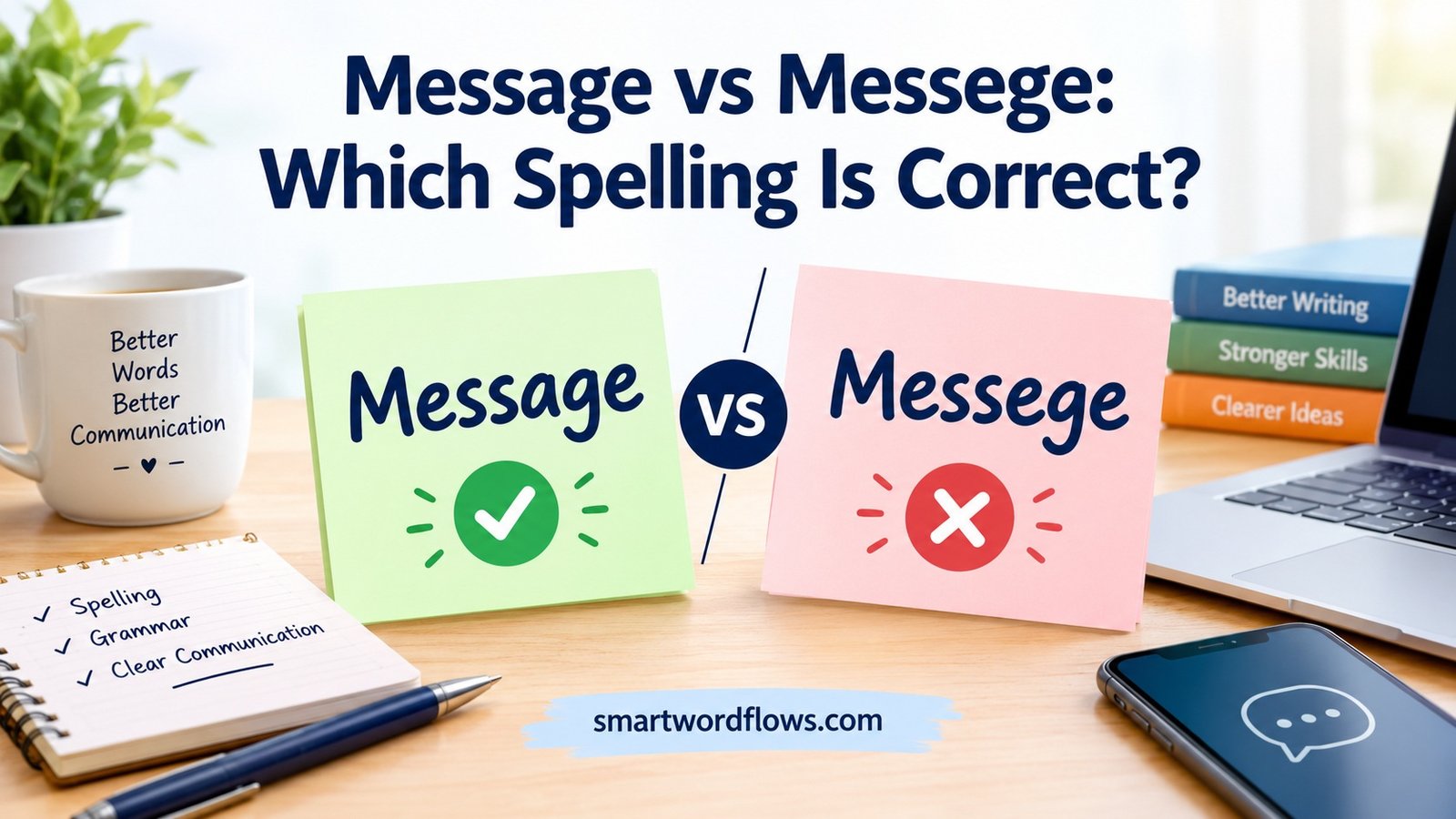

Message vs Messege: Which Spelling Is Correct? helps you avoid common spelling confusion and choose the right form in clear English writing. In modern communication, words have immense power, so a simple misspelling can alter the entire meaning of a message and cause confusion.
A common dilemma is whether to use messege or message, but this language quandary is easy to clarify once you know the correct spelling. Message is the correct form, whereas messege is the wrong spelling. From my experience with daily writing, this spelling confusion happens because these similar words have a similar sound. In the English language, remembering the exact word form is the simplest way to clear it up. The spelling issue matters because effective communication relies on clear meaning, correct spelling, and strong writing skills. The Message vs Messege difference can be seen in the writing of students, workers, learners, professionals, English learners, fast typists, and native speakers. Anyone may misspell the word in a text, email, text messages, assignments, or social media posts. Typical spelling mistakes often result from a memory slip, the sound of a word, or fast writing instead of remembering the standard spelling. In the digital world, messenger, Whats App, SMS, emails, online chats, and other platforms encourage rapid communication, so hurried typing mistakes and fast keyboard use can cause users to make errors. These errors appear in written communication, email communication, digital communication, and text-based communication, which can affect writing precision and communication effectiveness.
In both formal writing and informal writing, choosing the correct versions, usage, contexts, and phrases helps keep communication clear. For example, you can tell your manager, “I sent a message,” or ask someone to “message me later.” When people search for message or messege, how to spell message correctly, or which is correct message or messege, the quick answer is message. A friendly guide can explain its meanings, practical ways, and practical examples to build confidence. The Messege or Message question is another common spelling question in English, and people may confuse the correct version with the spelling suggested by its sound. A comparison table, sentence examples, and real sentence examples can help you remember the correct form. It’s also useful to understand message vs. massage because these words are sometimes confused. A message is information sent to someone, while a massage is a physical treatment. This common confusion makes the distinction a useful comparison when learning English.
Quick Answer: Message vs Messege
Message is the correct spelling.
Messege is incorrect in standard English and should generally be corrected to message.
| Spelling | Correct? | Meaning | Example |
| Message | ✅ Yes | A communication or information sent to someone | I received your message. |
| Messege | ❌ No | No standard English meaning | I received your messege. ❌ |
The correct spelling contains -sage:
M-E-S-S-A-G-E
The incorrect form changes the final part to -sege:
M-E-S-S-E-G-E
That small difference creates the entire spelling problem.
For example:
- Correct: Please send me a message.
- Incorrect: Please send me a messege.
If you’re writing in standard American English, academic English, business English, or everyday digital communication, use message.
Comparison Overview
The easiest way to understand message vs messege is to compare their spelling, meaning, grammar, and practical use.
| Feature | Message | Messege |
| Standard spelling | Yes | No |
| Dictionary word | Yes | No |
| Noun | Yes | No |
| Verb | Yes | No |
| Plural form | messages | Incorrect |
| Past tense | messaged | Incorrect |
| Present participle | messaging | Incorrect |
| Common in emails | Yes | No |
| Common in texting | Yes | No |
| Suitable for professional writing | Yes | No |
| Standard American English | Yes | No |
The distinction is straightforward. Message is an established English word with several grammatical uses. Messege is simply a spelling error when someone intends to write message.
That distinction matters because spelling errors can affect how polished your writing appears. A single typo usually doesn’t prevent readers from understanding you. Still, repeated errors can distract from your ideas.
Main Differences Between Message vs Messege
The biggest difference between message vs messege is simple: message is correct and messege is incorrect.
Yet there’s more worth understanding because message has a surprisingly broad range of uses.
Message Is the Correct Spelling
The standard spelling is:
message
The word contains two s letters near the beginning and ends with -age.
For example:
- I left a message on your desk.
- She sent me a message yesterday.
- The teacher asked us to understand the message of the story.
- You can message me after work.
Notice that the spelling stays recognizable across these examples even though the word performs different grammatical roles.
Messege Is a Misspelling
Messege isn’t the standard spelling of the English word.
People commonly create this error because the word’s pronunciation doesn’t make every letter obvious. When typing quickly, you might remember the general shape of the word while accidentally placing e where a belongs.
For example:
❌ I sent you a messege.
The corrected version is:
✅ I sent you a message.
The difference looks tiny. In formal writing, however, the correct form matters.
Message Can Be a Noun and a Verb
Another important distinction involves grammar.
As a noun, message refers to communication or information:
Your message was helpful.
As a verb, message means to communicate with someone by sending a message:
I’ll message you tonight.
This flexibility explains why you encounter the word so often in modern English.
Message: Definition and Meaning
What Does Message Mean?
A message is information, an idea, or communication that someone sends or communicates to another person or group.
The communication can take many forms. It might be written on paper, spoken aloud, delivered electronically, or communicated through an online platform.
For example:
- She left a message for her brother.
- The manager sent a message to the staff.
- The advertisement has a clear message.
- The story delivers a powerful message.
The word therefore has a wider meaning than simply “text.”
Message as a Noun
As a noun, message commonly refers to something communicated to another person.
Consider these examples:
- A friend sends you a text.
- A customer leaves a voicemail.
- A manager emails an employee.
- A person writes a note.
- A speaker communicates an important idea.
All of these can involve a message.
The word can also describe the main idea behind something. For instance, a novel may have a message about courage or friendship.
Message as a Verb
English also uses message as a verb.
When someone says:
Message me when you arrive.
They mean:
Send me a message when you arrive.
This usage has become especially common because digital communication has made messaging a routine activity.
You might see phrases such as:
- Message me on the app.
- I’ll message you later.
- She messaged her friend.
- They were messaging all evening.
The verb follows ordinary English patterns:
message → messaged → messaging
Why Is “Message” the Correct Spelling?
The spelling message comes from the established English form of the word. It isn’t a spelling created specifically for modern texting or smartphones.
The word has a long history in English and ultimately traces back through French to Latin. Its historical development explains why its spelling doesn’t always feel perfectly intuitive to modern English speakers.
English contains many words whose spelling reflects their history rather than their pronunciation alone.
That’s why relying entirely on sound can lead you astray.
When you hear message, the final vowel sound doesn’t necessarily tell you whether the written ending should contain a or e. Learning the standard written form solves the problem.
The Correct Letter Pattern
Break message into manageable parts:
mes + sage
The final part is sage, not sege.
That gives you a useful visual reminder:
mes + sage = message
You don’t need to memorize complicated linguistic rules. Recognizing the correct letter pattern is usually enough.
Messege: Why Is It Incorrect?
The spelling messege doesn’t represent an accepted standard spelling of message.
It’s usually a typographical or spelling error.
Several factors can cause it.
Fast Typing
When people type quickly, they often rely on muscle memory rather than consciously checking every letter.
A familiar word can therefore come out slightly wrong.
Pronunciation Confusion
English spelling and pronunciation don’t always match perfectly. Someone who learns the word primarily through conversation may know exactly what it means while still being uncertain about its written form.
Visual Similarity
Message and messege look almost identical.
That makes the incorrect form particularly easy to overlook during proofreading.
Memory-Based Spelling
You might remember that the word contains several e letters. That general memory can lead you toward messege, even though the correct spelling uses a before the final g.
How to Spell Message Correctly
The simplest approach is to focus on the final portion.
Remember “-sage”
The correct spelling ends in:
-sage
So:
message
not:
messege
You can also visualize the word as:
M E S S A G E
The A comes before G.
That one detail is often enough to prevent the error.
Use the Word in Sentences
Spelling becomes easier when you repeatedly see a word in context.
Try these examples:
- I received your message.
- Please read the message carefully.
- She sent a message to her manager.
- I’ll message you after lunch.
- The book has an important message.
Rather than memorizing isolated letters, connect the spelling with meaning and usage.
A Simple Memory Trick for Message
Here’s an easy trick:
Message has “sage” at the end.
Think:
mes + sage = message
The word sage is itself a familiar English word. Associating the ending with something recognizable can make the spelling easier to recall.
Another useful visual reminder is:
message = mess + age
The final four letters are age, not ege.
That gives you two possible memory anchors:
- mes + sage
- mess + age
Both point toward the correct spelling.
Message in Different Contexts
The word message appears in far more situations than texting.
Message in Everyday Communication
In everyday conversation, a message can be a note, phone communication, reminder, or piece of information.
Examples include:
- There’s a message for you.
- Did you get my message?
- I’ll leave a message.
- She passed along your message.
The context determines the exact type of communication.
Message in Professional Writing
Businesses use messages constantly.
You might encounter the word in:
- Emails
- Customer support
- Internal communications
- Meeting reminders
- Business letters
- Workplace applications
- Company announcements
For example:
Please send your message to the customer service team.
A spelling mistake such as messege can make otherwise professional communication look rushed.
Message in Technology
Modern technology has expanded the everyday meaning of message.
People now send messages through:
- Text messaging
- Social media
- Workplace collaboration platforms
- Online chat
- Customer support systems
- Mobile applications
In these settings, message can describe both the communication itself and the act of sending it.
Message in General Writing
The word also has a broader, more abstract meaning.
A movie can have a message.
A speech can have a message.
A political campaign can communicate a message.
A novel can contain a message about society or human behavior.
For example:
The central message of the story is that honesty builds trust.
Here, message doesn’t mean a text or email. It means the main idea the writer wants the audience to understand.
Read More:Whose vs Who’s: Which One Is Correct?
Common Sentences Using Message
Seeing the correct word in different contexts makes the distinction easier to remember.
Message as a Noun
- I received your message this morning.
- She left a message on my phone.
- The teacher wrote a message for the parents.
- His message was short but clear.
- We need to understand the message behind the advertisement.
- Did you read the message I sent yesterday?
Message as a Verb
- Message me when you get home.
- I’ll message you after the meeting.
- She messaged her brother about the appointment.
- You can message the support team through the website.
- They messaged each other throughout the afternoon.
Incorrect Examples
These sentences use the common misspelling:
- ❌ I received your messege.
- ❌ Please messege me later.
- ❌ She sent a messege to the manager.
Correct versions:
- ✅ I received your message.
- ✅ Please message me later.
- ✅ She sent a message to the manager.
Common Mistakes With Message
Writing “Messege” Instead of “Message”
This is the main spelling problem.
The incorrect version replaces the a in message with e.
Remember:
message ✅
messege ❌
Confusing Spelling With Pronunciation
English pronunciation doesn’t always provide a perfect guide to spelling.
If you only hear the word, you might not know which vowel belongs in the written form. That’s why visual familiarity matters.
Reading the correct spelling repeatedly can strengthen your memory.
Using Inconsistent Spelling
Professional writers should maintain consistent spelling throughout a document.
Imagine reading a customer-service email containing:
Thank you for your messege. We have received your messege and will respond soon.
The meaning remains understandable. However, the repeated misspelling makes the communication appear less polished.
One quick proofreading pass could fix the problem.
Message: Related Word Forms
The word message has several common forms.
| Word form | Function | Example |
| message | Noun/verb | I sent a message. |
| messages | Plural noun/third-person verb | She sends messages daily. |
| messaged | Past-tense verb | He messaged me yesterday. |
| messaging | Present participle/gerund | They are messaging now. |
Messages
The plural form is messages.
For example:
I have several messages waiting for me.
Notice that the base spelling remains message before the plural ending.
Messaged
The past tense is messaged:
She messaged me last night.
The spelling retains the original message before adding the past-tense ending.
Messaging
The present participle is messaging:
They are messaging each other.
This form drops the final e before adding -ing, following a common English spelling pattern.
Compare:
message → messaging
That change is normal. It doesn’t mean the original word is spelled messege.
Message vs Similar Words
Understanding related words can prevent another kind of confusion: using a correct word in the wrong context.
Message vs Memo
A memo is usually a short written communication, especially in a workplace or organization.
A message has a much broader meaning.
For example:
- The manager sent a memo to the entire department.
- I left a message for the manager.
A memo often has a formal organizational purpose. A message can be formal, informal, personal, digital, spoken, or abstract.
Message vs Note
A note usually refers to a short written communication or piece of information.
For example:
She left a note on the kitchen table.
A message can also be written down, but it doesn’t have to be.
You can send a message electronically or communicate a message through speech.
Message vs Text
Text can refer specifically to a text message or the act of sending one.
For example:
I’ll text you later.
You could also say:
I’ll message you later.
The two expressions often overlap in modern communication. However, message has a broader meaning and isn’t limited to SMS or phone texting.
Message vs Messenger
These words are related but aren’t interchangeable.
A message is the communication.
A messenger is someone or something that delivers communication.
For example:
The messenger delivered the message.
The distinction becomes particularly clear in historical contexts where a person physically carried messages between locations.
How to Avoid the “Messege” Spelling Mistake
A few simple habits can make this error much less likely.
Remember the “-sage” Ending
The strongest spelling reminder is:
message ends with -sage.
Don’t change that ending to -sege.
Read the Word Regularly
Frequent exposure strengthens visual memory.
When you read:
- message
- messages
- messaged
- messaging
your brain gradually becomes more familiar with the correct pattern.
Use Spell-Check Wisely
Spell-checkers can catch messege in many applications.
Still, don’t depend entirely on automatic correction. Some tools may miss unusual errors or fail to catch mistakes when a misspelled word happens to resemble another valid word.
Proofread Important Writing
Take a few seconds to check important emails, applications, assignments, and business documents.
Look especially carefully at words you tend to mistype.
A tiny proofreading habit can prevent an avoidable spelling error from reaching your reader.
Message vs Messege: A Practical Case Study
Consider two customer-service emails.
Version A
Thank you for your messege. Our team has received your request and will contact you soon.
The reader can understand the email immediately. However, messege is visibly incorrect.
Version B
Thank you for your message. Our team has received your request and will contact you soon.
The second version uses the standard spelling and creates a more polished impression.
The lesson isn’t that one typo ruins communication. It doesn’t. The lesson is that correct spelling supports clarity and credibility, especially when you communicate professionally.
Is “Messege” Ever Correct?
For the ordinary English word meaning a communication or piece of information, messege isn’t the correct spelling.
If you’re writing standard English, use message.
A username, fictional name, product name, or other proper name could theoretically contain unusual spelling. Such a special use wouldn’t turn messege into the standard spelling of the English word.
So if you mean a communication, write:
message
Not:
messege
Why Do People Spell Message as Messege?
This mistake is understandable because several features make message slightly tricky.
First, the pronunciation doesn’t provide a perfect letter-by-letter guide. English contains many words where spelling and pronunciation don’t line up neatly.
Second, message contains multiple letters that appear in quick succession. When you’re typing quickly, your fingers may reproduce an incorrect vowel pattern.
Third, the incorrect version still looks believable.
Compare them visually:
message
messege
At a glance, the difference is only one letter. That’s precisely why proofreading matters.
Message vs Messege in Digital Communication
Digital communication has made message one of the most frequently encountered everyday words.
People send messages through phones, websites, social platforms, workplace tools, and customer-service systems.
You might see phrases such as:
- Send a message
- New message
- Message received
- Message request
- Message history
- Delete message
- Unread messages
- Message notifications
These phrases all use message, never messege, in standard English.
The digital age hasn’t changed the spelling. It has simply increased how often people use the word.
Why Correct Spelling Matters
A spelling mistake doesn’t always create confusion. Most readers will understand messege from context.
Still, correct spelling has practical benefits.
It Improves Readability
Correctly spelled words let readers focus on your ideas rather than your errors.
It Looks More Professional
Business communication often represents an individual, company, or organization.
Small details can influence how polished a message appears.
It Helps Academic Writing
Students encounter the word in essays, reports, presentations, and assignments.
Using the standard spelling avoids an unnecessary error.
It Builds Strong Writing Habits
Learning one troublesome word can help you develop better proofreading habits overall.
When you learn to spot small spelling differences, you’ll often become more attentive to other commonly confused words.
Message vs Messege: Common Questions
Is “message” or “messege” correct?
Message is correct. Messege is a misspelling.
Why do people write “messege”?
People commonly make this error because message can be difficult to spell from pronunciation alone. Fast typing and visual similarity can also contribute to the mistake.
Is “messege” an English word?
No. Messege isn’t the standard spelling of the English word message.
How do you spell message?
Spell it:
M-E-S-S-A-G-E
The key point to remember is the a before g.
Can “message” be a verb?
Yes. Message works as both a noun and a verb.
For example:
- Noun: I received your message.
- Verb: I’ll message you tonight.
What is the plural of message?
The plural is messages.
Example:
I have three new messages.
What is the past tense of message?
The past tense is messaged.
Example:
She messaged me yesterday.
What is the difference between message and text?
A text can refer specifically to a text message. Message has a broader meaning and can describe many forms of communication.
Final Takeaway: Message vs Messege
When it comes to Message vs Messege, message is the correct spelling in standard English. It refers to information, communication, or a piece of content sent from one person to another. You can use it when talking about text messages, emails, notes, social media posts, or workplace communication. Messege is a common spelling mistake and should be avoided in formal and everyday writing. Remembering the correct spelling can help you communicate clearly and make your writing look more professional.
If you often confuse these two spellings, focus on the correct form: message. A simple way to remember it is to notice the “ss” in the middle of the word. Whether you are writing a quick text or an important business email, choosing message will always be the safe and correct choice.




1 thought on “Message vs Messege: Which Spelling Is Correct?”