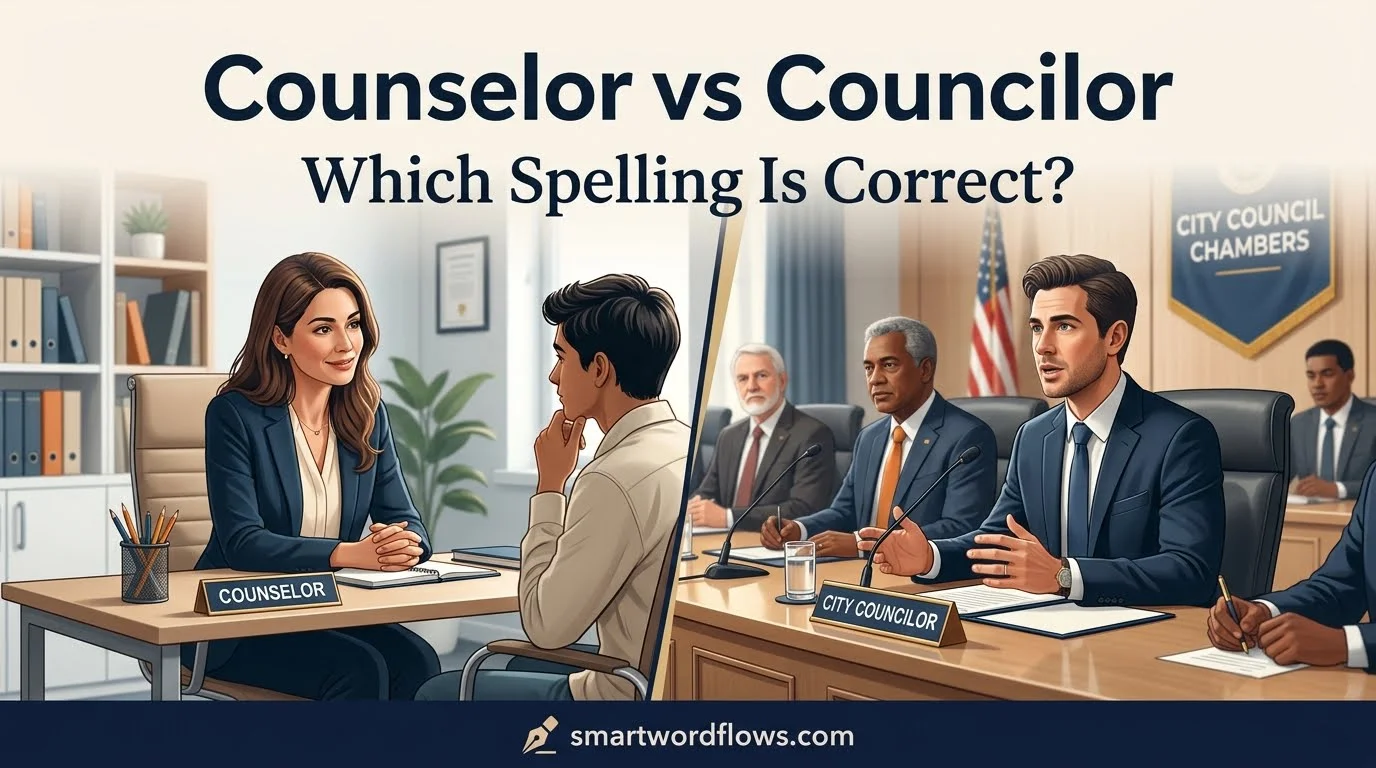

Counselor vs Councilor: Which Spelling Is Correct? Learn how these similar words differ in meaning, usage, and American and British English. These confused words look almost identical and sound the same in many varieties of English, but they describe different roles. Their definitions, word meanings, and uses depend on context.
A counselor provides advice, guidance, and support, while a councilor serves as a member of a council and may work in local government. A school counselor helps students with classes and school guidance, whereas a mental health counselor supports people facing personal challenges. A city councilor may attend public meetings, discuss community issues, and vote on local decisions. Understanding this distinction improves word choice and writing accuracy in the English language. The spelling differences reflect regional spelling practices: American English generally uses counselor and councilor, while British English commonly uses counsellor for someone in the counseling profession and councillor for a council member. These American spelling and British spelling conventions demonstrate linguistic variation and broader language differences. To strengthen your vocabulary, grammar, and usage, consider the contextual meaning of each word. The counselor definition relates to personal advice and guidance, while the councilor definition relates to public service and government.
Example sentences make the difference easier to understand: “The counselor helped me manage stress” describes personal guidance, while “The councilor discussed plans for the community” refers to local government. Instead of memorizing complicated grammar rules, use this word comparison to connect each word with its root and purpose. The word counselor relates to counsel, meaning advice, while councilor identifies someone who belongs to a council. This memory trick makes the spelling distinction easier to remember and helps you choose the correct spelling when you write. Although counselor and counsellor share the same meaning, their spelling follows different regional conventions. Likewise, councilor and councillor refer to council members, with the preferred form depending on the region. These simple methods improve correct usage across different forms of English spelling and terminology. When you explore these words, examine the surrounding sentence rather than relying on appearance alone. This approach reduces confusion, helps writers avoid the wrong word, and prevents spelling choices from changing the meaning of a sentence.
Quick Answer
Both counselor and councilor are correct American English spellings, but they have different meanings.
- Counselor: A person who provides advice, guidance, or counseling. Example: The school counselor helped Mia choose her college courses.
- Councilor: A person who serves on a council, such as a city or town council. Example: The councilor proposed a new public park.
The easiest way to remember the distinction is to look at the root words:
- Counsel relates to advice, guidance, or legal representation.
- Council refers to a group that meets to discuss issues or make decisions.
Therefore, choose counselor when discussing guidance and councilor when discussing council membership. If you’re writing for a British audience, remember the alternative spellings counsellor and councillor.
Comparison Overview
Although counselor and councilor differ by only one letter, their meanings and uses are distinct. The following table highlights their main differences.
| Feature | Counselor | Councilor |
| Meaning | A person who provides advice or guidance | A member of a council |
| Root word | Counsel | Council |
| Main purpose | To advise, guide, support, or counsel | To participate in group decisions and represent interests |
| Common settings | Schools, counseling centers, workplaces, camps, and legal contexts | City halls, town councils, and other council-based organizations |
| American English spelling | Counselor | Councilor |
| Common British English spelling | Counsellor | Councillor |
| Example | The counselor helped the student manage stress. | The councilor attended a meeting about road repairs. |
| Related words | Counseling, counsel, counselor-at-law | Council, council meeting, city council |
The key difference lies in what the person does. A counselor helps someone address a question, problem, or personal need. A councilor participates in the work of a council.
For example, imagine a town that wants to improve its public schools. A school counselor might help students choose suitable classes or access support services. A city councilor might discuss the town’s budget and vote on a proposal affecting school facilities.
Both people may contribute to their community, but they perform different jobs. Their titles aren’t interchangeable.
Main Differences Between Counselor vs Councilor
What Does Counselor Mean?
A counselor is someone who offers advice, guidance, or support to help another person make decisions, solve problems, or handle a particular situation. The exact responsibilities depend on the counselor’s profession and workplace.
The word comes from counsel, which refers to advice or guidance. When you counsel someone, you help that person consider a situation, understand available options, or work toward a solution.
Counselors work in many fields. Some focus on education, while others help people manage career choices, personal challenges, or emotional difficulties.
Here are several common types of counselors:
- School counselor: Helps students with academic planning, educational goals, and relevant personal or social concerns.
- Career counselor: Helps people explore career paths, prepare for job searches, and make informed employment decisions.
- Mental health counselor: Provides professional support for emotional, behavioral, and mental health concerns within their qualifications and scope of practice.
- Camp counselor: Supervises campers, organizes activities, and helps maintain a safe and supportive environment.
- Substance use counselor: Supports people dealing with substance-related problems and recovery goals, according to their training and professional scope.
- Legal counselor: Provides legal advice or guidance. In some contexts, counselor-at-law is a formal or traditional term for an attorney.
The word doesn’t describe one specific qualification or license. For example, a camp counselor and a licensed mental health counselor may both use the title, but their training, duties, and professional requirements differ.
Examples of counselor in sentences:
- The school counselor helped Jordan explore scholarship opportunities.
- After several career changes, Elena consulted a career counselor.
- The camp counselor organized a nature walk for the children.
- The couple met with a marriage counselor to discuss communication problems.
- The attorney served as legal counselor during the negotiations.
In each example, the person offers guidance, support, supervision, or professional advice rather than serving as a member of a council.
What Does Councilor Mean?
A councilor is a person who serves as a member of a council. A council is an organized group that meets to discuss matters, represent interests, develop policies, or make decisions within its authority.
The word comes from council, not counsel. In American English, councilor commonly refers to an elected or appointed member of a local governing body, such as a city council.
A councilor’s responsibilities depend on the organization. In local government, those duties may involve public services, budgets, land use, transportation, community facilities, and other municipal issues.
Common contexts include:
- City councilor: Participates in municipal government and considers local policies.
- Town councilor: Helps address issues affecting a town or its residents.
- Student councilor: In some institutions, serves on a student council or representative body.
- Councilor in an organization: Participates in a formal council that oversees or advises on specific matters.
The exact title varies by jurisdiction. Some places use council member, councillor, or another official designation instead. Always follow the organization’s preferred title when writing about a particular person.
Examples of councilor in sentences:
- The councilor listened to residents’ concerns about traffic congestion.
- A city councilor proposed improvements to the neighborhood playground.
- The councilor asked questions about the proposed municipal budget.
- Several councilors attended the public hearing.
- Residents contacted their councilor about damaged sidewalks.
Notice that these examples involve council membership, public representation, or participation in formal discussions. None describes a person whose primary role is to provide individual counseling.
Counselor vs Councilor: The Difference in Meaning
The simplest way to distinguish these words is to examine their roots. Although the spellings look similar, counsel and council carry different meanings.
Counsel means advice, guidance, or legal representation. It can also function as a verb meaning to advise someone.
For example:
- The counselor offered practical advice about college applications.
- Her attorney provided legal counsel before the hearing.
- The teacher counseled the student about study habits.
Council means an organized group that meets to discuss matters or make decisions.
For example:
- The city council approved funding for street repairs.
- The council held a public meeting on Tuesday.
- The councilor presented residents’ concerns to the council.
A useful memory trick is to connect the last part of each word to its meaning:
- A counselor offers counsel.
- A councilor serves on a council.
This distinction remains the same whether you’re writing a school report, a workplace email, a news article, or a formal document.
Counselor vs Councilor Example Sentences
Examples make the distinction easier to recognize because they show how each word works in everyday writing.
Examples of Counselor
| Sentence | Why counselor is correct |
| The counselor helped the student select suitable classes. | The person provides academic guidance. |
| Maria visited a career counselor before changing jobs. | The person advises clients about career decisions. |
| The counselor encouraged the family to discuss their concerns openly. | The person provides counseling support. |
| Our camp counselor planned games for the afternoon. | The person supervises and guides campers. |
| The defendant spoke with legal counsel before the trial. | Counsel refers to legal advice or representation. |
The last example uses counsel, not counselor. It’s included to illustrate the related root word and its legal meaning.
Examples of Councilor
| Sentence | Why councilor is correct |
| The councilor supported a proposal to repair the local library. | The person participates in council decisions. |
| Residents invited their councilor to a neighborhood meeting. | The person represents a community within a council role. |
| The councilor questioned the cost of the road project. | The person discusses public spending. |
| Every councilor received a copy of the proposed ordinance. | The word identifies members of a council. |
| The councilor voted against the proposed measure. | The person participates in a council vote. |
These examples show why spelling matters. If you write counselor when you mean a local government representative, readers may picture someone who provides personal or professional guidance instead.
Likewise, calling a school adviser a councilor suggests membership in a council rather than a role in student support.
Counselor vs Councilor in Real-Life Situations
Consider a town planning a new community center. Residents want a building with a library, recreation rooms, and spaces for youth programs.
A school counselor might explain which youth services students need or help connect families with educational resources. A city councilor might attend budget meetings, review the funding proposal, and vote on whether the town should support the project.
Now imagine a student struggling to choose college courses. The student would contact a school counselor, not a city councilor. The counselor can discuss academic goals and available options, while the councilor’s municipal responsibilities are unrelated to that individual decision.
These situations highlight a practical rule: identify the person’s actual role before choosing the spelling. Don’t rely only on the setting or assume that anyone who helps people is a counselor.
The same distinction applies in news reports. A sentence about a councilor voting on a housing proposal should use councilor. A sentence about a counselor helping a client manage housing-related stress should use counselor.
Counselor vs Councilor in American and British English
American and British English use different spelling conventions for both words. These regional differences can make the comparison seem more complicated than it really is.
The good news? The underlying meanings remain the same. The main distinction is whether the person provides counseling or serves on a council.
Counselor vs Counsellor
Counselor is the standard American English spelling for someone who provides advice, guidance, or counseling. Counsellor is the common British English spelling for the same role.
The British form contains an extra l, but that additional letter doesn’t change the meaning.
Consider these examples:
- American English: The school counselor helped students prepare for college.
- British English: The school counsellor helped students prepare for university.
- American English: She became a licensed mental health counselor.
- British English: She trained as a professional counsellor.
The examples reflect common regional preferences. Actual professional titles may vary by country, institution, and licensing system.
If you’re writing for an American audience, use counselor. For a British audience, counsellor is generally the expected spelling.
Canadian English also commonly uses counsellor, although conventions can vary by context. When writing for an international audience, follow the relevant publication’s style guide.
Councilor vs Councillor
The same regional spelling pattern appears in the words for council members.
Councilor is the standard American spelling. Councillor is the common British spelling. Both refer to someone who serves on a council.
For example:
- American English: The councilor attended the city budget meeting.
- British English: The councillor attended the local council meeting.
- American English: Residents contacted their councilor about road repairs.
- British English: Residents contacted their councillor about road repairs.
Neither form is inherently incorrect. The appropriate choice depends on your audience and the spelling conventions you follow.
You may also encounter councillor in Canada, Australia, and other countries that use British-derived spelling conventions. However, official titles can differ across jurisdictions, so check the terminology used by the relevant government or organization.
Counselor, Counsellor, Councilor, and Councillor Compared
These four spellings are easier to understand when you separate their meanings from their regional variations.
| Word | Common usage | Meaning |
| Counselor | American English | Someone who provides advice or counseling |
| Counsellor | British English | Someone who provides advice or counseling |
| Councilor | American English | Someone who serves on a council |
| Councillor | British English | Someone who serves on a council |
The first pair describes a guidance-related role. The second pair describes membership in a council.
Here’s the crucial point: the spelling difference between counselor and councilor isn’t simply a matter of American versus British English. Both are standard American spellings, but they refer to different things.
The extra l in counsellor and councillor reflects a regional spelling convention. The difference between counsel and council, however, determines which word you need.
Read More:Nominator vs. Nominee: Which Word Is Correct?
How to Use Counselor and Councilor Correctly
Choosing the right word becomes much easier when you focus on the person’s responsibilities. Think about what the person does rather than how the word sounds.
When to Use Counselor
Use counselor when referring to someone who offers advice, guidance, counseling, or support. In American English, the word fits several professional and everyday contexts.
Common situations include:
- Education: A school counselor helps students plan classes, explore educational opportunities, and address relevant school concerns.
- Career planning: A career counselor helps people consider job options, identify skills, and prepare for employment.
- Mental health: A mental health counselor provides professional counseling within their training and qualifications.
- Summer programs: A camp counselor supervises activities and supports campers.
- Legal services: The related word counsel refers to legal advice or representation. Counselor-at-law is also used as a legal title in certain contexts.
Here are a few examples:
- The counselor recommended several resources for improving study habits.
- A career counselor helped David prepare for his interview.
- The camp counselor reminded everyone to stay together during the hike.
In each sentence, the person guides, advises, or supervises others. The word doesn’t imply membership in a governing council.
Remember that counselor is a broad occupational term. It doesn’t automatically mean that someone holds a particular professional license. When discussing mental health or other regulated services, use the person’s accurate professional title.
When to Use Councilor
Use councilor when referring to someone who serves on a council. In American English, this often means an elected or appointed member of a local government body.
The word commonly appears in discussions about:
- Municipal government and local administration
- Public meetings and community representation
- Local budgets and spending proposals
- Public facilities and neighborhood improvements
- Policies, ordinances, and other council decisions
For example:
- The councilor asked residents to share their views on the proposed development.
- A councilor introduced a measure to improve pedestrian safety.
- The councilor reviewed the budget before the public hearing.
These sentences describe someone participating in the work of a council rather than providing individual counseling.
It’s also important to remember that councilors don’t necessarily have identical powers everywhere. Their authority depends on the relevant legal framework and the structure of the organization they serve.
For example, one municipal council may vote directly on local ordinances, while another may have a more limited advisory role. The spelling remains councilor in American English when that is the person’s official role.
How Context Helps You Choose the Right Word
Context often provides a useful clue when you’re deciding between counselor and councilor. Certain words commonly appear alongside each term.
| Clues associated with counselor | Clues associated with councilor |
| Student support | City council |
| Career planning | Municipal budget |
| Mental health | Public hearing |
| Academic guidance | Local ordinance |
| Personal advice | Council meeting |
| Counseling session | Community representation |
These associations aren’t strict grammatical rules. They simply help you recognize the likely meaning.
For instance, the sentence The counselor attended the meeting doesn’t automatically contain an error. A school counselor might attend a staff meeting or a community meeting.
Likewise, a councilor might offer informal advice to a resident. However, when the sentence identifies the person’s official role, choose the word that accurately describes that role.
Context helps, but meaning makes the final decision.
Common Mistakes When Using Counselor and Councilor
Even experienced writers occasionally confuse words that look and sound alike. The following mistakes are easy to correct once you understand the difference.
Using Councilor When You Mean Counselor
Suppose you’re writing about a student who needs help choosing classes.
Incorrect: The student met with the councilor to discuss her academic schedule.
Correct: The student met with the counselor to discuss her academic schedule.
The second sentence is appropriate if the person provides school counseling. The word councilor would instead suggest that the person serves on a council.
Another example:
Incorrect: The mental health councilor helped the client develop coping strategies.
Correct: The mental health counselor helped the client develop coping strategies.
In American English, counselor is the appropriate spelling for the mental health professional described here.
Using Counselor When You Mean Councilor
The reverse mistake occurs when writers describe local government officials.
Incorrect: The city counselor proposed a new traffic ordinance.
Correct: The city councilor proposed a new traffic ordinance.
The corrected sentence identifies someone who serves on a city council. The original wording could suggest a person who provides counseling related to the city, rather than a member of its governing body.
Here’s another example:
Incorrect: Residents asked the counselor to explain the proposed municipal budget.
Correct: Residents asked the councilor to explain the proposed municipal budget.
The second version fits if the person is a council member discussing public spending.
Confusing Counsel With Council
The root words deserve special attention because they explain the spelling difference.
Counsel can mean advice, guidance, or legal representation. It can also function as a verb.
Examples:
- The adviser offered useful counsel.
- The attorney served as legal counsel.
- The teacher counseled the student about study habits.
Council refers to a group that meets to discuss issues or make decisions.
Examples:
- The city council discussed the proposed park.
- The council approved the meeting agenda.
- The councilor presented a new proposal.
A helpful reminder is that counsel connects to advice, while council connects to a group.
This distinction also helps you understand related expressions. Legal counsel refers to legal advice or representation, while a city council is a governing body. The words may sound alike, but their meanings differ.
Assuming British Spellings Are Incorrect
Another common mistake is treating counsellor and councillor as misspellings.
Both are established forms in British English. They follow different regional spelling conventions rather than representing errors.
For example, a British publication might refer to a school counsellor and a local government councillor. An American publication would generally use counselor and councilor.
When editing a document, don’t automatically change a British spelling to its American equivalent unless the publication requires American English.
Consistency matters. Mixing spelling systems without a clear reason can make an article or report look poorly edited, even when each individual spelling is valid.
Easy Ways to Remember Counselor vs Councilor
You don’t need to memorize a long list of grammar rules to use these words correctly. A couple of simple associations will usually do the trick.
Connect Counselor With Counsel
Think of the phrase a counselor offers counsel.
Both words share the same root, and both relate to advice or guidance. When someone helps you consider a decision, understand your options, or work through a concern, counselor is likely the word you need.
For example:
The counselor offered helpful advice about choosing a college.
The person provides guidance, so the spelling connects to counsel.
Connect Councilor With Council
Now remember the phrase a councilor serves on a council.
The two words share the spelling council. If the person belongs to a group that discusses public matters or makes decisions, councilor is the appropriate American English form.
For example:
The councilor attended a meeting about the town’s new recreation center.
The person participates in council business, so the word connects to council.
Use a Simple Sentence Test
When you’re unsure which word to use, ask yourself one question:
Is the person providing guidance, or are they serving on a council?
- If the person provides advice or counseling, choose counselor.
- If the person serves as a council member, choose councilor.
Try applying this rule to the following examples.
| Situation | Correct word | Reason |
| A student needs help planning classes. | Counselor | The person provides academic guidance. |
| A town representative votes on a proposal. | Councilor | The person serves on a council. |
| Someone seeks help with career options. | Counselor | The person provides career guidance. |
| A local official discusses road repairs. | Councilor | The person participates in council business. |
This test works in most everyday situations because it focuses on the meaning rather than the spelling.
Frequently Asked Questions About Counselor vs Councilor
Is Counselor or Councilor the Correct Spelling?
Both are correct American English spellings, but they have different meanings. A counselor provides advice or guidance, while a councilor serves on a council.
For example, a school counselor helps students plan their education. A city councilor participates in local government decisions.
Is a Counselor the Same as a Councilor?
No. A counselor and a councilor generally perform different roles.
A counselor offers advice, support, or guidance in a professional or personal setting. A councilor serves as a member of a council, often participating in meetings, discussions, or decisions.
Although a councilor may give advice as part of their duties, that doesn’t make counselor the correct title for the role.
Is Counsellor the British Spelling of Counselor?
Yes. Counsellor is the common British English spelling of the American English word counselor. Both refer to someone who provides advice, guidance, or counseling.
For American audiences, use counselor. For British audiences, counsellor is generally preferred.
Is Councillor the British Spelling of Councilor?
Yes. Councillor is the common British English spelling of the American English word councilor. Both refer to a person who serves on a council.
The regional spelling difference doesn’t change the meaning.
Do Counselor and Councilor Sound the Same?
In many varieties of English, counselor and councilor are pronounced identically or very similarly. Their similar pronunciation explains why writers sometimes confuse them.
Because you can’t always distinguish the words by sound alone, context and meaning become especially important. In writing, the correct spelling makes the intended role clear.
Can Counselor and Councilor Be Used Interchangeably?
No. The words aren’t interchangeable when referring to someone’s role.
Use counselor for someone who provides counseling or guidance. Use councilor for someone who serves on a council.
Substituting one for the other can misrepresent a person’s job or responsibilities.
How Can I Remember the Difference Between Counselor and Councilor?
Connect counselor with counsel, which means advice or guidance. Connect councilor with council, which refers to a group that meets to discuss matters or make decisions.
The memory trick is simple: counselor = guidance; councilor = council membership.
Which Word Should I Use in American English?
Use both words where appropriate. American English generally uses counselor for someone who provides guidance and councilor for a member of a council.
The correct choice depends on the person’s role, not on which spelling looks more familiar.
Conclusion
The difference between counselor and councilor comes down to meaning. Although the words look almost identical and sound alike in many accents, they describe distinct roles. A counselor provides advice, guidance, or support, while a councilor serves on a council and participates in its work.
Remember the roots to make the distinction easier. Counsel relates to advice, while council refers to an organized group. In American English, use counselor for the guidance-related role and councilor for council membership. British English commonly uses counsellor and councillor instead.Once you understand these connections, choosing the correct spelling becomes straightforward. Focus on what the person actually does, and the right word will usually follow.




1 thought on “Counselor vs Councilor: Which Spelling Is Correct?”