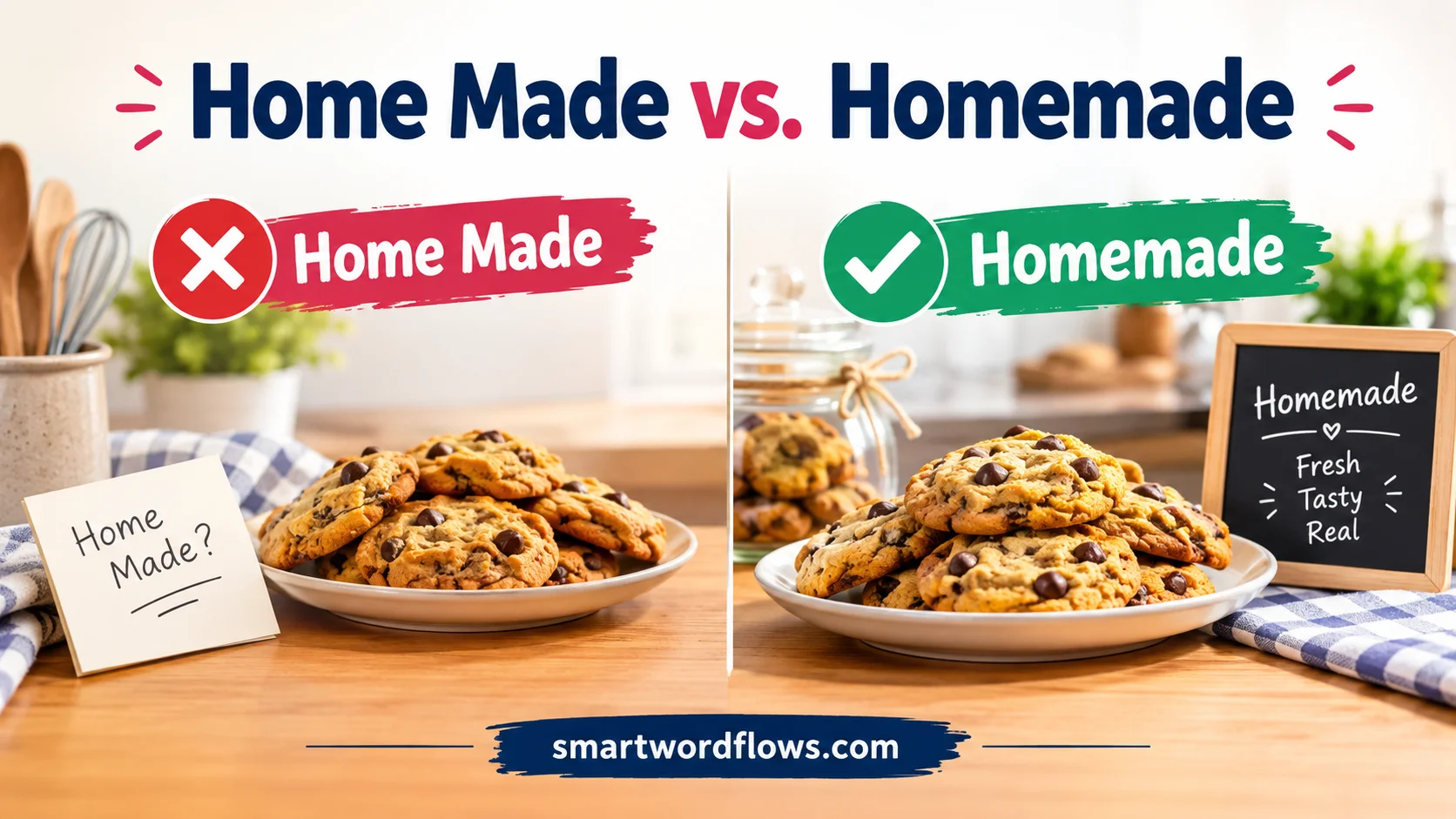

Home Made vs. Homemade can be confusing when you are unsure about the correct spelling. In modern American English, homemade is the preferred one-word spelling for something made at home. Although home and made are ordinary English words, together they form an established compound adjective. You can write homemade cookies, homemade bread, or homemade soap. This form is common in recipe blogs, restaurant menus, product descriptions, and everyday conversation. Choosing the correct form makes your writing more polished.
The forms home made and home-made can still appear in older writing, older texts, casual posts, and some dictionary traditions. Home-made is a hyphenated form, while home made uses two separate words. However, modern dictionaries and current grammar standards generally favor homemade. When you want to explain the action more explicitly, you can use made at home. Understanding this grammar, usage, meaning, and writing style helps prevent spelling mistakes, common mistakes, uncertainty, and confusion in standard English.
Quick Answer: Is It Home Made or Homemade?
Homemade is the standard and preferred spelling in modern American English when you mean “made at home.”
For example:
- She baked a homemade cake for the party.
- We had homemade soup for dinner.
- He sells homemade candles online.
- These cookies are homemade.
The spelling home made as two separate words isn’t normally used for this compound adjective.
You may also encounter home-made, especially in older texts or sources that retain the hyphenated form. However, homemade is the clearest choice for contemporary US English.
At a Glance
| Form | Modern US English | Meaning | Example |
| homemade | Preferred | Made at home | She brought homemade bread. |
| home made | Usually not preferred | Separate words rather than the standard compound adjective | Usually replace it with homemade. |
| home-made | Less common variant | Made at home | They served home-made pie. |
| made at home | Fully standard phrase | Describes something produced at home | I made the pie at home. |
So, if you need one simple rule, remember this:
When “made at home” describes something as an adjective, use “homemade” as one word.
Comparison Overview
The easiest way to understand home made vs. homemade is to compare how each form functions.
| Feature | Homemade | Home Made | Home-Made | Made at Home |
| Standard modern US spelling | Yes | No, generally | Less common variant | Yes |
| Written as one word | Yes | No | No | No |
| Means “made at home” | Yes | Usually intended to | Yes | Yes |
| Common in modern writing | Very common | Uncommon | Less common | Common |
| Works before a noun | Yes | Usually avoid | Possible | Usually rewritten |
| Example | homemade bread | home made bread | home-made bread | bread made at home |
The important distinction isn’t really about pronunciation. All four forms can communicate the same basic idea in the right context. The main issue is standard spelling and grammatical structure.
If you’re writing for an American audience, homemade is the safest and most natural choice.
Main Differences Between Home Made vs. Homemade
The main difference between home made vs. homemade comes down to whether the words form an established compound adjective.
Homemade functions as a single adjective. It tells you that something was made at home.
For example:
My aunt makes homemade pasta every Sunday.
Here, homemade describes pasta. The word acts as one adjective.
By contrast, made at home is a phrase that describes where the making happened:
My aunt made the pasta at home every Sunday.
These sentences communicate closely related ideas, but their grammatical structures differ.
Homemade Is a Compound Adjective
A compound adjective combines two or more words to create a single descriptive idea.
Consider:
- homemade bread
- handmade jewelry
- store-bought cookies
- homegrown vegetables
- self-made entrepreneur
English contains many compounds like these. Some appear as one word, some use hyphens, and others remain separate phrases.
Homemade has become firmly established as a single word in modern English.
Made at Home Is a Phrase
The expression made at home doesn’t need to become one word.
For example:
The bread was made at home using locally purchased flour.
Here, made remains a verb form and at home functions as a prepositional phrase.
You wouldn’t normally turn this into:
The bread was home made using locally purchased flour.
Instead, use either:
The bread was homemade.
or:
The bread was made at home.
Both are natural and correct.
What Does “Homemade” Mean?
Homemade means made at home rather than purchased as a commercially manufactured or prepared product.
The word commonly describes food, crafts, clothing, decorations, household products, and other things people make themselves.
For example:
- homemade bread
- homemade jam
- homemade pizza
- homemade candles
- homemade cards
- homemade decorations
- homemade costumes
- homemade furniture
The word doesn’t necessarily tell you how something was made. It simply identifies its connection to being made at home.
For example, homemade bread might involve an electric mixer, a bread machine, or completely manual preparation. It remains homemade if the relevant preparation took place at home.
Homemade Doesn’t Automatically Mean Handmade
This distinction matters.
Homemade describes where something was made.
Handmade describes how something was made, especially when a person makes it manually rather than relying heavily on machinery.
A person could make homemade bread with a bread machine. That bread could reasonably be called homemade, but calling it handmade might give readers a different impression.
Similarly, someone could make a handmade wooden bowl in a professional workshop. That item may be handmade, but it isn’t necessarily homemade.
Why Is “Homemade” One Word?
English has a long history of turning frequently used combinations into compound words.
As words appear together repeatedly, speakers and writers may begin treating them as a single concept. Over time, spelling conventions can shift from separate words to hyphenated compounds and eventually to closed compounds.
Homemade represents an established compound in modern English.
The same pattern appears in words such as:
- handmade
- homegrown
- housework
- schoolwork
- newspaper
- sunlight
Of course, English doesn’t follow one universal rule for deciding when compounds become one word. That’s why you have to learn established spellings individually.
You wouldn’t automatically assume that every combination should close up into one word.
For example, made at home remains a phrase. You shouldn’t invent spellings such as madeathome.
The practical lesson is simple: use the established dictionary spelling rather than trying to predict compound spelling from individual words.
When Should You Use “Homemade”?
Use homemade when you want to describe something as having been made at home.
It commonly appears directly before a noun.
Homemade Before a Noun
This is probably the most familiar structure.
Examples include:
- We served homemade pizza at the family gathering.
- She brought homemade cookies to the office.
- He sells homemade candles at the weekend market.
- My grandmother makes delicious homemade jam.
- They decorated the house with homemade ornaments.
In each example, homemade modifies the noun that follows it.
The pattern is straightforward:
homemade + noun
Examples:
- homemade bread
- homemade soup
- homemade soap
- homemade cards
- homemade gifts
Homemade After a Linking Verb
You can also use homemade after a linking verb.
For example:
The soup is homemade.
Everything on the dessert menu is homemade.
These decorations are homemade.
Here, homemade still functions as an adjective. It simply appears after the verb rather than immediately before a noun.
When Should You Write “Made at Home” Instead?
Sometimes made at home sounds more natural because you want to emphasize the process or location.
Compare these sentences:
I made homemade bread yesterday.
I made the bread at home yesterday.
The first sentence describes the bread. The second focuses more directly on where the action occurred.
This difference can be subtle, but it becomes useful in detailed writing.
Compare the Two Structures
Homemade:
The restaurant serves homemade pasta.
This tells you something about the pasta’s origin or preparation.
Made at home:
I made this pasta at home.
This emphasizes the person’s action and location.
Both are perfectly natural. The choice depends on what you want the sentence to highlight.
Is “Home Made” Ever Correct?
This is where the question becomes more interesting.
If you’re using home + made as the adjective meaning “made at home,” modern US English normally uses homemade.
Therefore, you should generally write:
She baked a homemade pie.
rather than:
She baked a home made pie.
However, English can sometimes place home and made next to each other for entirely different grammatical reasons.
For instance, unusual sentence structures can contain separate words that happen to appear beside each other. That doesn’t make home made an alternative spelling of the adjective homemade.
The safest approach is to ask what you actually mean.
If you mean “made at home,” use homemade.
If you’re describing an action and location, use made at home.
Home Made vs. Homemade in American English
For contemporary American readers, homemade is the normal spelling.
You’ll find the word in everyday speech and writing across many settings:
- Recipes
- Restaurant menus
- Food packaging
- Advertising
- Blogs
- Newspapers
- Product descriptions
- Personal messages
- School assignments
- Business websites
The word is completely ordinary. It isn’t slang, and it isn’t too informal for professional writing.
For example, a restaurant can naturally write:
Enjoy our homemade tomato soup, prepared fresh every morning.
A business might say:
Our homemade candles are crafted in small batches.
A student could write:
The family prepared a homemade meal for the celebration.
The important issue isn’t whether the word sounds professional. It does. The bigger concern is whether the description is accurate and clear.
Homemade vs. Home-Made: What About the Hyphen?
You may have seen home-made in books, articles, advertisements, or older documents.
That spelling isn’t an imaginary word. Home-made has existed as a hyphenated form and remains recognizable in English.
However, contemporary US writing generally favors the closed form:
homemade
rather than:
home-made
This reflects the modern tendency to write the compound as a single established word.
Why Do Some Sources Use “Home-Made”?
Dictionary and style conventions don’t always evolve at exactly the same pace. Historical publications, regional varieties, and older editorial styles can preserve hyphenated forms after many writers have moved toward a closed spelling.
That’s why you might encounter both forms when searching older material.
For current American writing, however, homemade is the cleanest choice.
Homemade vs. Hand-Made: Are They the Same?
No. Homemade and handmade overlap in some situations, but they describe different things.
Homemade means something was made at home.
Handmade generally means something was made by hand, especially rather than mass-produced.
Consider a knitted scarf.
If someone knits it at home, you could call it homemade.
Because they physically knitted it by hand, you could also call it handmade.
Now consider a cake.
Someone might make the cake at home with a stand mixer. It’s clearly homemade, but describing it as handmade isn’t as natural because the word usually emphasizes handcrafted production.
The terms answer different questions:
| Word | Main Question It Answers |
| Homemade | Where was it made? |
| Handmade | How was it made? |
| Store-bought | Was it purchased commercially? |
| Homegrown | Where was it grown? |
That distinction helps prevent careless word choices.
Homemade vs. Store-Bought
Homemade often appears as the opposite of store-bought.
For example:
Homemade tomato sauce can taste different from store-bought sauce.
The contrast focuses on how the product entered the household.
A store-bought sauce came through commercial production and retail distribution. Homemade sauce was prepared at home.
However, don’t assume that homemade automatically means healthier, cheaper, or better.
That’s an important distinction, particularly in food writing.
A homemade dessert can contain more sugar than a commercial alternative. A homemade product can also cost more because it requires expensive ingredients or considerable time.
Homemade describes origin, not quality.
Common Examples of “Homemade”
The word works across a surprisingly broad range of contexts.
Food Examples
- homemade bread
- homemade cookies
- homemade pasta
- homemade soup
- homemade pizza
- homemade jam
- homemade ice cream
- homemade salad dressing
Drinks
- homemade lemonade
- homemade iced tea
- homemade hot chocolate
- homemade fruit juice
Crafts and Decorations
- homemade candles
- homemade greeting cards
- homemade decorations
- homemade ornaments
- homemade costumes
Gifts and Personal Items
- homemade gift
- homemade quilt
- homemade toy
- homemade furniture
In every case, the word communicates that the item was made at home.
Read This: Either vs Eather: Which Is Correct Spelling and Usage?
Home Made vs. Homemade in Sentences
Seeing the forms side by side makes the difference easier to remember.
| Avoid in standard modern US usage | Preferred |
| She baked a home made cake. | She baked a homemade cake. |
| We had home made soup. | We had homemade soup. |
| He sells home made candles. | He sells homemade candles. |
| They prepared home made pizza. | They prepared homemade pizza. |
| I bought a home made card. | I bought a homemade card. |
Now compare those examples with sentences where made at home works naturally:
She made the cake at home.
We prepared the soup at home.
He makes the candles at home.
Here, made functions as part of the verb phrase. It isn’t functioning as the compound adjective homemade.
A Simple Case Study: Recipe Writing
Imagine you’re writing a recipe for tomato sauce.
You could write:
This homemade tomato sauce uses fresh tomatoes, garlic, basil, and olive oil.
That’s concise and descriptive. Homemade tells the reader that the sauce is prepared at home.
You could also write:
This tomato sauce is made at home using fresh tomatoes, garlic, basil, and olive oil.
This version takes slightly more space but emphasizes the preparation process.
Now imagine writing:
This home made tomato sauce uses fresh tomatoes.
That spelling looks awkward because home made isn’t the standard closed compound used in modern American English.
The better choices are homemade or made at home, depending on the sentence.
Common Mistakes With “Homemade”
The most common mistakes are easy to avoid once you know what to look for.
Writing “Home Made” as the Adjective
The biggest mistake is treating home made as the standard spelling.
Write:
homemade bread
Not:
home made bread
Adding an Unnecessary Hyphen
Home-made isn’t necessarily incomprehensible or historically invalid, but it isn’t the usual modern US form.
For contemporary American writing, choose:
homemade
Confusing Homemade With Handmade
Don’t use the words interchangeably.
A product can be homemade without being handmade. Conversely, something can be handmade without being homemade.
Assuming Homemade Means Better
The word only describes where something was made.
It doesn’t guarantee:
- Better taste
- Better nutrition
- Lower cost
- Higher quality
- Fewer ingredients
- Greater safety
Those claims require separate evidence.
Using Homemade When “Made at Home” Is Clearer
Sometimes the longer phrase gives readers a more precise picture.
For example:
I made the cake at home before bringing it to the party.
This sounds more natural than forcing homemade into every sentence.
Is “Homemade” Formal or Informal?
Homemade is a standard English adjective, so there’s no problem using it in professional writing.
It can appear in casual conversation:
My dad makes homemade pizza every Friday.
It can also appear in business writing:
Our bakery specializes in fresh homemade-style desserts.
It can work in informational writing:
Homemade cleaning products often require careful ingredient measurements.
The word’s tone depends more on the surrounding sentence than on the word itself.
There’s no need to replace homemade with an unnecessarily complicated phrase simply to sound professional.
Is “Homemade” Professional?
Yes. Homemade can work perfectly well in professional communication when it accurately describes a product or process.
Restaurants frequently use it in menu descriptions because customers immediately understand the term.
For example:
Homemade chicken soup with seasonal vegetables
A small business might also write:
We make homemade soy candles in small batches.
However, businesses should avoid using homemade in a misleading way.
If a company manufactures an item in a commercial facility, calling it homemade could give customers the wrong impression. The word carries a specific meaning: something made at home.
When precision matters, alternatives such as prepared in-house, made from scratch, or locally produced may communicate a different and more accurate claim.
These phrases aren’t exact synonyms, though. Made from scratch, for example, doesn’t necessarily mean something was made at home.
Homemade vs. Made From Scratch
These expressions often appear together, particularly in food writing, but they don’t mean precisely the same thing.
Homemade emphasizes the place of preparation.
Made from scratch emphasizes the ingredients or preparation process.
For example:
I made homemade bread using a bread-machine mix.
That could reasonably be homemade because you prepared it at home.
But some readers might not consider it made from scratch because you started with a prepared mix.
On the other hand:
The restaurant makes its tomato sauce from scratch.
That tells you the restaurant prepares it using its own ingredients and process. It doesn’t mean the sauce is homemade.
This is a useful reminder that similar marketing phrases can carry different meanings.
How to Remember the Correct Spelling
There’s no need to memorize a complicated grammar rule.
Use this simple shortcut:
If “homemade” means “made at home,” spell it as one word.
Think:
- homemade cake
- homemade bread
- homemade soup
- homemade candles
If you’re describing the action itself, use:
- made at home
- prepared at home
- cooked at home
A Quick Memory Trick
Think of homemade alongside handmade.
Both are familiar compound adjectives written as single words in modern US English.
homemade = made at home
handmade = made by hand
That simple association makes the spelling easier to remember.
Homely, Homemade, and Homegrown: Don’t Mix Them Up
Several English words begin with home, but their meanings differ significantly.
| Word | Meaning |
| Homemade | Made at home |
| Homegrown | Grown at home or produced locally |
| Homelike | Resembling the comfort or atmosphere of a home |
| Homely | Having a simple, home-like quality; its meaning varies by dialect |
| Homebound | Unable or unlikely to leave home |
For example:
We served homemade bread with homegrown tomatoes.
Both words relate to home, but they describe different things.
The bread was made at home. The tomatoes were grown at home.
That’s why replacing one with another can change the meaning.
Homemade in Different Types of Writing
The word fits many forms of writing without sounding forced.
Recipes
Recipe writing often uses homemade because it distinguishes a preparation from a commercially purchased version.
Serve the homemade dressing immediately or refrigerate it for later.
Restaurant Menus
Menus use the word to highlight preparation style.
Homemade chicken noodle soup
Homemade chocolate cake
Personal Writing
The word sounds natural in stories and everyday communication.
My grandmother’s homemade bread always filled the kitchen with a warm, comforting smell.
Business Writing
Businesses can use the term when it accurately represents how they produce something.
Our homemade sauces are prepared in small batches.
Academic and Informational Writing
More formal writing may sometimes favor prepared at home because it can sound more precise.
For example:
Participants who prepared meals at home reported different eating patterns.
In a research context, prepared at home may be more exact because the writer wants to describe a measurable behavior rather than a general product quality.
Is “Homemade Food” Correct?
Yes. Homemade food is completely standard.
Examples include:
- homemade food
- homemade meals
- homemade snacks
- homemade desserts
- homemade sauces
You should not normally write:
home made food
Instead, write:
homemade food
The same rule applies whether homemade appears before a singular or plural noun.
Is “Homemade” One Word or Two?
Homemade is one word.
That is the standard modern spelling in American English.
Correct:
homemade
Not normally preferred:
home made
Less common variant:
home-made
If you’re writing an article, email, essay, menu, product description, or social media post for a modern US audience, homemade is the straightforward choice.
What Is Another Way to Say “Homemade”?
Several phrases can express a similar idea, although their meanings aren’t always identical.
Made at Home
This is the closest direct alternative.
This bread was made at home.
Prepared at Home
This works especially well for food.
The meal was prepared at home.
Home-Prepared
This is another adjective, although homemade usually sounds more natural in everyday American English.
The study compared restaurant meals with home-prepared meals.
Made From Scratch
This emphasizes preparation from basic ingredients rather than commercial preparation.
She makes the sauce from scratch.
Remember that made from scratch doesn’t necessarily mean homemade.
Quick Grammar Guide for Homemade
| Question | Answer |
| Is homemade one word? | Yes. |
| Is home made the standard spelling? | No. |
| Is home-made a possible spelling? | Yes, but it’s less common in modern US usage. |
| Does homemade mean made at home? | Yes. |
| Can it describe food? | Yes. |
| Can it describe crafts? | Yes. |
| Can it appear before a noun? | Yes. |
| Can it appear after a linking verb? | Yes. |
| Is it acceptable in professional writing? | Yes. |
| Is made at home also correct? | Yes. |
FAQs:
1. Is “homemade” one word?
Yes. Homemade is normally written as one word, especially in modern American English.
2. Is “home made” incorrect?
Home made is generally not the preferred spelling when used as an adjective. Homemade is the standard choice in most modern writing.
3. Is “home-made” correct?
Home-made can be found in older writing and some British English usage, but homemade is more common in modern English.
4. Should I write “homemade cookies” or “home made cookies”?
You should normally write homemade cookies. Here, homemade works as an adjective describing the noun cookies.
5. What is the difference between “homemade” and “made at home”?
Homemade is a concise adjective, while made at home is a phrase that describes something produced at home more explicitly.
Conclusion:
The correct modern spelling is usually homemade, especially when you are describing food, products, or other things prepared at home. Although home made and home-made may appear in older or casual writing, homemade is the safest and most natural choice for modern standard English.