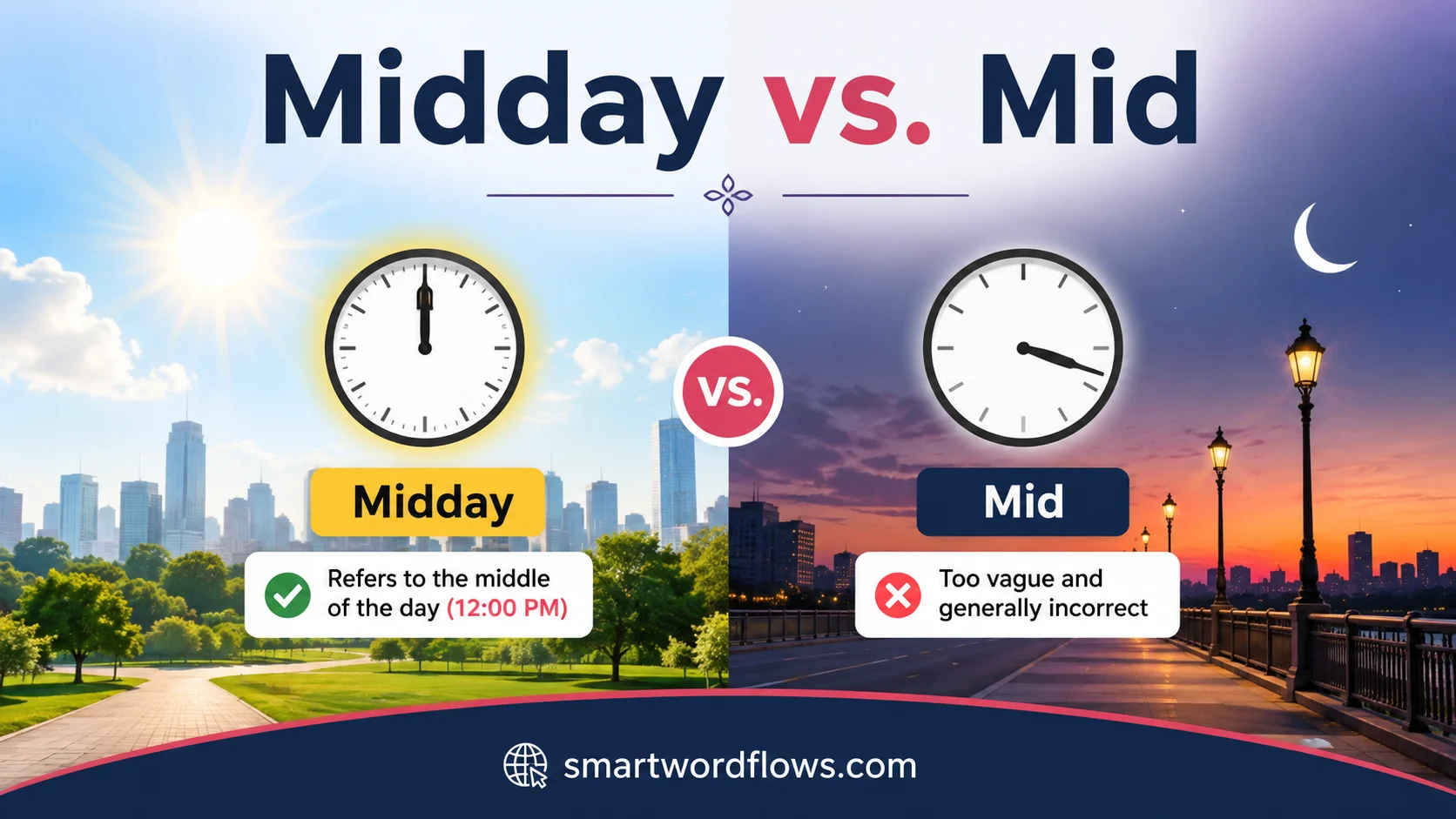

Midday vs. Mid Day can create confusion for learners, students, and writers because English grammar and spelling have changed over time. In modern English, midday is the standard one word form for the middle of the day, while mid day is usually not preferred. Understanding this word choice improves clarity, accuracy, and communication. From my experience with writing, using the correct form helps avoid repeated mistakes and makes everyday writing easier.
English evolution included spaced words, hyphenated forms, and later modern standardization. This shift affected orthography, hyphenation, and language modernization. Good grammar learning comes from awareness, exposure, supported usage examples, and writing guidance tools. Seeing midday in an email, schedule, or other text helps build fluency and consistent grammar learning. A simple guide with real examples can also make the correct structure easier to remember.
Quick Answer
Use “midday” as one word.
When you mean 12:00 p.m., noon, or the central part of the day, the standard spelling is midday.
- Midday — correct and standard
- Mid-day — occasionally seen, but generally unnecessary in modern writing
- Mid day — usually incorrect for the meaning of noon or the middle of the day
Example
- Correct: We will meet at midday.
- Correct: The midday sun was intense.
- Usually incorrect: We will meet at mid day.
Comparison Overview
The difference between midday, mid-day, and mid day becomes much easier to understand when you compare their spelling and modern usage side by side.
| Form | Modern Status | Meaning | Best Choice for Writing |
| midday | Standard | Noon or the middle of the day | Yes |
| mid-day | Less common | Same intended meaning | Usually avoid |
| mid day | Generally nonstandard | Intended to mean midday | Avoid |
The key point is straightforward. Midday has become a closed compound word. English speakers and major dictionaries treat it as one established word.
That doesn’t mean you will never see mid-day. Older books, publications with unique style rules, and individual writers sometimes use a hyphen. Still, modern standard English generally prefers the simpler form.
Main Differences Between Midday vs. Mid Day
The main differences between midday vs. mid day involve spelling, standard usage, and grammatical acceptance.
Midday Is the Standard Form
Midday is the form you should use in ordinary writing. It appears in dictionaries and works naturally in formal and informal situations.
You can write:
- The report will arrive by midday.
- We usually eat lunch around midday.
- The midday heat made the walk uncomfortable.
The word looks familiar because English has already accepted it as a complete compound.
Mid Day Is Usually Not Standard
When writers use mid day as two separate words, they usually mean the same thing as midday. However, standard modern English does not normally spell the time expression this way.
For example:
- ❌ The event starts at mid day.
- ✅ The event starts at midday.
The space breaks apart a compound that standard usage has already joined.
Mid-Day Is an Older or Stylistic Alternative
Mid-day can still appear in writing. A writer may use it because of an older style guide, a publication’s house style, or personal preference.
However, the hyphen usually adds nothing in modern writing.
- Less common: mid-day meeting
- Preferred: midday meeting
If you want the safest choice for school, work, publishing, or general communication, use midday.
What Does “Midday” Mean?
Midday means the middle of the day, especially the period around 12:00 p.m., also called noon.
The word can carry two closely related meanings.
Midday as an Exact Time
Sometimes, midday refers directly to around 12:00 p.m.
For example:
“The ceremony begins at midday.”
In this sentence, the speaker likely means around noon.
Midday as a Period of Time
In other situations, the word describes a broader stretch of time around noon.
For example:
“By midday, the city streets were crowded.”
Here, the exact minute doesn’t matter. The writer refers to the general middle portion of the day.
This flexibility makes midday useful in weather reports, news stories, schedules, travel writing, and everyday conversation.
Is Midday One Word?
Yes. Midday is one word.
It is a closed compound word, which means English joins two meaningful elements into a single written form.
The word combines:
- mid — meaning the middle
- day — referring to the daytime period
Together, they form midday, meaning the middle of the day.
English contains many closed compounds:
- midnight
- today
- tonight
- sunset
- sunrise
- football
- notebook
However, compound words don’t all follow one fixed pattern. That is where many spelling problems begin.
Some compounds stay open:
- high school
- post office
- living room
Others use hyphens:
- well-known
- mother-in-law
- up-to-date
Then some become closed:
- afternoon
- midnight
- someday
For that reason, you shouldn’t assume that every compound word follows the same rule. Dictionary usage remains the best guide when you are unsure.
Why Did “Midday” Become One Word?
English spelling changes over time. Words often begin as separate expressions. As people use them more frequently, the parts can move closer together.
A simplified pattern looks like this:
Separate words → Hyphenated form → Closed compound
For example, language may gradually shift from:
mid day → mid-day → midday
Not every word follows this exact path. Still, the pattern helps explain why English contains so many spelling variations.
Frequent use creates familiarity. Once speakers and publishers consistently treat a combination as a single idea, dictionaries may recognize it as a closed compound.
Midday represents one complete concept. You don’t usually think about “mid” and “day” separately when you read it. You immediately understand the time period.
That mental unity helps explain the modern spelling.
Midday vs. Mid-Day vs. Mid Day
Let’s look more closely at all three forms.
Midday: The Best Modern Choice
Midday is the standard spelling.
Use it in:
- School assignments
- Business emails
- News articles
- Blog posts
- Books
- Reports
- Everyday messages
Examples:
- The store closes at midday.
- We reached the hotel shortly after midday.
- The midday traffic was lighter than expected.
- The team took a midday break.
The form is simple, clear, and widely recognized.
Mid-Day: Understandable but Less Common
The hyphenated form mid-day isn’t usually necessary.
You may find it in:
- Older publications
- Historical texts
- Personal writing
- Certain editorial styles
For example:
“They paused for a mid-day meal.”
Modern style generally favors:
“They paused for a midday meal.”
Language often prefers efficiency once a compound becomes well established. In this case, the hyphen has largely stepped out of the picture.
Mid Day: Why the Space Causes Confusion
Mid day may look logical because the phrase contains two meaningful parts. Yet logic alone doesn’t determine English spelling.
English has accepted midday as a single compound.
So, if you mean noon or the central part of the day, write:
midday
Not:
mid day
It’s a small change. Still, polished writing often depends on small choices.
How to Use “Midday” Correctly in a Sentence
Midday works in several common sentence patterns.
Using Midday as a Time Noun
You can use midday after common prepositions.
At midday
The meeting begins at midday.
This means the meeting starts around noon.
By midday
Please send the documents by midday.
This means the documents should arrive before or no later than midday.
That difference matters. “At” points to a time. “By” sets a deadline.
Around midday
Rain is expected around midday.
This allows flexibility. The rain may begin before or after 12:00 p.m.
Until midday
The museum remains open until midday.
This means the museum stays open up to around noon.
From midday
Temperatures rose sharply from midday onward.
This means the change began around noon and continued later.
Using Midday Before Another Noun
Midday can also describe another noun.
Common combinations include:
- midday sun
- midday heat
- midday meal
- midday break
- midday traffic
- midday rush
- midday meeting
Examples:
The midday sun reflected off the water.
We avoided driving during the midday rush.
The company scheduled a midday meeting.
This use is natural because midday identifies the time connected to the noun.
“At Midday” vs. “In the Midday”
At midday sounds natural in standard English.
We arrived at midday.
The bells rang at midday.
However, in the midday often sounds unnatural when you simply mean “around noon.”
Instead, choose:
- at midday
- around midday
- by midday
- during the middle of the day
That said, a phrase like in the midday sun can work because “midday” directly describes “sun.”
For example:
They rested under a tree in the midday sun.
The complete phrase gives the wording a natural rhythm.
Midday vs. Noon: Is There a Difference?
Midday and noon often overlap. However, they don’t always feel exactly the same.
| Word | Typical Meaning | Example |
| noon | Often exactly 12:00 p.m. | The train leaves at noon. |
| midday | Noon or the period around it | The heat increased by midday. |
| lunchtime | The usual period for eating lunch | I’ll call you at lunchtime. |
Noon Often Sounds More Precise
If you mean exactly 12:00 p.m., noon often feels more specific.
The deadline is at noon.
Midday Can Feel Broader
Midday can describe the wider period surrounding noon.
By midday, the beach was crowded.
Nobody expects a stopwatch here. The writer simply refers to the middle of the day.
Which One Should You Use?
Choose noon when precision matters.
Choose midday when describing a broader time period, atmosphere, event, or condition.
For example:
- The interview begins at noon.
- The midday heat became unbearable.
Both words are useful. They simply shine in different situations.
Midday vs. Afternoon
Midday sits around the point where morning gives way to afternoon.
Still, everyday language doesn’t always treat time as a strict set of boxes.
For example, some people consider 12:00 p.m. the start of the afternoon. Others use midday for a wider period that includes the late morning and early afternoon.
Context usually solves the issue.
Consider these sentences:
We arrived just before midday.
We left in the early afternoon.
The first sentence places the event near noon. The second clearly moves beyond that period.
Weather reports also use these time expressions broadly:
- morning
- midday
- afternoon
- evening
- overnight
The exact boundaries can shift depending on the situation.
Common Phrases That Use “Midday”
Many natural English expressions include midday.
Midday Sun
The midday sun refers to sunlight around noon, often when the sun appears high in the sky.
The hikers rested to avoid the midday sun.
Midday Heat
This phrase describes the warmer conditions often felt around the middle of the day.
The midday heat slowed everyone down.
Midday Meal
A midday meal is a meal eaten around noon.
The guests gathered for a midday meal.
Midday Break
A midday break is a pause in work or activity around noon.
The team took a short midday break.
Midday Rush
A midday rush describes increased activity around lunchtime.
The café filled quickly during the midday rush.
Midday Traffic
This refers to road conditions around the middle of the day.
The midday traffic was surprisingly light.
These phrases show how naturally midday works as a modifier.
Common Mistakes to Avoid
Even experienced writers occasionally stumble over short compound words.
Writing “Mid Day” for Noon
Avoid:
The package will arrive by mid day.
Use:
The package will arrive by midday.
Adding a Hyphen Automatically
Some writers assume every word beginning with mid- needs a hyphen. That isn’t true.
For example:
- midnight
- midday
- midair
- midlife
The safest approach is simple: check the standard dictionary spelling when you feel uncertain.
Confusing Midday With Midnight
This mistake can create real confusion in schedules.
| Time | Correct Word |
| 12:00 p.m. | midday or noon |
| 12:00 a.m. | midnight |
If a travel itinerary says a flight leaves at 12:00, adding p.m., a.m., noon, or midnight can prevent mistakes.
Using “Good Midday” as a Greeting
English speakers don’t normally greet people by saying:
“Good midday.”
Use familiar greetings instead:
- Good morning
- Good afternoon
- Hello
- Hi
Midday describes a time. It isn’t a standard greeting.
Capitalizing “Midday” Without a Reason
Usually, write midday in lowercase.
We will meet at midday.
Capitalize it only when normal grammar rules require capitalization, such as at the beginning of a sentence or within a title style.
Midday Spelling Rules: An Easy Memory Trick
A simple way to remember the correct spelling is to connect midday with midnight.
Both describe the central point of a major time period:
- midday = middle of the day
- midnight = middle of the night
Both are written as one word.
Think:
Midday and midnight stick together.
It isn’t a scientific grammar rule. Still, it works as a practical memory trick.
How Major Dictionaries Spell Midday
Leading dictionaries recognize midday as the standard word.
| Dictionary | Standard Form | General Meaning |
| Cambridge Dictionary | midday | Twelve o’clock or around the middle of the day |
| Merriam-Webster | midday | The middle of the day |
| Collins Dictionary | midday | Noon or the middle part of the day |
These references reinforce the same practical conclusion: write midday as one word.
Is “Midday” Formal or Informal?
Midday works in both formal and informal writing.
In Formal Writing
You might see:
The presentation will conclude by midday.
Construction will pause during the midday period.
In Everyday Conversation
You might say:
Let’s grab lunch around midday.
I’ll be home by midday.
The word doesn’t sound overly formal. At the same time, it doesn’t sound casual or sloppy.
That makes it a flexible choice.
Read More: Which vs. Witch vs. Wich: Differences, Meanings, and Correct Usage
Midday in American English and British English
Both American and British English use midday.
The spelling remains the same:
midday
However, speakers may choose different words depending on context.
In everyday American English, noon often sounds especially common when someone means exactly 12:00 p.m.
For example:
“Let’s meet at noon.”
In British English, midday and noon are also understood and widely used.
The important point is that this isn’t mainly a British-versus-American spelling issue. Midday is standard in both varieties of English.
Examples of “Midday” in Everyday Writing
Here are several natural examples:
- The package should arrive by midday.
- We stopped for lunch at midday.
- By midday, the temperature had climbed sharply.
- The midday meeting lasted longer than expected.
- She avoided walking in the midday sun.
- Traffic usually increases around midday.
- The farmers rested during the midday heat.
- Please call me sometime before midday.
- The park was nearly empty until midday.
- A light shower moved through around midday.
Notice how the word fits into different types of writing. It works with schedules, weather, work, travel, and daily routines.
Midday in Professional and Academic Writing
Small spelling choices can influence how polished a document appears.
Suppose a business email says:
The meeting will begin at mid day.
Most readers will understand it. Still, the spelling looks less polished than:
The meeting will begin at midday.
The same principle applies to:
- Reports
- Research papers
- Presentations
- Press releases
- Professional emails
- Newsletters
- Website content
Consistency matters too. Don’t write midday in one paragraph and mid-day in the next unless a specific style requirement demands it.
A Practical Editing Case Study
Imagine an editor reviewing a 1,500-word company newsletter. The draft uses:
- midday — 8 times
- mid-day — 3 times
- mid day — 2 times
The editor should standardize the wording to midday unless the publication follows a different documented house style.
This isn’t just about one word. Consistent spelling makes the entire document feel more carefully prepared.
Related Compound Words With “Mid”
Writers sometimes assume that all words beginning with mid follow the same spelling pattern. English isn’t that cooperative.
Here are several common examples:
- midnight
- midair
- midlife
- midterm
- midweek
- midafternoon
- midpoint
These words show that many established mid- compounds appear as single words.
However, don’t turn that observation into a universal spelling rule. Some compounds vary by dictionary, region, or style guide.
When accuracy matters, check a trusted dictionary.
That habit takes seconds and can save you from a surprisingly stubborn spelling mistake.
Midday Time Expressions: A Practical Comparison
The words around midday can change the meaning of a sentence.
| Expression | Meaning | Example |
| at midday | At or around noon | We will meet at midday. |
| by midday | Before or no later than noon | Finish the report by midday. |
| around midday | Near noon | The rain should stop around midday. |
| before midday | Earlier than noon | Please arrive before midday. |
| after midday | Later than noon | The event continues after midday. |
| from midday onward | Starting around noon and continuing later | Temperatures rose from midday onward. |
This is where grammar becomes practical. A single preposition can change what the reader understands.
For example:
Meet me at midday.
This gives a meeting time.
Meet me by midday.
This gives a deadline.
That small difference can matter in work, travel, and scheduling.
Quick Grammar Quiz: Midday vs. Mid Day
Try these before checking the answers.
Choose the Correct Form
The conference begins at _____.
- A. mid day
- B. midday
- C. mid-day
Correct answer: B. midday
Choose the Correct Form
The _____ sun made the pavement feel hot.
- A. midday
- B. mid day
- C. mid-day
Correct answer: A. midday
Choose the Correct Form
Please submit the assignment by _____.
- A. midday
- B. mid day
- C. Both A and B
Correct answer: A. midday
Choose the Correct Sentence
- A. We ate lunch at mid day.
- B. We ate lunch at midday.
- C. We ate lunch at mid-day every day.
Correct answer: B. We ate lunch at midday.
Which Word Refers to 12:00 a.m.?
- A. midday
- B. noon
- C. midnight
Correct answer: C. midnight
Midday vs. Mid Day in Search and Modern Usage
Search engines have made spelling differences more visible than ever.
A person may search:
- midday vs mid day
- is midday one word
- midday or mid-day
- how do you spell midday
- is mid day correct
These searches usually come from a simple need: the writer wants a quick answer before sending an email, publishing an article, or submitting an assignment.
The best answer remains consistent.
Use midday.
Don’t overthink it unless you are following a publication’s specific style guide.
A Simple Decision Guide
If you are unsure which spelling to choose, follow this process.
Ask What You Mean
Do you mean:
- Noon?
- Around 12:00 p.m.?
- The middle part of the day?
If yes, continue.
Choose the Standard Form
Write:
midday
Check for a Special Style Guide
If you write for a publication, company, or academic institution, check whether it follows a specific editorial style.
Otherwise, midday remains the safest choice.
FAQs:
1. Is midday one word or two?
Midday is normally written as one word when it means the middle of the day.
2. Is mid day correct?
Mid day is generally not the standard form when referring to the middle of the day. Midday is preferred in modern English.
3. What does midday mean?
Midday means approximately the middle of the day, especially around 12:00 p.m.
4. Should I use midday in formal writing?
Yes. Midday is the standard and widely accepted spelling, so it works well in formal and everyday writing.
5. What is the easiest way to remember midday vs. mid day?
Remember that midday is normally treated as a single word. Using this form helps you avoid unnecessary spelling mistakes.
Conclusion:
Understanding Midday vs. Mid Day is simple once you remember that midday is the standard one-word spelling. Although English has changed through different spelling and usage patterns, modern writing generally favors midday. Using the correct form improves clarity, accuracy, and confidence in everyday and formal English.