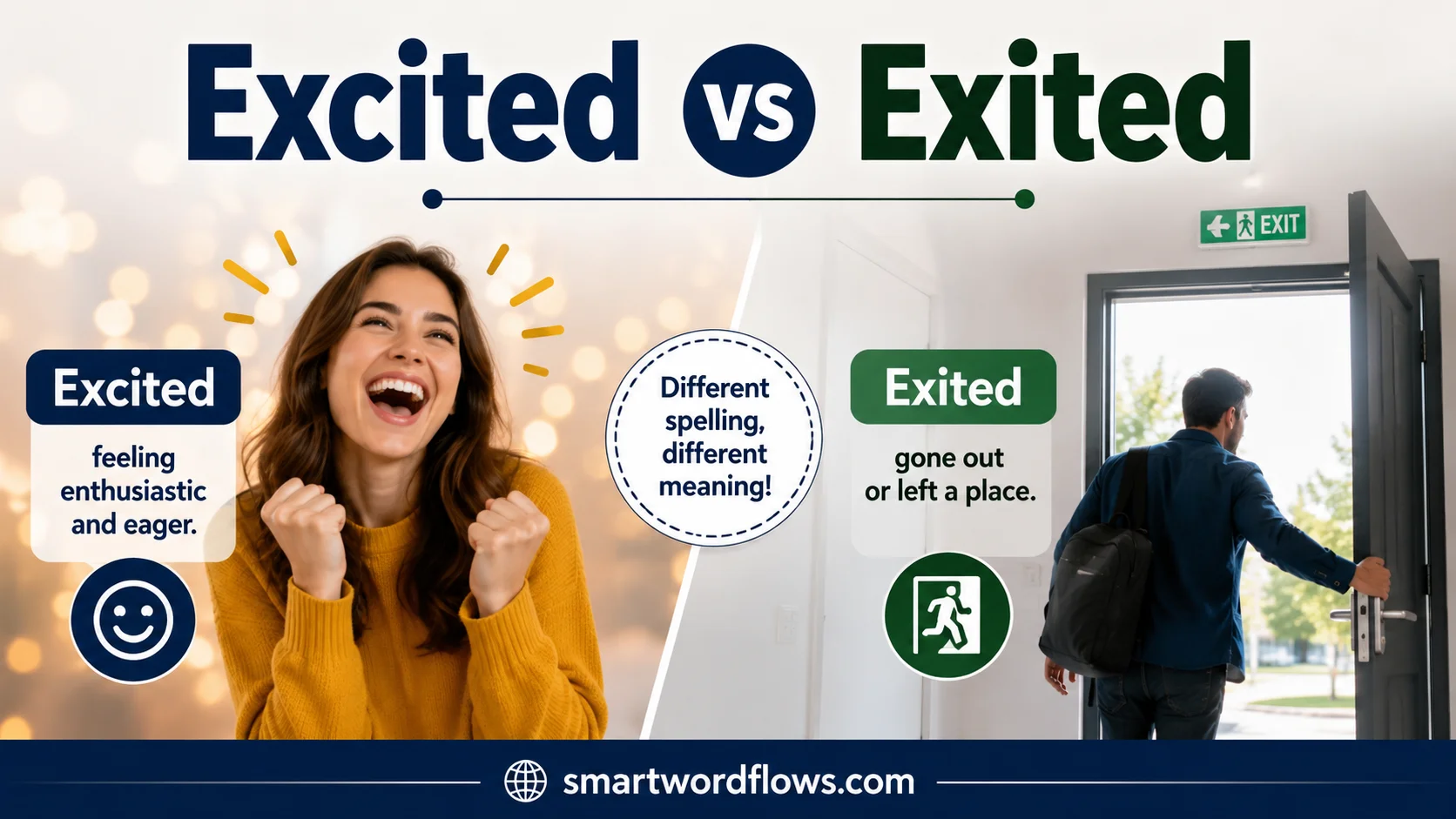

Excited vs Exited are commonly confused words in English because they look and sound almost identical. Excited describes excitement, when someone feels eager, enthusiastic, or happy. It is the past tense of excite, while related forms include excites and exciting. In writing and typing, choosing the correct word matters because a spelling difference can change the meaning. Spelling checkers may not catch the mistake because both words are valid in a professional email or school essay.
Exited is the past tense of exit, meaning to depart, leave, or go out. For example, you exited the building after the meeting. The word exit comes from Latin and was originally used as a stage direction. Later, it became a noun for a door or means of escape. A simple way to avoid this confusing mistake is to connect excited with excitement and exited with an exit whenever you check your sentences for correct usage in daily communication.
Quick Answer
Excited means feeling very happy, enthusiastic, or eager about something.
Exited means leaving a place, situation, or system. It is the past tense of the verb exit.
| Word | Meaning | Example |
| Excited | Feeling happiness, enthusiasm, or anticipation | I’m excited about my new job. |
| Exited | Left a place or situation | She exited the building after the meeting. |
A simple way to remember the difference:
- Excited = Emotion
- Exited = Exit (leave)
If you can replace the word with happy, use excited.
If you can replace it with left, use exited.
Examples:
- I’m excited about the concert. → I’m happy about the concert.
- He exited the room. → He left the room.
Comparison Overview
Understanding the basic difference between excited vs exited becomes easier when you compare their meanings, grammar roles, and usage.
| Feature | Excited | Exited |
| Meaning | A feeling of happiness, enthusiasm, or eagerness | The action of leaving somewhere |
| Root word | Excite | Exit |
| Part of speech | Usually an adjective | Verb (past tense) |
| Describes | Emotions and reactions | Movement or departure |
| Common question | “How do you feel?” | “Where did someone go?” |
| Example | She is excited for the trip. | She exited the airport. |
The easiest difference is that excited happens inside your mind and emotions, while exited happens through an action or movement.
Think about a person waiting for a surprise party. Before the event starts, they feel excited because they are happy and curious. After the party ends, they exit the room because they leave the location.
The two words may share similar letters, but they tell completely different stories.
Main Differences Between Excited vs Exited
The biggest difference between excited vs exited is the type of information each word communicates.
Excited tells someone about a person’s emotional state. It answers questions like:
- How does someone feel?
- What makes someone happy or enthusiastic?
- What event is someone looking forward to?
Exited tells someone about an action. It answers questions like:
- Who left?
- Where did someone go?
- When did someone leave?
Excited Describes Feelings
The word excited comes from the verb excite, which means to create strong interest, happiness, or enthusiasm.
When someone feels excited, they usually look forward to something. This feeling often appears before important moments such as:
- A vacation
- A new job
- A celebration
- A competition
- A personal achievement
- Meeting someone special
Examples:
- I’m excited about my first day at college.
- The children were excited to open their gifts.
- She feels excited about starting her own business.
In these sentences, nobody is moving away from a place. The sentences describe emotions.
Exited Describes Leaving
The word exited comes from the verb exit, which means to leave a location or situation.
It describes a completed action in the past.
Examples:
- The audience exited the theater quietly.
- He exited the car after reaching his destination.
- The employee exited the meeting early.
In each example, someone physically or figuratively leaves something.
A useful trick is to imagine a door. The word exit is often connected with a doorway or a way out. If someone walks through that doorway, they have exited.
What Does Excited Mean?
Excited describes a strong feeling of happiness, interest, enthusiasm, or anticipation. It shows that someone feels positive energy toward something that is happening or will happen.
People commonly use excited when they talk about future events. It often connects with things they are looking forward to.
For example:
“I’m excited about my upcoming vacation.”
This sentence tells us that the person feels happy and eager about the vacation. It does not mean they have left anywhere.
Definition and Meaning of Excited
According to standard English usage, excited can describe:
- Happiness about something upcoming
- Strong interest in an opportunity
- Enthusiasm toward an idea
- Emotional energy caused by something enjoyable
The word can describe people, groups, and even animals.
Examples:
- The students were excited about the science project.
- My dog gets excited whenever I pick up the leash.
- The fans were excited before the championship game.
How Excited Works in Grammar
Although excited comes from a verb, it commonly functions as an adjective.
It describes the condition or feeling of a person or living thing.
Common sentence patterns include:
Excited + About
Use this structure when talking about a thing, event, or situation.
Examples:
- She is excited about her promotion.
- They are excited about the new restaurant opening.
- I’m excited about learning a new language.
Excited + To + Verb
Use this structure when talking about an action someone wants to do.
Examples:
- I’m excited to visit New York.
- He is excited to start his new position.
- We are excited to announce the results.
Excited + That + Sentence
Use this when explaining the reason for excitement.
Examples:
- She was excited that her team won.
- I’m excited that you’re joining us.
- They were excited that the project succeeded.
What Does Exited Mean?
Exited is the past tense and past participle form of the verb exit. It means someone or something moved out of a place, system, or situation.
Unlike excited, this word has nothing to do with happiness or emotions.
Examples:
- The passengers exited the airplane.
- The manager exited the conference room.
- The company exited the market.
Each example shows departure.
Definition and Meaning of Exited
The word exited can describe leaving:
- A building
- A vehicle
- A website or application
- A business market
- A conversation or situation
Examples:
Physical leaving:
- The students exited the classroom after the bell rang.
- She exited the elevator on the fifth floor.
Digital leaving:
- He exited the website after completing the form.
- The user exited the application.
Business meaning:
- The company exited the international market.
- The investor exited the partnership.
The meaning changes slightly depending on the situation, but the main idea stays the same: something or someone leaves.
How to Use Exited Correctly in a Sentence
The word exited usually appears when talking about something that already happened.
Common structures include:
Subject + Exited + Place
Examples:
- The guests exited the hall.
- The players exited the field.
- She exited the office.
Subject + Exited + Situation
Examples:
- The company exited the agreement.
- He exited the competition.
- The team exited the tournament.
The key question to ask is:
Did someone leave something?
If the answer is yes, exited is probably the correct choice.
Grammar Differences Between Excited vs Exited
Understanding the grammar behind excited vs exited makes it much easier to choose the correct word. Although they look similar, they perform different jobs in a sentence.
The main difference is simple:
- Excited usually works as an adjective because it describes a feeling.
- Exited works as a verb because it describes an action that happened.
Let’s look at each word more closely.
How Excited Works in Grammar
The word excited often describes someone’s emotional condition. It tells the reader or listener how a person feels.
Examples:
- She is excited about her new opportunity.
- The children were excited before the school trip.
- I’m excited to learn something new.
In these examples, excited does not show an action. It describes a reaction or emotion.
A helpful comparison:
| Sentence | Meaning |
| Sarah is excited about the concert. | Sarah feels happy and enthusiastic. |
| Sarah exited the concert. | Sarah left the concert. |
The sentence changes completely when one letter changes.
Excited Comes From the Verb Excite
The word excited comes from the verb excite.
The verb excite means to cause someone to feel enthusiasm, interest, or happiness.
Examples:
- The announcement excited the employees.
- The news excited the fans.
- The opportunity excited her.
However, when describing the person’s feeling after something exciting happens, English usually uses excited.
Example:
- The news excited him.
- He was excited by the news.
The first sentence focuses on what caused the feeling. The second sentence focuses on the person’s emotional response.
How Exited Works in Grammar
The word exited comes from the verb exit.
It is the past form of the verb, which means the action already happened.
Examples:
- The customer exited the store.
- The passengers exited the bus.
- The player exited the game.
Here, exited answers the question: “What did the person do?”
The answer is: they left.
Exited Shows Movement or Departure
Unlike excited, exited does not describe emotions.
For example:
- He exited the room.
This does not tell us whether he was happy, sad, angry, or calm. It only tells us that he left the room.
A person can exit while feeling:
- Excited
- Nervous
- Angry
- Relaxed
- Confused
The action and the emotion are separate.
Example:
“Maria was excited about the event, so she entered the hall early. After the event ended, she exited the building.”
This sentence uses both words correctly because they describe different things.
Common Mistakes Between Excited and Exited
Many English learners confuse excited vs exited because the spelling difference is very small. The letter c in excited changes the entire meaning.
A single missing letter can create an incorrect sentence.
Mistake: Using Exited When You Mean Excited
Incorrect:
I’m exited about my new job.
Many people write this because they hear a similar sound and connect it with enthusiasm.
Correct:
I’m excited about my new job.
Why?
The sentence talks about a feeling. The person is happy and eager about the new job.
More examples:
She is exited for her birthday party.
She is excited for her birthday party.
We are exited to meet you.
We are excited to meet you.
The students were exited about the competition.
The students were excited about the competition.
Mistake: Using Excited When You Mean Exited
Incorrect:
He excited the building after work.
Correct:
He exited the building after work.
Why?
The sentence describes leaving a location. It has nothing to do with happiness or enthusiasm.
More examples:
The passengers excited the airplane.
The passengers exited the airplane.
She excited the office at 6 p.m.
She exited the office at 6 p.m.
The customers excited the store before closing.
The customers exited the store before closing.
A Simple Test to Choose the Correct Word
When you are unsure about excited vs exited, use this quick test.
Ask yourself:
Is this sentence about a feeling?
If yes, use:
Excited
Example:
- I’m ___ about my wedding.
Answer:
- I’m excited about my wedding.
Is this sentence about leaving?
If yes, use:
Exited
Example:
- She ___ the building after the meeting.
Answer:
- She exited the building after the meeting.
This small technique works because the meanings are completely different.
Read More: Protestors or Protesters: Which Spelling Is Actually Correct?
Excited vs Exited Examples in Everyday Sentences
Real-life examples make the difference easier to remember. These words appear frequently in conversations, workplaces, schools, and online communication.
Examples With Excited
Here are common sentences using excited:
- I’m excited about my upcoming vacation.
- She was excited to receive the award.
- The team is excited about the new project.
- The children were excited when they saw the presents.
- He feels excited about starting college.
- We are excited to share the news.
- The fans were excited before the final match.
- My family is excited about our weekend plans.
- She looked excited when she opened the letter.
- The students were excited to try the new experiment.
In every example, the word describes enthusiasm or happiness.
Examples With Exited
Here are common sentences using exited:
- The guests exited the restaurant after dinner.
- He exited the car and walked toward the house.
- The audience exited the stadium peacefully.
- She exited the meeting before it ended.
- The customer exited the website without purchasing anything.
- The employees exited the office at closing time.
- The company exited the market after several years.
- The player exited the competition because of an injury.
- The passengers exited the train at the final station.
- The user exited the application after saving the file.
In every example, the word shows departure or withdrawal.
Excited vs Exited in Different Contexts
The meaning of these words becomes even clearer when you see how people use them in different situations.
Workplace Examples of Excited vs Exited
The workplace often uses both words, but they describe completely different situations.
When someone starts a new role, they may feel excited.
Examples:
- I’m excited to join this company.
- She is excited about her new responsibilities.
- The team is excited about the upcoming project.
These sentences show motivation and enthusiasm.
However, when someone leaves a workplace, they may have exited.
Examples:
- The employee exited the meeting after giving the presentation.
- The manager exited the company last month.
- The organization exited the partnership.
A useful workplace comparison:
| Situation | Correct Word | Example |
| Starting a new position | Excited | She is excited about her promotion. |
| Leaving a meeting | Exited | He exited the meeting early. |
| Looking forward to a project | Excited | The team is excited about the launch. |
| Leaving a company | Exited | The company exited the market. |
Travel and Daily Life Examples
Travel provides many examples where both words can appear together.
Before a trip:
- We are excited about our vacation.
- The children are excited to visit the beach.
During the trip:
- The passengers exited the airplane.
- Everyone exited the bus at the station.
A traveler can feel excited before exiting a vehicle.
Example:
“The tourists were excited to explore the city after they exited the train.”
The first word describes emotion. The second describes movement.
Technology Examples of Excited vs Exited
Technology also uses both terms in different ways.
People often feel excited about:
- New smartphones
- Software updates
- New apps
- Artificial intelligence tools
- Gaming releases
Examples:
- Users are excited about the latest software update.
- Developers are excited to launch the new application.
On the other hand, exited often appears when someone leaves a digital space.
Examples:
- He exited the browser after finishing his work.
- The user exited the account.
- She exited the application.
Technology creates an interesting contrast because someone can be excited about a new app but exit that same app later.
A Short Real-Life Case Study: How One Letter Changes Meaning
Imagine a company manager writing an announcement:
Incorrect:
“We are exited to introduce our new service.”
The message accidentally says:
“We have left to introduce our new service.”
That is not the intended meaning.
Correct:
“We are excited to introduce our new service.”
Now the message communicates enthusiasm and confidence.
This small spelling mistake can affect professional communication. In business writing, emails, presentations, and marketing messages, choosing the correct word matters.
Synonyms for Excited
The word excited is common in everyday English, but sometimes you need a different word to express a specific level of enthusiasm. Choosing the right synonym can make your writing more interesting and help you describe emotions more accurately.
For example, being thrilled sounds stronger than simply being excited, while being interested shows curiosity without the same level of emotion.
Here are useful alternatives for excited with meanings and examples.
| Synonym | Meaning | Example |
| Thrilled | Extremely excited and happy | She was thrilled to receive the award. |
| Delighted | Very pleased and happy | I’m delighted to meet you. |
| Enthusiastic | Showing strong interest and energy | He is enthusiastic about the new project. |
| Eager | Very interested and ready to do something | The students were eager to begin the lesson. |
| Overjoyed | Extremely happy | They were overjoyed when they heard the news. |
| Pumped | Informal word for being very excited | The team is pumped for the championship game. |
| Happy | Feeling pleasure or satisfaction | She was happy about the opportunity. |
| Inspired | Filled with motivation or creativity | The speech left everyone inspired. |
| Motivated | Excited because of a goal or purpose | He feels motivated to improve his skills. |
| Looking forward to | Feeling happy about something coming soon | I’m looking forward to the weekend. |
Thrilled
Thrilled describes a very high level of excitement. It often appears when someone receives great news or experiences something special.
Examples:
- She was thrilled when she got accepted into university.
- The fans were thrilled with the team’s performance.
The word creates a stronger emotional impact than excited.
Delighted
Delighted means extremely pleased or happy. It sounds slightly more formal than excited.
Examples:
- We are delighted to welcome our new members.
- She was delighted with the results.
This word works well in professional conversations, emails, and announcements.
Enthusiastic
Enthusiastic describes someone who shows strong interest and energy toward something.
Examples:
- The employees were enthusiastic about the new changes.
- He is enthusiastic about learning new skills.
Unlike simple excitement, enthusiasm often suggests ongoing interest and dedication.
Eager
Eager means someone strongly wants to do something.
Examples:
- The children were eager to open their gifts.
- She is eager to start her new career.
This word focuses more on readiness and anticipation.
Overjoyed
Overjoyed describes extreme happiness.
Examples:
- The family was overjoyed after hearing the good news.
- She was overjoyed to see her old friend again.
It is stronger than excited and usually describes major emotional moments.
Synonyms for Exited
Unlike excited, the word exited describes an action. The best synonym depends on what someone left and why they left.
Some alternatives work for physical movement, while others work for business or social situations.
| Synonym | Meaning | Example |
| Left | Moved away from a place | He left the office early. |
| Departed | Went away, often formally | The train departed at noon. |
| Walked out | Left a place, sometimes suddenly | She walked out of the meeting. |
| Went out | Moved outside or away | They went out of the building. |
| Withdrew | Removed oneself from a situation | The team withdrew from the competition. |
| Quit | Stopped participating or working | He quit the job last year. |
| Abandoned | Left something behind permanently | They abandoned the old building. |
| Released | Allowed something to leave or end | The company released the employee. |
Left
Left is the most common replacement for exited.
Examples:
- She exited the room.
- She left the room.
Both sentences have almost the same meaning.
However, left sounds more natural in everyday conversation.
Departed
Departed sounds more formal and often appears in travel situations.
Examples:
- The passengers exited the plane.
- The passengers departed the plane.
The second sentence can sound less natural because departed usually focuses on the journey beginning rather than simply leaving.
A better example:
- The train departed from the station.
Walked Out
Walked out suggests a person physically leaving, often with emphasis on the action.
Examples:
- He exited the meeting.
- He walked out of the meeting.
The second sentence may suggest frustration or disagreement depending on the context.
Withdrew
Withdrew works when someone removes themselves from an activity or situation.
Examples:
- The athlete exited the competition.
- The athlete withdrew from the competition.
The second sentence sounds more natural when talking about competitions or official participation.
Pronunciation Difference Between Excited and Exited
Although excited and exited look similar, their pronunciation is slightly different.
How to Pronounce Excited
Excited is pronounced:
ik-SY-ted
The middle sound has a strong “sigh” sound.
Example:
- I’m excited about the trip.
The pronunciation highlights the second syllable.
How to Pronounce Exited
Exited is pronounced:
EK-sit-ed
The first syllable sounds like the word “exit.”
Example:
- She exited the building.
The pronunciation connects directly to the verb exit.
Why Pronunciation Causes Confusion
Many speakers confuse these words because they contain similar sounds.
When people speak quickly, the difference becomes harder to notice. However, context usually makes the meaning clear.
Consider:
“I’m excited about my vacation.”
The listener understands that the speaker feels happy.
Now compare:
“I exited the airport.”
The listener understands that the speaker left a location.
The surrounding words usually reveal the correct meaning.
Tips to Remember the Difference Between Excited and Exited
Remembering excited vs exited does not need to be complicated. A few simple tricks can prevent mistakes.
Think About Emotion vs Exit
The easiest memory trick:
Excited = Emotion
The word contains the letter c, which you can connect with:
- Celebration
- Cheer
- Curiosity
All of these relate to positive feelings.
Example:
- She is excited about the celebration.
Exited = Exit
The word starts with exit, which means leaving.
Example:
- He exited through the emergency door.
Replace the Word With a Simpler Word
When unsure, replace the word mentally.
Ask:
Can I replace it with happy?
If yes:
Use excited
Example:
- I’m happy about the results.
- I’m excited about the results.
Can I replace it with left?
If yes:
Use exited
Example:
- She left the office.
- She exited the office.
This quick test works in most situations.
Look at the Sentence Context
Context gives clues.
Words that often appear with excited:
- About
- To
- Opportunity
- Event
- News
- Future
- Experience
Examples:
- excited about the opportunity
- excited to begin
- excited for the event
Words that often appear with exited:
- Building
- Room
- Car
- Door
- Office
- Market
- System
Examples:
- exited the building
- exited the application
- exited the market
Practice Makes the Difference
Learning vocabulary is similar to learning a sport. Reading the rules helps, but practice creates confidence.
Try creating your own sentences:
- I’m excited about ______.
- I exited ______.
For example:
- I’m excited about my weekend plans.
- I exited the store after shopping.
After a few attempts, the difference becomes automatic.
FAQs:
1. What is the difference between excited and exited?
Excited means feeling happy, eager, or enthusiastic, while exited means left or went out.
2. Is “I am exited” correct?
Usually, no. If you mean that you are looking forward to something, the correct phrase is “I am excited.”
3. Is exited a real word?
Yes. Exited is the past tense of exit, meaning to leave or go out.
4. Why are excited and exited confused?
They are often confused because their spelling and pronunciation are very similar, but their meanings are different.
5. How can I remember the difference?
Connect excited with excitement and exited with an exit. This simple association makes the correct word easier to remember.
Conclusion
The difference between Excited vs Exited is simple once you connect each word with its meaning. Excited describes enthusiasm or excitement, while exited means to leave or go out. Remembering this small difference can help you avoid common spelling and usage mistakes.