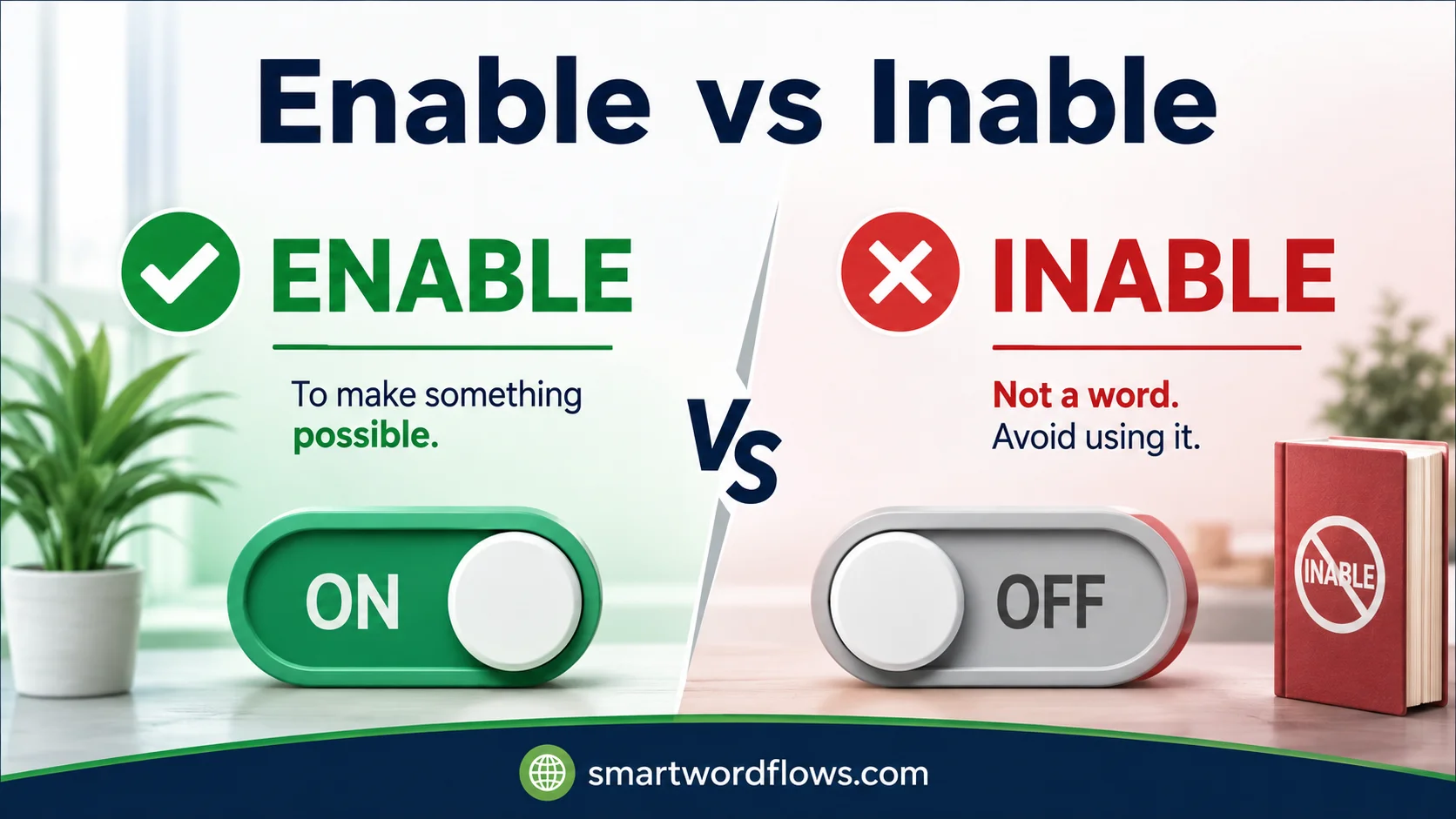

Enable vs Inable can confuse English learners because both words look similar. However, enable is the correct, proper, recognized, and standard verb in modern English. Inable is generally obsolete or nonstandard in modern writing. This difference matters in emails, essays, and professional writing, where incorrect word choice can cause confusion, hesitation, and second-guessing. Understanding the meaning, spelling, grammar, and context makes writing clearer, sharper, smoother, and more polished for every reader.
The definition of enable is to give someone the ability, authority, permission, or means to perform an action. For example, software can enable someone to complete a task efficiently, while a device or feature can make something operational. Merriam-Webster provides related meanings that clarify this usage. Choosing the right word can improve communication, efficiency, and completion. The myth that inable is the opposite of enable can create small but avoidable problems in ordinary sentences.
Quick Answer
The quick answer is simple: enable is the correct English word. Inable is not accepted in standard modern English, so you should not use it in formal or professional writing.
If you mean to say that something makes a process possible, allows a feature to work, or gives someone the ability to do something, use enable.
Comparison Overview
Here is the simplest way to see the difference.
| Feature | Enable | Inable |
| Standard English word | Yes | No |
| Common modern usage | Yes | No |
| Meaning in modern English | To make possible, allow, or give ability | No standard meaning |
| Suitable for professional writing | Yes | No |
| Common spelling concern | Sometimes confused with similar words | Usually a misspelling of enable |
| Example | The setting enables notifications. | This form is not correct in standard English. |
The table tells the story fast. Enable works in everyday English, business writing, technical settings, and academic writing. Inable does not belong in standard usage.
Main Differences Between Enable vs Inable
The heart of the issue is not just spelling. It is usage, meaning, and acceptance.
Enable is a real, common verb
Enable means to make something possible, to give someone the power or ability to do something, or to turn on a feature or function.
Here are a few easy examples:
- This tool enables faster work.
- The app enables users to track expenses.
- Good lighting enables better reading.
- The new policy enables more people to apply.
In each sentence, the word shows that something becomes possible.
Inable is not standard English
Inable is not a regular word in modern English dictionaries for general use. Most people who type it mean enable. In some rare historical contexts, a similar-looking form may appear in old texts, but that does not make it correct for modern writing.
So if you are writing for a website, school paper, business report, resume, or email, do not use inable.
The confusion is mostly visual
The two words look similar because they share letters and both begin with a vowel sound. But similarity does not mean correctness. English is full of words that look like they should exist but do not.
A better comparison is this:
enable is like a working key.
inable is like a key-shaped piece of plastic.
It looks close. It is not the same thing.
What Does Enable Mean?
The word enable has a clear, practical meaning. It is a verb, and people use it in several ways.
Basic meaning
To enable something means to make it possible or easier.
Example:
- The ramp enables wheelchair access.
Ability or power
It can also mean to give someone the ability or the means to do something.
Example:
- The scholarship enables him to continue his studies.
Technology and settings
In tech, enable often means to turn on a feature.
Example:
- Please enable notifications in your browser.
Professional and formal writing
Writers often use enable when they want to sound precise and direct.
Example:
- The new system enables teams to collaborate more efficiently.
That is why the word appears so often in business, education, software, and policy writing. It is useful because it is flexible, clear, and widely understood.
What Does Inable Mean?
This is where many writers get stuck. They see inable and assume it should mean the opposite of enable. That guess sounds logical, but English does not always work that way.
It is not a standard modern word
In ordinary modern English, inable is not the word you want. Most style guides, editors, and readers will treat it as an error.
It is often a typo
People usually type inable when they mean one of these:
- enable
- unable
- inability
That is why context matters. If you read a sentence and see inable, ask yourself what the writer was trying to say. In most cases, the correct word is obvious.
Why people search for it
People search for inable because they are unsure whether it exists. That is a fair question. The English language has lots of words that start with in- as a negative prefix, so inable feels like it should mean “not able.” But English already has unable, which does that job clearly.
So the short answer is this: inable is usually a mistake, not a valid choice.
Why Do People Mistype Enable as Inable?
This mistake happens for a few simple reasons.
Similar spelling patterns
English words often form opposites with prefixes like un-, in-, im-, or dis-. That pattern can lead people to guess incorrectly.
For example:
- able → unable
- legal → illegal
- possible → impossible
Because of that, some writers assume enable should have a negative partner like inable. But English already gives us unable and disable, so that guess leads nowhere useful.
Sound and memory errors
When people type quickly, they sometimes remember the sound of the word but not the exact spelling. That is especially common with words used often in speech but less often in writing.
Auto-correct and muscle memory
Sometimes the keyboard makes the mistake for you. Other times, you have written the same error so many times that your fingers repeat it automatically.
The fix is simple: pause and check whether the word you need is enable, unable, or disable.
How to Use Enable Correctly
The good news is that enable is easy to use once you know the pattern.
Use it when something becomes possible
- The new bridge enables travel across the river.
- This update enables faster login.
- The training program enables workers to handle the software.
Use it when someone gains ability
- The device enables blind users to access the app.
- The extra support enables students to finish the course.
Use it when turning on a feature
- Enable Bluetooth.
- Enable dark mode.
- Enable cookies in your browser.
Use it in formal writing
- This policy enables greater accountability.
- The program enables local businesses to reach more customers.
- Better data systems enable smarter decisions.
The pattern stays consistent. If the meaning is “make possible,” “give ability,” or “turn on,” enable is probably the right choice.
Real Examples of Enable in Sentences
Here are simple examples from different settings.
- The software enables remote access.
- Good planning enables smoother travel.
- The report enables leaders to make informed decisions.
- The new law enables better protection for workers.
- Her savings enabled her to move to a new city.
- This feature enables users to save time.
- The platform enables secure payments.
- Strong communication enables better teamwork.
- The adapter enables the phone to connect to the monitor.
- The scholarship enabled him to study abroad.
These examples show how flexible the word is. It can describe technology, relationships, business, education, and daily life.
Read More: Emersion vs Immersion: Differences, Meaning, and Correct Usage
Common Mistakes to Avoid
Even strong writers make small errors with this word family. Here are the ones worth watching.
Mistaking enable for unable
This one can change the meaning completely.
- Correct: The tool enables access.
- Incorrect: The tool unable access.
Using inable instead of enable
This is the main mistake in this topic.
- Correct: The setting enables notifications.
- Incorrect: The setting inables notifications.
Using enable when disable is needed
These two words are opposites.
- Enable means to turn on or make possible.
- Disable means to turn off or prevent.
Example:
- Please enable the feature.
- Please disable the feature.
Forgetting the verb pattern
Enable usually needs an object and often an infinitive structure.
Examples:
- The app enables users to share files.
- The grant enabled her to start the project.
That structure keeps the sentence clear and natural.
Enable vs Unable vs Disable
A lot of confusion disappears once you compare these three words side by side.
| Word | Meaning | Example |
| Enable | To make possible or turn on | The update enables notifications. |
| Unable | Not able | He is unable to attend the meeting. |
| Disable | To turn off or stop | You can disable the feature later. |
This small table is worth remembering. It separates the words cleanly and saves you from easy mistakes.
Grammar Tips for Using Enable
Good grammar makes the difference between a sentence that works and one that feels awkward.
Keep the sentence active
Active voice usually sounds better.
- Better: The software enables users to collaborate.
- Weaker: Users are enabled to collaborate by the software.
The first version feels cleaner and more direct.
Use clear objects
Enable should point to something specific.
- Correct: The feature enables sharing.
- Less clear: The feature enables.
Pair it with action or ability
You will often see enable followed by an action phrase.
- enable someone to do something
- enable access to something
- enable a feature
Examples:
- The system enables employees to submit requests.
- This option enables the camera to work in low light.
Avoid stuffing the sentence
If a sentence gets too long, split it.
- Better: The tool enables tracking. It also improves accuracy.
- Worse: The tool enables tracking and improves accuracy and supports better reporting and helps teams.
Shorter usually reads better.
Enable in Technology
Technology is one of the most common places you will see this word.
Software and apps
- Enable notifications
- Enable permissions
- Enable two-factor authentication
- Enable dark mode
Devices
- Enable Bluetooth
- Enable Wi-Fi
- Enable location services
Websites and browsers
- Enable cookies
- Enable JavaScript
- Enable pop-ups
In tech writing, enable often means “turn on.” That usage is so common that many users barely notice the word. They just understand the action.
A practical example
A user opens a settings page and sees:
- Enable microphone access
- Enable camera access
- Enable background sync
Each option tells the user what to turn on. That is the clearest, most practical use of the word.
Enable in Business and Workplace Writing
Business writing benefits from words like enable because they sound professional without sounding stiff.
Common business uses
- The new process enables faster approvals.
- Better training enables stronger performance.
- This dashboard enables better planning.
- The partnership enables market growth.
Why businesses use it
Companies like the word because it highlights action and progress. It suggests that one thing creates the conditions for another.
Example in a case study
Imagine a small online store that struggles with slow checkout. After switching to a better payment system, the store cuts waiting time and improves sales.
A strong sentence would be:
- The new payment system enabled faster checkout and improved customer satisfaction.
That sentence works because it shows cause and result clearly.
Enable in Education
Teachers, trainers, and students use enable all the time.
In classroom settings
- The extra resources enable students to practice more.
- Clear instructions enable better learning.
- Support services enable students with disabilities to participate fully.
In academic writing
The word is useful when describing conditions that support learning or research.
- The study enables a better understanding of the topic.
- Access to data enables deeper analysis.
Why it matters
Education is often about removing barriers. Enable fits that idea well because it means creating the conditions for success.
Real-World Case Study Examples
A few practical examples make the difference even easier to see.
Case study: A mobile app
A developer adds a new privacy option.
- Correct sentence: The update enables users to control their data.
- Wrong sentence: The update inables users to control their data.
The first sentence is clear and standard. The second one looks like a typo and breaks the flow.
Case study: A school program
A school provides laptops to students who cannot afford them.
- Correct sentence: The program enables more students to complete assignments at home.
- Wrong sentence: The program inables more students to complete assignments at home.
Again, enable carries the meaning naturally.
Case study: Workplace communication
A manager writes a project update.
- Correct sentence: The new workflow enables faster feedback across teams.
That version sounds polished and professional. It tells the reader exactly what changed.
Memory Tricks to Remember the Difference
If you keep forgetting the correct word, use a simple trick.
Remember the word enable by meaning
Think of enable as “make able.”
That little phrase is easy to hold in memory:
- enable = make able
Pair it with technology
When you see a button or setting, ask:
- Am I turning something on?
- Am I making something possible?
If yes, enable is the word you need.
Use the opposite test
Try replacing it with another word:
- If “turn on” fits, use enable.
- If “not able” fits, use unable.
- If “turn off” fits, use disable.
This quick check catches a lot of mistakes before they leave the page.
Synonyms for Enable
Sometimes a different word works better. Here are useful alternatives depending on the sentence.
- allow
- permit
- empower
- facilitate
- support
- make possible
- give the ability to
- open the door to
- help
- authorize
Example usage
- The new policy allows better access.
- The software facilitates faster work.
- The grant makes possible new research.
The best synonym depends on tone and context. In technical writing, enable is often the cleanest choice. In simpler writing, allow or help may sound more natural.
Final Verdict
The conclusion is straightforward.
Enable is the correct word in modern English. It means to make something possible, give someone the ability to do something, or turn on a feature. Inable is not standard English and should not be used in normal writing.
If you remember just one rule, make it this:
Enable means “make able.”
That small idea will save you from a big spelling mistake.
FAQs:
1. Is enable the correct word?
Yes, enable is the correct, standard, and widely used word in modern English. It means to give someone the ability, permission, or means to do something.
2. Is inable a correct English word?
Inable is generally considered obsolete or nonstandard in modern English. In most ordinary sentences, enable or unable should be used instead.
3. What does enable mean?
Enable means to give someone the ability, authority, capability, or means to perform an action or complete a task.
4. Why do people confuse enable and inable?
The two words have similar forms, which can create confusion and hesitation. The simple way to avoid this problem is to remember that enable is the standard modern word.
5. Can enable be used in professional writing?
Yes. Enable is widely used in professional writing, emails, essays, software descriptions, and everyday English. Using it correctly makes communication clearer and more polished.
Conclusion
Understanding enable vs inable is simple once you know the difference. Enable is the correct modern word, while inable is obsolete or nonstandard. Using the right word improves clarity, grammar, and professional communication.