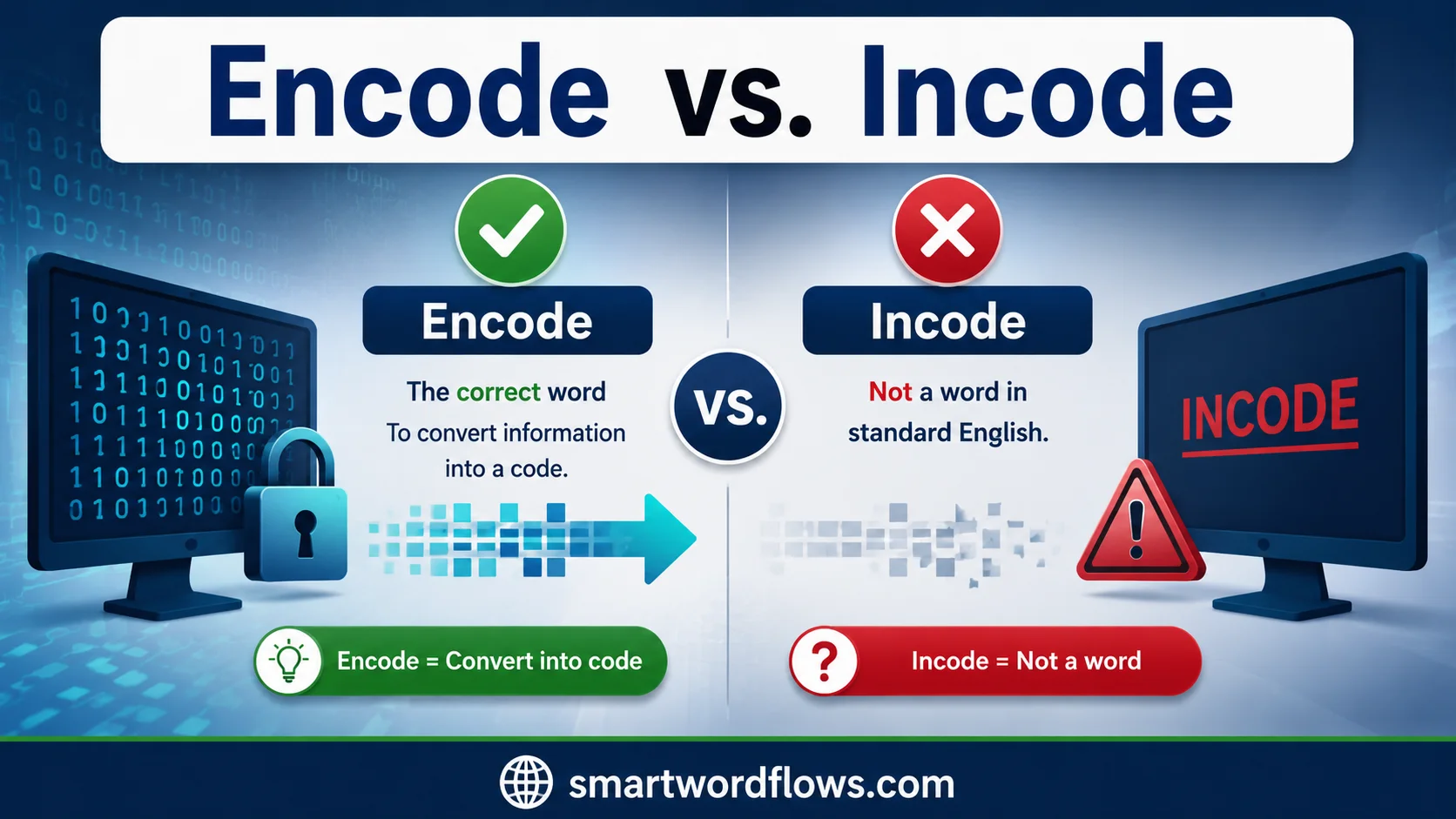

In English, the correct word is encode, while incode is an incorrect term and spelling mistake; Encode vs. Incode Correct Usage: Which One Should You Use? helps explain this common confusion clearly. Although both may sound similar, they do not mean the same meaning, and standard English uses encode as the proper, widely accepted technical term for changing information into a coded format. In programming, encode refers to conversion, transformation, and data processing, including data encoding, character encoding, information encoding, data encoding techniques, and encoding techniques used in digital communication. It also appears in web development, coding, and programming functions, where developers convert data into another format for a specific purpose.
Encoding should also be separated from encryption, because encryption methods and encryption basics focus on protecting information, while encoding supports information transformation. These terms are common in programming terminology, technical vocabulary, technical writing, and simple tech terms. When incode appears in your language, it is usually a typo caused by a keystroke, keyboard mistake, or confusion about the word. A small letter can make a correct technical term appear wrong, inaccurate, or unprofessional, especially during typing, debugging, or writing about a program. For writers, students, and tech enthusiasts working with computers and code, choosing encode improves clarity, accuracy, and confidence. Remember the encode meaning and use the real word accepted in technical language, then write your explanation professionally with the right word and a clear distinction.
Quick Answer
Use encode in normal writing. Use Incode only when you are referring to the company or another proper noun with that exact name. If your sentence is about converting information, securing a message, or changing a file format, encode is the correct choice.
Comparison Overview
Here is the cleanest way to think about it:
| Word | Standard English usage | What it means | Example |
| encode | Yes | Convert information into code, another format, or a symbolic form | We encoded the message before sending it. |
| Incode | Only as a proper noun | A company name in identity verification and fraud prevention | Incode builds digital identity tools for businesses. |
The key point is simple: encode is the action word. Incode is usually a name. That difference matters in schoolwork, business writing, software documentation, and everyday English.
Main Differences Between Encode vs. Incode Correct Usage
Encode is the standard verb
Encode means to convert something from one system into another. Dictionaries also show a broader meaning: it can mean to convey something symbolically, not just to hide a message. Merriam-Webster even includes a medical sense tied to genetics, where a sequence can encode a specific amino acid.
That makes encode a flexible word. You can use it when talking about computers, communication, biology, and symbolism. It is not limited to secret codes. That is one reason people use it so often in modern writing.
Incode is usually a proper noun
Incode is not the word most English speakers use when they want the verb. The clearest verified use is as a brand name. Incode’s own site presents it as a company focused on identity verification, authentication, KYC compliance, and fraud prevention.
So if you see Incode with a capital I, check the context. It may refer to a business, software platform, or product. If you are writing ordinary English, though, the word you almost certainly want is encode.
Why people mix them up
The confusion makes sense. The words sound close, and spellcheck does not always catch a brand name or a typo in a short sentence. Also, many people see Incode in product names and assume it is a spelling variant of encode. It is not.
A good habit helps here: ask yourself whether the sentence describes an action or a name. If it describes an action, use encode. If it names a company, keep Incode. That one habit clears up most mistakes.
What Encode Means in Real Writing
In technology and computing
In tech writing, encode often means changing data into a different form so a system can store, send, or process it. Cambridge describes this as representing complicated information in a shorter or simpler way. Merriam-Webster’s definition also points to converting information from one system of communication into another.
Common examples:
- The app encoded the file before upload.
- The server encodes video for faster streaming.
- The software encoded the text into UTF-8.
These are all normal, natural uses of the word.
In security and messaging
In security settings, encode can overlap with words like encrypt, code, cipher, and encipher. Merriam-Webster lists those as related terms in its thesaurus, but they are not perfect substitutes in every sentence.
That distinction matters. For example, you might encode a message into a digital format without encrypting it. Or you might encrypt a message to keep it secret. Those are related ideas, but they are not identical.
In media and file formats
People also use encode when converting audio, video, or images into another file format. That is why you hear phrases like “video encoding” or “audio encoding.” In this sense, encoding is about preparing content for storage, sharing, or playback.
Examples:
- The editor encoded the video for mobile devices.
- The platform encodes audio in a compressed format.
- The system encoded the image before downloading it.
These are straightforward, practical uses. They sound natural because they match everyday professional language.
In biology and science
This is where the word gets even more interesting. Merriam-Webster includes a medical definition of encode: to specify the genetic code for. In plain English, that means a sequence can carry instructions for building something in the body.
That is why you may read sentences like:
- A gene encodes a protein.
- The sequence encodes a trait.
- Scientists study how DNA encodes biological information.
So encode is not just a tech word. It works in science too.
When Incode Is Correct
As a company name
If you are referring to the identity verification company, Incode is correct. The company’s official site and related pages use that exact spelling and capitalization.
Examples:
- We use Incode for identity verification.
- The contract mentions Incode as the provider.
- Incode helps businesses reduce fraud.
In those cases, spelling it as encode would be wrong because you would be changing the company name.
In branded or product-specific writing
Sometimes a team uses a brand name in marketing copy, internal notes, or product documentation. When that happens, you should keep the exact brand spelling. That is standard practice for proper nouns. So if the product is called Incode, write Incode. If the verb is about converting information, write encode.
That difference sounds small. In real writing, though, it protects clarity and credibility.
Common Mistakes People Make
Here are the mistakes that show up most often:
- Writing incode when they mean encode
- Using Incode in the middle of a normal sentence when they are not talking about the company
- Mixing up encode with encrypt
- Treating encode as if it only means “hide a message”
- Forgetting that encode can also mean represent information symbolically or biologically
A corrected version helps more than a rule alone:
- Wrong: Please incode the file.
- Right: Please encode the file.
- Wrong: The report was incode in UTF-8.
- Right: The report was encoded in UTF-8.
- Wrong: We need to incode the data before upload.
- Right: We need to encode the data before upload.
These examples show the pattern clearly.
Practical Case Studies
Case study: a student paper
A student writes, “The software can incode large files quickly.”
That looks close, but it is not correct standard English. The right sentence is: “The software can encode large files quickly.”
Why? Because the sentence describes an action performed on data. It is not naming a company.
Case study: a software team
A developer writes documentation that says, “The application encodes the audio stream before sending it to the server.”
That works. It uses encode in the exact sense dictionaries support: converting information into another form for transmission or processing.
Case study: a business website
A landing page says, “We partner with Incode to verify customer identity.”
That is also correct, because Incode is a proper noun and the page is naming a company. The capital I matters here.
Read More: Realist vs Realest Correct Usage
What Dictionaries and Thesauruses Support
Merriam-Webster defines encode as “to convert … from one system of communication into another.” It also notes the symbolic and medical uses of the word. Cambridge adds that encode can mean sending messages secretly or representing complicated information in a simpler way.
Merriam-Webster’s thesaurus lists related words such as encrypt, code, cipher, and encipher. Those words can be useful, but they do not always mean the same thing. A good writer chooses the one that matches the exact situation.
That is the real skill here. It is not just about spelling. It is about choosing the right word for the job.
Synonyms and Closest Alternatives for Encode
Here is a helpful guide to words that often show up near encode:
| Word | Best use | Important note |
| encrypt | Security and privacy | Stronger secrecy meaning than encode |
| code | General communication or programming | Broader and sometimes less precise |
| cipher | Cryptography or hidden messages | More specialized; often used in security contexts |
| encipher | Formal cryptography writing | Close to encrypt, but slightly more old-fashioned in tone |
| translate | Converting meaning from one form to another | Works only in some contexts, not all |
These words are related, but they are not interchangeable in every sentence. That is why strong writers check the context before choosing one.
How to Remember the Difference
A simple memory trick helps:
- encode = the verb you use for data, messages, or symbolic meaning
- Incode = a name, not the standard action word
Try this test:
- If you can replace it with convert, encrypt, or represent in some form, you probably mean encode.
- If you are naming a company, platform, or product, you may mean Incode.
That small habit saves time and cuts down on embarrassing mistakes.
Quick Rules You Can Use Every Time
- Use encode for actions.
- Use Incode for the company name.
- Keep the capitalization if it is a proper noun.
- Do not use incode as a casual spelling of the verb.
- Choose the related word that best matches the meaning, not just the sound.
Those rules work in emails, essays, reports, and technical writing.
FAQs:
1. Is “incode” a correct English word?
No. Incode is generally considered a spelling mistake. The correct and widely accepted term is encode.
2. What does “encode” mean?
Encode means to convert information or data into a particular coded format so it can be processed, stored, or communicated.
3. What is the difference between encode and encrypt?
Encoding changes data into another format, while encryption protects information by making it unreadable without the proper key or method.
4. Is encode used in programming?
Yes. Encode is commonly used in programming, web development, data processing, character encoding, and digital communication.
5. Why do people write “incode”?
People usually write incode because it looks or sounds similar to encode. It can also result from a typing mistake or confusion about technical terminology.
Conclusion
Encode is the correct word to use in English and technical contexts, while incode is normally an incorrect spelling. Understanding this simple difference can help you write more accurately and confidently, especially when discussing programming, data, coding, and digital communication.