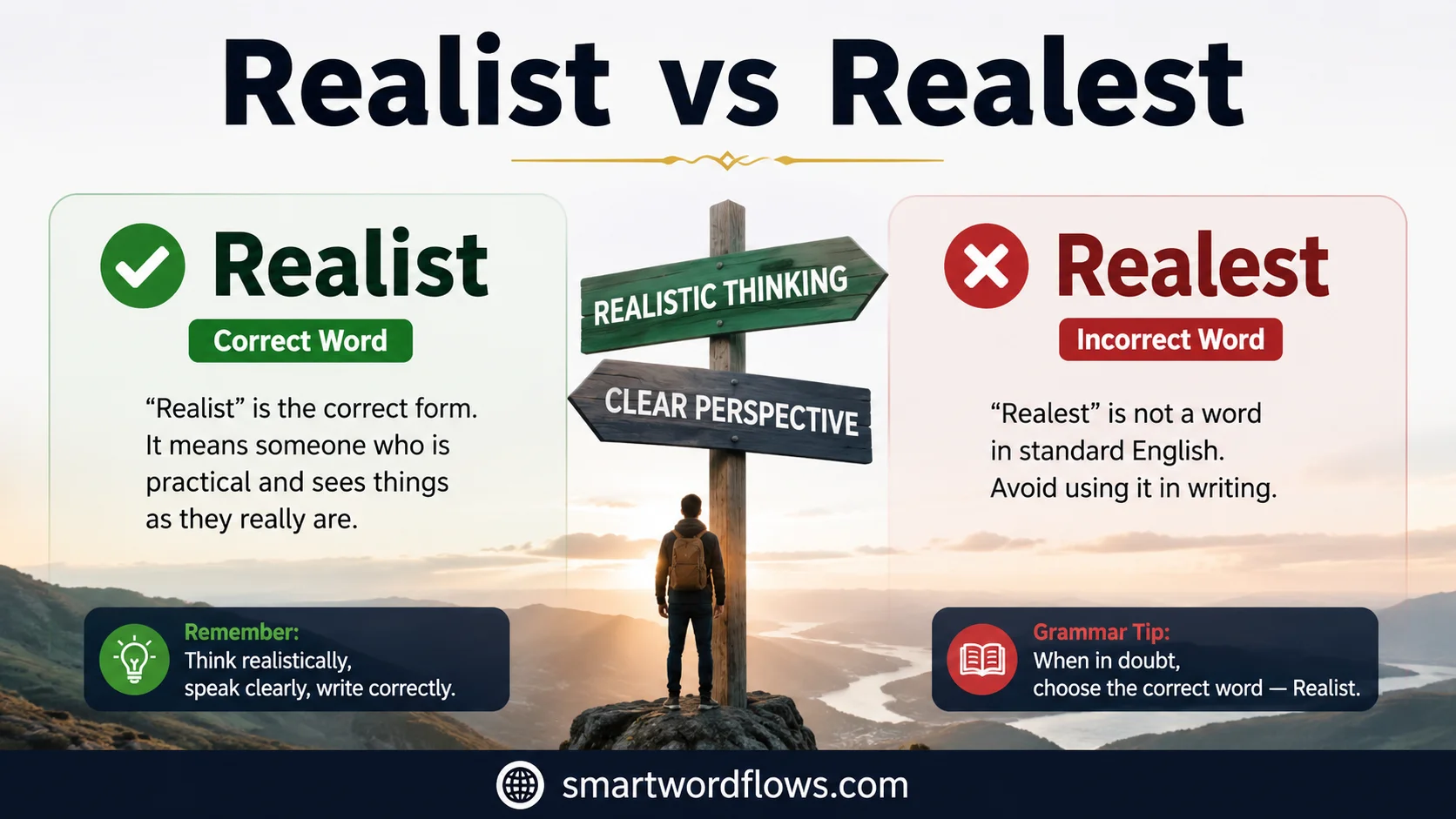

Confused about Realist vs Realest? Although these words look and sound similar, they have different meanings and grammatical roles. A realist is a person who views life practically, relying on facts, logic, and realistic expectations. In contrast, realest is the superlative form of real, meaning the most genuine, authentic, or true. Knowing this key difference can help you avoid common spelling mistakes and use each word correctly in everyday conversations, formal writing, and online communication.
Both realist and realest are valid English words, but their usage depends on the context. Realist is mainly a noun describing a practical person, thinker, writer, or artist who focuses on reality. Realest, however, is commonly used in informal speech, social media, and casual writing to describe someone or something exceptionally genuine or authentic. Understanding their meaning, grammar, context, and examples makes it easier to select the right word and communicate your intended message clearly.
Quick Answer
Use realist when you mean a person who accepts reality and deals with it practically. Use realest when you mean “most real,” but only in informal speech or casual writing. In formal writing, realest often sounds too slangy, so writers usually choose words like most genuine, most authentic, or most realistic instead.
Comparison Overview
| Feature | Realist | Realest |
| Part of speech | Noun | Superlative adjective in informal use |
| Core meaning | A practical person who accepts reality | The most real, genuine, or authentic |
| Standard use | Common in formal and informal English | Common in casual speech and slang |
| Best context | Essays, business writing, analysis, everyday speech | Social media, music, casual compliments |
| Can describe a person? | Yes | Sometimes, but usually in an informal, expressive way |
| Formal writing friendly? | Yes | Usually no |
| Main idea | Practical viewpoint | Highest level of authenticity |
Bottom line: realist is about a type of person, while realest is about degree and usually sounds informal.
Main Differences Between Realist vs. Realest
The biggest difference is grammatical. Realist is a noun. Merriam-Webster defines it as “a person who recognizes what is real or possible in a particular situation.” Oxford Learner’s Dictionaries gives a similar idea: a realist accepts a situation as it is and does not pretend it is different. That makes realist the right word when you are talking about attitude, outlook, or philosophy.
Realest, on the other hand, comes from the adjective real. Merriam-Webster lists realer, realest as forms of the adjective real, and Dictionary.com describes realest as the superlative form used in slang for someone or something “extremely authentic” or “exceptional.” So when people say “You’re the realest,” they are usually not making a grammar-heavy statement. They are giving a strong, casual compliment.
Another difference is tone. Realist fits cleanly into professional writing, academic discussion, and clear everyday speech. Realest works best when the tone is relaxed, emotional, or expressive. That is why you see realist in articles, essays, and debates, while realest shows up more often in captions, lyrics, and friendly banter.
What Does “Realist” Mean in Realist vs. Realest Correct Usage?
A realist is someone who sees the world as it is, not as they wish it were. Merriam-Webster’s definition captures this directly: “a person who recognizes what is real or possible in a particular situation.” Cambridge says a realist accepts only what seems possible or likely. Those two definitions line up closely.
In everyday use, a realist is often calm, practical, and grounded. That does not mean the person is negative. It means they deal with facts first. A realist may say, “We want the promotion, but we need a better plan first.” That is not pessimism. That is perspective.
The word also appears in art, literature, and philosophy. Merriam-Webster notes that a realist can also be a writer or painter who represents things faithfully to nature or real life. Dictionary.com also lists philosophical and artistic senses. So realist can describe both a person’s mindset and a creative style.
Realist examples in sentences
- She is a realist about the job market.
- He’s a realist, so he checks the numbers before making a big decision.
- The author is a realist who writes about ordinary life with sharp detail.
- I’m a realist. I know this plan needs more time.
Best times to use “realist”
Use realist when you want to describe:
- a practical thinker
- a grounded attitude
- a philosophical position
- a style in art or writing
It is the safer choice for school, business, journalism, and formal communication.
What Does “Realest” Mean in Realist vs. Realest Correct Usage?
Realest is an informal superlative of real. In plain English, it means the most genuine, the most authentic, or the most true-to-life. Dictionary.com labels it slang, while Merriam-Webster’s word finder lists realer, realest as forms of real.
This word is popular because it carries emotion. Saying “You’re the realest friend” sounds warmer than “You are very sincere.” It is short, punchy, and expressive. That is why it works well in casual conversation, social posts, and music.
Still, realest is not the best choice for every setting. In formal writing, it can sound too casual or too trendy. If you are writing for a classroom, a report, a business email, or a professional article, safer options are most genuine, most authentic, or most realistic depending on the meaning.
Realest examples in sentences
- You’re the realest person I know.
- That was the realest reaction in the room.
- She gave the realest advice anyone offered all week.
- This story feels the realest because it sounds so true.
Best times to use “realest”
Use realest when:
- the tone is casual
- the message is personal
- you want a warm compliment
- you are writing slang, lyrics, or social media content
That said, in polished writing, it is usually smarter to replace it with a clearer phrase.
Realist vs. Realest in Grammar
Grammar is where the confusion clears up fast.
Realist is a noun. It names a person or a viewpoint holder. You can usually place it after verbs like is, was, become, or seems.
Example: “She is a realist.”
Realest is tied to the adjective real. It is the top degree of that adjective in informal use. It works like bigger and biggest, except the style is much more casual.
Example: “He is the realest friend.”
Here is the key idea:
- realist = who a person is
- realest = how real something or someone feels in casual speech
That is why you cannot swap them freely. A sentence like “She is the realest” might sound fine in slang, but “She is a realist” means something totally different.
Realist vs. Realest: Side-by-Side Examples
| Sentence | Correct Word | Why |
| He is a realist about money. | Realist | It describes his mindset |
| She is the realest friend I have. | Realest | It is a casual compliment |
| The painter was a realist. | Realist | It refers to an artistic style |
| That scene felt the realest. | Realest | It means most authentic or believable |
| I need a realist on this team. | Realist | It describes the kind of person needed |
| I need the realest version of the story. | Realest | It means the most authentic version |
These examples show the difference in action. One word points to a personality type. The other points to a feeling of authenticity.
When to Use Realist
Use realist when you are writing about:
- practical thinking
- realistic expectations
- philosophy
- art or literature
- a grounded personality
Here are a few natural examples:
- The manager is a realist and plans for problems early.
- I’m a realist, so I want facts before promises.
- The novel features a realist who trusts evidence more than emotion.
- She took a realist approach to the budget.
A useful test is this: if you can replace the word with practical thinker or person who accepts reality, realist is probably right.
When to Use Realest
Use realest when you want a casual superlative of real.
It often works in:
- compliments
- text messages
- captions
- slang-heavy writing
- music or pop culture
Examples:
- You’re the realest.
- That was the realest thing anyone said today.
- He gave me the realest advice.
- This is the realest scene in the whole movie.
A simple rule helps here. If the sentence sounds like something you would say to a friend, realest may fit. If it sounds like something you would hand in for school or business, choose a clearer formal phrase instead.
Common Mistakes to Avoid in Realist vs. Realest Correct Usage
A lot of mistakes come from treating the words as if they were interchangeable. They are not.
Mistake: Using “realest” when you mean “realist”
Wrong: He is a realest about politics.
Right: He is a realist about politics.
Mistake: Using “realist” when you mean “most genuine”
Wrong: You are the realist friend.
Right: You are the realest friend.
Mistake: Using “realest” in formal writing
Wrong: The report gives the realest view of the issue.
Better: The report gives the most realistic view of the issue.
Mistake: Assuming both words have the same part of speech
They do not. Realist is a noun. Realest is tied to an adjective form. That grammatical difference controls how each word behaves in a sentence.
Also Read This: Grately vs Greatly: Differences, Correct Usage
Realist vs. Realest in Everyday Conversation
In daily speech, both words can sound natural, but in different ways.
A realist usually sounds thoughtful and grounded.
Example: “My brother is a realist. He never buys into hype.”
Realest sounds more personal and emotional.
Example: “You’re the realest for helping me last night.”
That difference is why the words carry different energy. Realist sounds measured. Realest sounds warm. One is about judgment. The other is about loyalty or authenticity.
Realist vs. Realest in Professional Writing
Professional writing usually prefers realist.
Why? Because it is precise. It clearly describes a person or viewpoint that deals with facts. That makes it useful in business, policy, analysis, and education. Cambridge and Oxford both support that practical idea of a realist.
Realest is usually too informal for that setting. If you are writing a client email or a report, you will usually sound stronger with a phrase like:
- most genuine
- most authentic
- most realistic
- most credible
Those alternatives keep the tone clean and professional.
Case Study: Choosing the Right Word
Case study on a workplace message
A team lead wants to praise a coworker in a meeting recap.
Bad choice: “Sara gave the realist feedback.”
Good choice: “Sara gave the realest feedback.”
Why? The praise is emotional and casual, so realest fits better. It means Sara was honest and direct.
Now imagine the same team lead writing a strategy memo.
Bad choice: “We need a realest view of the budget.”
Good choice: “We need a realist view of the budget.”
Or better: “We need a realistic view of the budget.”
Why? In formal writing, the sentence needs precision. Realist or realistic makes the point clearly. Realest sounds too informal.
Case study on a social post
A friend posts, “You’re the realest one I know.”
That works because the post is personal and expressive. It reads like appreciation, not analysis. The grammar is informal, but the meaning is clear.
Realist, Realistic, Reality, and Realest
These words look close, so it helps to separate them.
| Word | Part of Speech | Main Idea | Example |
| Realist | Noun | A practical person | She is a realist |
| Realistic | Adjective | Sensible, practical, true to life | That goal is realistic |
| Reality | Noun | What is real | He faced reality |
| Realest | Informal superlative adjective | Most real, genuine, authentic | You are the realest |
Realistic is especially useful when you want to describe a plan, goal, expectation, or image that matches what is possible or true to life. Cambridge and Merriam-Webster both define it in that practical sense.
Best Choice by Situation
Choose the word based on your goal.
- Use realist when you describe a person or outlook.
- Use realistic when you describe a plan, expectation, or image.
- Use realest when you want a casual, emotional superlative.
- Use most genuine or most authentic when you want to stay formal.
A handy rule is this:
If the sentence is about a mindset, use realist.
If the sentence is about authenticity, use realest.
If the sentence is about a plan or claim, use realistic.
Faqs :
1. Is “realist” a correct English word?
Yes, realist is a correct English word. It usually refers to a person who accepts reality and approaches situations in a practical, logical, and fact-based way. It can also describe someone involved in realism in art, literature, or philosophy.
2. Is “realest” a correct word?
Yes, realest is also a valid word. It is the superlative form of “real” and means “the most real,” “most genuine,” or “most authentic.” It is more common in informal and conversational English.
3. What is the main difference between realist and realest?
The main difference is their grammatical function and meaning. Realist is generally a noun for a practical or realistic person, while realest is an adjective meaning the most genuine, authentic, or true.
4. Should I use realist or realest in formal writing?
Use realist when you mean a person who thinks practically or realistically. Although realest is grammatically possible, it can sound informal in some contexts. In formal writing, alternatives such as most genuine or most authentic may sound more natural.
5. How can I remember realist vs realest?
A simple way to remember the difference is that realist = a person, while realest = the most real. If you are describing someone’s practical outlook, choose realist. If you are comparing levels of authenticity, realest may be appropriate.
Conclusion :
Understanding realist vs realest becomes easy once you focus on their roles. Realist describes a person who sees situations realistically and relies on facts and practical thinking. Realest means the most real, genuine, or authentic and is often used in casual language. Remembering this distinction will help you avoid common mistakes and choose the right word with confidence.