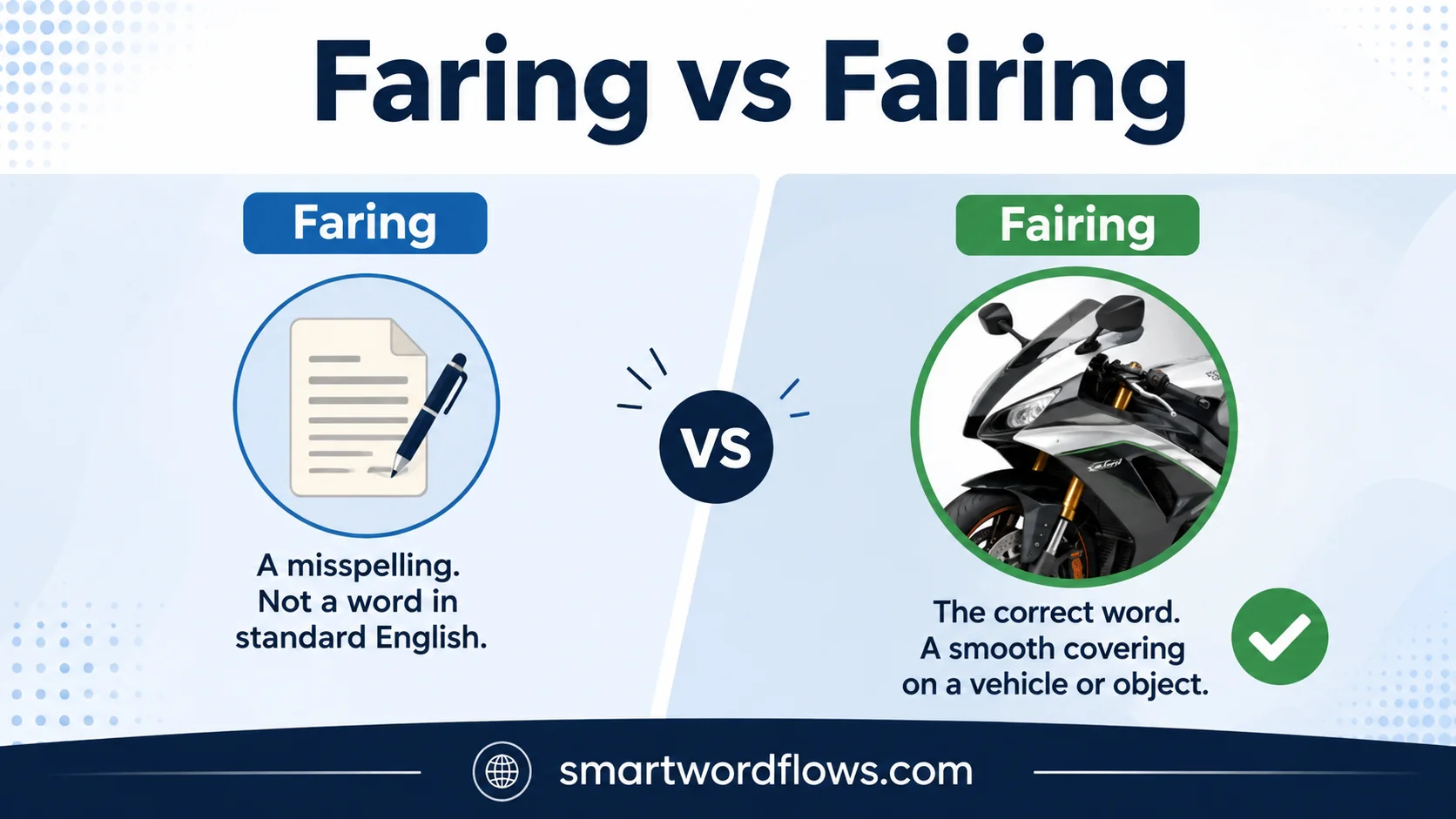

Understanding Faring vs Fairing becomes easier when you focus on meaning and correct usage. Faring describes how a person is doing, coping, or progressing in a life situation. For example, How are you faring is the correct expression. In everyday writing, conversation, or an email, using fairing here is a spelling mistake. These homophones sound the same, which causes confusion for many English learners. Knowing this difference helps you avoid common mistakes and use the right word with confidence.
Fairing has a different meaning and is mainly used in engineering, transportation, and vehicle design. A fairing is a physical component that covers or shapes part of a vehicle, often helping its movement through the air. Therefore, How are you fairing is incorrect when asking a person about progress. Learning the difference between faring and fairing improves grammar, vocabulary, and clarity. Simple pronunciation tips, memory tricks, and sentence examples can help you use both words correctly and avoid grammar mistakes in professional writing.
Quick Answer
Faring is the present participle of fare. It means doing, progressing, coping, or succeeding in a particular situation.
Fairing is usually a noun. It refers to a physical structure or covering designed to create a smooth exterior, reduce aerodynamic drag, or deflect wind and rain.
| Word | Meaning | Example |
| Faring | Doing or progressing in a particular way | “How are you faring at your new job?” |
| Fairing | A streamlined or protective structure | “The motorcycle’s fairing was damaged.” |
Here’s the easiest test:
If you mean “doing” or “progressing,” use faring. If you mean a physical structure, use fairing.
For example:
- Correct: “How are you faring after the move?”
- Correct: “The aircraft’s fairing needs inspection.”
- Incorrect: “How are you fairing?”
- Incorrect: “The motorcycle needs a new faring.”
Cambridge defines faring as the present participle of fare, while fare as a verb describes how well or badly someone or something does in a particular situation.
Comparison Overview
The difference between faring vs fairing becomes obvious when you compare their meanings, grammatical roles, and typical contexts.
| Feature | Faring | Fairing |
| Root | Fare | Fair |
| Common part of speech | Verb form | Noun |
| Basic meaning | Doing or progressing | Streamlined structure or covering |
| Typical context | People, businesses, situations, performance | Aircraft, motorcycles, boats, bicycles, vehicles |
| Example | “The students are faring well.” | “The bike has a damaged fairing.” |
| Related word | Fare | Fair |
| Can describe progress? | Yes | No |
| Can name a vehicle component? | No | Yes |
There is an important grammatical clue here.
Faring describes an action or condition. It tells you how someone or something is doing.
Fairing names a thing. In its common technical sense, it identifies a physical component designed to smooth a vehicle’s exterior or manage airflow.
That distinction alone solves most spelling questions.
Main Differences Between Faring vs Fairing
The biggest difference between faring vs fairing isn’t pronunciation. It’s meaning.
Faring Comes From the Verb “Fare”
The word faring comes directly from fare.
In its verbal sense, fare means to succeed, progress, or be treated in a particular way. Cambridge gives examples involving people doing well or badly in exams, elections, and other situations.
The verb follows this pattern:
fare → fared → faring
For example:
- “How did you fare in the interview?”
- “She fared well in the competition.”
- “She is faring well in her new position.”
Notice how the meaning stays consistent. The word always relates to how something or someone is doing.
Fairing Usually Names a Physical Structure
Fairing, on the other hand, commonly functions as a noun.
Merriam-Webster defines the technical sense as a member or structure whose primary function is to produce a smooth outline and reduce drag, such as on an airplane.
The word appears frequently in transportation and engineering.
You might encounter:
- motorcycle fairing
- aircraft fairing
- wheel fairing
- payload fairing
- wing-to-fuselage fairing
- bicycle fairing
- boat fairing
Dictionary.com similarly defines a fairing as a structure on an aircraft or boat that reduces drag, or a structure on a motorcycle or bicycle that helps deflect wind and rain.
One Word Describes Performance, the Other Describes Hardware
Think of the distinction this way:
Faring tells you how something is going. Fairing tells you what a physical component is.
That simple contrast covers the overwhelming majority of everyday uses.
Consider these two sentences:
“The company is faring well.”
Here, faring describes the company’s performance.
“The aircraft has a damaged fairing.”
Here, fairing identifies a physical component.
The spelling changes because the meaning changes.
What Does Faring Mean?
Faring means doing, progressing, coping, or performing in a particular situation.
It is the present participle of fare. Cambridge explicitly identifies faring as the present participle of fare.
The word often appears with an adverb that explains the quality of the progress.
Common combinations include:
- faring well
- faring badly
- faring better
- faring worse
- faring poorly
- faring successfully
For example:
“The new restaurant is faring well despite strong competition.”
The restaurant isn’t physically traveling anywhere. The sentence means the business is doing well.
Likewise:
“How are you faring in your new role?”
This asks how you’re doing or coping in that role.
Faring in Questions
One of the most common uses appears in questions.
“How are you faring?”
This is a somewhat formal or literary way to ask:
- How are you doing?
- How are things going?
- How are you managing?
- How are you coping?
It’s perfectly valid English. Cambridge lists fare as a verb used to describe how well or badly someone or something does in a particular situation.
For everyday American conversation, “How are you doing?” is usually more natural.
Still, “How are you faring?” has a useful place in professional writing, journalism, analysis, and more formal conversation.
Faring in Business and Economics
You can also use faring to describe companies, industries, markets, or economic groups.
Examples include:
- “Small businesses are faring well this year.”
- “Retailers are faring better than analysts expected.”
- “Some industries are faring poorly under the new regulations.”
- “The company’s overseas division is faring worse than its domestic operation.”
The structure remains the same.
Subject + is/are + faring + description
For example:
“The company is faring better than expected.”
Here, faring essentially means performing or progressing.
Faring Examples in Sentences
Context makes the meaning especially clear.
Personal Progress
- “How are you faring after your first month at college?”
- “She is faring well in her new position.”
- “The new employees are faring better than expected.”
Academic Performance
- “The students are faring well in mathematics.”
- “He wasn’t faring well on the practice exams.”
- “The class is faring better this semester.”
Business Performance
- “The company is faring well despite rising costs.”
- “Smaller retailers are faring poorly in the current market.”
- “The regional stores are faring better than the national chain.”
Conditions and Situations
- “The crops are faring well after the recent rainfall.”
- “The old equipment isn’t faring well in extreme temperatures.”
- “The project is faring worse than the team expected.”
In every example, faring describes a state of progress or performance.
What Does Fairing Mean?
A fairing is commonly a structure that gives a vehicle or aircraft a smoother exterior shape.
Its primary aerodynamic purpose is to reduce drag or manage airflow. Depending on the application, a fairing can also shield components from wind, rain, debris, or other environmental exposure.
The concept is easier to understand with a simple example.
Imagine air flowing around a vehicle. If exposed components create abrupt edges, gaps, or protrusions, the airflow can become more turbulent. A carefully shaped fairing can create a smoother transition.
That’s why you’ll find fairings across aviation, automotive engineering, motorcycles, bicycles, marine vehicles, and aerospace systems.
Fairings on Aircraft
Aircraft use many types of fairings.
A fairing can smooth the transition between different parts of an aircraft and reduce unnecessary aerodynamic disruption. Examples include structures around:
- landing gear
- wheels
- wing-to-fuselage junctions
- other external components
The goal isn’t simply to make the aircraft look sleek. Aerodynamic shaping has a functional purpose.
A poorly shaped external component can interfere with airflow. A well-designed fairing can help create a cleaner external profile.
Fairings on Motorcycles
Motorcycle fairings are probably the most familiar example outside aviation.
A motorcycle fairing can surround or partially cover the front and sides of a motorcycle. Its shape helps manage airflow around the motorcycle and rider.
Depending on the motorcycle, a fairing may also provide:
- wind protection
- weather protection
- coverage for mechanical components
- aerodynamic benefits
- a smoother exterior appearance
For example:
“The rider replaced the cracked fairing after the accident.”
Here, fairing clearly refers to a physical motorcycle component.
Fairings on Bicycles
Fairings can also appear on bicycles, particularly specialized or aerodynamic designs.
A fairing may cover part of the bicycle or rider to reduce exposure to airflow. This application becomes especially relevant when designers focus heavily on aerodynamic efficiency.
Dictionary.com specifically includes bicycle structures that deflect wind and rain in its definition of fairing.
Fairings on Boats
Fairings aren’t limited to vehicles that travel through air.
Marine designs can use fairings to create smoother external shapes and manage water flow around structures. In this environment, the same basic engineering principle applies: a smoother shape can reduce unwanted resistance or turbulence.
Rocket Payload Fairings
A particularly important aerospace use is the payload fairing.
A rocket payload fairing is the protective enclosure around a payload during the atmospheric portion of launch. It helps protect satellites or spacecraft from aerodynamic forces and environmental conditions during ascent.
Modern rocket systems frequently use large composite payload fairings. Merriam-Webster’s current examples include rocket payload fairings and reusable fairing systems.
So if you read:
“The rocket’s payload fairing separated after atmospheric ascent.”
The spelling is fairing, not faring.
Faring vs Fairing in Common Sentences
Side-by-side examples make the difference almost impossible to miss.
| Sentence | Correct Word | Why |
| “How are you faring?” | Faring | It means “How are you doing?” |
| “The company is faring well.” | Faring | It describes performance. |
| “The students are faring poorly.” | Faring | It describes academic progress. |
| “The motorcycle’s fairing is cracked.” | Fairing | It names a physical component. |
| “The aircraft fairing reduces drag.” | Fairing | It describes an aerodynamic structure. |
| “The rocket’s payload fairing separated.” | Fairing | It names a protective aerospace structure. |
The rule remains consistent across every example.
Faring = performance or progress.
Fairing = physical structure.
Also Read This: Check-in vs Check In: Meaning, Grammar, Rules, and Real-World Usage
“How Are You Faring?” vs “How Are You Fairing?”
This is probably the most common point of confusion.
The correct sentence is:
How are you faring?
Why?
Because the question asks how you’re doing. The verb fare means to succeed or progress in a particular way.
The sentence isn’t referring to a physical object.
Therefore:
How are you faring?
How are you fairing?
The second spelling changes the word into a noun associated with structures and coverings. It doesn’t mean “doing.”
More Examples of the Same Pattern
- “How are the new employees faring?”
- “How is the business faring?”
- “How did the team fare in the tournament?”
- “The students are faring better this year.”
Compare them with:
- “The motorcycle needs a new fairing.”
- “The aircraft’s fairing was inspected.”
- “The rocket’s fairing protects the payload.”
The first group deals with performance.
The second group deals with physical structures.
Common Mistakes With Faring and Fairing
These words create a handful of predictable spelling errors.
Writing “Fairing Well”
If you’re saying that someone is doing well, use faring well.
Correct:
“She is faring well in her new position.”
Incorrect for this meaning:
“She is fairing well in her new position.”
The mistake happens because fair feels semantically related to something positive. However, fairing isn’t the verb form of fair in this sentence.
Writing “Motorcycle Faring”
When referring to motorcycle bodywork, use fairing.
Correct:
“The motorcycle’s fairing was scratched.”
Incorrect:
“The motorcycle’s faring was scratched.”
The physical component requires fairing.
Confusing “Fairing” With “Fair”
There’s an interesting linguistic connection here.
Merriam-Webster lists fair as a verb meaning to join surfaces so that they blend smoothly. Its present participle is fairing.
That helps explain why the technical noun fairing relates to smooth external shapes.
In other words, the technical sense isn’t an arbitrary spelling accident.
Faring vs Fairing Pronunciation
Pronunciation can make this pair especially tricky.
In American English, the words are commonly pronounced very similarly. Merriam-Webster gives fairing as /ˈfer-iŋ/.
Cambridge gives the pronunciation of fare in American English as /fer/, which helps explain why faring and fairing can sound nearly indistinguishable in ordinary speech.
That means you can’t reliably solve the spelling problem by listening.
Context is your best clue.
If you’re talking about someone’s performance, think fare → faring.
If you’re talking about an aerodynamic structure, think fair → fairing.
The Word “Fairing” Has Other Meanings
There’s one wrinkle worth knowing.
Fairing has older British meanings unrelated to aircraft or motorcycles. Merriam-Webster lists fairing as a British noun meaning a present bought or given at a fair.
Collins also records an archaic meaning involving a present from a fair and a British meaning referring to a sweet circular biscuit.
These meanings are much less relevant to modern American English.
For most contemporary readers, especially in American English, fairing will usually appear in a technical or transportation context.
That doesn’t make the older meanings wrong. It simply means they occupy a much narrower corner of modern vocabulary.
Faring vs Fairing: A Simple Memory Trick
You don’t need a complicated mnemonic.
Remember this:
Faring = Fare = Doing
Fairing = Fair = Physical shaping
When you see faring, ask:
“How is someone or something doing?”
When you see fairing, ask:
“What physical structure is being described?”
Here are two examples worth memorizing:
How are you faring? → How are you doing?
The motorcycle fairing is damaged. → The motorcycle’s bodywork is damaged.
One letter changes the meaning dramatically.
When Should You Use Faring?
Use faring when you describe how someone or something is performing, progressing, or coping.
Common situations include:
- personal circumstances
- academic performance
- business performance
- professional progress
- political performance
- economic conditions
- project progress
- how something handles difficult conditions
A useful substitution test works surprisingly well.
Try replacing faring with doing.
If the sentence still makes sense, faring may be the correct choice.
For example:
“The company is faring well.”
Becomes:
“The company is doing well.”
The meaning remains intact.
Another example:
“How are you faring?”
Becomes:
“How are you doing?”
Again, the meaning stays essentially the same.
When Should You Use Fairing?
Use fairing when you’re naming a physical structure that smooths an exterior shape, manages airflow, reduces drag, or provides protection.
Common contexts include:
- aircraft
- motorcycles
- bicycles
- boats
- cars
- rockets
- spacecraft
- other aerodynamic vehicles
A quick physical-object test helps.
Ask:
Could I point to the thing I’m calling a fairing?
If yes, there’s a good chance fairing is the right word.
For example:
“The motorcycle’s fairing is cracked.”
You can point to the component.
Likewise:
“The rocket’s fairing protects the payload.”
You can identify the physical enclosure.
That doesn’t work with:
“The company is faring well.”
You can’t point to faring because it describes the company’s performance rather than naming an object.
A Practical Case Study: One Spelling Error Changes the Meaning
Imagine you’re writing a motorcycle review.
You want to say:
“The bike is faring well on winding roads.”
That’s grammatically correct if you’re discussing how the motorcycle is performing.
Now suppose you write:
“The bike’s fairing improves wind protection.”
That’s also correct. Here, you’re discussing the motorcycle’s physical bodywork.
Now switch the words:
“The bike is fairing well on winding roads.”
This becomes a spelling error if you intend faring to mean performing.
And:
“The bike’s faring improves wind protection.”
That also fails because faring doesn’t name the bodywork.
The lesson is simple: the correct spelling follows the intended meaning.
Faring vs Fairing in Professional Writing
The distinction matters even more in technical, academic, and business writing.
A spelling mistake can change the apparent meaning of a sentence and make an otherwise polished document look careless.
Consider a business report:
“Small manufacturers are faring better than larger competitors.”
The writer is comparing business performance.
Now consider an engineering report:
“The new fairing design reduces aerodynamic drag.”
The writer is discussing a physical design.
These words may appear next to technical vocabulary, but they play entirely different roles.
Using the wrong spelling can make the sentence look as though the writer misunderstood the underlying concept.
Faring vs Fairing: Related Words
Understanding related forms makes the distinction easier to remember.
Words Related to Faring
The main family comes from fare:
- fare
- fares
- fared
- faring
Examples:
“How did they fare?”
“They fared well.”
“They are faring well.”
The underlying idea remains doing or progressing.
Words Related to Fairing
The technical noun connects to fair in the sense of creating a smooth external form.
Related technical terms can include:
- fair
- faired
- fairing
- fairings
Merriam-Webster defines fair as a verb meaning to join surfaces so their external surfaces blend smoothly.
This explains the engineering sense of fairing more clearly.
FAQs:
1. What is the difference between faring and fairing?
Faring describes how someone is doing, coping, or progressing. Fairing usually refers to a physical part used in vehicle design, engineering, or transportation.
2. Is “How are you faring?” correct?
Yes. How are you faring? is the correct expression when asking someone how they are doing or how a situation is progressing.
3. Is “How are you fairing?” correct?
No, not when you’re asking about someone’s well-being or progress. In that context, faring is the correct word.
4. Why do people confuse faring and fairing?
People often confuse them because they are homophones. They have the same pronunciation but different spellings, meanings, and uses.
5. How can I remember faring vs. fairing?
Remember faring for a person or situation and fairing for a physical component related to engineering or vehicles.
Conclusion:
The difference between faring and fairing is simple once you understand their meanings. Use faring when talking about how someone is doing, coping, or progressing. Use fairing when referring to a physical component used in transportation or vehicle design. Remembering these different contexts will help you avoid common spelling mistakes and use both words correctly with confidence.