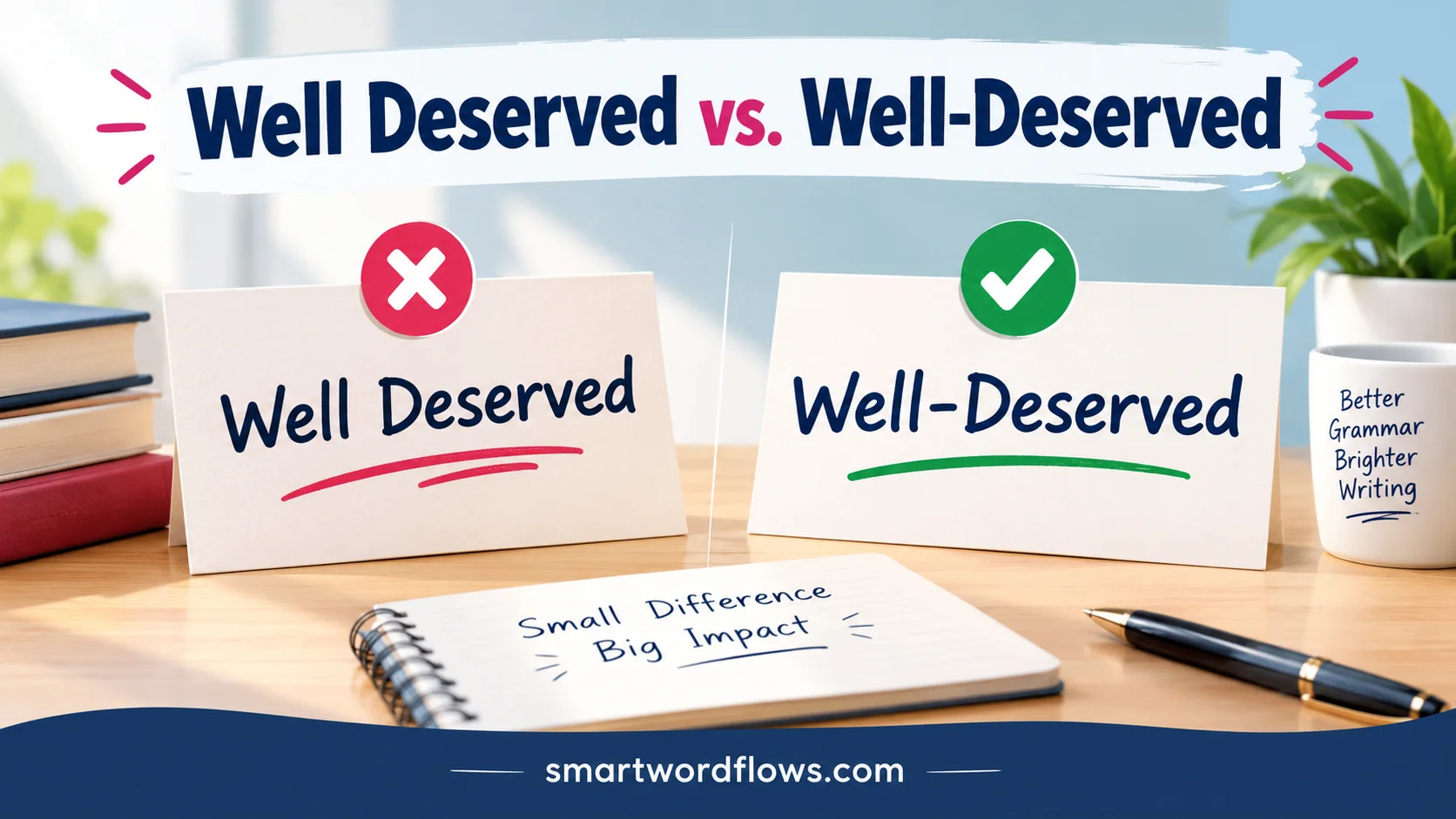

When comparing Well Deserved vs. Well-Deserved, understanding the correct hyphenation helps you write clearly and professionally. Both forms can be correct depending on how you use them in a sentence. Well deserved usually follows a verb, while well-deserved commonly works as a compound adjective before a noun. Knowing this small but important grammar rule can make your writing sound more natural and polished.
The phrase well deserved means that someone or something has fully earned praise, recognition, or a reward. For example, you might say that someone received a well-deserved award or that their success was well deserved. The main difference depends on the phrase’s position and grammatical role. Once you understand this simple distinction, you can confidently choose the correct form in everyday writing, professional communication, and formal English.
Quick Answer
Both well deserved and well-deserved are correct. The difference usually comes down to grammatical position.
Use well-deserved when the two words work together as a compound adjective before a noun.
She received a well-deserved award.
Use well deserved when the phrase comes after a linking verb and describes the subject.
Her award was well deserved.
The Simple Rule
Before a noun → well-deserved
After a linking verb → well deserved
Here are a few quick comparisons:
| Sentence | Correct Form | Reason |
| She earned a well-deserved promotion. | well-deserved | It modifies promotion before the noun. |
| Her promotion was well deserved. | well deserved | It follows the linking verb was. |
| They received well-deserved recognition. | well-deserved | It modifies recognition. |
| The recognition was well deserved. | well deserved | It follows was. |
| He enjoyed a well-deserved break. | well-deserved | It modifies break. |
| His break was well deserved. | well deserved | It follows was. |
The easiest way to remember the distinction is to look at what comes immediately after the phrase.
Comparison Overview
Well-deserved and well deserved don’t normally express different ideas. Both mean that something is earned, justified, or appropriate because of someone’s actions, effort, qualities, or achievements.
The difference lies mainly in how the phrase functions grammatically.
| Feature | Well-Deserved | Well Deserved |
| Number of words | Two connected by a hyphen | Two separate words |
| Main function | Compound adjective | Adjective phrase |
| Typical position | Before a noun | After a linking verb |
| Meaning | Fully earned or justified | Fully earned or justified |
| Example | A well-deserved reward | The reward was well deserved |
| Common error | Omitting the hyphen before a noun | Adding an unnecessary hyphen after a linking verb |
Consider these two sentences:
She received a well-deserved promotion.
Her promotion was well deserved.
The meaning barely changes. The sentence structure does.
In the first sentence, well-deserved sits directly before promotion and acts as a combined modifier. In the second sentence, well deserved follows was and describes the promotion independently.
A Useful Grammar Pattern
You can think of the difference this way:
well + deserved + noun → well-deserved + noun
noun + linking verb + well deserved
For example:
- well-deserved praise
- well-deserved success
- well-deserved recognition
- well-deserved rest
But:
- The praise was well deserved.
- Her success was well deserved.
- The recognition was well deserved.
- The rest was well deserved.
This pattern handles most everyday uses correctly.
Main Differences Between Well Deserved and Well-Deserved
The main difference between well deserved vs. well-deserved isn’t meaning. Instead, it involves sentence structure and the role the phrase plays.
Well-Deserved Comes Before a Noun
When well and deserved combine to modify a noun that follows, the hyphen makes their relationship clear.
For example:
Maria received a well-deserved promotion.
Here, well-deserved describes the noun promotion. The two words function as one compound modifier.
Without the hyphen, readers can still understand the sentence:
Maria received a well deserved promotion.
However, standard edited English generally favors well-deserved in this construction.
The same principle applies to many similar expressions:
- a well-deserved vacation
- a well-deserved reward
- a well-deserved victory
- a well-deserved compliment
- a well-deserved opportunity
- a well-deserved reputation
Well Deserved Follows a Linking Verb
When the phrase appears after a linking verb such as is, are, was, were, seems, or feels, you generally don’t hyphenate it.
For example:
The promotion was well deserved.
Here, well deserved describes the subject promotion after the linking verb was. It doesn’t sit directly before the noun as a compound modifier.
More examples include:
Her success is well deserved.
The team’s victory was well deserved.
Your recognition is well deserved.
The employee’s praise seems well deserved.
This distinction is simple once you start looking at sentence position instead of the words themselves.
What Does “Well-Deserved” Mean?
Well-deserved means fully earned, justified, or appropriate because someone has earned something through effort, behavior, achievement, or merit.
The word commonly describes something positive that a person has earned, such as recognition, praise, rest, success, or a reward.
For example:
After months of difficult work, she received a well-deserved promotion.
The promotion isn’t merely deserved. Calling it well-deserved emphasizes that the circumstances strongly support the person’s claim to it.
The expression can also describe things that aren’t necessarily rewards:
The player received well-deserved criticism after repeatedly ignoring the team’s instructions.
So, well-deserved doesn’t always mean praise. It means that something is appropriately earned or justified.
Common Things Described as Well-Deserved
You can naturally use well-deserved with many nouns:
- well-deserved praise
- well-deserved recognition
- well-deserved success
- well-deserved rest
- well-deserved vacation
- well-deserved reward
- well-deserved promotion
- well-deserved victory
- well-deserved attention
- well-deserved criticism
The meaning depends on the noun that follows.
What Does “Well Deserved” Mean?
Well deserved has essentially the same meaning as well-deserved. It describes something that someone has earned or something that circumstances justify.
The important difference is grammatical.
When well deserved appears after a linking verb, you normally leave the words open:
The award was well deserved.
Her promotion was well deserved.
The team’s victory was well deserved.
Your vacation is well deserved.
Here, well modifies deserved, while the entire phrase acts as a description of the subject.
Think of it as a normal adjective phrase rather than a compound adjective placed before a noun.
When to Use “Well-Deserved” With a Hyphen
Use well-deserved when the phrase comes before a noun and works as a compound modifier.
The hyphen connects well and deserved so readers understand that the two words belong together as a unit describing the following noun.
Examples of Well-Deserved Before a Noun
- She received a well-deserved promotion after consistently exceeding her targets.
- The athlete celebrated a well-deserved victory after years of disciplined training.
- After finishing the project, the team enjoyed a well-deserved break.
- His manager gave him well-deserved recognition during the annual meeting.
- The author earned well-deserved praise for the novel’s thoughtful storytelling.
- They finally took a well-deserved vacation after an exhausting year.
- Her dedication earned her a well-deserved reward from the organization.
- The teacher received a well-deserved compliment from one of her former students.
- The company achieved well-deserved success after improving its customer service.
- He received a well-deserved opportunity to lead the new project.
In every example, well-deserved comes immediately before the noun it modifies.
When to Use “Well Deserved” Without a Hyphen
Use well deserved when it follows the noun it describes, especially after a linking verb.
This construction often follows forms of to be:
- is well deserved
- are well deserved
- was well deserved
- were well deserved
It can also follow other linking verbs in suitable contexts.
Examples of Well Deserved Without a Hyphen
- Her promotion was well deserved after years of excellent performance.
- The team’s victory was well deserved because they dominated the entire match.
- Your break is well deserved after such a demanding week.
- The award was well deserved and reflected years of creative work.
- His success is well deserved because he worked consistently toward his goal.
- Their recognition was well deserved after the successful launch.
- The criticism was well deserved because the mistake affected several customers.
- Her praise was well deserved after she solved the difficult problem.
Notice how the phrase follows the subject and linking verb in each example.
Why Is “Well-Deserved” Hyphenated?
The hyphen comes from the general rules governing compound modifiers.
A compound modifier combines multiple words that work together to describe a noun. When that compound appears before a noun, writers often use a hyphen to show that the words function as a single descriptive unit.
Compare:
- a well-deserved award
- a long-term strategy
- a high-quality product
- a full-time employee
- a well-known author
The hyphen helps readers process the words as a unit.
In well-deserved award, well doesn’t independently describe award. Instead, well-deserved describes the award as a whole.
That distinction matters because punctuation can clarify relationships between words.
The Hyphen Isn’t Changing the Meaning
It’s important not to think of the hyphen as creating a completely different word.
Well-deserved and well deserved generally communicate the same basic idea.
The hyphen primarily reflects how the phrase functions in the sentence.
That’s why these two sentences can describe essentially the same situation:
She received a well-deserved reward.
The reward was well deserved.
The punctuation changes because the grammatical structure changes.
Why Is “Well Deserved” Sometimes Written Without a Hyphen?
When well deserved appears after a linking verb, it functions as a predicate adjective phrase rather than a compound modifier placed before a noun.
Consider:
The award was well deserved.
The subject is the award. The verb was links that subject to the description well deserved.
Now compare:
She received a well-deserved award.
Here, well-deserved directly modifies award.
This difference explains why the hyphen appears in one sentence but not the other.
The Contrast in One Glance
Before noun:
a well-deserved achievement
After linking verb:
The achievement was well deserved.
Before noun:
a well-deserved compliment
After linking verb:
The compliment was well deserved.
Before noun:
a well-deserved rest
After linking verb:
The rest was well deserved.
Well Deserved vs. Well-Deserved in Different Sentence Positions
Sentence position provides one of the fastest ways to determine which form you need.
| Sentence Position | Preferred Form | Example |
| Before a noun | well-deserved | She earned a well-deserved reward. |
| After is | well deserved | The reward is well deserved. |
| After was | well deserved | The reward was well deserved. |
| Before a noun | well-deserved | He received a well-deserved promotion. |
| After seems | well deserved | The promotion seems well deserved. |
| Before a noun | well-deserved | They enjoyed a well-deserved vacation. |
This isn’t an absolute substitute for checking the entire sentence, but it works for the vast majority of ordinary constructions.
Common Examples of “Well-Deserved”
The expression appears frequently in professional writing, news articles, sports coverage, personal messages, and everyday conversation.
Well-Deserved Promotion
Congratulations on your well-deserved promotion.
The phrase works because well-deserved modifies promotion.
Well-Deserved Recognition
Her contributions earned well-deserved recognition from the organization.
Again, the compound adjective comes before recognition.
Well-Deserved Praise
The restaurant received well-deserved praise for its excellent service.
The phrase emphasizes that the praise matches the quality of the service.
Well-Deserved Break
After completing the demanding assignment, he took a well-deserved break.
This is especially common in casual and workplace communication.
Well-Deserved Victory
The team celebrated a well-deserved victory after controlling the game from start to finish.
Sports writers frequently use this construction because victories can result directly from strong performance.
Common Examples of “Well Deserved”
The unhyphenated form is equally common when the phrase follows a linking verb.
With “Was”
The award was well deserved.
With “Is”
Her success is well deserved.
With “Seems”
His recognition seems well deserved.
With “Feels”
After such a difficult year, the vacation feels well deserved.
With “Were”
Their congratulations were well deserved after the successful project.
The phrase remains open because it doesn’t directly precede and modify a noun.
Also Read This: Challenge vs Challange: Which Is Actually Right?
Well-Deserved in Professional and Formal Writing
Well-deserved works naturally in professional communication when it appears before a noun.
For example:
Congratulations on your well-deserved promotion.
That’s polished, warm, and grammatically appropriate.
You might also write:
The team received well-deserved recognition for completing the project ahead of schedule.
Or:
Her well-deserved achievement reflects years of consistent effort.
In a performance review, award announcement, recommendation, or company newsletter, the expression can communicate praise without sounding overly dramatic.
Professional Examples
- well-deserved promotion
- well-deserved recognition
- well-deserved award
- well-deserved accomplishment
- well-deserved success
- well-deserved praise
When the phrase follows a linking verb, use the open form:
Your promotion is well deserved.
The award was well deserved.
Both constructions belong comfortably in formal writing.
Well-Deserved in Casual and Everyday Writing
You don’t need formal writing to use well-deserved correctly.
The phrase appears naturally in texts, social media posts, congratulations, workplace chats, and conversations.
For example:
You definitely earned that well-deserved break!
Or:
That’s a well-deserved win!
You could also say:
Your vacation is well deserved!
The same grammar applies whether you’re writing a formal letter or sending a quick message to a friend.
Common Mistakes With Well Deserved and Well-Deserved
Although the rule is straightforward, several mistakes appear frequently.
Omitting the Hyphen Before a Noun
Incorrect in standard edited usage:
She received a well deserved promotion.
Preferred:
She received a well-deserved promotion.
Because the compound modifier appears directly before promotion, the hyphen makes the construction clearer.
Adding the Hyphen After a Linking Verb
Less appropriate:
Her promotion was well-deserved.
Preferred:
Her promotion was well deserved.
The phrase comes after was rather than directly before a noun.
Hyphenating Every Occurrence
A common mistake involves treating well-deserved as though it always requires a hyphen.
That’s not how compound modifiers generally work.
Compare:
a well-deserved award
with:
The award was well deserved.
The second sentence doesn’t need the hyphen.
Assuming the Forms Have Different Meanings
They generally don’t.
The words communicate essentially the same idea. Grammar determines the form, not a major difference in definition.
Incorrect vs. Correct Examples
| Incorrect or Less Preferred | Correct | Explanation |
| She received a well deserved award. | She received a well-deserved award. | The compound modifier comes before award. |
| He earned a well deserved promotion. | He earned a well-deserved promotion. | The phrase modifies promotion. |
| The award was well-deserved. | The award was well deserved. | It follows the linking verb was. |
| Her success is well-deserved. | Her success is well deserved. | It follows is. |
| They enjoyed a well deserved vacation. | They enjoyed a well-deserved vacation. | The compound adjective precedes vacation. |
| The vacation was well-deserved. | The vacation was well deserved. | The phrase follows was. |
Does “Well-Deserved” Always Need a Hyphen?
No.
The phrase doesn’t require a hyphen every time you use it.
The usual distinction is based on whether it functions as a compound modifier before a noun or as an adjective phrase after a linking verb.
Before a Noun
She earned a well-deserved reward.
After a Linking Verb
The reward was well deserved.
That’s the key difference.
However, English punctuation can involve style choices at the margins. Different dictionaries and style guides sometimes handle individual compounds differently, particularly as language evolves.
For ordinary writing, though, the before-a-noun versus after-a-linking-verb rule gives you a reliable and widely accepted approach.
Well-Deserved vs. Well Deserved vs. Related Expressions
Several expressions overlap with well-deserved, but they aren’t always interchangeable in every sentence.
| Expression | Meaning | Example |
| well-deserved | Fully earned or justified | a well-deserved reward |
| well deserved | Fully earned or justified | The reward was well deserved. |
| earned | Obtained through effort or merit | She earned the promotion. |
| hard-earned | Gained through significant effort | His hard-earned success mattered deeply. |
| merited | Deserved based on merit | The criticism was merited. |
| justified | Supported by good reasons or circumstances | The decision was justified. |
| warranted | Reasonable or justified under the circumstances | The concern was warranted. |
Hard-earned deserves particular attention because it has a related but slightly different emphasis. Something well-deserved is appropriately earned, while something hard-earned highlights the difficulty or effort involved in obtaining it.
For example:
She received a well-deserved promotion.
This focuses on why she deserves the promotion.
She celebrated her hard-earned promotion.
This emphasizes the effort required to achieve it.
How to Remember the Hyphenation Rule
If punctuation rules tend to slip through the cracks, use this simple test.
Ask: “Does It Come Before a Noun?”
If yes, well-deserved is generally the right choice.
a well-deserved award
a well-deserved break
a well-deserved promotion
If the phrase comes after a linking verb, use well deserved.
The award was well deserved.
The break was well deserved.
The promotion was well deserved.
The Memory Trick
Before the noun? Grab the hyphen.
After the linking verb? Leave it open.
It’s short enough to remember when you’re proofreading an email five minutes before hitting send.
Well Deserved vs. Well-Deserved: Comparison Table
| Question | Well-Deserved | Well Deserved |
| Is it correct? | Yes | Yes |
| Does it usually contain a hyphen? | Yes | No |
| Where does it commonly appear? | Before a noun | After a linking verb |
| Does it mean “earned or justified”? | Yes | Yes |
| Example | a well-deserved opportunity | The opportunity was well deserved |
| Example | well-deserved praise | The praise was well deserved |
| Main grammatical role | Compound modifier | Predicate adjective phrase |
The important point is that neither form is inherently “more correct.” The sentence determines which form you need.
Examples in Context
Seeing both forms inside complete passages makes the distinction easier to recognize.
Workplace Example
After completing a difficult project ahead of schedule, Daniel received a well-deserved promotion. His manager explained that the promotion was well deserved because Daniel consistently delivered strong results.
The first instance comes before promotion, so it uses the hyphen. The second follows was, so it doesn’t.
Academic Example
After years of research, the professor received a well-deserved award for her contribution to the field. Her colleagues agreed that the honor was well deserved.
Again, the sentence position controls the punctuation.
Sports Example
The team earned a well-deserved victory after controlling the match from beginning to end. By the final whistle, even the opposing coach admitted that the victory was well deserved.
The meaning remains consistent while the grammatical structure changes.
Personal Example
After working seven long days, Maya finally took a well-deserved rest. Nobody questioned whether the rest was well deserved.
This example shows how naturally both forms can appear in the same paragraph.
A Practical Case Study: Editing a Congratulations Message
Imagine that you’re writing this message:
Congratulations on your well deserved promotion! Your success is well-deserved, and you’ve earned this well deserved recognition.
At first glance, the meaning is perfectly clear. However, the punctuation isn’t consistent.
A cleaner version would be:
Congratulations on your well-deserved promotion! Your success is well deserved, and you’ve earned this well-deserved recognition.
Why?
- well-deserved promotion → before the noun promotion
- well deserved → follows the linking verb is
- well-deserved recognition → before the noun recognition
This illustrates an important editing principle: don’t choose one spelling and apply it everywhere. Examine the role of the phrase each time it appears.
Is “Well-Deserved” Professional and Correct?
Yes. Well-deserved is a standard and appropriate expression in professional writing when it modifies a noun.
For example:
Congratulations on your well-deserved promotion.
She received well-deserved recognition for her leadership.
The organization presented him with a well-deserved award.
These sentences sound natural in workplace communication.
The phrase also works well when you want to offer sincere praise without becoming overly elaborate. It tells the reader that the achievement isn’t accidental or undeserved.
Is “Well Deserved” Professional and Correct?
Yes. Well deserved is also professional and grammatically correct when it follows a linking verb.
For example:
Your promotion is well deserved.
The award was well deserved.
Her recognition was well deserved.
There’s no reason to think the open form sounds casual simply because it doesn’t contain a hyphen.
In fact, both forms frequently appear in polished professional writing. Their difference comes from syntax, not formality.
A Quick Editing Checklist
Before publishing or sending your writing, check the phrase’s position.
- Does “well deserved” come directly before a noun? Use well-deserved.
- Does it follow a linking verb such as “is” or “was”? Use well deserved.
- Does the phrase modify the following noun as one combined description? The hyphen is generally appropriate.
- Are you using the phrase after the subject and a linking verb? Leave it open.
- Are you following a particular editorial style guide? Check its rules for unusual or specialized constructions.
- Have you applied the same grammatical principle consistently? Check every occurrence separately.
Is “Well Deserved” One Word or Two Words?
Well deserved is normally written as two words when it appears as an adjective phrase after a linking verb.
Correct:
The award was well deserved.
It isn’t normally written as welldeserved.
When it appears before a noun as a compound modifier, use the hyphenated form:
It was a well-deserved award.
So the three forms shouldn’t be confused:
- ❌ welldeserved
- ✅ well deserved
- ✅ well-deserved
The last two forms are both correct in the appropriate grammatical contexts.
Which Is Correct: “A Well Deserved Reward” or “A Well-Deserved Reward”?
The preferred form is:
A well-deserved reward
Here, well-deserved directly modifies reward before the noun. The hyphen joins the words into a compound modifier.
Similarly:
a well-deserved compliment
a well-deserved opportunity
a well-deserved victory
a well-deserved break
Which Is Correct: “The Reward Was Well-Deserved” or “The Reward Was Well Deserved”?
The preferred form is:
The reward was well deserved.
Because well deserved follows the linking verb was, you generally don’t need the hyphen.
Compare the two constructions:
She received a well-deserved reward.
The reward was well deserved.
Both sentences are correct. The difference comes from where the phrase appears.
Here are 5 clear FAQs followed by a concise conclusion:
FAQs :
1. Is “well deserved” or “well-deserved” correct?
Both forms can be correct. Use well-deserved before a noun as a compound adjective, such as “a well-deserved reward.” Use well deserved after a verb, such as “The reward was well deserved.”
2. What does “well deserved” mean?
Well deserved means that someone or something has fully earned praise, recognition, a reward, or a positive result through their actions or achievements.
3. When should I use “well-deserved” with a hyphen?
Use well-deserved when the two words work together as an adjective directly before a noun. For example, “She received a well-deserved promotion.”
4. Is “well deserve” grammatically correct?
No. Well deserve is generally incorrect when you mean that someone has earned something. The correct expression is usually well deserved or well-deserved, depending on its position in the sentence.
5. What is an example of “well deserved”?
A common example is: “Your success is well deserved.” Here, the phrase comes after the verb “is,” so it doesn’t need a hyphen.
Conclusion :
Understanding Well Deserved vs. Well-Deserved is easier when you focus on how the phrase functions in a sentence. Use well-deserved before a noun and well deserved after a linking verb. This simple rule will help you avoid common grammar mistakes and make your writing clearer and more professional.