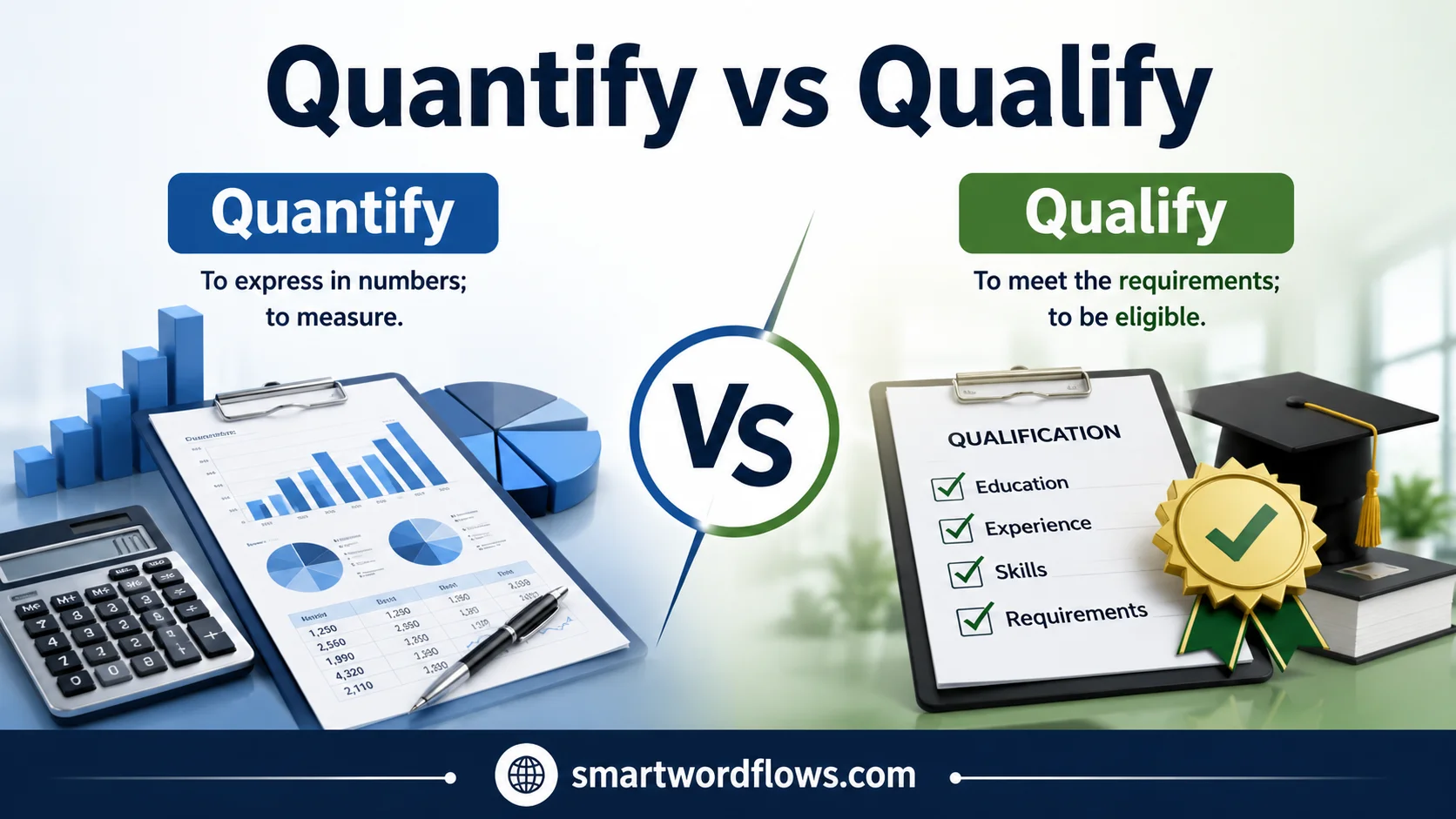

Quantify vs Qualify can confuse students, professionals, and experienced writers because both words look and sound similar but have different meanings. Quantify means to measure, count, or express an amount, quantity, or number. Qualify means to modify, limit, or describe precisely an idea, condition, or requirement. When you are wondering which word to write in a sentence, focus on the key difference: quantify deals with measurable information, while qualify adds a condition or limitation. This distinction helps you choose the right word correctly.
In academic writing, business writing, science, and everyday conversations, these words have useful roles. You can quantify sales, results, costs, or survey data when you need measurable figures. You can qualify a statement when you need to add a limitation, condition, or specific requirement. Related terms such as quantitative and qualitative can also help explain the difference. Using simple grammar tips, real-world examples, and practice exercises makes the comparison easier and prevents confusion in professional writing.
Quick Answer
Quantify means to measure or express something in numbers.
Qualify means to meet requirements, describe something more precisely, or add limits and conditions to a statement.
A fast memory trick helps here:
- Quantify = quantity = numbers
- Qualify = quality or qualification = conditions, standards, or details
If you are talking about how much or how many, use quantify. If you are talking about whether something meets a standard or needs more detail, use qualify.
Comparison Overview
Here is the simplest way to compare quantify vs qualify.
| Word | Main Meaning | Core Idea | Common Use | Example |
| Quantify | Measure or express in numbers | Quantity | Data, research, business, finance | “The report quantified the sales increase at 18%.” |
| Qualify | Meet requirements, add detail, or limit a statement | Quality, conditions, precision | Jobs, education, writing, formal speech | “She qualified her comment by adding more context.” |
The table shows the main split clearly. Quantify gives you measurable facts. Qualify gives you conditions, standards, or clarification.
Main Differences Between Quantify vs Qualify
The difference between quantify and qualify gets easier once you look at what each word asks for.
Quantify asks about measurement
When you quantify something, you answer questions like:
- How much?
- How many?
- To what extent?
- What is the amount?
That makes quantify a measurement word. It belongs in reports, research, analytics, and any setting where numbers matter.
Examples:
- The team quantified the damage after the flood.
- Scientists quantified the bacteria in the sample.
- The company quantified the financial loss from the outage.
Qualify asks about conditions or detail
When you qualify something, you may be doing one of three things:
- Meeting a requirement
- Adding detail or limitation to a statement
- Describing a quality or characteristic
That makes qualify a conditions word. It often appears in job applications, legal language, academic writing, and careful everyday speech.
Examples:
- She qualified for the scholarship.
- He qualified his statement because the data was incomplete.
- Her experience qualifies her for the role.
The real difference in one line
- Quantify turns an idea into a measurable amount.
- Qualify turns a statement into something more specific, limited, or eligible.
That is the core distinction. Keep that in mind, and the rest becomes much easier.
What Quantify Means
Quantify means to measure, count, calculate, or express something in numerical terms. If you can attach a number to it, you can usually quantify it.
This word comes up all the time in modern writing because people want evidence. They want data. They want proof. Quantifying something gives it structure and makes it easier to compare.
What you quantify
You can quantify things such as:
- Sales growth
- Customer satisfaction
- Traffic
- Losses
- Time
- Errors
- Performance
- Risk
- Damage
- Participation
Why quantifying matters
Numbers help people make decisions. A vague claim like “traffic improved” does not say much. A quantified claim like “traffic improved by 32% in one month” tells a much fuller story.
That is why business leaders, researchers, teachers, and analysts rely on quantification. It removes guesswork and gives readers something concrete.
Examples of quantify in context
- The hospital quantified patient wait times to improve service.
- The startup quantified user engagement through monthly active users.
- The teacher quantified student progress using test scores.
- The city quantified air pollution across five neighborhoods.
A useful way to think about quantify
Imagine you are holding a basket of apples. If you say, “There are apples here,” that sounds general. If you say, “There are 27 apples here,” you have quantified the basket.
That is the difference. Quantify gives shape through numbers.
What Qualify Means
Qualify has more than one meaning, which is part of why people mix it up with quantify. It can mean meeting a requirement, adding a condition or clarification, or having the right qualities for something.
Qualify as meeting requirements
This is one of the most common uses. If someone qualifies for a job, scholarship, loan, tournament, or program, that person meets the required standard.
Examples:
- She qualified for the internship.
- The team qualified for the finals.
- You qualify for free shipping if your order exceeds $50.
Qualify as adding detail or limitation
Writers often qualify statements when they want to avoid sounding too absolute. They add detail so the statement becomes more accurate.
Examples:
- He qualified his opinion by saying the sample was small.
- She qualified her claim with a few exceptions.
- The researcher qualified the result because the study lasted only two weeks.
In this sense, qualify helps you avoid overstatement. It softens a claim when needed.
Qualify as having the right qualities
You may also hear qualify used to describe whether someone has the skills, background, or traits needed for a role.
Examples:
- His years of experience qualify him for the position.
- That certificate qualifies her to teach the course.
- Strong leadership skills qualify him for the promotion.
Why qualify matters
Qualifying language can save you from being too vague or too bold. It helps you stay accurate. It also helps you sound fair and careful, especially in professional writing.
A well-placed qualifier can turn a blunt statement into a precise one.
Quantify vs Qualify: Side-by-Side Meaning
The easiest way to avoid confusion is to compare the two words directly.
| Situation | Correct Word | Why |
| Measuring revenue growth | Quantify | You need numbers |
| Checking scholarship eligibility | Qualify | You need to meet requirements |
| Describing a claim more carefully | Qualify | You are adding detail |
| Reporting customer complaints | Quantify | You are counting or measuring them |
| Saying someone meets a standard | Qualify | The person fits the rule |
| Turning an estimate into a number | Quantify | You are measuring it |
This comparison shows the pattern clearly. Quantify belongs with measurement. Qualify belongs with standards, conditions, or careful wording.
How to Use Quantify Correctly
You should use quantify when your sentence involves a measurable amount or a numeric expression.
Use quantify in research
Researchers quantify results all the time.
- The study quantified changes in blood pressure.
- The survey quantified customer satisfaction.
- The lab quantified the chemical concentration in each sample.
Use quantify in business
Businesses use quantification to make decisions and track performance.
- The company quantified monthly revenue growth.
- The finance team quantified operating costs.
- The marketing team quantified the impact of the campaign.
Use quantify in daily speech
You do not need to work in science or finance to use quantify.
- Can you quantify how much time we wasted?
- It is hard to quantify the value of good advice.
- They quantified the number of missing items.
A simple rule for quantify
If the sentence sounds like it should answer how much or how many, quantify is probably the right choice.
How to Use Qualify Correctly
Use qualify when your sentence involves eligibility, conditions, or added precision.
Use qualify for eligibility
- She qualified for the grant.
- He qualifies for the senior program.
- They did not qualify for the discount.
Use qualify when softening a statement
- I should qualify that comment by saying the sample was limited.
- She qualified her answer with a few examples.
- He qualified the statement to avoid misunderstanding.
Use qualify for skills or standards
- Her certifications qualify her for advanced work.
- The athlete qualifies for international competition.
- His background qualifies him for the role.
A simple rule for qualify
If the sentence sounds like it should answer does it meet the standard? or does it need more detail?, qualify is probably the right choice.
Common Mistakes With Quantify vs Qualify
These two words cause trouble because they feel close. Still, the mistake usually comes from mixing up measurement and eligibility.
Using qualify when you mean quantify
Incorrect:
- The report qualified the number of injuries.
Correct:
- The report quantified the number of injuries.
Why? Because you are talking about a count. That calls for quantify.
Using quantify when you mean qualify
Incorrect:
- She quantified for the scholarship.
Correct:
- She qualified for the scholarship.
Why? Because she met the requirements. That calls for qualify.
Using qualify when you mean add detail
Incorrect:
- He quantified his statement by giving a few exceptions.
Correct:
- He qualified his statement by giving a few exceptions.
Why? He did not measure anything. He made the statement more precise.
Using quantify for vague traits
Incorrect:
- It is hard to quantify someone’s character in a job interview.
This one is tricky. It can be correct if you mean measurement, but it often sounds better with a different word such as assess or evaluate. Not every idea fits neatly into a number.
That is an important point. Some things are easy to quantify. Others are not.
Read More: Plaque vs Plague: Difference, Meaning, and Correct Usage
Real-World Examples of Quantify and Qualify
Examples help the difference stick.
Quantify in real life
- A manager quantifies overtime hours to control labor costs.
- A doctor quantifies blood sugar levels during a checkup.
- A teacher quantifies attendance to track student participation.
- A retailer quantifies returns to spot product problems.
Qualify in real life
- A job applicant qualifies for the interview.
- A coach qualifies the team for the championship round.
- A speaker qualifies a statement by adding context.
- A student qualifies for honors because of strong grades.
The key point is simple. Quantify deals with measurement. Qualify deals with standards, limits, or precision.
Case Study: Choosing the Right Word in Business Writing
Imagine a company preparing a quarterly report.
The marketing team writes:
“We qualified customer engagement and found a strong rise in clicks.”
That sentence sounds wrong. The team did not describe requirements or add limitations. It measured behavior. The better version is:
“We quantified customer engagement and found a strong rise in clicks.”
Now the sentence fits the meaning.
In another part of the report, the manager writes:
“The campaign performed well, but the results came from a small audience.”
That version is fine, but it can improve with qualification:
“The campaign performed well, although the results need to be qualified because the audience was small.”
Here, the word qualified works because it limits the claim. It keeps the statement honest.
This is why language matters in business. The right word does more than sound polished. It protects meaning.
Case Study: Choosing the Right Word in Academic Writing
Now picture a research paper.
A student writes:
“The experiment qualified the amount of water loss in the plants.”
That is incorrect. The student measured water loss. So the sentence should say:
“The experiment quantified the amount of water loss in the plants.”
Later, the student writes:
“The conclusion is based on a very short observation period.”
That idea needs qualification. A stronger academic sentence would be:
“The conclusion should be qualified because the observation period was short.”
In academic writing, this distinction matters a lot. Researchers quantify results. They qualify conclusions. That difference keeps the writing honest and accurate.
Memory Tricks That Actually Help
A good memory trick can save time and prevent mistakes.
Quantify = quantity
Think of quantity. If the word points to numbers, count, amount, or measurement, use quantify.
Example:
- Quantify the amount of time.
- Quantify the number of errors.
Qualify = qualification
Think of qualification. If the word points to eligibility, standards, or added detail, use qualify.
Example:
- Qualify for the job.
- Qualify the statement with context.
Another easy trick
Picture this:
- Quantify asks, “How much?”
- Qualify asks, “Under what conditions?”
That single contrast can help you choose the right word quickly.
Quantify vs Qualify in a Simple Reference Table
| Word | Ask Yourself | Best Used When | Example |
| Quantify | How much or how many? | Measuring data, results, or amounts | “We quantified the results.” |
| Qualify | Does it meet the standard or need more detail? | Eligibility, limitations, clarification | “She qualified for the award.” |
Keep this table in mind, and you will make fewer mistakes in writing.
What to Do When the Difference Is Still Unclear
Sometimes you may know the word feels wrong, but the sentence still sounds fuzzy. In that case, ask yourself one question:
Am I measuring something, or am I describing a condition?
If you are measuring, go with quantify.
If you are describing eligibility, adding precision, or limiting a claim, go with qualify.
Here is a practical test:
- If you can put a number on it, use quantify.
- If you need to explain a standard or limitation, use qualify.
That test works more often than people expect.
Common Pairings and Natural Usage
You will often see these words in certain patterns.
Quantify often appears with
- data
- results
- effects
- impact
- loss
- growth
- risk
- damage
- performance
Qualify often appears with
- for a job
- for a scholarship
- a statement
- a claim
- a result
- the finals
- a requirement
- the position
These pairings can help you spot the right word faster.
Quick Examples You Can Model
Quantify examples
- The analyst quantified the drop in sales.
- The report quantifies the problem clearly.
- It is difficult to quantify trust.
- The survey quantified customer preferences across age groups.
Qualify examples
- She qualified for the next round.
- He qualified his claim with new evidence.
- The statement needs to be qualified.
- His background qualifies him for the leadership role.
FAQs:
1. What is the difference between quantify and qualify?
Quantify means to measure or express something using numbers or amounts. Qualify means to add a condition, limitation, or clarification to a statement.
2. How do you use quantify in a sentence?
You can use quantify when discussing measurable information. For example: The researchers quantified the survey results to identify the most common response.
3. How do you use qualify in a sentence?
Use qualify when adding a condition, limitation, or requirement. For example: The manager qualified her statement by explaining that the results were preliminary.
4. Is quantitative related to quantify?
Yes. Quantitative relates to numbers, measurements, and amounts, while quantify is the verb meaning to measure or express something numerically.
5. What is an easy way to remember quantify vs qualify?
Remember that quantify = quantity and qualify = qualification or condition. If you are dealing with numbers, choose quantify; if you are adding a limitation or condition, choose qualify.
Conclusion
Quantify vs Qualify becomes easier to understand when you remember their core meanings. Quantify focuses on numbers, measurements, and amounts, while qualify focuses on conditions, limitations, and clarifications. Whether you are writing academically, professionally, or conversationally, recognizing this key distinction will help you choose the correct word and communicate your ideas more precisely. Practice with real-world examples, and you will quickly avoid confusing these two similar-looking words.