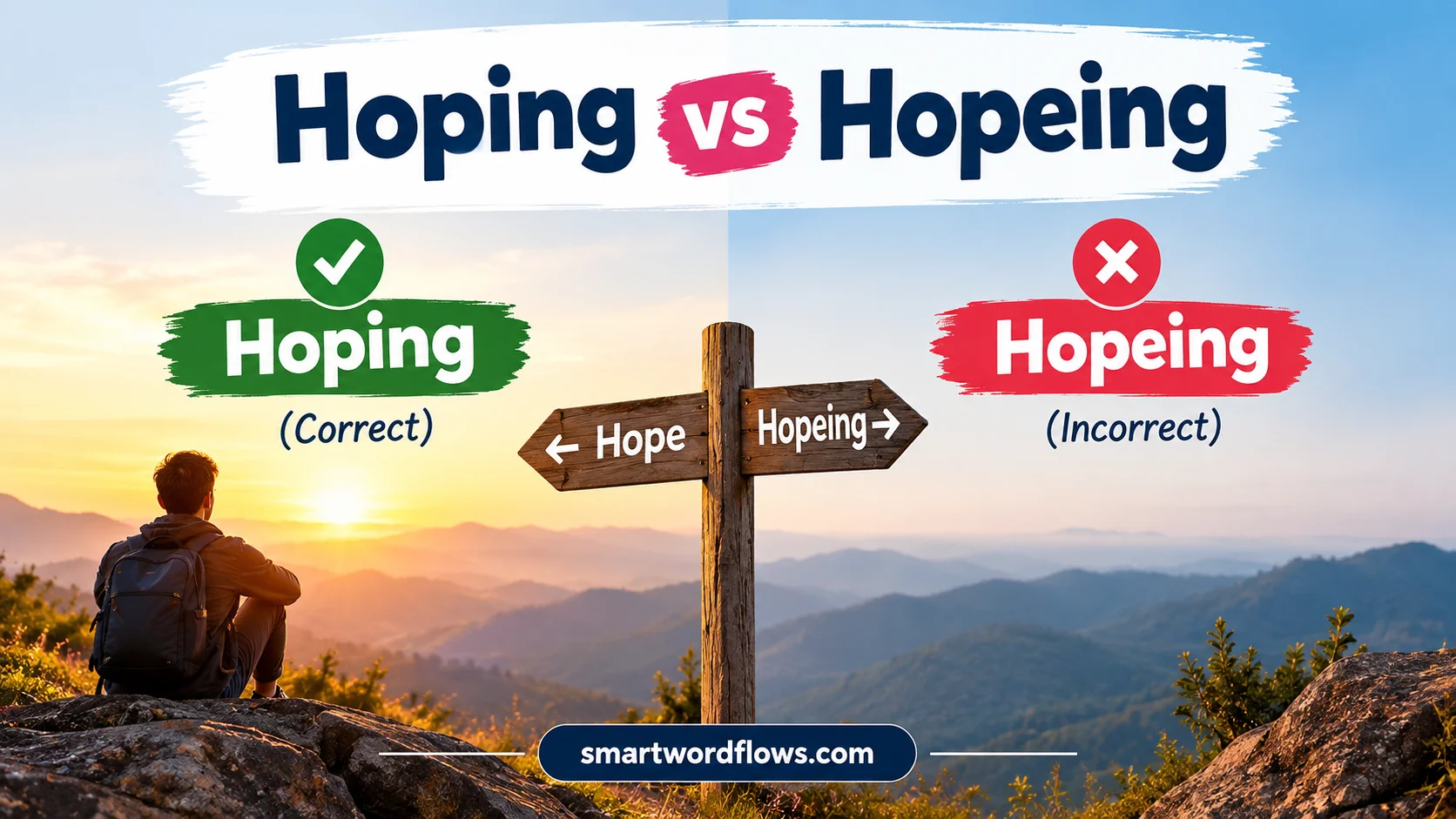

Hoping vs Hopeing is a common spelling mistake that can confuse English learners. The correct spelling is hoping, while hopeing is an incorrect spelling. The word hoping comes from the verb hope and is formed by adding the -ing suffix after removing the final e. This spelling rule also works with make → making, write → writing, and take → taking. Once you understand this simple pattern, you can avoid this common misspelling and make your writing clearer and more accurate.
The explanation is simple: the final e in hope is silent, so it disappears before the -ing ending. Therefore, hope + ing becomes hoping, not hopeing. This rule applies in both American English and British English. With regular practice, you can easily remember the correct form. If you see hopeing on your screen, treat it as a spelling error and change it to hoping. This small rule can help prevent similar related spelling mistakes in everyday writing.
Quick Answer
Hoping is the correct spelling.
Hopeing is an incorrect spelling of the verb hope when you add -ing.
The spelling follows this pattern:
hope + ing = hoping
The final e in hope is silent. English normally removes that silent e before the -ing suffix.
For example:
- I’m hoping you can come. ✅
- She’s hoping for good news. ✅
- We’re hoping to finish today. ✅
- I’m hopeing you can come. ❌
- She’s hopeing for good news. ❌
So, if you’re wondering whether to write hoping or hopeing, choose hoping every time in standard English.
Comparison Overview
The difference between hoping vs hopeing comes down to spelling and word formation rather than meaning.
| Word | Correct Spelling? | Meaning | Example |
| Hoping | Yes | Wishing or expecting something to happen | “I’m hoping for a positive answer.” |
| Hopeing | No | Incorrect spelling of hoping | “I’m hopeing for a positive answer.” ❌ |
The important point is that hopeing doesn’t represent a different meaning. It simply contains an extra e that standard English spelling doesn’t use in this form.
You might still encounter hopeing in social media posts, informal messages, comments, or documents containing spelling errors. Its appearance in writing doesn’t make it an accepted standard spelling.
Main Differences Between Hoping vs Hopeing
There is really only one central difference: hoping is correct, while hopeing is incorrect.
However, understanding why the difference exists helps you remember the spelling instead of simply memorizing it.
| Feature | Hoping | Hopeing |
| Standard spelling | Correct | Incorrect |
| Base word | hope | hope |
| Suffix | -ing | -ing |
| Final silent e | Removed | Incorrectly retained |
| Meaning | Expressing a wish or expectation | Intended to mean hoping |
| Suitable for formal writing | Yes | No |
The Spelling Pattern
The base verb is hope.
When you add -ing, you don’t simply attach the ending to every letter:
hope + ing → hopeing ❌
Instead, English spelling removes the final silent e:
hope + ing → hoping ✅
That gives you the correct form.
This same pattern appears in many familiar English verbs:
- make → making
- take → taking
- write → writing
- drive → driving
- save → saving
- use → using
- hope → hoping
The spelling change doesn’t alter the basic identity of the verb. It simply reflects a common English word-formation pattern.
What Does “Hoping” Mean?
Hoping is the -ing form of the verb hope. It describes the act or state of wishing for something to happen or expecting a particular outcome.
The word hope can involve a strong desire, a reasonable expectation, or simply a positive wish.
For example:
“I’m hoping for a better result this time.”
Here, hoping shows that the speaker wants a better result and expects that possibility to remain open.
You can also use hoping when you want something without knowing whether it will happen.
“She’s hoping to get the job.”
The sentence doesn’t say that she will get the job. It tells you that getting the job is something she wants and anticipates.
Examples of Hoping
- I’m hoping the weather improves before the weekend.
- They’re hoping to complete the project before Friday.
- She’s hoping for a quick response from the company.
- We’re hoping that everyone can attend the meeting.
- He’s hoping to travel abroad next year.
These examples show that hoping commonly connects with for, to, or that-clauses, depending on the sentence structure.
Why Is “Hoping” Spelled Without the E?
The reason comes from a common English spelling rule involving verbs that end in a silent e.
When you form the present participle by adding -ing, you generally remove the final silent e.
The pattern looks like this:
Base verb → -ing form
- hope → hoping
- move → moving
- love → loving
- come → coming
- write → writing
The final e in hope doesn’t contribute a separate sound at the end of the word. Instead, it helps establish the spelling and pronunciation of the base word.
If you wrote hopeing, you would be carrying the final e into a form where standard spelling doesn’t keep it.
Why the Rule Matters
English spelling often uses letters to signal pronunciation patterns.
In hope, the final e helps distinguish the word from hop, especially because the vowel sounds differ.
Compare:
- hope → long o sound
- hop → short o sound
When hope becomes hoping, the spelling already gives enough information about the vowel sound. The final e no longer needs to remain.
That’s why:
hope → hoping
works naturally in English spelling.
The Spelling Rule: Drop the Silent E Before -ing
A useful rule to remember is:
When many verbs end in a silent e, remove the final e before adding -ing.
Here are several common examples:
| Base Verb | Correct -ing Form | Incorrect Form |
| hope | hoping | hopeing |
| make | making | makeing |
| write | writing | writeing |
| take | taking | takeing |
| drive | driving | driveing |
| use | using | useing |
| save | saving | saveing |
| move | moving | moveing |
This is one reason learning word patterns can help more than memorizing individual spellings.
However, English contains exceptions and special cases. For example, verbs ending in -ee generally keep their final letters before -ing, as in see → seeing and agree → agreeing.
So don’t treat the rule as an absolute mechanical formula for every word ending in e. Instead, recognize it as the standard pattern that applies to hope.
When to Use “Hoping”
You can use hoping whenever you need the -ing form of hope.
One of the most common structures is “I’m hoping…”
Hoping + to
Use hoping to when someone wants or expects to do something.
Examples:
- I’m hoping to visit my family next month.
- She’s hoping to find a new apartment soon.
- We’re hoping to finish the work today.
The structure is:
subject + be + hoping + to + verb
Hoping + for
Use hoping for when you express a desire for a person, thing, result, or situation.
Examples:
- We’re hoping for good news.
- They’re hoping for a peaceful solution.
- I’m hoping for better results next time.
The structure is:
subject + be + hoping + for + noun
Hoping + that
You can also use hoping before a clause beginning with that.
Examples:
- I’m hoping that everything goes well.
- She’s hoping that her application gets accepted.
- They’re hoping that the problem gets resolved soon.
This construction lets you express a desired outcome in a complete clause.
“Hoping” in Different Sentence Structures
The word hoping can perform several grammatical roles depending on how you construct the sentence.
Most commonly, you’ll see it as part of a continuous verb phrase.
“I’m hoping to hear from you soon.”
Here, am hoping forms the present continuous.
You can also use hoping in a participial phrase:
“Hoping to avoid traffic, we left early.”
In this sentence, hoping to avoid traffic gives additional information about why the people left early.
The subject of the participial phrase should normally match the subject of the main clause. Otherwise, the sentence can become confusing or grammatically faulty.
Another Example
“Hoping for a quick answer, Maria contacted the office.”
Maria is the person who is hoping, so the relationship between the opening phrase and the main clause remains clear.
Common Mistakes With “Hoping”
The most obvious mistake is writing hopeing instead of hoping.
However, several other errors can appear when writers confuse related forms.
Adding the Extra E
Incorrect:
“I’m hopeing everything works out.”
Correct:
“I’m hoping everything works out.”
The extra e comes directly from the base word hope. The problem is that standard spelling removes that final e before -ing.
Confusing Hoping With Hopping
Hoping and hopping differ by more than one letter.
Hoping comes from hope, which means wishing or expecting something.
Hopping comes from hop, which means making small jumps.
Compare these sentences:
“I’m hoping for a seat.”
“The rabbit is hopping across the yard.”
One letter changes the word’s pronunciation and meaning.
Using Hope Instead of Hoping
Sometimes the issue isn’t spelling at all. It’s choosing the wrong grammatical form.
Correct:
“I’m hoping to see you tomorrow.”
Also correct:
“I hope to see you tomorrow.”
Both sentences work. The difference lies in grammatical structure and nuance.
The form hope can state a wish directly, while hoping often appears in continuous constructions or participial phrases.
Hoping vs Hopping
This comparison deserves special attention because hoping and hopping look and sound different.
| Word | Base Word | Meaning | Example |
| Hoping | hope | Wishing or expecting | “She’s hoping for good news.” |
| Hopping | hop | Jumping or moving with small jumps | “The bird was hopping along the ground.” |
The spelling process explains the difference.
Hope ends with a silent e. Remove that e and add -ing:
hope → hoping
Hop ends with a consonant-vowel-consonant pattern. When you add -ing, the final consonant generally doubles:
hop → hopping
That creates two distinct words:
hoping = wishing
hopping = jumping
A useful memory trick is to connect hope with an expectation and hop with movement.
Read This: Bellies vs Bellys: Which One Is Correct?
Examples of “Hoping” in Everyday English
You’ll find hoping in ordinary conversations, professional emails, school writing, personal messages, and many other settings.
At Work
“I’m hoping to finish the report before lunch.”
The speaker expresses an intention or desired outcome without guaranteeing it.
At School
“I’m hoping to improve my grade on the next exam.”
Here, the word communicates a desired academic result.
In Relationships
“I’m hoping we can talk about this calmly.”
The speaker expresses a wish for a particular interaction.
During Travel
“We’re hoping to catch an earlier flight.”
The sentence communicates a desired travel arrangement.
About Personal Goals
“She’s hoping to start her own business next year.”
The goal remains uncertain, which makes hoping appropriate.
These examples demonstrate why hoping appears so often in everyday language. People constantly talk about things they want, expect, or wish to happen.
Is “Hoping” Used in Formal and Professional Writing?
Yes. Hoping is completely acceptable in professional writing when the sentence calls for it.
You can use it in emails, business correspondence, applications, reports, and workplace communication.
For example:
“I’m hoping to discuss the proposal with you next week.”
Or:
“We’re hoping to receive your feedback by Friday.”
These sentences sound professional while remaining natural.
However, context matters. In especially formal writing, you may sometimes choose a more direct construction.
For example:
Conversational professional wording:
“I’m hoping to receive your feedback soon.”
More direct wording:
“Please send your feedback by Friday.”
Neither construction is inherently wrong. The better choice depends on whether you want to sound tentative and courteous or direct and specific.
Is “Hopeing” Ever Correct?
In standard modern English, hopeing isn’t the correct spelling of the -ing form of hope.
If you encounter hopeing, it will generally represent a spelling mistake.
For example:
“I’m hopeing to hear from you soon.” ❌
The correct sentence is:
“I’m hoping to hear from you soon.” ✅
This remains true in both US English and British English.
The difference between American and British spelling affects certain words, such as color/colour or organize/organise in relevant style systems. It doesn’t change hoping into hopeing.
How to Remember the Correct Spelling
The easiest way to remember hoping is to picture the transformation visually:
HOPE → HOPING
Think of the final e as a letter that steps aside when -ing arrives.
A second memory trick involves comparing it with other familiar verbs:
- hope → hoping
- make → making
- write → writing
- take → taking
- drive → driving
Once you recognize the pattern, hopeing starts to look as unusual as makeing or writeing.
A Quick Spelling Test
When you’re unsure, ask:
“Does the base verb end with a silent e?”
If it does, check whether the standard -ing form removes that final letter.
For hope, the answer is yes:
hope + ing → hoping
That quick check can save you from a surprisingly common spelling error.
Hoping in American English vs British English
There is no spelling difference between standard American and British English for this word.
Both use:
hoping
Neither standard variety uses:
hopeing
| Variety | Correct Form |
| American English | hoping |
| British English | hoping |
| Incorrect form | hopeing |
So whether you’re writing an American business email, a British school assignment, or general international English, hoping remains the standard form.
Pronunciation of “Hoping”
Hoping is pronounced with the long o sound from hope.
A simple pronunciation guide is:
HOH-ping
The first syllable sounds like the vowel sound in go or home.
The word hopping sounds different:
HOP-ing
That first vowel uses the shorter sound found in hot or stop in many varieties of American English.
This distinction helps explain why the spelling matters.
| Word | Approximate Pronunciation | Meaning |
| hoping | HOH-ping | Wishing or expecting |
| hopping | HOP-ing | Jumping or moving by hops |
When you pronounce the words aloud, the difference becomes much easier to hear.
Hope, Hoped, Hoping, and Hopeful Compared
Several words come from the same root but perform different grammatical jobs.
| Word | Part of Speech | Basic Meaning | Example |
| hope | Verb/Noun | A wish or expectation | “I hope everything works out.” |
| hoped | Past tense/Past participle | Expressed a wish or expectation in the past | “I hoped you would come.” |
| hoping | Present participle/Gerund | Expressing a current wish or expectation | “I’m hoping you can help.” |
| hopeful | Adjective | Feeling or showing hope | “She feels hopeful about the future.” |
Understanding these related forms makes the spelling of hoping easier to remember.
The important distinction is that hoping specifically contains the -ing suffix. That suffix triggers the removal of the silent final e in hope.
A Simple Case Study: Why “Hopeing” Looks Tempting
Imagine someone knows that the base word is hope and needs to add -ing.
They might reason:
hope + ing = hopeing
At first glance, that seems perfectly logical. English doesn’t always form words by simply joining the base and suffix, though.
Now compare the standard spelling rule:
hope → hoping
The final e disappears before -ing.
This pattern appears often enough that experienced readers recognize hopeing immediately as a spelling error.
The same thing happens with:
write → writing
Nobody normally writes writeing in standard English. Once you see that pattern, hopeing becomes easier to identify as well.
Why Do People Spell “Hopeing” Incorrectly?
The mistake usually comes from treating word formation as a simple process of adding letters.
The writer sees:
hope
Then adds:
ing
The result seems like it should be:
hopeing
There’s another reason, too. The silent e remains visible in several other forms of the word.
Consider:
- hope
- hoped
- hopeful
- hopefully
Because you see the e in these forms, your brain may expect it to remain everywhere.
But -ing creates a different spelling pattern:
hope → hoping
That distinction explains why the error can occur even among otherwise strong writers.
Examples: Correcting “Hopeing”
Here are several common examples that make the difference clear.
| Incorrect | Correct | Why |
| I’m hopeing for good news. | I’m hoping for good news. | Remove the silent e. |
| She is hopeing to win. | She is hoping to win. | Hope becomes hoping. |
| We’re hopeing everything works out. | We’re hoping everything works out. | The final e drops before -ing. |
| He was hopeing for a promotion. | He was hoping for a promotion. | Standard spelling is hoping. |
| They are hopeing to arrive early. | They are hoping to arrive early. | Use hoping with no final e. |
The correction remains the same in every case.
Short Quiz: Hoping or Hopeing?
Test yourself before looking at the answers.
Choose the Correct Spelling
- I’m ______ to hear from you soon.
hoping / hopeing - She’s ______ for a positive outcome.
hoping / hopeing - We’re ______ to finish the project today.
hoping / hopeing - He was ______ that the weather would improve.
hoping / hopeing - They’re ______ for an opportunity to travel.
hoping / hopeing
Answers
- hoping
- hoping
- hoping
- hoping
- hoping
Every answer uses hoping because the final silent e in hope drops before the -ing ending.
FAQs:
1. Is “hoping” or “hopeing” correct?
Hoping is the correct spelling. Hopeing is an incorrect spelling because the final e in hope is removed before adding -ing.
2. Why is “hopeing” wrong?
Hopeing is wrong because English spelling rules require the final e to be dropped before the -ing ending. Therefore, hope + ing = hoping.
3. What does “hoping” mean?
Hoping is the -ing form of the verb hope. It means expecting or wishing that something good will happen.
4. Is “hoping” correct in American and British English?
Yes. Hoping is the standard correct spelling in both American English and British English.
5. What is an easy way to remember “hoping”?
Remember this simple pattern: hope → remove the final e → add -ing → hoping. The same rule works with make → making and write → writing.
Conclusion:
Hoping is the correct spelling, while hopeing is a common spelling mistake. The final silent e in hope is removed before adding -ing. Once you remember this simple rule, choosing hoping becomes easy and your writing becomes more accurate.