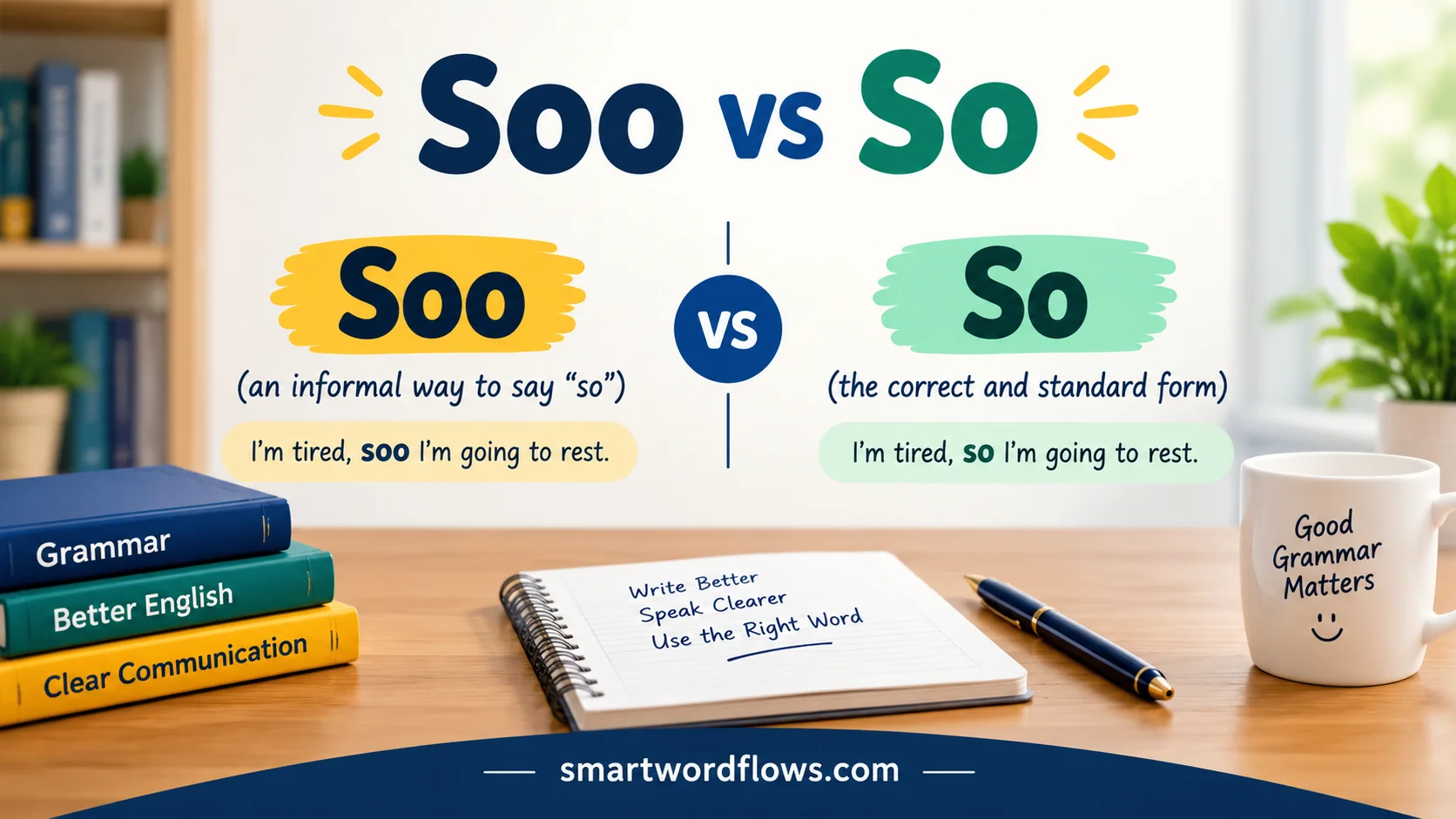

When comparing Soo vs So, many writers wonder whether both spellings are acceptable. So is the standard English word used in everyday and formal writing, while soo is generally an informal spelling found in texts, comments, and social media. It often stretches the sound of “so” to express excitement, emotion, surprise, or exaggeration. Knowing this difference can help you choose the correct spelling and avoid confusion in your writing.
The word so has several grammatical uses. It can function as an adverb, conjunction, or intensifier, depending on the sentence. For example, you can say “She is so happy” or “It was raining, so we stayed home.” In contrast, soo is not normally accepted in standard English. It is mainly a stylistic variation used in casual online communication. In formal emails, academic work, and professional writing, always use so.
Quick Answer
So is the standard English spelling. You should use it in normal sentences, including formal, academic, professional, and everyday writing.
Soo isn’t normally a standard alternative spelling of so. People sometimes use it in informal messages to make the word feel longer or more emotional.
For example:
- Correct standard English: She is so happy.
- Informal texting: She is soo happy!
- Highly exaggerated texting: She is sooo happy!
The extra o doesn’t create a new grammatical form. Instead, it usually represents emphasis, excitement, exaggeration, or a playful tone.
There’s one important exception: Soo can be a legitimate name or part of a proper noun. In that situation, its capitalization and spelling depend on the specific name.
Comparison Overview
| Feature | So | Soo |
| Standard English spelling | Yes | No, when used as an alternative to so |
| Common grammatical word | Yes | No |
| Used in formal writing | Yes | Generally no |
| Used in casual texting | Yes | Yes, for emphasis |
| Can express degree | Yes | Not as a standard grammatical form |
| Can show a result | Yes | No |
| Can show agreement | Yes | No |
| Can appear as a proper name | Yes | Yes, depending on the name |
| Example | It is so cold. | It is soo cold! |
| Best choice for normal writing | So | No |
The key distinction is simple: so belongs to standard English grammar, while soo is usually a creative spelling used in informal communication.
Main Differences Between Soo vs So
The biggest difference between soo vs so involves standard spelling and grammatical function. Although the two forms may represent the same spoken sound in casual writing, they don’t have the same status in standard English.
Spelling Difference
So contains two letters:
S + O = SO
Soo contains three:
S + O + O = SOO
That additional o doesn’t normally belong to the standard spelling.
For example:
I am so tired.
This sentence follows standard English spelling.
You might see this online:
I am soo tired.
The second version can work as an informal stylistic choice. However, it isn’t the conventional spelling you should use in formal writing.
Grammar Difference
So has several established grammatical functions. It can work as an adverb, conjunction, and part of common expressions.
For example:
The food was so delicious.
Here, so modifies the adjective delicious.
It can also connect two ideas:
I was tired, so I went home.
Here, so introduces the result of being tired.
Soo doesn’t normally perform these grammatical functions in standard English.
Difference in Formality
The word so works comfortably in almost every type of writing:
- Academic essays
- Business emails
- Reports
- Articles
- School assignments
- Books
- Everyday messages
- Conversations
By contrast, soo generally belongs to informal digital communication when someone intentionally stretches the word.
For example:
I’m soo excited about the trip!
A friend might understand the intended emotion immediately. A teacher, employer, or editor would generally expect:
I’m so excited about the trip!
Difference in Purpose
People usually write so because grammar requires or permits the word.
People often write soo because they want to add emotional emphasis.
Compare these:
That movie was so good.
This is a normal statement.
That movie was soo good!
The second sentence feels more enthusiastic. The writer has visually stretched the word to imitate an exaggerated spoken sound.
What Does “So” Mean?
So is a versatile English word with several meanings and grammatical roles. Its meaning depends heavily on the sentence around it.
So as an Adverb
One of the most common uses of so is to show a high degree or intensity.
For example:
The water is so cold.
Here, so tells you how cold the water is. It strengthens the adjective cold.
More examples include:
- She is so kind.
- The test was so difficult.
- That dog is so cute.
- He runs so quickly.
- I’m so hungry.
- The room looks so clean.
In these examples, replacing so with soo would create a nonstandard spelling.
So With Adjectives
The structure so + adjective is extremely common.
Examples:
so beautiful
so expensive
so difficult
so interesting
so important
Consider this sentence:
This book is so interesting.
The word so increases the intensity of interesting.
However, English also uses very in similar situations:
This book is very interesting.
Although so and very can sometimes express similar degrees, they aren’t always interchangeable. So often carries a stronger sense of personal reaction or emphasis.
Compare:
The movie was very good.
with:
The movie was so good!
The second sentence often sounds more emotional.
So as a Conjunction
So can connect an action with its result.
For example:
It started raining, so we went inside.
The first clause gives the situation. The second clause gives the result.
More examples:
- I missed the bus, so I walked home.
- She studied hard, so she passed the exam.
- The store was closed, so we came back later.
- He was sick, so he stayed home.
In these sentences, soo cannot replace so in standard English.
So for Agreement
English also uses so to express agreement with a previous statement.
For example:
“I love this song.”
“So do I.”
Another example:
“I’m tired.”
“So am I.”
The exact structure changes depending on the verb.
Examples include:
- So do I.
- So am I.
- So can she.
- So did they.
- So will we.
These are established grammatical patterns. Writing soo instead would make the sentence nonstandard.
So in Common Expressions
You’ll find so in many familiar phrases.
Examples include:
- so far
- so much
- so many
- so long
- so soon
- so well
- so often
- so far as
- so that
For example:
We haven’t received the package so far.
And:
There were so many people at the event.
These expressions use the standard spelling so.
What Does “Soo” Mean?
The meaning of soo depends on context because it doesn’t function as a normal alternative spelling of so in standard English.
Is “Soo” a Standard English Word?
When someone writes soo to mean the ordinary English word so, it generally isn’t considered the standard spelling.
For example:
I’m soo happy.
In standard English, this should be:
I’m so happy.
However, language doesn’t always behave like a school grammar book. Online communication often uses creative spellings to show emotion, personality, and tone.
That’s where soo comes in.
“Soo” in Informal Internet Writing
People often add letters to words when texting or posting online.
For example:
I am sooo tired.
The writer doesn’t actually believe sooo has a different dictionary meaning. The repeated letters create a visual representation of an extended pronunciation.
It’s similar to saying:
“I am sooooo tired!”
The longer spelling makes the emotion feel stronger.
Common forms include:
- soo
- sooo
- soooo
- sooooo
The more letters someone adds, the more exaggerated the expression may appear.
“Soo” as a Name
Soo can also be a legitimate name or part of a proper name.
For example, someone may have Soo as a given name, surname, or part of a longer name. In that situation, it isn’t a misspelling of so.
This distinction matters because context determines whether the word represents informal emphasis or a proper noun.
For instance:
Soo is attending the meeting.
If Soo is someone’s name, the spelling is intentional.
Therefore, it would be incorrect to say that Soo can never be a legitimate word or name. The more precise explanation is that soo isn’t the standard spelling of the ordinary English word “so.”
When to Use “So”
If you’re writing a normal English sentence, so is almost always the form you want.
Use “So” in Formal Writing
Choose so in:
- School assignments
- University papers
- Business reports
- Professional emails
- Resumes
- Cover letters
- Articles
- Official documents
For example:
The weather was so severe that the event was canceled.
Not:
The weather was soo severe that the event was canceled.
The second version looks informal and may appear to be a spelling error.
Use “So” in Everyday Writing
You don’t need formal writing to use so correctly.
It’s perfectly normal in:
- Text messages
- Online comments
- Social media
- Personal emails
- Conversations
- Blog posts
For example:
I’m so glad you came!
Standard spelling doesn’t make casual writing less friendly.
Read More: Hoping vs Hopeing: Which Spelling Is Correct?
When Is “Soo” Acceptable?
Soo can be acceptable when the writer intentionally uses informal spelling for emotional or stylistic effect.
For example:
That puppy is soo cute!
The writer wants to exaggerate the feeling of cute.
However, this choice depends on the audience.
Casual Conversation
In a message to a close friend, something like this may feel natural:
I’m sooo excited!
The stretched spelling communicates enthusiasm.
Social Media
Informal spellings appear frequently in social posts because users often write the way they speak.
For example:
This dress is sooo pretty!
The repeated o gives the sentence a playful tone.
Formal Communication
Formal writing is different.
A professional email should normally say:
Thank you so much for your help.
Not:
Thank you sooo much for your help.
The second version might sound overly casual or playful.
Soo vs So Examples
Examples make the distinction much easier to understand.
Correct Examples With “So”
She is so talented.
I’m so hungry right now.
The weather is so hot today.
He was so tired after work.
That was so funny.
The instructions were so clear.
I wanted to go, so I called him.
Each sentence uses so according to standard English grammar.
Informal Examples With “Soo”
You may encounter these online:
I’m soo happy right now!
That baby is soo cute!
You’re soo funny!
I miss you soo much!
These examples intentionally stretch the word. They’re common in casual digital communication, but they’re not the standard spelling.
So vs Soo vs Sooo
The three forms create slightly different impressions:
| Form | Typical meaning or effect |
| So | Standard English |
| Soo | Informal emphasis |
| Sooo | Stronger or more playful emphasis |
| Soooo | Very exaggerated emphasis |
Think of the extra letters as a volume knob. The grammar doesn’t change. The tone does.
Common Mistakes With Soo and So
Mistake: Using “Soo” in Formal Writing
A common mistake occurs when casual internet spelling moves into formal writing.
For example:
The results were soo surprising.
Use:
The results were so surprising.
The standard form keeps your writing polished and professional.
Mistake: Treating “Soo” as a Grammatical Form
Adding another o doesn’t create a new grammatical form of so.
English doesn’t normally change so into soo to indicate tense, number, comparison, or degree.
For example:
- so is standard.
- soo isn’t a standard grammatical variation.
- sooo is usually expressive writing.
That’s an important distinction.
Mistake: Confusing Emphasis With Standard Spelling
Informal writing often bends conventional spelling.
Consider:
I am soooo excited!
Nobody normally reads this as a spelling lesson. The repeated letters communicate enthusiasm.
Still, if you’re writing an essay, replace it with:
I am so excited.
The intended meaning remains intact while the writing follows standard conventions.
Soo vs So in Texting and Social Media
Digital communication has changed how people express tone through text.
When you’re speaking, you can stretch a sound:
“I’m sooo tired.”
Your voice communicates the emotion.
Text doesn’t give you that vocal information. Writers therefore use repeated letters, punctuation, capitalization, and emojis to create similar effects.
For example:
I’m so tired.
sounds neutral.
I’m soo tired 😭
feels more emotional.
And:
I’m SOOO tired!!!
feels even more dramatic.
This is why soo and sooo appear frequently online. They aren’t necessarily accidental spelling mistakes. In many cases, they’re deliberate choices designed to make written language feel more expressive.
Informal Spelling Doesn’t Equal Standard Spelling
This distinction is worth remembering:
A form can be common online without being standard English spelling.
Internet language evolves quickly. Slang, abbreviations, stretched spellings, and memes can become widespread without replacing conventional forms in formal writing.
That’s exactly how soo often functions.
Soo vs So in Different Writing Situations
Your choice should depend on the context and audience.
| Situation | Recommended Form | Example |
| Academic essay | So | The issue was so important. |
| Business email | So | Thank you so much. |
| Resume | So | Not usually needed as an emphasis word |
| Blog article | So | The process is so simple. |
| Text message | So | I’m so happy! |
| Casual social post | Soo/Sooo can be stylistic | This is sooo cute! |
| Formal report | So | The change was so significant. |
| Proper name | Soo if that’s the established name | Soo joined the team. |
The audience acts like a filter. The more formal the situation, the more important standard spelling becomes.
Case Study: Why “Sooo” Feels More Emotional
Consider two messages from a friend:
I’m so excited to see you.
and:
I’m sooo excited to see you!!!
The basic meaning remains the same. Yet the second message carries more emotional energy.
Why?
Three visual signals work together:
- Repeated letters stretch the word.
- An exclamation mark increases intensity.
- Casual phrasing makes the message feel spontaneous.
This shows why informal spelling shouldn’t always be treated as random error. Sometimes it performs a real communication function.
However, that function belongs to style and tone, not standard grammar.
A Simple Rule for Remembering Soo vs So
Here’s the easiest way to remember the difference:
Use “so” for standard English. Use “soo” only when you intentionally want an informal, exaggerated style or when “Soo” is a proper name.
You can also use this quick test:
Are you writing a school assignment?
Use so.
Are you writing a professional email?
Use so.
Are you writing a normal sentence?
Use so.
Are you deliberately stretching the word in a casual message?
Soo or sooo may work stylistically.
Is Soo someone’s actual name?
Use Soo if that’s the person’s established spelling.
Soo vs So: Quick Decision Guide
When you’re unsure, ask what you’re trying to accomplish.
Choose “So” If:
- You want standard English.
- You’re writing formally.
- You’re writing academically.
- You’re writing professionally.
- You’re simply using the normal word so.
- You want your spelling to follow conventional English.
“Soo” May Appear If:
- You’re texting casually.
- You’re posting informally on social media.
- You want to exaggerate emotion.
- You’re deliberately mimicking stretched speech.
- Soo is part of a proper name.
Remember This
So = standard spelling.
Soo = usually informal emphasis or a proper name.
That one rule handles most Soo vs So questions.
Faqs :
Is “soo” a correct English word?
Soo is generally not considered a standard English spelling when you mean the common word so. It is often used informally online to stretch the word for emphasis, such as “I’m soo happy!”
Which is correct: “soo” or “so”?
So is the correct spelling in standard English. Use it in formal writing, academic work, emails, essays, and professional communication. “Soo” is mainly a casual internet-style variation.
Why do people write “soo” instead of “so”?
People often write soo to add extra emotion or emphasis. For example, “That movie was soo good!” can make the statement feel more excited or dramatic. It is a stylistic choice rather than standard grammar.
Can I use “soo” in texting?
Yes, you can use soo in casual texting, social media posts, or friendly conversations when you want to express extra emphasis. However, it is better to use so when you want your writing to follow standard English rules.
Does “soo” have the same meaning as “so”?
In casual online writing, soo usually has the same basic meaning as so, but the extra “o” adds emphasis or emotion. In standard English, however, so is the appropriate spelling.
Conclusion :
The difference between soo vs so is mainly about standard English versus informal style. So is the correct and widely accepted spelling, while soo is commonly used online to express stronger emotion or emphasis. Use so for formal, academic, and professional writing, and reserve soo for casual situations where a playful or exaggerated tone fits.