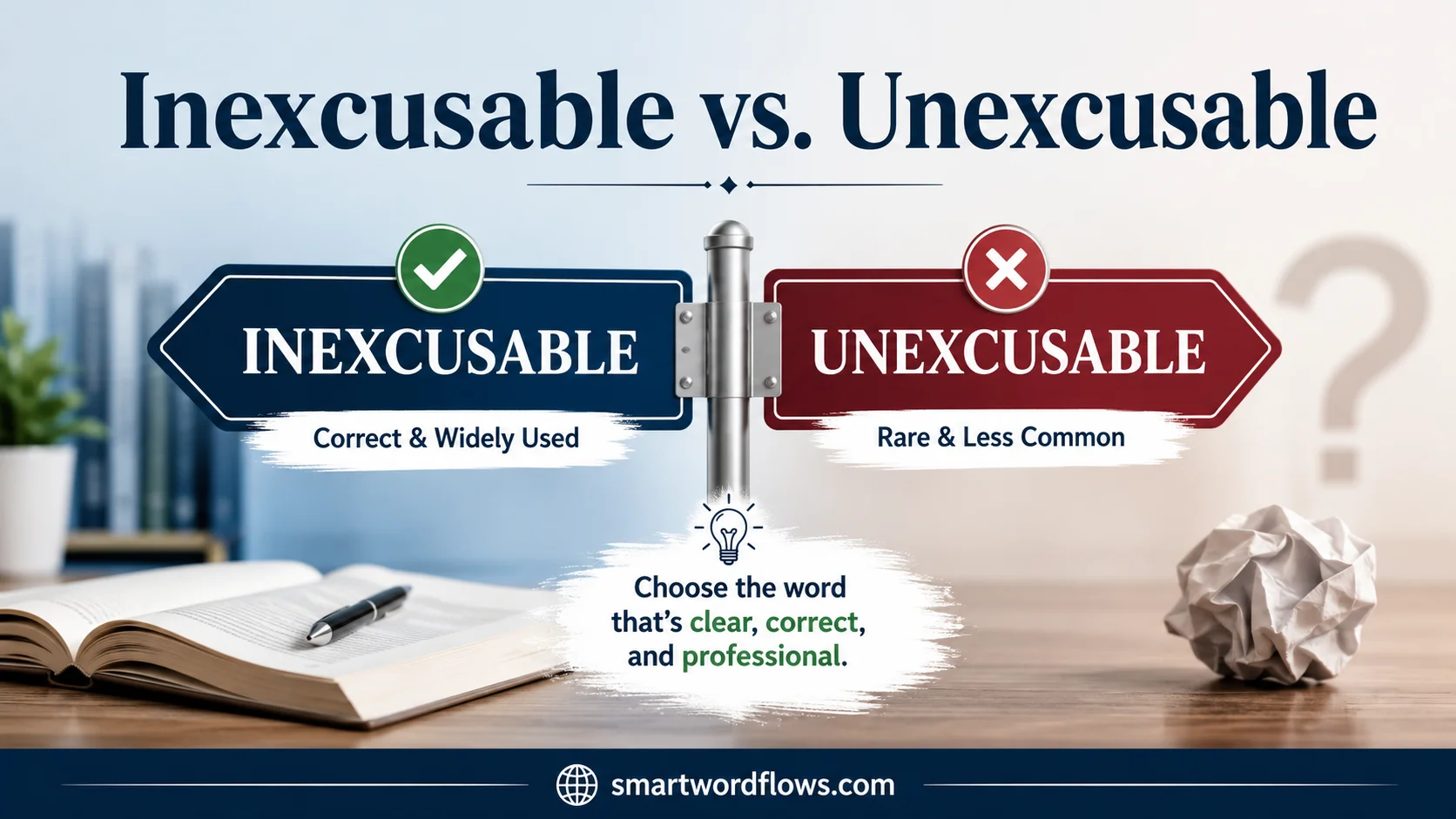

Choosing between Inexcusable vs. Unexcusable can be confusing because both words are understandable and appear in English. However, inexcusable is the standard and much more common choice in modern English. It means something that cannot be justified, forgiven, or accepted. You’ll commonly see it in professional writing, academic work, and everyday conversations. If you want the safest and most natural option, inexcusable is the word you should generally choose.
Unexcusable is also a dictionary-listed adjective and means essentially the same thing as inexcusable. However, it’s much less common and may sound unusual to many readers. The two words don’t have a meaningful difference in ordinary modern usage. While unexcusable isn’t necessarily wrong, inexcusable is more familiar and widely accepted. Therefore, when writing an email, article, assignment, report, or professional document, choosing inexcusable will usually be the better option.
Quick Answer
Inexcusable is the standard and much more common choice.
Unexcusable is also a legitimate English word. Merriam-Webster lists it as an adjective meaning “inexcusable.”
In everyday and formal writing, however, inexcusable is the better choice because it is more familiar and conventional.
| Word | Meaning | Status | Recommended use |
| Inexcusable | Impossible to excuse or justify | Standard and common | Yes |
| Unexcusable | Impossible to excuse | Dictionary-listed but uncommon | Usually avoid |
So if you’re wondering whether to write “His behavior was inexcusable” or “His behavior was unexcusable,” choose the first sentence.
Best choice: “His behavior was inexcusable.”
Oxford defines inexcusable as something “too bad to accept or forgive” and gives unjustifiable as a synonym.
Comparison Overview
The simplest way to understand the inexcusable vs. unexcusable question is to compare their meaning, grammatical role, and normal usage.
| Feature | Inexcusable | Unexcusable |
| Part of speech | Adjective | Adjective |
| Basic meaning | Not excusable | Not excusable |
| Can describe behavior? | Yes | Yes |
| Can describe a mistake? | Yes | Yes |
| Dictionary-listed? | Yes | Yes |
| Common in modern English? | Very common | Uncommon |
| Suitable for formal writing? | Yes | Possible, but unusual |
| Meaningful semantic difference? | No | No |
| Best general choice | Yes | Usually no |
The key point is easy to miss: the two words don’t form a normal contrast in meaning.
You might expect inexcusable to mean one thing and unexcusable to mean something slightly different. Standard dictionary evidence doesn’t support that distinction. Merriam-Webster defines inexcusable as “impossible to excuse or justify” and defines unexcusable simply as inexcusable.
In other words, the real difference lies mainly in frequency, familiarity, and conventional usage.
Main Differences Between Inexcusable vs. Unexcusable
Although the meanings overlap almost completely, several practical differences matter when you write.
Inexcusable is the established form
Inexcusable has a long history in English and remains the ordinary modern form.
Merriam-Webster traces it to Middle English and Latin inexcusabilis. Its first known use dates to the 15th century.
Oxford likewise traces the word to late Middle English and identifies its Latin origin as inexcusabilis, from in- meaning “not” and excusabilis meaning “able to be excused.”
That history helps explain why inexcusable feels so natural to modern readers.
Consider these examples:
- His behavior was inexcusable.
- The delay was completely inexcusable.
- Ignoring the safety warning was inexcusable.
- The company’s failure to respond was inexcusable.
Nothing sounds unusual about these sentences.
Unexcusable has the same basic meaning
Unexcusable isn’t simply a spelling mistake.
Merriam-Webster lists it as an adjective and defines it as “inexcusable.” Its word history identifies the formation as un- + excusable.
That makes the construction fairly transparent:
un- + excusable → unexcusable
The problem isn’t that readers can’t understand it. They can.
The issue is that unexcusable isn’t the form most English speakers normally choose.
For example:
“The manager’s behavior was unexcusable.”
The sentence is understandable and dictionary-supported. Still, most polished editors would naturally change it to:
“The manager’s behavior was inexcusable.”
That’s a matter of conventional usage rather than basic grammatical meaning.
Inexcusable sounds more natural
Language isn’t always governed by perfect mathematical logic.
English contains many words that could theoretically have competing prefixes. Yet one version becomes firmly established while another remains rare.
That’s what happened here.
Inexcusable has become the familiar form. Unexcusable never achieved the same level of ordinary usage.
As a result, readers are more likely to recognize inexcusable immediately without stopping to think about the word.
The difference is mainly about preference
Here’s the practical rule:
If you’re choosing a word for normal modern writing, use “inexcusable.”
You don’t need to use unexcusable merely because it is technically a word.
Think of it this way: dictionary status tells you whether a form exists. Usage tells you whether it’s the form most people expect.
Those aren’t always the same thing.
What Does Inexcusable Mean?
Inexcusable is an adjective describing something that cannot reasonably be excused or justified.
Merriam-Webster defines it as “impossible to excuse or justify.”
Oxford gives a closely related definition: something too bad to accept or forgive.
Cambridge explains the word in terms of behavior that is too bad to be accepted.
So when you call something inexcusable, you’re making a strong judgment.
You’re saying that whatever explanation someone might offer isn’t enough to make the behavior acceptable.
Examples of inexcusable
Consider these sentences:
- His rude comments were inexcusable.
- Leaving the children alone was inexcusable.
- The repeated safety violations were inexcusable.
- Missing the deadline without any warning was inexcusable.
- Treating a customer that way was completely inexcusable.
The word often carries a strong emotional or moral judgment.
If someone makes a minor mistake, calling it inexcusable may sound excessive. The word suggests that the problem crosses a line.
For example, forgetting a pen probably isn’t inexcusable. Deliberately ignoring a serious safety warning could be.
Inexcusable can describe mistakes
The word doesn’t apply only to intentional wrongdoing.
You can call a serious error inexcusable even when nobody intended the outcome.
For example:
“The accounting error was inexcusable because the team had already identified the problem twice.”
Here, inexcusable doesn’t necessarily mean the person wanted to make the mistake. It means the circumstances provided no acceptable reason for allowing the mistake to happen.
That distinction makes the word useful in professional and institutional contexts.
What Does Unexcusable Mean?
Unexcusable means essentially the same thing as inexcusable.
Merriam-Webster explicitly defines unexcusable as “inexcusable.”
The word follows a familiar English pattern:
un- + excusable
The prefix un- commonly creates negative adjectives, such as:
- unhappy
- unfair
- unclear
- unusual
- unacceptable
- unnecessary
So unexcusable may look perfectly reasonable when someone creates it from excusable.
That’s one reason people use it.
However, English doesn’t always reward the most obvious word-building pattern. A form can be logical while remaining uncommon.
Examples of unexcusable
You may encounter sentences such as:
- “The treatment of the employees was unexcusable.”
- “Such negligence is unexcusable.”
- “His conduct was unexcusable.”
- “The repeated failures were unexcusable.”
These sentences communicate the intended meaning.
Still, inexcusable would usually be the more natural choice:
- “The treatment of the employees was inexcusable.”
- “Such negligence is inexcusable.”
- “His conduct was inexcusable.”
- “The repeated failures were inexcusable.”
The difference is subtle but important: valid doesn’t necessarily mean preferred.
Is Unexcusable a Correct Word?
Yes.
This is where many explanations of inexcusable vs. unexcusable go wrong.
It would be inaccurate to say that unexcusable simply isn’t a word. Merriam-Webster has a dictionary entry for it and defines it as inexcusable.
However, that doesn’t mean you should routinely replace inexcusable with unexcusable.
Why does unexcusable sound wrong to many readers?
The main reason is familiarity.
Most readers have encountered inexcusable many times. The word appears naturally in descriptions of unacceptable behavior, serious mistakes, failures, misconduct, and other situations.
Unexcusable is much less familiar.
When readers encounter an uncommon form, they may briefly wonder whether the writer made a spelling error. That’s not ideal when a well-established alternative is available.
For professional writing, clarity usually wins.
A useful distinction
There are three different questions you can ask about a word:
- Does the word exist?
- What does the word mean?
- Is it the best choice in this sentence?
For unexcusable, the answers are:
- Yes.
- It means essentially the same thing as inexcusable.
- Usually not when “inexcusable” is available.
That three-part test resolves much of the confusion.
Why Does English Have Both Inexcusable and Unexcusable?
The two forms come from different word-building routes.
The origin of inexcusable
Oxford traces inexcusable to late Middle English and Latin inexcusabilis. The Latin prefix in- means “not,” while excusabilis means “able to be excused.”
Merriam-Webster similarly gives its etymology as Middle English from Latin inexcusabilis.
The basic structure is therefore:
in- + excusable → inexcusable
The word entered English centuries ago and established itself as the conventional form.
The origin of unexcusable
Unexcusable takes a different route:
un- + excusable → unexcusable
Merriam-Webster specifically identifies its etymology as un- + excusable.
That formation makes sense from a modern English perspective. Yet word formation isn’t simply a matter of attaching whichever negative prefix seems logical.
Historical usage decides which forms become standard.
Why “In-” and “Un-” Don’t Always Work the Same Way
English has several negative prefixes. Their distribution comes from history, language contact, pronunciation, and established usage.
For example:
- inaccurate, not usually unaccurate
- incomplete, not usually uncomplete
- inexcusable, not usually unexcusable
- unfair, not infair
- unhelpful, not inhelpful
- unusual, not inusual
A learner might try to create a rule that always predicts the correct prefix. Unfortunately, English doesn’t make it that easy.
The better approach is to learn the established form.
That’s particularly useful with vocabulary that contains negative prefixes. If you know the conventional word, you don’t need to reconstruct it from scratch every time.
Inexcusable vs. Unexcusable in Formal Writing
When the audience expects polished English, inexcusable is clearly the safer option.
Academic writing
Use inexcusable when discussing serious errors or unacceptable practices.
“Failing to acknowledge the original source is inexcusable in academic writing.”
The word sounds direct and conventional.
Business writing
It also works naturally in workplace communication.
“The repeated failure to follow the safety procedure is inexcusable.”
Here, the word emphasizes the seriousness of the failure.
Professional correspondence
Suppose a company repeatedly misses a promised deadline.
You could write:
“This delay is inexcusable given the agreed delivery schedule.”
That sounds firm and professional.
Writing unexcusable instead would probably distract from the actual point.
Journalism and general nonfiction
Inexcusable is also the natural choice when describing misconduct, failures, or unacceptable decisions.
Cambridge’s examples include uses involving inappropriate behavior, serious mistakes, failures, and other situations judged too bad to accept.
Also Read This: Symptomatology vs Symptomology: Differences, Meaning, and Correct Usage
How to Use Inexcusable Correctly
The adjective works in several common sentence patterns.
“It is inexcusable to…”
This structure directly criticizes an action.
It is inexcusable to ignore repeated safety warnings.
It is inexcusable to treat customers disrespectfully.
“It was inexcusable that…”
This structure introduces a specific situation.
It was inexcusable that the warning was ignored.
It was inexcusable that nobody informed the passengers about the cancellation.
Before a noun
You can place inexcusable directly before a noun.
an inexcusable mistake
inexcusable behavior
an inexcusable delay
an inexcusable failure
After a linking verb
You can also place it after verbs such as be, seem, or remain.
“His behavior was inexcusable.”
“The company’s response seemed inexcusable.”
“That level of negligence remains inexcusable.”
These patterns cover most everyday uses.
Inexcusable Examples in Different Contexts
The meaning becomes easier to understand when you see the word operating in different settings.
Workplace example
“The employee’s mistake was understandable, but failing to report it was inexcusable.”
This sentence shows an important nuance. A mistake can be understandable while a later decision remains unacceptable.
School example
“Copying another student’s work without permission is inexcusable.”
Here, the word expresses a strong judgment about academic conduct.
Customer service example
“Keeping customers waiting for hours without an explanation was inexcusable.”
The issue isn’t simply inconvenience. The speaker considers the company’s behavior unacceptable.
Personal example
“Forgetting the appointment was unfortunate. Refusing to apologize was inexcusable.”
This contrast shows how inexcusable can mark the point where ordinary forgiveness ends.
Safety example
“Ignoring the emergency warning was inexcusable.”
This is particularly strong because safety-related failures can carry serious consequences.
Unexcusable Examples and Why They Sound Unusual
Because unexcusable is dictionary-listed, it can appear in genuine English.
For example:
“The repeated negligence was unexcusable.”
The sentence isn’t difficult to understand.
Yet most readers would probably find this version more familiar:
“The repeated negligence was inexcusable.”
That’s why word choice matters beyond strict dictionary validity.
A useful analogy is clothing. Two shirts might both be perfectly wearable, but one may fit the occasion much better. Inexcusable fits the normal expectations of modern English. Unexcusable is the less familiar option.
Inexcusable vs. Unexcusable: Common Mistakes
Mistake: Calling unexcusable completely incorrect
This is too absolute.
Unexcusable is dictionary-listed. Merriam-Webster explicitly gives it the meaning inexcusable.
A better explanation is that it is valid but uncommon.
Mistake: Inventing a difference in meaning
There’s no solid reason to claim that inexcusable describes one type of behavior while unexcusable describes another.
Both express the basic idea of something that cannot be excused.
Mistake: Assuming every “un-” formation is preferable
English doesn’t work like a word-building machine.
You can’t always take a positive adjective and automatically create the preferred negative form with un-.
For excusable, the established negative adjective is inexcusable.
Mistake: Using inexcusable for every minor mistake
The word carries weight.
If someone forgets to bring a pencil, calling the mistake inexcusable may sound melodramatic.
The severity of the situation matters.
Compare:
“Forgetting your pencil was inconvenient.”
with:
“Ignoring the emergency procedure was inexcusable.”
The second sentence carries a much stronger judgment.
Inexcusable vs. Unjustifiable
Another useful comparison involves unjustifiable.
Oxford lists unjustifiable as a synonym of inexcusable.
The words overlap, but their emphasis can differ.
| Word | Main emphasis |
| Inexcusable | No acceptable excuse can be offered |
| Unjustifiable | No reasonable justification supports it |
| Unforgivable | Too serious to forgive |
| Unacceptable | Cannot reasonably be accepted |
Consider this example:
“The manager’s behavior was inexcusable.”
The focus is on the lack of an acceptable excuse.
Now consider:
“The manager’s decision was unjustifiable.”
The emphasis shifts toward the lack of a defensible reason for the decision.
They can overlap heavily, but the choice can subtly change the tone.
Inexcusable vs. Unforgivable
These words also deserve separation.
Inexcusable means something cannot reasonably be excused or justified.
Unforgivable goes further by focusing on forgiveness.
For example:
“The mistake was inexcusable, but the employee apologized immediately.”
That sentence makes sense because something can be unacceptable while still eventually receiving forgiveness.
By contrast:
“What he did was unforgivable.”
This makes a stronger claim about the possibility of forgiveness.
So don’t treat inexcusable, unforgivable, and unjustifiable as interchangeable in every situation.
Inexcusable vs. Unacceptable
Unacceptable is often broader.
Something can be unacceptable without necessarily being described as impossible to excuse.
For example:
“The service was unacceptable.”
This could refer to poor quality or disappointing performance.
But:
“The employee’s deliberate misconduct was inexcusable.”
The second sentence carries a much stronger moral judgment.
This distinction helps you choose the right word rather than simply reaching for the strongest adjective available.
Pronunciation of Inexcusable
Inexcusable is pronounced approximately:
in-ik-SKYOO-zuh-buhl
Cambridge gives the US pronunciation as /ˌɪn.ɪkˈskjuː.zə.bəl/.
Oxford gives the same basic pronunciation pattern and marks the primary stress on the SKYOO syllable.
The stress matters because it helps the word sound natural when spoken.
Related form: inexcusably
The adverb is:
inexcusably
For example:
“The deadline was inexcusably missed.”
Merriam-Webster lists inexcusably as the adverbial form of inexcusable.
Related Words You Should Know
Understanding the word family makes the main distinction easier.
| Word | Part of speech | Meaning |
| Excuse | Verb/noun | Forgive, justify, or provide a reason |
| Excusable | Adjective | Able to be excused |
| Inexcusable | Adjective | Not able to be excused or justified |
| Inexcusably | Adverb | In a way that cannot be excused |
| Inexcusableness | Noun | The quality of being inexcusable |
Oxford defines excusable as something that can be excused and identifies inexcusable as its opposite.
The relationship is straightforward:
excusable → inexcusable
That’s the form to remember.
A Simple Case Study: Choosing the Right Word
Imagine a company promised to deliver an important order on Monday.
The shipment arrives on Tuesday because of a major storm. The customer may be disappointed, but the delay could be excusable.
Now imagine the company had the shipment ready but forgot to arrange transportation. The situation might be considered inexcusable, particularly if employees had several reminders.
Finally, imagine someone writes:
“The company’s failure was unexcusable.”
The reader will understand the sentence. However, inexcusable is the more natural choice:
“The company’s failure was inexcusable.”
This small example captures the entire issue. The difference isn’t really about what the writer wants to communicate. Both forms communicate the same basic judgment. The established form simply communicates it more naturally.
When Should You Use Inexcusable?
Use inexcusable when you want a clear, conventional word for something that cannot reasonably be excused or justified.
It’s especially appropriate in:
- Professional writing
- Academic writing
- News writing
- Business communication
- Formal complaints
- Essays
- General nonfiction
- Everyday conversation
Examples include:
“The error was inexcusable.”
“Such behavior is inexcusable.”
“The failure to follow the instructions was inexcusable.”
“It is inexcusable to ignore the warning.”
If you want the safest option, this is it.
When Might Unexcusable Appear?
There are limited situations where unexcusable may appear naturally.
You might encounter it:
- In older writing
- In quotations
- In discussions about vocabulary
- In individual writers’ stylistic choices
- In texts where the writer deliberately chooses an unusual formation
Its dictionary status means you don’t need to treat every occurrence as an error.
Still, if you’re writing from scratch, there’s rarely a compelling reason to choose it over inexcusable.
Which One Should You Use?
The practical answer is simple:
Use “inexcusable” in most situations
Choose inexcusable for:
- Formal documents
- School assignments
- Blog posts
- Business emails
- Reports
- Essays
- Professional correspondence
- Everyday conversation
Don’t automatically call “unexcusable” wrong
If you encounter unexcusable, understand what it means from context. It is a real dictionary-listed adjective.
But if you’re deciding which form to write yourself, inexcusable is the clear default.
Quick Decision Guide
Use this simple guide when you’re unsure:
Do you mean “not excusable”?
→ Yes.
Are you writing normal modern English?
→ Use inexcusable.
Did you encounter “unexcusable” somewhere?
→ Don’t assume it’s automatically a spelling error. It is dictionary-listed.
Are you writing professionally or academically?
→ Prefer inexcusable.
Are you deliberately discussing an unusual or historical form?
→ Unexcusable may be relevant in that specific context.
This approach keeps the distinction practical rather than turning it into an unnecessary grammar puzzle.
A Quick Memory Trick for Inexcusable vs. Unexcusable
Here’s the easiest way to remember the preferred form:
Excusable → Inexcusable
Think of inexcusable as the established opposite of excusable.
Oxford explicitly identifies excusable and inexcusable as opposites.
So when you’re writing quickly, don’t stop to debate whether unexcusable looks more logical.
Reach for:
inexcusable
It is the form your readers are most likely to expect.
FAQs:
1. Is inexcusable or unexcusable correct?
Both words are dictionary-listed, but inexcusable is the standard and much more common choice in modern English.
2. What does inexcusable mean?
Inexcusable means something that cannot be justified, forgiven, or accepted because it is clearly wrong or unacceptable.
3. Is unexcusable a real word?
Yes. Unexcusable is a real adjective, but it is far less common than inexcusable and may sound unusual to many readers.
4. Is there a difference between inexcusable and unexcusable?
In ordinary modern usage, there’s essentially no difference in meaning. Both describe something that cannot be excused or justified.
5. Which word should I use in formal writing?
Use inexcusable. It is more common, familiar, and natural in academic, professional, and everyday writing.
Conclusion:
Although inexcusable and unexcusable can both be used to describe something that cannot be justified or forgiven, inexcusable is clearly the more common and preferred choice. Unexcusable is valid but much less frequently used. For clear, natural, and professional writing, choose inexcusable in most situations.