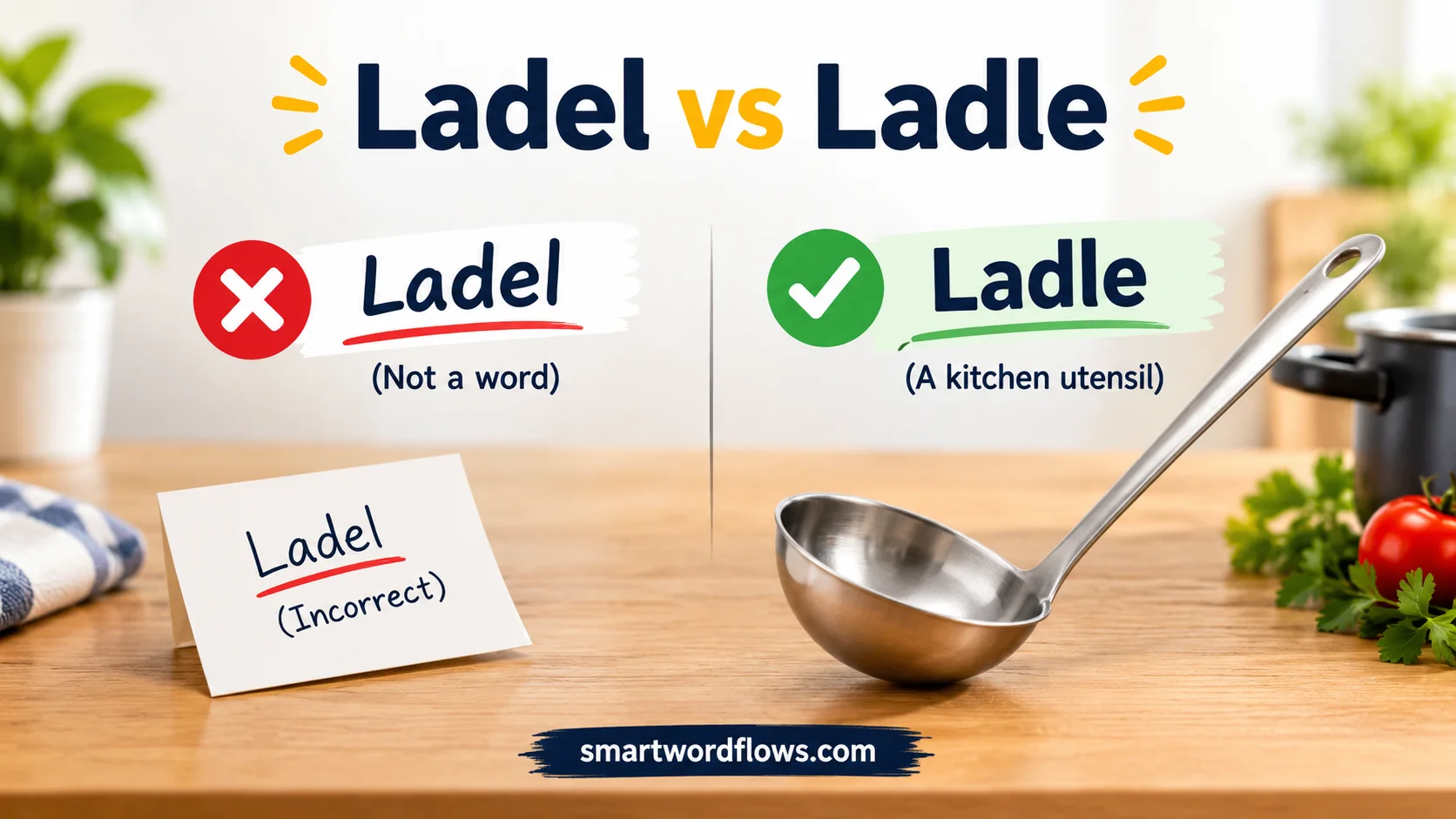

Have you ever stopped while writing a recipe and wondered about Ladel vs Ladle? This common spelling confusion happens because both forms sound nearly identical. However, ladle is the correct English spelling, while ladel is a common misspelling. If you’re writing about cooking, recipes, or kitchen tools, using the correct word makes your writing clearer and more professional.
A ladle is a deep, bowl-shaped kitchen tool with a long handle, commonly used to scoop and serve soups, sauces, gravies, and other liquids. The word can also work as a verb when describing the action of scooping or serving liquid food. Learning the difference between these spellings can improve your writing accuracy and help you avoid mistakes in recipes, articles, academic writing, and everyday communication.
Quick Answer: Ladel vs Ladle
Ladle is the correct spelling.
Ladel is generally an incorrect spelling when you mean the kitchen utensil.
A ladle is a large, deep spoon with a long handle. People commonly use it to serve soup, stew, gravy, sauces, and other liquids. The word can also work as a verb, meaning to serve or transfer food with a ladle.
Correct
She used a ladle to serve the soup.
Incorrect
She used a ladel to serve the soup.
The easiest way to remember it is simple: ladle ends with -dle, not -del.
So, whenever you’re talking about the large serving spoon, choose ladle.
Comparison Overview
| Feature | Ladle | Ladel |
| Standard spelling | Yes | No |
| Meaning | A large, deep spoon used for serving or transferring liquids | Generally a misspelling of ladle |
| Part of speech | Noun and verb | Not the standard form for this meaning |
| Common use | Soup, stew, gravy, sauce, liquids | Usually appears as a spelling error |
| Pronunciation | /ˈleɪdəl/ | Usually intended to represent ladle |
| Example | “Use a ladle for the soup.” | “Use a ladel for the soup.” |
| Correct choice | Ladle | Avoid |
The distinction becomes even clearer when you look at how dictionaries define the word. Cambridge describes a ladle as a large spoon with a long handle and a deep, cup-shaped section, especially for serving soup. It also recognizes ladle as a verb for putting soup or other liquid food into bowls. Oxford gives essentially the same core meaning and lists the word’s historical origin.
Main Differences Between Ladel vs Ladle Difference
Although ladel and ladle may appear close at first glance, they don’t have equal standing in standard English. The important difference comes down to spelling, dictionary recognition, meaning, and usage.
Spelling Difference
The correct spelling is:
L-A-D-L-E
The common incorrect form is:
L-A-D-E-L
Notice where the letters d and l appear.
In ladle, the final three letters are d-l-e. That small arrangement is easy to overlook, especially when you’re spelling the word from its pronunciation.
Think of the word visually:
lad + le = ladle
Once you become familiar with that pattern, the spelling becomes much easier to remember.
Meaning Difference
Ladle has a clear meaning in English. It refers to a large, deep utensil designed to scoop, carry, and serve liquids or semi-liquid foods.
For example, you might use a ladle for:
- Soup
- Stew
- Gravy
- Curry
- Sauce
- Punch
- Broth
- Beans with plenty of liquid
- Other foods that need to be scooped and poured
Ladel, when used with this meaning, doesn’t represent a separate kitchen utensil. In ordinary English writing, it is generally a misspelling of ladle.
That means you shouldn’t treat these as two different kitchen tools. There isn’t a special utensil called a ladel that differs from a ladle.
Usage Difference
You’ll see ladle in many practical situations.
A recipe might say:
Ladle the soup into four bowls.
A cooking article might say:
Use a deep ladle to serve the stew.
A restaurant description could say:
The chef ladled the sauce over the pasta.
In each case, ladle is the correct form.
Writing ladel in these sentences creates a spelling error rather than a meaningful variation.
Grammar Difference
Another useful point is that ladle can function as both a noun and a verb.
As a noun, it names the utensil:
The ladle is next to the soup pot.
As a verb, it describes the action:
She ladled soup into the bowls.
This flexibility makes ladle more interesting than it might first appear. The same spelling names the object and describes an action involving that object.
What Does Ladle Mean?
A ladle is a large spoon designed primarily for scooping and serving liquids or liquid-heavy foods.
Unlike a normal eating spoon, a ladle usually has a deep bowl and a long handle. The deeper bowl allows it to hold more liquid, while the long handle helps you reach into a deep cooking pot without putting your hand too close to the heat.
Oxford defines ladle as a large, deep spoon with a long handle, especially one used for serving soup. Cambridge similarly describes it as a large spoon with a long handle and deep cup-shaped section.
Why Is a Ladle Different From a Regular Spoon?
A regular spoon is mainly designed for eating or handling relatively small amounts of food.
A ladle has a different job.
Its shape makes it useful for moving larger quantities of liquid from one container to another. The deep bowl holds more food, while the handle gives you better reach.
For example, imagine a large pot of chicken soup.
Trying to serve everyone with a teaspoon would be slow and messy. A ladle lets you scoop a reasonable amount of soup in one movement and pour it neatly into a bowl.
That’s the basic idea behind the utensil.
Common Foods Served With a Ladle
A ladle can be useful for many dishes, including:
- Chicken soup
- Tomato soup
- Lentil soup
- Vegetable soup
- Beef stew
- Chicken curry
- Gravy
- Pasta sauce
- Broth
- Chili
- Punch
The exact design varies depending on the intended use. Some ladles have relatively shallow bowls, while others are considerably deeper.
Ladle as a Noun
When ladle functions as a noun, it refers to the physical utensil.
Here are several examples:
The ladle was hanging beside the stove.
Please bring a ladle for the soup.
The chef picked up a ladle from the kitchen counter.
We need a larger ladle for this pot.
In all these examples, ladle identifies an object.
Plural Form of Ladle
The plural form is ladles.
For example:
The restaurant keeps several ladles in the kitchen.
Wash the ladles after serving the soup.
The spelling simply adds -s to the singular form.
Ladle as a Verb
Here’s where the word becomes especially useful.
Ladle can also function as a verb. In this form, it means to serve or transfer food using a ladle.
For example:
She ladled soup into each bowl.
He ladled gravy over the mashed potatoes.
The cook ladled stew into large bowls.
The verb often appears with words such as into, over, or out.
Common Verb Forms of Ladle
| Form | Example |
| Base form | ladle |
| Third-person singular | ladles |
| Past tense | ladled |
| Past participle | ladled |
| Present participle | ladling |
Examples:
- I ladle soup into bowls.
- She ladles soup for the guests.
- He ladled gravy over the potatoes.
- They have ladled the stew into serving dishes.
- She is ladling soup into bowls.
Oxford lists these verb forms and gives examples such as ladle the soup into bowls. It also notes that the verb can be used more broadly for distributing something in large quantities.
Is Ladel a Correct Word?
When you’re referring to the kitchen utensil, ladel is not the standard spelling.
The major learner dictionaries consulted for this article identify ladle as the English word for the utensil. Cambridge lists both the noun and verb, while Oxford provides separate noun and verb entries.
Therefore, if you write:
I need a ladel.
you should normally change it to:
I need a ladle.
This isn’t a case where American and British English use different spellings. Ladle is the standard form in both varieties.
Why Does “Ladel” Look So Natural?
The mistake is understandable.
English spelling doesn’t always match pronunciation perfectly. When people hear a word rather than see it written, they may reconstruct the spelling according to the sounds they hear.
The ending of ladle can especially cause confusion because the spoken word doesn’t sound like every letter is pronounced separately.
You don’t clearly hear:
lad-le
Instead, the word flows together as one spoken unit.
That’s why someone who knows the word orally may still hesitate when writing it.
Ladel vs Ladle Pronunciation
The standard pronunciation of ladle is approximately:
LAY-dəl
Cambridge gives the pronunciation as /ˈleɪdəl/ in both its British and American entries. Oxford also lists /ˈleɪdl/ for the word.
The pronunciation helps explain why spelling can become confusing.
The final part isn’t pronounced as a strong, separate “del” sound. Instead, the word tends to flow quickly from the d into the final syllable.
Does Pronunciation Change the Spelling?
No.
Even if the pronunciation makes the spelling less obvious, the standard written form remains:
ladle
Pronunciation can explain a spelling mistake, but it doesn’t make ladel an alternative spelling.
Read This: Soo vs So: Which Is Correct?
Examples of Ladle Used Correctly
Seeing a word in context often makes its usage much easier to understand.
Ladle as a Noun
The ladle was too small for the large soup pot.
Please use the ladle to serve the stew.
She placed the ladle beside the serving bowl.
The wooden ladle has a long handle.
He washed the ladle after dinner.
These sentences all use ladle as the name of a physical object.
Ladle as a Verb
She ladled soup into each bowl.
The chef ladled gravy over the turkey.
He ladled the stew into four containers.
They ladled out soup for the guests.
The cook is ladling sauce onto the plates.
Here, ladle describes an action rather than an object.
Ladel vs Ladle: Incorrect and Correct Examples
| Incorrect | Correct |
| She grabbed a ladel. | She grabbed a ladle. |
| Use the ladel for the soup. | Use the ladle for the soup. |
| I washed the ladel. | I washed the ladle. |
| The ladel is beside the pot. | The ladle is beside the pot. |
| He ladelled the soup. | He ladled the soup. |
The last example highlights another useful spelling point. The past tense is ladled, not ladelled. The standard verb forms follow the spelling of ladle.
Common Mistakes With Ladle
Mistake: Writing Ladel
This is the most direct spelling mistake.
Incorrect:
Put the soup in the ladel.
Correct:
Put the soup in the ladle.
Mistake: Adding an Extra “L”
Some writers may also struggle with the verb form.
The correct past tense is:
ladled
Not:
ladelled
Likewise, the present participle is:
ladling
not:
ladleing
The spelling changes slightly when suffixes are added, so paying attention to the base word helps.
Mistake: Assuming Every Sound Has a Separate Letter
English doesn’t work that neatly.
A word can contain letters that aren’t pronounced exactly as beginners expect. Ladle is a good example.
Rather than spelling it purely by sound, remember its written pattern.
How to Remember the Correct Spelling
A small memory trick can save you from repeatedly making the same mistake.
Think of “Ladle” as “Lad + Le”
Break the word visually:
LAD + LE
That gives you:
LADLE
The middle L belongs before the final E.
Another useful comparison is handle:
- handle
- ladle
Both contain the -dle pattern.
You don’t need a complicated mnemonic. A clear visual pattern is enough.
Use the Word in a Sentence
Instead of memorizing the spelling alone, connect it with a familiar sentence:
Use the ladle to serve the soup.
The more often you see and write the word correctly, the more natural its spelling becomes.
Ladle vs Similar Kitchen Utensils
Understanding what a ladle does also helps distinguish it from similar utensils.
Ladle vs Spoon
A spoon is usually smaller and has a shallower bowl.
A ladle is generally larger, deeper, and designed to move more food or liquid at once.
For example, you might eat soup with a spoon but serve the soup with a ladle.
Ladle vs Serving Spoon
A serving spoon can handle vegetables, rice, meat, and other solid foods.
A ladle is especially useful when the food contains substantial liquid.
For example:
| Food | Useful utensil |
| Soup | Ladle |
| Gravy | Ladle |
| Stew | Ladle |
| Cooked rice | Serving spoon |
| Salad | Salad servers |
| Small dessert | Spoon |
There can be overlap. A large serving spoon may work for some foods that could also be handled with a ladle. The key difference is the deep bowl and liquid-handling design of the ladle.
Ladle vs Scoop
The word scoop describes a broader type of tool or action.
A scoop may be designed for ice cream, flour, grains, or other materials. A ladle specifically has the familiar deep-bowl shape and long handle associated with serving liquids.
So, while both can scoop, they’re not automatically the same utensil.
A Practical Case Study: Choosing the Correct Word in a Recipe
Imagine you’re writing a recipe for homemade chicken soup.
You want to tell the reader how to serve it.
You write:
Take a ladel and pour the soup into each bowl.
The reader will probably understand what you mean. However, the spelling is still incorrect.
The polished version is:
Take a ladle and pour the soup into each bowl.
Now imagine you want to describe the action instead:
Ladle the soup into warm bowls and serve immediately.
Here, ladle has changed from a noun into a verb.
This example demonstrates why learning the correct word is more useful than simply memorizing one spelling. Once you understand ladle, you can use it naturally in several grammatical situations.
The Historical Background of Ladle
The word ladle has a long history.
Oxford traces it to Old English hlædel, from hladan, a West Germanic word connected with the idea of loading or drawing. (Oxford Learner’s Dictionaries)
The word has therefore been part of English vocabulary for many centuries.
Historical dictionaries also show older meanings associated with drawing or dipping liquids. Webster’s 1828 dictionary, for example, described a ladle as a utensil resembling a dish with a long handle used for dipping liquid from a vessel. (Websters Dictionary 1828)
Modern English has kept the central idea intact: a tool used to dip, carry, and serve.
Other Meanings of Ladle
Although most people encounter ladle in the kitchen, the word has additional technical uses.
In metallurgy, a ladle can refer to a large container used to transport molten metal. Dictionary sources recognize this technical meaning alongside the ordinary kitchen meaning.
That makes sense when you consider the basic function of the object.
A kitchen ladle carries liquid food.
A metallurgical ladle carries molten metal.
The scale and construction are dramatically different, but the underlying idea of holding and transferring a substance remains similar.
Why Correct Spelling Matters
A single spelling mistake rarely makes a sentence impossible to understand. Still, correct spelling matters when you’re producing polished writing.
It becomes especially important in:
- Recipes
- Cookbooks
- Food blogs
- Restaurant menus
- Product descriptions
- School assignments
- Instruction manuals
- Cooking tutorials
- Professional websites
Imagine a restaurant menu repeatedly spelling ladle as ladel. Customers can probably understand it, but the error makes the writing look less carefully edited.
Correct spelling creates a smoother reading experience.
It also helps readers find the information they’re looking for when they search for the word online.
Ladel vs Ladle in Search Queries
People often type a misspelling into a search engine because they aren’t sure which version is correct.
That’s completely normal.
If you’ve searched for “ladel vs ladle difference,” you’re likely looking for confirmation about the spelling rather than two genuinely different words.
The important distinction is this:
Ladel → generally a misspelling when referring to the utensil.
Ladle → the standard English word.
Search engines may still understand a misspelled query and show results for ladle. That doesn’t make the misspelled form correct in formal writing.
Quick Facts About Ladle
- Correct spelling: Ladle
- Plural: Ladles
- Past tense: Ladled
- -ing form: Ladling
- Part of speech: Noun and verb
- Typical utensil: Large, deep spoon
- Common purpose: Serving or transferring liquids
- Common foods: Soup, stew, gravy, sauce, broth
- Standard pronunciation: Approximately “LAY-dəl”
- Common misspelling: Ladel
- Word origin: Old English hlædel
- Technical use: A container for transferring molten metal
Which One Should You Use?
When you’re unsure between ladel vs ladle, use this simple rule:
If you mean the large, deep serving spoon, write “ladle.”
Use ladle when you’re:
- Naming the kitchen utensil
- Describing its use
- Writing a recipe
- Explaining a cooking process
- Describing serving soup or stew
- Using the word as a verb
Avoid ladel when you’re trying to write the standard English word for that utensil.
FAQs :
Is ladle or ladel correct?
Ladle is the correct spelling. Ladel is a common misspelling and is not the standard English word for the kitchen utensil used to serve liquids.
What does ladle mean?
A ladle is a kitchen utensil with a long handle and a deep, rounded bowl. It is mainly used for serving soup, gravy, sauces, and other liquids.
Why do people spell ladle as ladel?
People often write ladel because the two spellings can sound very similar when spoken. The unusual vowel arrangement in ladle can also make its spelling easy to forget.
Can ladle be used as a verb?
Yes. Ladle can be used as both a noun and a verb. As a verb, it means to scoop or serve liquid food using a ladle. For example, “She ladled soup into the bowls.”
How can I remember the spelling of ladle?
A simple way to remember ladle is to focus on the ending -dle. Think of the word as lad + le, rather than adding an extra “e” before the final consonant.
Conclusion :
When comparing Ladel vs Ladle, ladle is the correct spelling in standard English. It refers to a long-handled utensil used for scooping and serving liquids such as soup, gravy, and sauces. Ladel is simply a common spelling error. Remembering the correct -dle ending will help you use the word accurately in recipes, articles, and everyday writing.