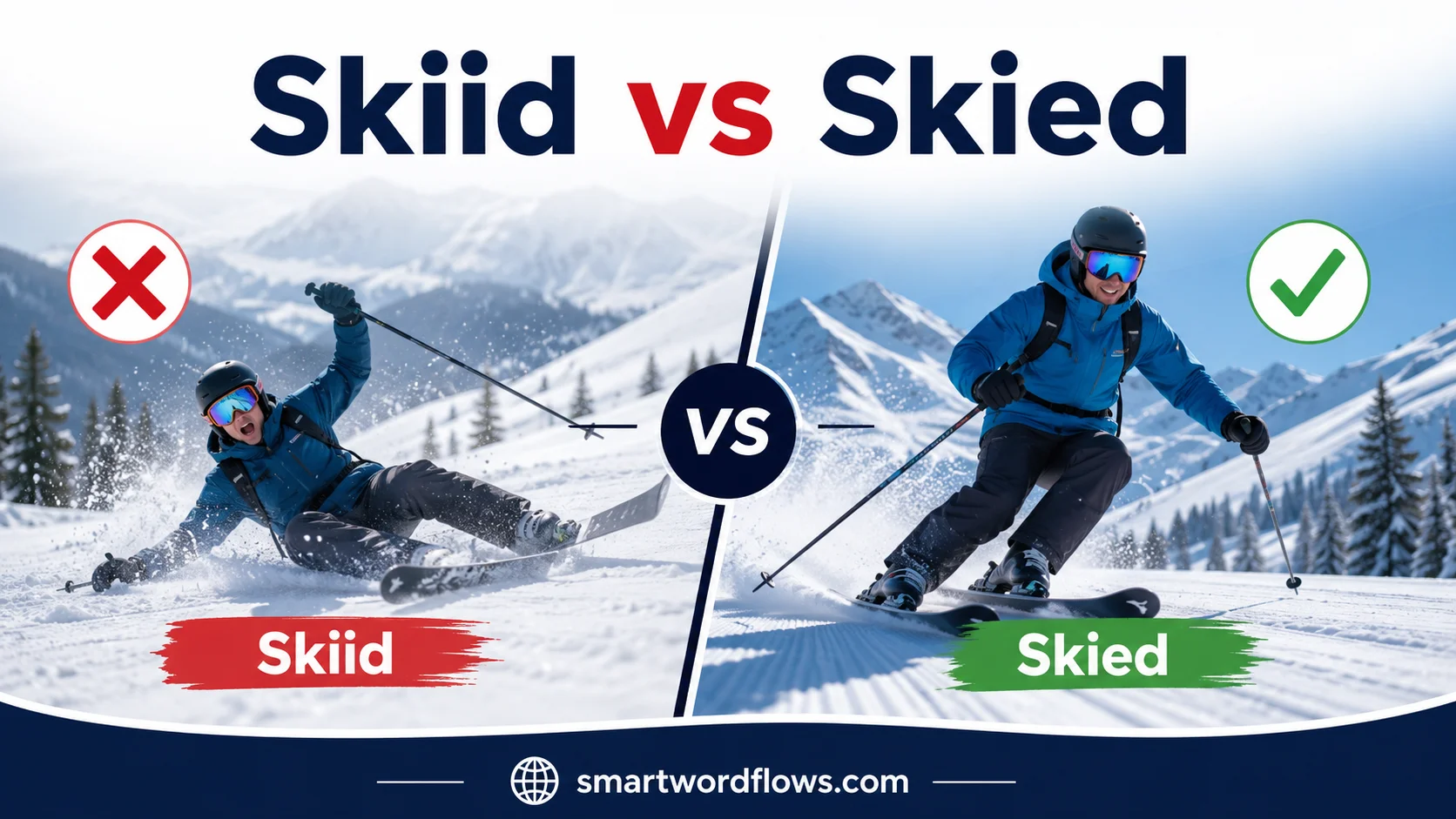

When comparing Skiid vs Skied, the correct spelling is Skied. It is the past tense and past participle of the verb ski in standard English. Skiid is a misspelling and an incorrect form. This grammar rule is supported by dictionaries, and using the right form improves English spelling, writing accuracy, and clarity. Writers, learners, and fluent writers can avoid this common grammar mistake by remembering that Skied is the accepted form.
In formal writing and informal writing, Skied can be used naturally in an email, school assignment, travel blog, social media caption, or document. Choosing the correct form makes your writing more professional and accurate while improving credibility. Simple examples and practical tips can help you remember the spelling. If a red underline appears under Skiid, treat it as an error and use Skied instead. This small step helps prevent common mistakes in everyday English.
Quick Answer
Skied is the correct standard past tense and past participle of ski.
Skiid isn’t the standard English past-tense form of ski. If you’re describing an action that happened in the past, use skied.
| Word | Standard form? | Function | Example |
| ski | Yes | Base form | I want to ski tomorrow. |
| skis | Yes | Third-person singular present | She skis every winter. |
| skiing | Yes | Present participle/gerund | They enjoy skiing. |
| skied | Yes | Past tense and past participle | We skied yesterday. |
| skiid | No | Not the standard past form of ski | We skiid yesterday. |
| skiied | No | Not the standard past form of ski | We skiied yesterday. |
Cambridge specifically identifies skied as the past simple and past participle of ski. Its American English entry gives the same verb pattern: ski, skis, skiing, skied.
Merriam-Webster likewise lists skied as the past form of ski and gives its pronunciation as approximately /skiːd/ in American English.
The simplest rule to remember is:
ski → skied
Once you remember that pair, the spelling becomes much easier.
Comparison Overview
The difference between skiid vs skied is mainly a matter of standard spelling and grammar.
| Feature | Skied | Skiid |
| Correct past tense of ski | Yes | No |
| Correct past participle of ski | Yes | No |
| Found as the standard form in major dictionaries | Yes | No |
| Refers to past skiing activity | Yes | No |
| Appropriate in formal writing | Yes | No |
| Example | We skied all afternoon. | We skiid all afternoon. |
The key point is simple: skied is the conventional English form.
If you’re writing an article, school assignment, email, story, report, or social media post and need the past form of ski, skied is the form to choose.
What Does “Ski” Mean?
As a verb, ski means to move over snow using skis. It can also be used transitively when someone skis a particular area, route, or terrain. Merriam-Webster defines the verb as gliding on skis for travel or sport.
For example:
- I ski every winter.
- We ski on weekends.
- She skied down the hill.
- They have skied together for years.
The verb can describe recreational activity, competitive sport, transportation across snowy terrain, or simply the act of using skis.
What Does “Skied” Mean?
Skied means that someone skied in the past.
It works in two important grammatical roles:
- Simple past
- Past participle
For example:
- I skied yesterday.
- She skied in Colorado last year.
- They have skied together many times.
- He had skied there before.
Cambridge lists skied as both the past simple and past participle of ski.
Main Differences Between Skiid vs Skied
There isn’t a genuine competition between two standard forms here. Skied is the established English spelling, while skiid isn’t the standard past tense of ski.
Still, understanding why the confusion happens can help you avoid it.
Skied Is the Standard Past Form
When you change ski into its past tense, English uses skied.
Consider this progression:
Present:
I ski every winter.
Past:
I skied last winter.
Present perfect:
I have skied there several times.
The spelling remains consistent in the past forms.
Skiid Is Not the Standard Past Tense
The spelling skiid may look logical if someone tries to build the past tense by attaching -ed mechanically. However, standard English doesn’t use skiid for the past tense of ski.
For example:
We skiid down the slope.
The standard version is:
We skied down the slope.
That small spelling difference matters in edited and formal English.
Skiied Is Also Incorrect
Another tempting form is skiied.
Someone might reason:
ski + ed = skiied
But English doesn’t form the past tense of ski that way.
Use:
ski → skied
Not:
ski → skiied
This is one of those spelling patterns that you simply need to recognize as part of the standard form.
Why Is “Skiid” Incorrect?
The confusion comes partly from the unusual appearance of the word ski.
Many English learners expect a verb ending in a vowel to behave predictably when -ed is added. That expectation doesn’t always work.
English spelling has developed through many different linguistic influences. Some words follow productive spelling patterns while others have established forms that don’t look perfectly predictable from the base word.
With ski, the standard past form is skied.
Think of the final i as staying in place while -ed attaches:
ski + ed → skied
The result contains the letters s-k-i-e-d.
It doesn’t require another i.
Merriam-Webster’s current dictionary entry gives the verb forms as skied and skiing, while Cambridge similarly lists skied as the past tense and past participle.
A Useful Way to Remember It
Don’t try to invent the spelling each time.
Instead, memorize the word family:
ski → skiing → skied
That approach works especially well because skiing can tempt you toward the wrong spelling of skied. The two forms look different, but both are standard.
How to Use “Skied” Correctly
Once you understand that skied is the past form of ski, using it becomes straightforward.
Skied in the Simple Past
Use skied when a skiing action happened and finished in the past.
Examples:
- I skied yesterday.
- We skied all morning.
- She skied down the steep trail.
- They skied in Utah last winter.
- Daniel skied with his friends during the vacation.
Notice how each sentence describes a completed past event.
You can also add a specific time:
- We skied last Saturday.
- She skied there in January.
- I skied for three hours yesterday.
- They skied in the mountains last year.
Skied With “Have” or “Has”
Use skied as a past participle after have or has.
Examples:
- I have skied in several countries.
- She has skied since childhood.
- He has never skied before.
- We have skied on that mountain many times.
The auxiliary verb carries the tense while skied supplies the past participle.
Skied With “Had”
The same form works with had in the past perfect.
Examples:
- We had skied for several hours before the storm arrived.
- She had never skied before that trip.
- They had skied there once before.
- He had already skied the easier runs.
The important pattern is:
had + skied
Not:
had + skiid
And not:
had + ski
when the past perfect is required.
When You Should Use “Ski” Instead of “Skied”
One of the most common grammar mistakes involves did.
Because did already marks the past tense, the main verb should return to its base form.
Correct
Did you ski yesterday?
Incorrect
Did you skied yesterday?
Also Incorrect
Did you skiid yesterday?
The same rule applies to negative sentences.
Correct
I didn’t ski yesterday.
Incorrect
I didn’t skied yesterday.
Why?
Because did already carries the past-tense meaning.
Compare these patterns:
| Sentence type | Correct form |
| Statement | I skied yesterday. |
| Question | Did you ski yesterday? |
| Negative | I didn’t ski yesterday. |
| Present perfect | I have skied before. |
| Past perfect | I had skied before. |
This is a useful distinction because the mistake isn’t only about spelling. It’s also about verb structure.
Ski, Skis, Skiing, and Skied
Understanding the entire verb family makes the skiid vs skied question much easier.
| Verb form | Grammatical use | Example |
| ski | Base form | I want to ski. |
| skis | Third-person singular present | She skis every weekend. |
| skiing | Present participle/gerund | He enjoys skiing. |
| skied | Simple past | We skied yesterday. |
| skied | Past participle | They have skied there before. |
Cambridge’s American English entry specifically gives skis as the present-tense third-person form, skiing as the present participle, and skied as both the past tense and past participle.
Present: Ski
Use ski for the base form.
I want to ski tomorrow.
It also follows modal verbs:
- can ski
- should ski
- might ski
- will ski
- must ski
For example:
We might ski tomorrow if the weather improves.
Present Third Person: Skis
Use skis with he, she, or it in the simple present.
She skis every winter.
Michael skis competitively.
My brother skis whenever he gets the chance.
Present Participle: Skiing
Use skiing with forms of be for progressive constructions.
I am skiing today.
They were skiing when the snow started.
She has been skiing all morning.
Skiing can also function as a gerund:
Skiing requires balance and control.
Merriam-Webster defines skiing as the art or sport of sliding and jumping on skis.
Past: Skied
Use skied for completed past actions.
We skied last weekend.
That’s the form that answers the central skiid vs skied question.
Skied vs Skiing: Why the Spellings Differ
A common source of confusion is the fact that skiing contains two consecutive i letters while skied doesn’t.
Look closely:
- skiing
- skied
Both are correct.
The spelling patterns aren’t identical because different suffixes interact with the base word differently.
Examples
I enjoy skiing.
I skied yesterday.
We are skiing tomorrow.
We skied yesterday.
So don’t assume that because skiing contains ii, the past tense should contain ii as well.
It doesn’t.
Skiing is correct.
Skied is correct.
Skiid and skiied aren’t the standard past forms.
Read More: Inexcusable vs. Unexcusable: Difference, Meaning, and Correct Usage
Pronunciation of “Skied”
When skied comes from the verb ski, its pronunciation is straightforward.
In American English, dictionaries represent it approximately as /skiːd/. Merriam-Webster gives the pronunciation as “skēd,” while Cambridge gives ski as /skiː/.
It sounds roughly like:
skeed
For example:
She skied down the hill.
The word has one syllable.
Don’t pronounce it as though it contains two separate vowel sounds. The ie spelling represents the long e sound in this word.
Why Pronunciation Doesn’t Solve the Spelling
English spelling often doesn’t provide a perfect one-to-one map between sounds and letters.
That’s why hearing skied won’t necessarily tell you whether it should be spelled skied, skiid, or skiied.
The reliable answer comes from the established word form:
skied
Common Mistakes With Skiid vs Skied
Small spelling mistakes often appear because the writer knows the meaning but hasn’t memorized the conventional form.
Here are the most common errors.
Mistake: “Skiid”
We skiid down the mountain.
Correct:
We skied down the mountain.
Mistake: “Skiied”
She skiied with her family.
Correct:
She skied with her family.
Mistake: “Skied” After “Did”
Did you skied yesterday?
Correct:
Did you ski yesterday?
Mistake: “Skied” After “Will”
We will skied tomorrow.
Correct:
We will ski tomorrow.
Modal verbs such as will, can, should, and might take the base form.
Mistake: “Ski” in a Simple Past Statement
We ski yesterday.
Correct:
We skied yesterday.
The context determines the form you need.
Examples of “Skied” in Different Contexts
The word skied works naturally in many types of writing.
Everyday Conversation
I skied with my brother last weekend.
This sounds natural in casual conversation.
Travel Writing
We skied in Colorado during our winter vacation.
Here, skied describes a completed activity during a trip.
Sports Writing
The athlete skied through the course with remarkable control.
In this context, the verb describes athletic performance.
Personal Experience
I’ve skied since I was a teenager.
Here, skied functions as the past participle after have.
Storytelling
We reached the summit just before noon and skied back down before the weather changed.
The simple past keeps the sequence of events moving.
Formal Writing
The participants skied several marked routes during the training session.
Even formal writing uses the same ordinary past-tense form.
There is no special formal alternative to skied.
Case Study: Choosing the Right Verb Form
Consider this short paragraph:
Last winter, Maya traveled to a mountain resort with her friends. On the first morning, she skied for two hours. The next day, she wanted to ski again, but heavy snow delayed the group. By the end of the trip, she had skied on several different trails.
Three forms appear here:
- traveled — simple past
- skied — simple past
- ski — base form after wanted to
- had skied — past perfect
This example shows why grammar matters alongside spelling.
The correct choice isn’t always simply “use skied when talking about skiing.” You need to consider the structure of the sentence.
For instance:
She skied yesterday.
But:
She wanted to ski yesterday.
And:
She had skied before the storm arrived.
The verb changes according to the grammatical construction.
“Skied” Can Also Come From “Sky”
There’s another interesting detail worth knowing.
Skied can also represent the past tense of the verb sky, which means to send or hit something high into the air in certain contexts.
Dictionary.com lists skied as a past-tense form of both ski and sky. However, the pronunciation and meaning differ.
Compare these:
The skier skied down the mountain.
Here, skied comes from ski.
The batter skied the ball into the outfield.
Here, skied comes from sky.
The context makes the meaning clear.
This distinction is useful because you may encounter skied in sports writing where nobody is talking about snow.
Two Meanings at a Glance
| Word | Original verb | Meaning | Example |
| skied | ski | Moved on skis | She skied down the slope. |
| skied | sky | Sent something high into the air | He skied the ball. |
So skied isn’t limited to winter sports.
Is “Skiid” Ever Used?
You may encounter skiid online, in usernames, names, informal writing, or other contexts. Seeing the spelling somewhere doesn’t automatically make it the standard English past tense of ski.
For ordinary English grammar, the distinction remains clear:
ski → skied
If you’re writing standard English, that’s the form to use.
This is an important principle for spelling questions generally. Internet usage can contain typos, usernames, slang, brand names, dialect forms, and deliberate misspellings. A word appearing online doesn’t necessarily establish it as the standard grammatical form.
Skied in Formal and Informal Writing
Skied works equally well in casual and formal contexts.
You can write:
We skied all afternoon.
in a casual message.
You can also write:
The competitors skied through the course under difficult weather conditions.
in a formal sports report.
The spelling doesn’t change.
Where Correct Spelling Matters Most
Use skied carefully in:
- School assignments
- Essays
- Professional emails
- Business documents
- Blog posts
- News articles
- Sports reports
- Academic writing
- Resumes and applications
- Website content
A single spelling mistake usually won’t destroy a piece of writing. Still, repeated errors can weaken credibility. When the correct form is only five letters, there’s little reason to choose the nonstandard version.
A Simple Memory Trick for Skied
Here’s the easiest way to remember the spelling:
SKI + ED = SKIED
Think of the word as a small bridge:
SKI → SKIED
The i stays.
The e from -ed follows it.
The result is:
S-K-I-E-D
Not:
S-K-I-I-D
And not:
S-K-I-I-E-D
You can reinforce the pattern with three sentences:
I ski in winter.
I skied last winter.
I have skied there before.
That three-step pattern covers the most useful forms.
Skiid vs Skied in Questions and Negative Sentences
This deserves special attention because many mistakes happen when writers combine past tense with auxiliary verbs.
Questions With “Did”
Correct:
Did you ski last weekend?
Incorrect:
Did you skied last weekend?
The word did already places the sentence in the past.
Negative Sentences With “Did Not”
Correct:
I did not ski yesterday.
Incorrect:
I did not skied yesterday.
The same principle applies to contractions:
I didn’t ski yesterday.
Not:
I didn’t skied yesterday.
Questions Without “Did”
Compare:
Did you ski yesterday?
with:
Have you skied there before?
The first sentence uses did + ski.
The second uses have + skied.
That distinction is fundamental.
Quick Grammar Guide
| Situation | Correct form | Example |
| Present | ski | I ski every winter. |
| Third-person present | skis | She skis often. |
| Continuous | skiing | We are skiing now. |
| Simple past | skied | We skied yesterday. |
| Present perfect | have/has skied | I have skied there. |
| Past perfect | had skied | We had skied before. |
| After did | ski | Did you ski? |
| After will | ski | We will ski tomorrow. |
| After can | ski | She can ski well. |
This table captures the main rule in one place.
Practice: Choose Ski, Skied, or Skiing
Test yourself with these sentences.
Questions
- We ___ down the mountain yesterday.
- I enjoy ___ during the winter.
- Did you ___ last weekend?
- She has ___ in several countries.
- They plan to ___ tomorrow.
- He was ___ when the weather changed.
- I ___ every winter when I was younger.
- We had ___ there before the resort closed.
Answers
- skied
- skiing
- ski
- skied
- ski
- skiing
- skied
- skied
The exercise highlights an important point: skied isn’t the correct form in every sentence about skiing.
Grammar determines the form.
The simple past and past participle use skied. After auxiliaries such as did and modals such as will, the base form ski appears instead.
FAQs:
1. Is “Skiid” or “Skied” correct?
Skied is the correct spelling. Skiid is a common misspelling and should not be used in standard English.
2. What is the past tense of “ski”?
The past tense of ski is skied. For example, “We skied down the mountain yesterday.”
3. Why is “Skiid” incorrect?
Skiid does not follow the accepted spelling pattern used in standard English. Dictionaries recognize skied as the correct past tense and past participle.
4. Can I use “skied” in formal writing?
Yes. Skied is appropriate for formal writing, informal writing, school assignments, emails, travel blogs, and everyday English.
5. How can I remember “Skied”?
A simple way to remember it is to connect ski with skied. Whenever you need the past tense, use skied, not skiid.
Conclusion:
Choosing between Skiid vs Skied becomes simple once you remember the correct spelling. Skied is the standard and accepted past tense and past participle of ski, while Skiid is a misspelling that should be avoided. Although both forms may look understandable, only Skied is suitable for correct English usage.
Using the right form helps your writing remain clear, accurate, professional, and credible. Whether you are writing a school assignment, email, travel blog, social media caption, or everyday sentence, choosing Skied will help you communicate confidently and avoid an unnecessary spelling mistake.