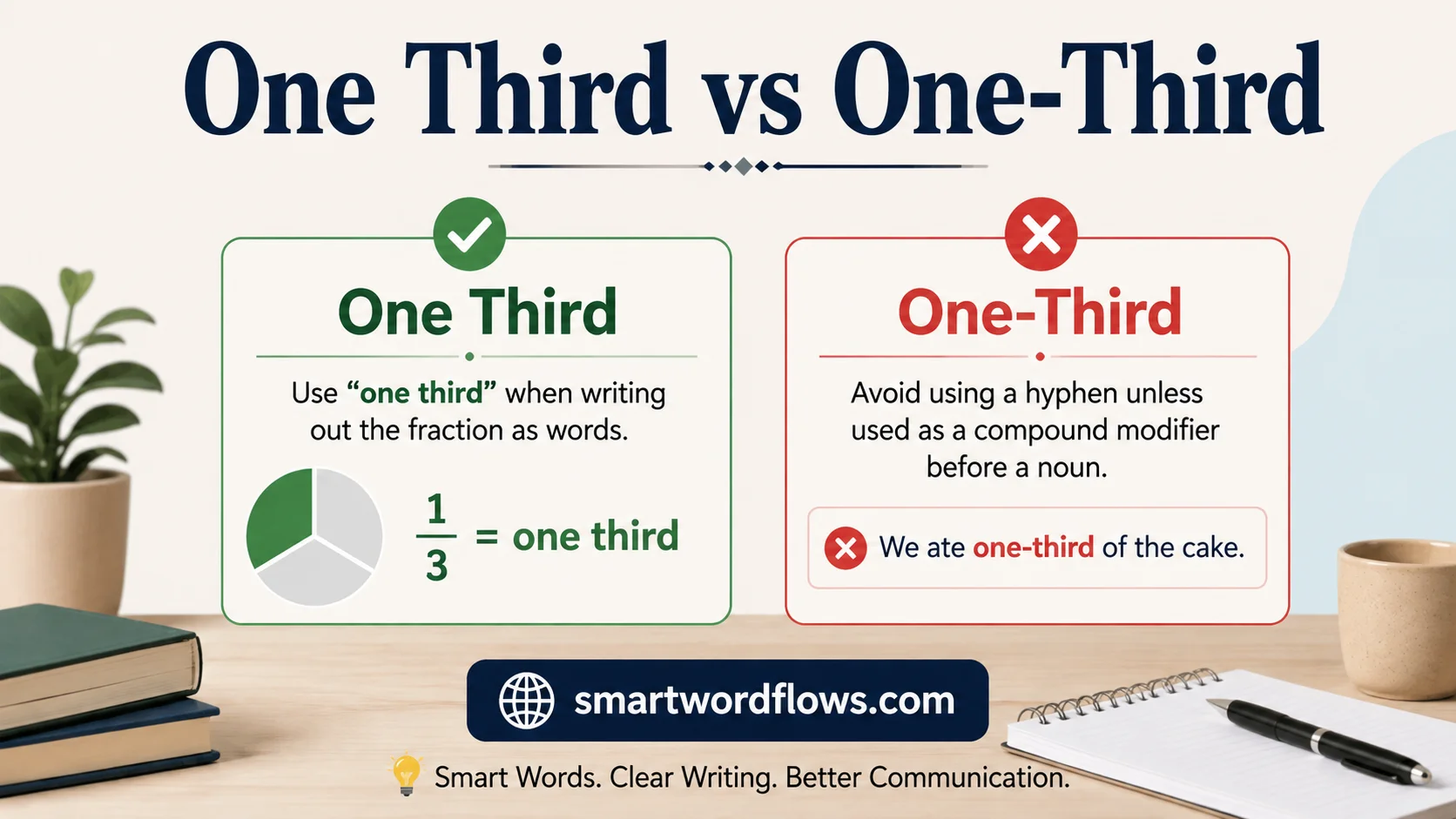

When comparing One Third vs One-Third, the main issue is hyphenation and how each form works in a sentence. Both can be correct, but the right choice depends on whether the phrase acts as a fraction or describes a noun. Understanding this small grammar difference can make your writing clearer, more accurate, and easier to read.
In general, one third is used when referring to a fraction or part of a whole, such as “one third of the students.” By contrast, one-third is commonly used as a compound adjective before a noun, such as “a one-third share.” Learning this simple English grammar rule helps you avoid punctuation mistakes and communicate your meaning with confidence.
Quick Answer
The short answer is that both “one third” and “one-third” can be correct, depending on sentence structure and style.
In practical US English, a useful rule is:
- Use one third when the fraction functions as a noun phrase.
- Use one-third when the fraction directly modifies a noun.
- Use one-third in compounds such as a one-third share or a one-third reduction.
- Check your organization’s style guide if it specifies a particular treatment.
- Don’t assume that every written fraction must always receive a hyphen.
For example:
One third of the students passed the examination.
Here, one third identifies a portion of the students.
The company announced a one-third reduction in operating costs.
Here, one-third directly describes reduction, creating a compound modifier.
The US Centers for Disease Control and Prevention gives the same basic distinction, stating that spelled-out common fractions should be hyphenated when they modify a noun.
Comparison Overview
| Form | Main function | Example | Usually correct? |
| one third | Noun phrase | One third of the cake remained. | Yes |
| one-third | Compound modifier | A one-third share was transferred. | Yes |
| one-third | Fraction under some style conventions | One-third of the budget was spent. | Yes, depending on style |
| one thirds | Incorrect plural form | One thirds of the cake remained. | No |
| one-thirds | Incorrect form for 1/3 | One-thirds of the cake remained. | No |
The important point is that meaning alone doesn’t determine the hyphen. Grammar, sentence structure, and editorial style all play a role.
Some style authorities traditionally hyphenate spelled-out fractions even when they function as nouns. GrammarBook, for example, recommends hyphenating written fractions and gives one-third as an example.
Other guidance makes the noun-versus-modifier distinction more directly. The CDC recommends leaving a noun-use fraction open while hyphenating a fraction that modifies a noun.
Main Differences Between One Third vs One-Third
The main difference between one third and one-third involves the grammatical job performed by the words.
One Third as a Noun Phrase
When you use the fraction to identify a portion of something, it can function as a noun phrase.
Consider this sentence:
One third of the budget went toward research.
The phrase one third represents the amount being discussed. It doesn’t directly modify the noun budget. Instead, of the budget tells you what that third belongs to.
More examples include:
- One third of the students arrived early.
- One third of the pizza disappeared within minutes.
- One third of the land remains undeveloped.
- One third of the money went toward supplies.
- One third of the year has already passed.
In each example, the fraction identifies an amount or portion.
One-Third as a Compound Modifier
Now look at a different construction:
The company introduced a one-third discount.
Here, one-third directly describes discount. The two words operate together as one descriptive unit.
The hyphen helps readers recognize that relationship immediately.
Other examples include:
- a one-third share
- a one-third reduction
- a one-third increase
- a one-third portion
- a one-third ownership stake
The general rule behind this usage extends beyond fractions. Hyphens often connect words that work together as a compound modifier before a noun.
What Does “One Third” Mean?
One third means one equal part of something divided into three equal parts.
Mathematically, one third is represented as 1/3. It can also be expressed as approximately 0.3333 in decimal form or approximately 33.33% as a percentage.
The fraction describes a proportional relationship rather than a fixed physical amount.
For example, one third of a six-foot board equals two feet. One third of nine dollars equals three dollars. One third of twelve students equals four students.
That flexibility makes the expression useful across everyday, academic, financial, scientific, and technical writing.
Examples of “One Third”
- One third of the students chose the afternoon session.
- She donated one third of her earnings to the project.
- One third of the garden receives direct sunlight.
- We used one third of the available storage space.
- One third of the original material remained after testing.
Notice the common structure. The fraction usually identifies the portion itself, often followed by of and another noun.
What Does “One-Third” Mean?
One-third has the same mathematical meaning as one third. The difference comes from its grammatical presentation.
When the fraction combines with another word to form a compound modifier, the hyphen connects one and third.
For instance:
a one-third portion
The fraction describes what kind of portion it is.
Similarly:
a one-third reduction
The fraction describes the size of the reduction.
The hyphen therefore acts like a small grammatical connector. It signals that one and third belong together as a single descriptive unit.
Cambridge explains that hyphens can connect words that work together as compound modifiers. Its examples include compounds such as twelve-year-old before a noun.
When to Use “One Third” Without a Hyphen
Use one third when the expression functions as the fraction or portion being discussed.
This commonly happens with constructions such as one third of the, one third of my, or one third of all.
For example:
One third of the employees work remotely.
The phrase identifies the employees who make up that fraction. It doesn’t act as a compound adjective directly before employees.
Here are additional examples:
- One third of the population lives in the region.
- One third of the payment remains outstanding.
- One third of the cake was left untouched.
- One third of the water evaporated overnight.
- One third of the participants completed the survey.
“One Third of” Is a Common Construction
The structure one third of + noun appears frequently in natural English.
You can use it when discussing portions, quantities, groups, measurements, resources, or time.
For example:
One third of the available seats were occupied.
The fraction isn’t describing the word seats as a compound adjective. Instead, it identifies how many seats belonged to the portion being discussed.
That distinction explains why many US writing contexts use the open form one third in this construction.
However, some style guides accept or prefer one-third of even when the fraction functions as a noun. The Canadian government’s writing guidance explicitly notes that usage differs among style guides.
When to Use “One-Third” With a Hyphen
Use one-third when the fraction functions as a compound modifier directly before a noun.
For example:
The investors purchased a one-third share.
The words one-third describe the noun share.
More examples make the pattern clearer:
- a one-third reduction in expenses
- a one-third increase in production
- a one-third portion of the property
- a one-third majority of the committee
- a one-third ownership interest
The hyphen isn’t changing the fraction’s mathematical value. It simply joins the words so readers understand their grammatical relationship.
One-Third as a Compound Adjective
A compound adjective contains multiple words that work together to describe a noun.
For example:
- a high-quality product
- a full-time employee
- a five-year contract
- a one-third share
In each case, the connected words work as a unit before the noun.
The same principle applies to measurements. Compare one third of a cup with a one-third-cup measure. The first identifies a quantity, while the second construction uses the fraction as part of a descriptive compound.
One Third vs One-Third in Measurements
Measurements create some of the most useful examples because the grammatical difference becomes easy to see.
Compare these sentences:
The recipe requires one third of a cup of milk.
The recipe requires a one-third-cup measure.
In the first sentence, one third identifies the amount. The phrase of a cup specifies the whole from which the portion comes.
In the second sentence, one-third-cup works together before measure.
A similar pattern appears with length:
The fabric needs one third of a yard.
She cut a one-third-yard strip of fabric.
The second example contains a more complex compound modifier. The fraction helps describe the measurement of the strip.
A Useful Measurement Table
| Quantity expression | Function | Example |
| one third of a cup | Quantity | Add one third of a cup of water. |
| a one-third-cup measure | Compound modifier | Use a one-third-cup measure for accuracy. |
| one third of a mile | Quantity | The trail extends one third of a mile farther. |
| a one-third-mile section | Compound modifier | They repaired a one-third-mile section of road. |
The hyphen belongs inside the compound when the measurement acts as a unified modifier.
One Third vs One-Third in Compound Modifiers
The same principle appears in business, education, science, and everyday writing.
Consider:
The company reported a one-third increase in revenue.
Here, one-third modifies increase.
Now compare:
One third of the revenue came from international sales.
Here, one third identifies a portion of the revenue.
The meaning remains closely related, yet the grammar changes.
This distinction becomes especially valuable in professional writing because compound modifiers can become difficult to parse when several words appear together.
Common Compound Modifier Examples
- one-third share
- one-third reduction
- one-third increase
- one-third decrease
- one-third ownership
- one-third portion
- one-third majority
- one-third-mile trail
- one-third-cup measure
When a fraction directly participates in a compound description before a noun, the hyphen usually improves grammatical clarity.
Read This: Goodmorning vs Good Morning: Which Is Correct?
What About “One-Third of”?
This is where many grammar articles oversimplify the issue.
You may encounter both:
one third of the group
and
one-third of the group
Both forms appear in published English. The choice depends partly on the style authority being followed.
The Canadian government’s language guidance specifically explains that fractions used as nouns have divided usage. It notes that some guides omit the hyphen while traditional practice often retains it.
Therefore, saying that one-third of is always wrong would be inaccurate.
For US readers, the CDC offers a particularly clear editorial rule: use the hyphen when the spelled-out fraction modifies a noun.
That approach gives you a practical distinction:
One third of the class passed.
versus
A one-third majority passed the measure.
The first treats the fraction as the quantity. The second makes the fraction part of a modifier.
One Third vs One-Third: Common Mistakes
Several mistakes appear repeatedly when writers handle fractions.
Mistake: Hyphenating Every Use
A writer might assume that every occurrence must appear as one-third.
For example:
One-third of the class attended.
This form isn’t universally considered wrong. However, some US guidance specifically recommends one third when the fraction functions as a noun phrase.
The better approach is to follow the style system required for your publication.
Mistake: Removing the Hyphen From a Compound Modifier
This construction can cause problems:
a one third share
A clearer standard construction is:
a one-third share
The hyphen tells the reader that one and third function together before share.
Mistake: Writing “One-Thirds”
The plural form one-thirds doesn’t normally make grammatical sense.
The fraction 1/3 contains one numerator and one denominator. You don’t make it plural simply because you’re discussing multiple instances.
For example:
The recipe uses one-third of the mixture.
If you discuss two separate thirds, the wording changes:
Two-thirds of the mixture remains.
The fraction becomes two-thirds, not one-thirds.
One Third vs One-Third: A Practical Case Study
Imagine a company has a $90,000 annual marketing budget.
The finance manager writes:
One third of the budget will support advertising.
Here, one third identifies the portion of the budget.
Now imagine the manager describes the allocation itself:
The company approved a one-third advertising allocation.
Here, one-third works as part of a compound modifier before allocation.
The underlying amount hasn’t changed. In both cases, the fraction represents $30,000, because one third of $90,000 equals $30,000.
The grammar changes because the sentence changes.
What the Case Study Shows
- one third can identify a quantity or portion.
- one-third can describe a noun as a compound modifier.
- The hyphen doesn’t change the mathematical value.
- Sentence structure determines the grammatical role.
- A style guide can influence how noun-use fractions appear.
This is why memorizing “always hyphenate” or “never hyphenate” doesn’t fully solve the problem.
One Third vs One-Third in Formal Writing
Formal writing rewards consistency more than personal preference.
In academic papers, reports, manuals, business documents, and technical material, choose a clear convention and apply it consistently.
If your employer, university, journal, publisher, or client follows a specific style guide, that guide should take priority.
For instance, a publication may require a traditional convention that hyphenates spelled-out fractions consistently. Another editorial system may distinguish between noun uses and adjectival uses.
The important thing is to avoid switching randomly.
A paragraph containing one third, one-third, and two thirds without a grammatical reason can look careless. Consistent usage gives readers one less thing to decode.
Formal Examples
Noun-like use:
One third of the sample showed measurable improvement.
Compound-modifier use:
The researchers observed a one-third reduction in the measured response.
Another compound modifier:
The study examined a one-third-mile section of the shoreline.
Each sentence uses the fraction differently.
Is “One Third” or “One-Third” More Professional?
Neither form is automatically more professional.
Correct usage is professional usage.
If the fraction stands as a noun phrase, one third may be the preferred form under a style system that distinguishes noun uses.
If the fraction modifies a following noun, one-third is the conventional compound-modifier form.
Professional editors also consider consistency, readability, and the publication’s house style.
The US CDC’s current writing guidance provides a clear example of this distinction. It uses one third in a noun-like construction and two-thirds before majority, where the fraction modifies the noun.
One Third vs One-Third in Different Contexts
The choice becomes easier when you compare several contexts side by side.
| Context | Preferred form in this construction | Example |
| Portion of something | one third | One third of the cake remained. |
| Compound modifier | one-third | A one-third portion remained. |
| Ownership | one-third | He purchased a one-third share. |
| Quantity with “of” | one third | One third of the water evaporated. |
| Measurement modifier | one-third | A one-third-mile path begins here. |
| Mathematical fraction | 1/3 | The answer is 1/3. |
| Percentage | 33.33% | About 33.33% participated. |
This table isn’t a substitute for a style guide. It simply gives you a practical US English pattern for everyday writing.
A Simple Way to Remember the Difference
Think of the hyphen as a small bridge between words.
When one and third need to work together to describe another noun, build the bridge:
one-third share
one-third reduction
one-third increase
When the fraction itself functions as the quantity, the words can remain open:
one third of the group
one third of the money
one third of the cake
This memory trick won’t cover every editorial exception. It will, however, help you handle the most common sentence structures correctly.
One Third vs One-Third: Style Guide Differences
Hyphenation rules aren’t completely uniform across all English style systems.
GrammarBook recommends hyphenating spelled-out fractions broadly, including fractions functioning as nouns.
The Canadian government’s writing guidance acknowledges this disagreement. It explains that some style guides omit hyphens in noun-use fractions while traditional practice often keeps them.
The CDC takes a narrower approach for common fractions, recommending a hyphen when the fraction modifies a noun.
That means a sentence such as one-third of the population may appear in professionally edited material even when another style system would choose one third of the population.
The Practical Lesson
Don’t treat one website’s rule as an absolute law of English.
Instead, ask three questions:
- How does the fraction function in this sentence?
- Does it directly modify a noun?
- Does the required style guide have a specific rule?
Those questions usually resolve the issue quickly.
How to Choose the Correct Form
Use this quick decision process when you’re editing your sentence.
Step One: Identify the Meaning
Ask whether you’re referring to one of three equal portions.
If yes, you’re dealing with the fraction 1/3.
Step Two: Look at the Words Around It
If the expression works as the quantity itself, consider one third.
Example:
One third of the workers agreed.
If it directly modifies a noun, use one-third.
Example:
A one-third majority agreed.
Step Three: Check Your Style Guide
If you’re writing for a school, newspaper, journal, business, or website with established editorial rules, follow those rules.
Some authorities allow more than one treatment.
Step Four: Stay Consistent
Once you’ve selected the appropriate convention, use it consistently throughout the document.
Consistency matters particularly in reports, academic papers, manuals, and edited publications.
Examples: One Third vs One-Third
Correct Examples With “One Third”
- One third of the class completed the assignment before Friday.
- One third of the budget went toward employee training.
- The hikers completed one third of the trail before sunset.
- One third of the water remained after the experiment.
- She donated one third of the proceeds to the local shelter.
Correct Examples With “One-Third”
- The partners agreed to a one-third share of the profits.
- The company reported a one-third reduction in waste.
- Engineers inspected a one-third-mile section of the pipeline.
- The committee required a two-thirds majority for approval.
- The recipe calls for a one-third-cup measure of flour.
Incorrect and Correct Comparisons
| Less suitable construction | Better construction | Reason |
| a one third share | a one-third share | The fraction modifies share. |
| a one third reduction | a one-third reduction | The fraction modifies reduction. |
| one thirds of the cake | one third of the cake | The fraction is singular. |
| one-thirds share | one-third share | The fraction is 1/3, not a plural quantity. |
| a one-third of the cake | one third of the cake | The article doesn’t belong before the fraction in this construction. |
One important warning deserves attention: not every sentence without a hyphen is automatically incorrect. Editorial practice varies when a spelled-out fraction functions as a noun.
Is “One Third” One Word?
No.
One third contains two separate words.
One-third contains two words joined by a hyphen. A hyphen doesn’t turn the expression into one word.
The same distinction appears with other fractions:
- one half
- one-half
- one quarter
- one-quarter
- two thirds
- two-thirds
- three fifths
- three-fifths
The exact treatment depends on grammatical function and style.
Is “One-Third” Always Hyphenated?
Not in every possible editorial system or sentence.
When one-third forms a compound modifier before a noun, the hyphen is normally appropriate.
For example:
a one-third share
a one-third reduction
However, noun-use fractions show variation among style guides. Some authorities traditionally hyphenate them, while others leave them open.
So the most accurate answer is no, you shouldn’t claim that every occurrence must use a hyphen.
Can You Write “One Third of the Cake”?
Yes.
One third of the cake is a natural and grammatically sound construction in US English.
Here, one third identifies the amount of cake being discussed.
For example:
One third of the cake was left after dinner.
You could also encounter one-third of the cake in edited writing that follows a style guide favoring hyphenated noun-use fractions. That variation doesn’t change the mathematical meaning.
What About “A Third” Instead?
A third is another standard way to express the same fraction.
For example:
A third of the students arrived late.
It means the same basic proportion as:
One third of the students arrived late.
The difference is mainly grammatical and stylistic rather than mathematical.
However, a third isn’t always interchangeable with every construction. For example, when a precise compound modifier is needed, a one-third share may be clearer than trying to force an open construction.
Why Does the Hyphen Matter?
A hyphen can make a sentence easier to process.
Consider:
The organization approved a one-third increase.
The reader immediately sees one-third as a single descriptive unit.
Without the hyphen:
The organization approved a one third increase.
The meaning remains understandable, yet the structure is less clearly marked under the standard compound-modifier rule.
Hyphens often perform this quiet organizational job throughout English. They don’t usually change pronunciation or meaning dramatically. Instead, they show readers which words belong together.
Cambridge describes hyphens as punctuation used between words or parts of words, including compound modifiers.
Final Verdict: One Third or One-Third?
The best answer is both can be correct.
For everyday US English, use one third when the fraction functions as the portion or quantity itself.
Use one-third when the fraction acts as a compound modifier before a noun.
For example:
One third of the employees attended.
A one-third increase in attendance was recorded.
The fraction remains mathematically identical in both sentences. Only its grammatical role changes.
One final detail matters for polished writing: style guides don’t all handle noun-use fractions identically. Some traditional systems hyphenate spelled-out fractions more broadly, while other US guidance distinguishes noun uses from modifiers.
So, when a style guide governs your writing, follow it.
Otherwise, remember the simple rule: one third works naturally as a quantity, while one-third works naturally as a compound modifier before a noun.
FAQs :
1. Is “one third” or “one-third” correct?
Both forms can be correct. Use one third when it functions as a fraction or noun phrase, and one-third when it directly modifies a noun.
2. Should I write “one third of the cake”?
Yes. When one third refers to a part of a whole, write it without a hyphen: “I ate one third of the cake.”
3. When should “one-third” have a hyphen?
Use one-third when it works as a compound adjective before a noun, such as “a one-third portion.”
4. Is “one-third share” grammatically correct?
Yes. In “a one-third share,” the hyphen connects the words because they work together to describe the noun “share.”
5. Is one form more formal than the other?
Neither is automatically more formal. The correct choice depends on the phrase’s grammatical function and its position in the sentence.
Conclusion :
Understanding one third vs one-third is mainly about how the phrase functions in a sentence. Use one third for a fraction or noun phrase, and one-third when it acts as a compound adjective before a noun. Following this simple rule keeps your English grammar, punctuation, and writing clear and accurate.