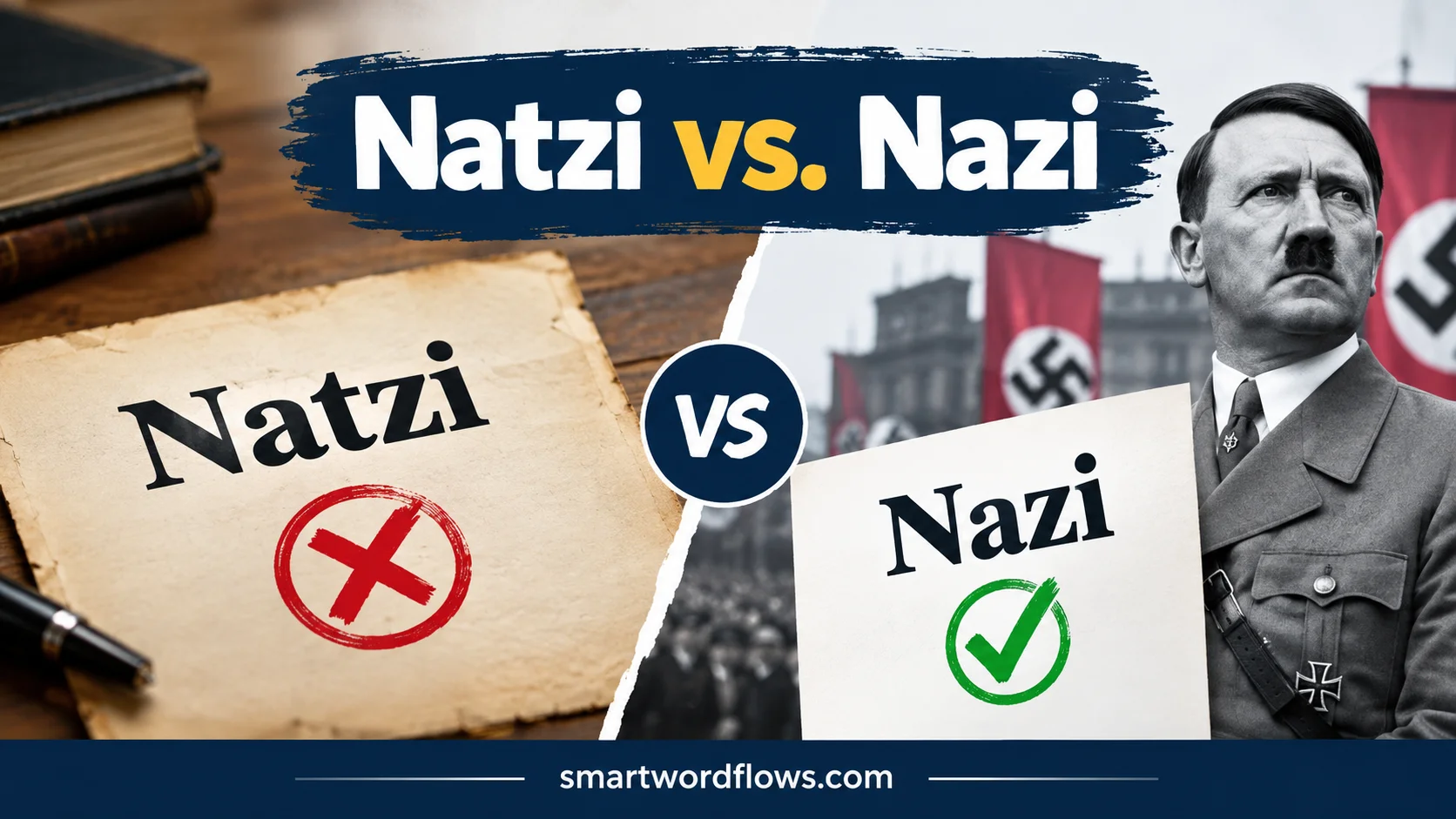

Natzi vs. Nazi ka difference samajhna simple hai: Nazi correct English spelling hai, jabke Natzi wrong spelling hai. People aksar confused ho jate hain aur online wrong word type kar dete hain. Agar aap writing mein history, politics, ya World War II discuss kar rahe hain, to correct spelling use karna zaroori hai. Is se aapki writing clear, accurate, aur easy to understand rehti hai, aur unnecessary spelling mistakes aapki credibility ko affect nahi kartin.
Nazi ek noun aur adjective dono ke taur par use hota hai. As a noun, it historically means a member or supporter of the National Socialist German Workers’ Party, also called the Nazi Party, led by Adolf Hitler in Germany. As an adjective, it describes something associated with the National Socialist movement, its regime, ideology, or historical period. The party was deeply connected with real historical events and the ideas of that time. Understanding this meaning helps you use the correct term confidently.
Quick Answer
Nazi is the correct spelling.
Natzi is a misspelling when you mean the German political movement, its members, its ideology, or something associated with Nazi Germany.
The correct forms are:
- Singular: Nazi
- Plural: Nazis
- Ideology: Nazism
- Political organization: Nazi Party
- Historical state: Nazi Germany
- Incorrect spelling: Natzi
Correct and Incorrect Examples
- Correct: Adolf Hitler led Nazi Germany during World War II.
- Incorrect: Adolf Hitler led Natzi Germany during World War II.
The extra “t” in Natzi doesn’t belong in the standard English spelling.
Comparison Overview
The difference between Nazi and Natzi is small on the page, yet only one form is standard English.
| Feature | Nazi | Natzi |
| Standard English spelling | Yes | No |
| Historical term | Yes | No |
| Refers to a Nazi Party member | Yes | No |
| Related ideology | Nazism | Not applicable |
| Correct plural | Nazis | Natzis is incorrect |
| Used in “Nazi Germany” | Yes | No |
| Suitable for formal writing | Yes | No |
| Contains the letter T | No | Yes |
The simplest rule is worth remembering:
Nazi is spelled N-A-Z-I, not N-A-T-Z-I.
If you remember that four-letter spelling, you can avoid the mistake entirely.
Main Differences Between Nazi and Natzi
The main difference is straightforward: Nazi is the established English spelling, while Natzi is a misspelling.
The difference isn’t a matter of American versus British English. It isn’t an alternate spelling used in formal English. You should use Nazi when referring to the historical movement or anything connected with it.
Nazi
Nazi is the standard English word used for a member or supporter of the Nazi Party. It can also function as an adjective when describing something connected with Nazi Germany, Nazism, or the Nazi movement.
Examples include:
- Nazi Party
- Nazi Germany
- Nazi regime
- Nazi propaganda
- Nazi ideology
- Nazi officials
- Nazi persecution
Natzi
Natzi is not the standard spelling of the historical term. Writers sometimes produce this version because the pronunciation can make the word sound different from its written form.
Adding “t” doesn’t make the spelling more phonetic or more accurate. It simply creates a misspelling.
What Does “Nazi” Mean?
Nazi has a specific historical meaning connected to German National Socialism.
In its most direct sense, a Nazi was a member or supporter of the National Socialist German Workers’ Party, known in German as the Nationalsozialistische Deutsche Arbeiterpartei, or NSDAP.
The party emerged in Germany after World War I and became increasingly powerful during the 1920s and early 1930s. Adolf Hitler became its central political leader, and the party took control of the German government in 1933.
Under Nazi rule, Germany became a dictatorship characterized by aggressive nationalism, racial ideology, antisemitism, political repression, militarism, and systematic persecution.
The Nazi regime also carried out the Holocaust, the systematic persecution and murder of approximately six million European Jews. Nazi Germany and its collaborators also persecuted and murdered millions of other people, including Roma, disabled people, Soviet prisoners of war, political opponents, and others targeted by the regime.
Because of this history, Nazi isn’t simply an ordinary political label. Its meaning carries substantial historical weight.
Nazi as a Noun
When used as a noun, Nazi can identify a person associated with the Nazi movement.
For example:
A Nazi official participated in the persecution of Jewish communities.
Here, Nazi describes the person’s political affiliation.
Nazi as an Adjective
The word can also describe something connected with Nazi Germany or Nazi ideology.
For example:
The museum contains documents from the Nazi era.
Here, Nazi functions as an adjective describing the historical period.
Why Is “Natzi” Incorrect?
The spelling Natzi usually results from a misunderstanding of pronunciation.
When English speakers pronounce Nazi, the sound can resemble something like “NAHT-see” or “NAHT-zee,” depending on the speaker and accent. That can tempt someone to insert a t between the a and z.
However, English spelling doesn’t always mirror pronunciation perfectly.
Consider words such as nation, nature, picture, and future. Their written forms contain letters that can produce sounds that aren’t obvious from a simple letter-by-letter reading.
The same principle applies here. You shouldn’t add a t to Nazi simply because you hear a sound that resembles one.
The correct spelling remains:
N-A-Z-I
Not:
N-A-T-Z-I
Where Does the Word “Nazi” Come From?
The word Nazi has its roots in the German political movement that developed around National Socialism.
The Nazi Party’s formal German name was Nationalsozialistische Deutsche Arbeiterpartei, usually abbreviated as NSDAP. In English, the party is generally called the National Socialist German Workers’ Party.
The shortened term Nazi developed from the German word Nationalsozialist, meaning a National Socialist.
The abbreviation became widely associated with members of the movement. English later adopted Nazi as the standard form.
This historical origin explains why the spelling doesn’t contain a t. The word wasn’t created in English by spelling out its pronunciation. It entered English as a shortened form of a German political term.
A Brief Historical Timeline
| Year | Event |
| 1919 | The German Workers’ Party, the precursor to the Nazi Party, was founded. |
| 1920 | The party adopted the name National Socialist German Workers’ Party, or NSDAP. |
| 1921 | Adolf Hitler became the party’s leader. |
| 1933 | Hitler became German chancellor, and the Nazi dictatorship developed rapidly. |
| 1939 | Germany invaded Poland, beginning World War II in Europe. |
| 1941 | Nazi Germany invaded the Soviet Union and the mass murder of European Jews escalated dramatically. |
| 1945 | Nazi Germany collapsed following Allied victory in Europe. |
These dates provide important context for understanding why Nazi appears so frequently in modern historical writing.
Nazi vs. Natzi: Spelling Comparison
The spelling difference can be reduced to one unnecessary letter.
Correct Spelling
Nazi
The word contains four letters:
N + A + Z + I
Incorrect Spelling
Natzi
This version contains five letters:
N + A + T + Z + I
That T is the problem.
There is no standard English spelling rule that changes Nazi into Natzi. If you’re referring to the historical movement, use Nazi.
How Do You Pronounce “Nazi”?
The English pronunciation of Nazi is commonly represented as approximately NAHT-see. Dictionary transcriptions can vary slightly depending on the pronunciation system and variety of English.
The important point is that pronunciation can create the illusion of an extra consonant.
For many speakers, the transition between the vowel and the z sound may seem to include a brief t-like sound. That doesn’t mean the word contains the letter t.
This is an important distinction:
Pronunciation: approximately “NAHT-see”
Spelling: Nazi
Think of it like hearing a word through a slightly distorted recording. Your ear detects a sound, but the written form follows the established spelling rather than every tiny feature of pronunciation.
Does German Pronunciation Matter?
German pronunciation can differ from English pronunciation. The original German context also helps explain why English speakers may perceive the word differently.
Still, when you’re writing in US English, the standard English spelling is Nazi.
Is “Nazi” Capitalized?
Yes. Nazi is normally capitalized when it refers to the historical political movement, its members, or things directly associated with the movement.
Examples include:
- Nazi Party
- Nazi Germany
- Nazi regime
- Nazi leadership
- Nazi officials
- Nazi persecution
- Nazi ideology
The capitalization reflects the established treatment of the historical proper term.
Is “Nazi” Always Capitalized?
In standard historical and academic writing, Nazi is generally capitalized.
For example:
Historians continue to study the political conditions that allowed the Nazi Party to gain power.
Writing nazi in lowercase would generally be inappropriate in this historical context.
The same principle applies to the plural:
Nazi → Nazis
Not:
nazi → nazis
when following standard capitalization for the historical term.
What Is the Plural of “Nazi”?
The standard English plural is Nazis.
You simply add s to the singular form.
| Singular | Plural |
| Nazi | Nazis |
Examples:
Several Nazis were prosecuted after the war.
The museum documents crimes committed by Nazis during the Holocaust.
The form Natzis is incorrect when you intend the plural of Nazi.
A useful spelling pattern is:
Nazi → Nazis
There is no t in either form.
Also Read This: Noisy vs Noisey: Which Is Correct and How to Use Each Word?
Examples of “Nazi” in a Sentence
Understanding the word becomes easier when you see how it works in different sentences.
Historical Person
The historian examined the political career of a senior Nazi official.
Here, Nazi functions as a noun describing the individual’s political affiliation.
Nazi Party
The Nazi Party gained significant political support in Germany during the early 1930s.
Here, Nazi forms part of the name commonly used for the political organization.
Nazi Germany
Nazi Germany invaded Poland in September 1939.
The phrase refers to Germany under Nazi rule.
Nazi Regime
The Nazi regime used censorship, propaganda, imprisonment, and political violence to suppress opposition.
Here, Nazi describes the government or ruling system.
Nazi Ideology
Nazi ideology placed racial hierarchy and antisemitism at the center of its worldview.
This usage describes the ideas associated with National Socialism.
Plural Form
The Nazis established concentration camps and carried out systematic persecution across territories under their control.
The plural form is Nazis, not Natzis.
Figurative Modern Usage
In informal modern English, people sometimes use Nazi metaphorically to describe someone they consider extremely strict or controlling.
For example:
He’s a grammar Nazi who corrects every spelling mistake.
This usage exists in informal speech and writing. However, it can be offensive or insensitive because it compares ordinary strictness with a movement responsible for mass persecution and genocide.
In formal writing, it’s usually better to choose a more precise word such as strict, controlling, rigid, or authoritarian, depending on the intended meaning.
Common Mistakes With “Nazi”
Spelling isn’t the only place where writers make mistakes. Several related errors appear frequently.
Writing “Natzi”
This is the most direct spelling error.
Incorrect: Natzi
Correct: Nazi
Writing “Natzis”
The plural inherits the same spelling mistake.
Incorrect: Natzis
Correct: Nazis
Lowercasing the Word
When discussing the historical movement, writing nazi instead of Nazi doesn’t follow standard capitalization.
Correct: Nazi Germany
Incorrect: nazi Germany
Confusing Nazi and Nazism
These terms are related, but they don’t mean exactly the same thing.
Nazi can refer to a person or describe something associated with the movement.
Nazism refers to the political ideology and movement itself.
Using the Term Too Broadly
Calling every authoritarian or highly disciplined person a Nazi can erase important historical distinctions.
If you mean that someone is strict, use strict.
If you mean someone exercises excessive control, use controlling.
If you mean someone supports fascist politics, describe that position accurately.
Precision usually makes writing stronger.
Nazi, Nazism, and Nazi Party: What’s the Difference?
These words are closely related, yet they serve different purposes.
| Term | Meaning | Example |
| Nazi | A member or supporter of the Nazi movement, or something associated with it | A Nazi official |
| Nazis | Plural of Nazi | Several Nazis |
| Nazism | The ideology and political movement associated with the Nazi Party | The study of Nazism |
| Nazi Party | The political organization formally known as the NSDAP | The Nazi Party gained power in 1933 |
| Nazi Germany | Germany under Nazi rule | Nazi Germany surrendered in 1945 |
Understanding these distinctions helps you avoid awkward or inaccurate sentences.
For instance, you wouldn’t normally write that someone was a “Nazism” because Nazism describes an ideology rather than a person.
Instead, you could write:
He was a Nazi who supported Nazism.
The two terms connect, but they aren’t interchangeable.
Nazi vs. Natzi in Formal and Academic Writing
Correct spelling becomes particularly important when you’re discussing history.
A typo in a casual text might go unnoticed. In a research paper, historical article, thesis, textbook, or professional publication, however, repeated spelling errors can weaken the credibility of the entire piece.
When discussing the subject, use established terminology consistently.
Good Academic Usage
- Nazi Party
- Nazi Germany
- Nazi regime
- Nazi persecution
- Nazi ideology
- Nazism
- Nazis
Avoid
- Natzi
- Natzis
- nazi, when standard capitalization requires Nazi
- Vague descriptions that blur the distinction between Nazism and other political movements
Historical writing benefits from precision. A small spelling detail can make a noticeable difference.
Is “Natzi” Ever a Correct Word?
Natzi isn’t the standard English spelling of Nazi.
That doesn’t mean a sequence of letters like Natzi could never appear anywhere. A surname, username, fictional name, product name, or other unrelated proper noun could theoretically contain those letters.
However, that possibility doesn’t make Natzi an acceptable alternate spelling of the historical term Nazi.
If you’re talking about Nazi Germany, the Nazi Party, Nazis, or Nazism, the correct spelling is Nazi.
Easy Trick to Remember Nazi vs. Natzi
The easiest memory trick is surprisingly simple:
Nazi has no T.
Write it as:
N-A-Z-I
Then compare it with the common mistake:
N-A-T-Z-I
If you hear a pronunciation that seems to contain a t, don’t let your ear rewrite the word.
Another useful trick is to remember the related word:
Nazi → Nazism
Both forms use the Z directly after the A.
That gives you a quick visual anchor whenever you’re uncertain.
Facts About the Word “Nazi”
Here are several useful facts that put the spelling and terminology into context:
- Nazi is the standard English spelling.
- The word derives from the German political term associated with National Socialism.
- The Nazi Party is commonly abbreviated NSDAP.
- Adolf Hitler became leader of the Nazi Party in 1921.
- Hitler became German chancellor in 1933.
- Nazi Germany existed as a dictatorship from 1933 until 1945.
- Nazi Germany invaded Poland on September 1, 1939, triggering the European war that became part of World War II.
- The Nazi regime carried out the Holocaust, murdering approximately six million Jews.
- The standard plural of Nazi is Nazis.
- Nazism refers to the ideology and political movement rather than an individual person.
- Natzi isn’t a standard English variant spelling of Nazi.
A Practical Case Study: Choosing the Right Spelling
Imagine that you’re writing a history assignment about Germany during World War II.
Your first draft contains this sentence:
The Natzi government used propaganda to influence German society.
The sentence contains a spelling error that changes none of its intended meaning, yet it still needs correction.
The revised version is:
The Nazi government used propaganda to influence German society.
Now imagine that the article contains the word twenty times. If you repeat Natzi throughout the entire piece, the mistake becomes much more noticeable.
The same issue can affect search visibility, editorial quality, and reader trust. Someone searching for information about Nazi Germany expects the standard spelling. A page that repeatedly uses Natzi may look poorly edited even when its historical information is otherwise accurate.
The lesson is simple: verify the spelling of important historical terms before publishing.
Why the “T” Gets Added to Nazi
The mistake makes more sense when you consider how humans process speech.
When you hear an unfamiliar word, your brain doesn’t always separate every individual sound perfectly. Instead, it interprets the sounds as a whole.
The pronunciation of Nazi can lead some listeners to perceive a slight t-like transition before the z sound. Once that perception becomes familiar, a writer may unconsciously transfer it into spelling.
This happens with many words.
English contains plenty of examples where pronunciation and spelling don’t line up neatly. That’s one reason spelling shouldn’t depend entirely on how a word sounds.
The correct approach is to learn the established written form:
Nazi = N-A-Z-I
How Dictionaries Treat “Nazi” and “Natzi”
These references also provide definitions and pronunciation information that can help distinguish the written form from how the word sounds.
When spelling matters, a dictionary is more reliable than trying to reconstruct a word from pronunciation.
When Should You Use “Nazi”?
Use Nazi when you are accurately referring to:
- A member of the Nazi Party.
- The Nazi Party itself.
- Nazi Germany.
- The Nazi regime.
- Nazi ideology.
- Nazi persecution.
- Nazi policies.
- Historical events involving Nazi rule.
- People or institutions directly associated with Nazism.
The surrounding noun usually makes the exact meaning clear.
For example, Nazi Germany refers to Germany under Nazi rule. Nazi propaganda refers to propaganda produced or promoted by the Nazi regime or movement.
When Should You Avoid the Word “Nazi”?
The word has a precise historical meaning, so avoid using it as a lazy substitute for unrelated concepts.
If someone follows strict rules, strict may be enough.
If someone constantly controls other people’s behavior, controlling may be more accurate.
If someone enforces rules rigidly, authoritarian or rigid might communicate the idea more precisely, depending on context.
This doesn’t mean figurative uses are impossible. It means word choice should match the meaning you actually intend.
Historical language deserves particular care because careless comparisons can minimize the seriousness of real events.
FAQs:
1. Is Natzi or Nazi correct?
Nazi is the correct English spelling. Natzi is a misspelling and should not be used in standard English writing.
2. What does Nazi mean?
Nazi refers historically to a member or supporter of the National Socialist German Workers’ Party led by Adolf Hitler in Germany.
3. Is Nazi a noun or an adjective?
Nazi can be both a noun and an adjective. As a noun, it refers to a person connected with the Nazi movement. As an adjective, it describes something related to Nazi ideology, the regime, or period.
4. Why do people write Natzi?
People may write Natzi because they are confused about the spelling or simply type the word incorrectly. The standard spelling is Nazi.
5. How can I remember the correct spelling?
A simple way is to remember that the standard spelling is Nazi, with no t. Using Nazi keeps your writing accurate and clear.
Conclusion:
The difference between Natzi vs. Nazi is straightforward: Nazi is the correct spelling, while Natzi is incorrect. When writing about history, World War II, or the National Socialist movement, always use Nazi for accurate and professional writing.