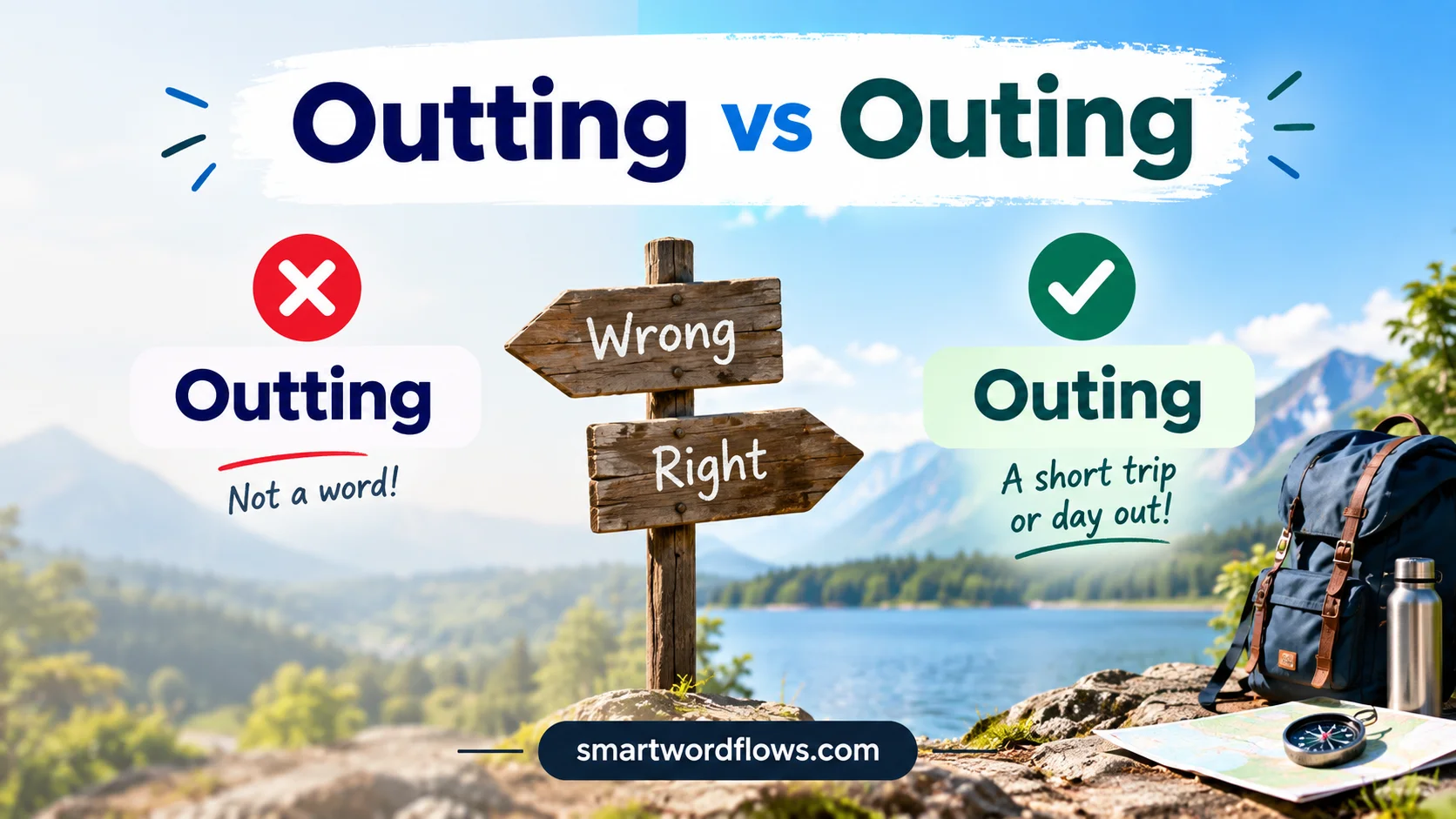

When comparing Outting vs Outing, many English learners wonder which spelling is correct. The answer is simple: outing is the standard spelling. It describes a short trip, excursion, or enjoyable journey, such as visiting a zoo, going to the beach, or having a picnic with friends. Although words like putting and sitting use double consonants, outing follows a different spelling pattern. Once you understand this difference, you can easily avoid this common spelling mistake.
An outing can refer to almost any brief activity done for leisure, entertainment, or relaxation. You might enjoy a family outing, a school outing, or a weekend outing with friends. The word works naturally in American and British English and is suitable for casual writing, emails, assignments, and everyday conversation. In contrast, outting is generally considered an incorrect spelling when you mean a trip or recreational activity.
Quick Answer
Outing is the correct standard spelling.
Outting is generally a misspelling when you mean a trip, excursion, social activity, or public appearance.
| Spelling | Correct? | Meaning | Example |
| Outing | Yes | A short trip or excursion | We planned a family outing. |
| Outting | No in standard English | Usually a spelling error | Avoid this spelling. |
So, if you’re writing an email, school assignment, article, invitation, caption, or business document, use outing.
Correct: We went on a family outing to the beach.
Incorrect: We went on a family outting to the beach.
The correct spelling also remains outing when the word has other meanings. For example, dictionaries use outing for a public appearance by a sports player and for the act of publicly revealing someone’s private identity or information.
Comparison Overview
The difference between outting vs outing comes down to one letter. Yet that single t can change a polished sentence into an obvious spelling mistake.
| Feature | Outing | Outting |
| Standard spelling | Yes | No |
| Listed as the standard noun | Yes | No |
| Common meaning | Trip, excursion, or recreational activity | Usually a misspelling of outing |
| Plural form | Outings | Not standard |
| Appropriate for formal writing | Yes | No |
| Example | Our school organized an outing. | Our school organized an outting. |
Oxford defines outing as a trip or excursion and also records other uses of the noun. Collins similarly defines it as a short trip or pleasure excursion and lists outings as its plural form.
The practical rule is simple:
Use “outing.” Don’t use “outting” when you mean a trip or excursion.
Main Differences Between Outting vs Outing
The biggest difference is that outing is the established English spelling, while outting is generally an error.
Outing Is the Correct Spelling
Outing is a standard English noun. It commonly describes a short trip away from home, school, work, or another familiar place.
For example:
- We had a family outing at the lake.
- The students went on a school outing.
- Our company arranged a weekend outing.
- They planned an outing to the museum.
- We enjoyed a quiet outing with friends.
The word can describe something informal and casual. You don’t need to be traveling far. A few hours at a park can count as an outing just as easily as a full-day group excursion.
Collins describes an outing as a short trip, usually involving a group, away from home, school, or work.
Outting Is Usually a Misspelling
Outting isn’t the standard spelling of the noun you’re looking for.
If you write:
We planned a family outting.
the reader will almost certainly understand what you mean. Still, the spelling should be corrected to:
We planned a family outing.
The mistake doesn’t usually create a meaning problem. It creates a spelling problem.
That’s why you may see outting in informal messages, comments, social media posts, or user-generated content. Its appearance doesn’t make it the standard form.
Why the Extra T Feels Natural
Here’s where the confusion gets interesting.
English has many familiar words that double their final consonant before -ing:
- run → running
- sit → sitting
- stop → stopping
- swim → swimming
- cut → cutting
Because these words are so common, it’s easy to assume:
out → outting
But that assumption doesn’t work here.
The standard word is:
out + ing → outing
There is no second t.
Why Is “Outing” Spelled With One T?
The spelling becomes much easier to remember when you look at the structure of the word.
Out + -ing = Outing
The word outing comes historically from out with the -ing formation. Oxford identifies its origin as the verb out plus -ing.
That gives us:
OUT + ING = OUTING
Not:
OUT + TING = OUTTING
The important point is that English doesn’t automatically double every final consonant before -ing.
Why “Running” Doubles the N
Consider run → running.
The final n doubles because the spelling pattern supports consonant doubling before the suffix.
You can see the same pattern in:
- hop → hopping
- plan → planning
- sit → sitting
- stop → stopping
However, out has a different spelling structure. The final t follows the vowel combination ou, not a single short vowel.
That’s why the standard form doesn’t become outting.
A useful comparison looks like this:
| Base word | + -ing | Correct form |
| run | run + ing | running |
| sit | sit + ing | sitting |
| stop | stop + ing | stopping |
| swim | swim + ing | swimming |
| out | out + ing | outing |
So don’t memorize the rule as “every word doubles its last consonant.” That’s simply not how English spelling works.
What Does “Outing” Mean?
The most common meaning of outing is a short trip or excursion taken for pleasure, recreation, education, or social activity.
For example, imagine a family spending Saturday afternoon at a zoo. They leave home, visit the zoo, eat lunch, and return home later that day.
That’s a family outing.
Likewise, if a school takes students to a museum for educational activities, that’s a school outing.
If coworkers spend a day at a resort or outdoor activity center, you might call it a company outing.
Oxford gives examples involving school and group trips, while Merriam-Webster defines the noun as a short pleasure trip.
Common Types of Outings
You can use outing in many everyday situations:
- Family outing
- School outing
- Company outing
- Weekend outing
- Group outing
- Beach outing
- Nature outing
- Picnic outing
- Fishing outing
- Shopping outing
The exact activity doesn’t determine whether something qualifies as an outing. The word mainly emphasizes the idea of going somewhere away from your usual surroundings, often for enjoyment or a shared activity.
Examples of “Outing” in a Sentence
Seeing the word in context makes the spelling much easier to remember.
Family Examples
We planned a family outing for Saturday.
The children enjoyed their outing to the zoo.
Our weekend outing turned into an afternoon picnic.
School Examples
The teacher organized a school outing to the science museum.
Everyone was excited about the class outing.
The students returned from their educational outing before sunset.
Work Examples
The company arranged a team outing for its employees.
Our department is planning a weekend outing.
The staff enjoyed an outdoor outing after completing the project.
Casual Examples
Let’s plan an outing with our friends.
We haven’t had a proper outing in months.
The weather was perfect for an afternoon outing.
Notice something important: outing works naturally with many modifiers. That’s one reason the word appears frequently in everyday English.
Outing Can Have More Than One Meaning
Although the recreational meaning is the one most people encounter, outing has other established meanings.
Outing as a Public Appearance
In sports, outing can refer to a player’s appearance or participation in a competition.
For example:
The pitcher had an impressive outing in his second game.
Collins records this sports-related meaning as a public appearance by a participant in an athletic contest.
You may also encounter the word in entertainment or performance contexts:
The actor’s latest outing received positive reviews.
Here, outing doesn’t mean a picnic or trip. It refers to a particular appearance, performance, or effort.
Outing as Public Disclosure
Outing can also refer to publicly revealing someone’s sexual orientation or another private identity without that person’s consent.
This is a separate meaning from a recreational outing. Oxford and Dictionary.com both record this usage.
For example:
The article discussed the ethical concerns surrounding the public outing of private information.
The spelling doesn’t change. It’s still outing, with one t.
That distinction matters because context determines the meaning.
Read More: Currier vs Courier: What’s the Difference?
Outting vs Outing: Why Writers Make This Mistake
The error isn’t completely random. Several features of English can make outting look reasonable.
Consonant-Doubling Confusion
Words such as sitting, running, and getting are extremely common.
A writer may unconsciously apply the same pattern to out:
out → outting
But English suffix rules depend on the spelling and sound structure of the base word.
That’s why learning each pattern through examples works better than assuming every word follows the same formula.
Fast Pronunciation
When people speak quickly, individual sounds can blend together.
The t in outing may sound more prominent in connected speech. A writer who has mostly heard the word rather than seen it may therefore imagine a second t.
This is a classic example of why pronunciation alone can’t always tell you how an English word should be spelled.
Familiarity With Similar Words
Words such as:
- cutting
- getting
- putting
- sitting
- hitting
all contain doubled consonants.
That visual pattern can make outting look familiar even though it isn’t the standard spelling.
Outing vs Trip: Are They the Same?
Outing and trip overlap, but they’re not always interchangeable.
A trip is a broad word for traveling from one place to another. It can describe anything from a short journey to international travel.
An outing usually carries a more social, recreational, or casual feeling.
| Word | Typical emphasis | Example |
| Trip | Travel or journey | We took a business trip to Chicago. |
| Outing | Leisure or shared activity | We had a family outing at the park. |
| Excursion | Organized or relatively short trip | The tour included a morning excursion. |
| Journey | The act or experience of traveling | The journey took several hours. |
For example, you’d naturally say:
We took a business trip to New York.
You could also say:
We had a company outing at a nearby resort.
The two phrases describe different kinds of experiences.
Outing vs Excursion
Excursion is another close synonym, but it can sound more formal.
An outing often feels casual:
We went on a family outing.
An excursion can sound more organized or purposeful:
The students went on an educational excursion.
That doesn’t mean the words are completely separate. Their meanings overlap considerably.
Oxford lists outing among words that can describe a trip or excursion.
The best choice depends on the tone and context.
Outing vs Going Out
These expressions look similar, but they function differently.
Outing is a noun.
We planned an outing.
Going out is a verb phrase.
We’re going out tonight.
The distinction becomes clearer when you change the sentence:
- We planned a family outing.
- We’re going out with our family.
- The school organized an outing.
- The students are going out on a school activity.
You can’t simply substitute one for the other in every sentence.
Singular and Plural Forms of Outing
The singular form is:
outing
The plural form is:
outings
For example:
We planned one outing this month.
But:
We planned three outings this summer.
The plural doesn’t become outtings.
| Singular | Plural |
| an outing | several outings |
| a family outing | family outings |
| a school outing | school outings |
| a weekend outing | weekend outings |
Merriam-Webster and Collins both list outings as the plural form.
Common Mistakes With “Outing”
A few errors appear repeatedly when people use this word.
Mistake: Adding a Second T
Incorrect:
We are planning a company outting.
Correct:
We are planning a company outing.
Mistake: Using “Outtings” as the Plural
Incorrect:
The school organizes several outtings each year.
Correct:
The school organizes several outings each year.
Mistake: Assuming Every -ing Word Doubles a Letter
English doesn’t use one universal doubling rule.
Compare:
- run → running
- sit → sitting
- stop → stopping
- out → outing
- visit → visiting
- open → opening
The spelling depends on the structure of the base word.
A Simple Way to Remember Outting vs Outing
When you’re unsure, use this quick memory trick:
Think “OUT” first. Then add “ING.”
OUT + ING = OUTING
Don’t insert another t.
You can also connect the word with familiar phrases:
- family outing
- school outing
- company outing
- weekend outing
- group outing
The more often you see the correct spelling, the more natural it becomes.
A Quick Spelling Test
If you write:
We had a family ______ to the beach.
Which looks right?
- outting
- outing
The answer is outing.
Now try:
The students went on several school ______.
The answer is:
outings
That tiny exercise reinforces both the singular and plural forms.
A Practical Case Study: Choosing the Right Spelling
Imagine you’re writing an invitation for an office event.
You draft:
Join us for our annual company outting this Saturday.
The meaning is clear, but the spelling contains an unnecessary t.
After correction:
Join us for our annual company outing this Saturday.
Now the sentence uses the standard dictionary form.
The same correction applies to other contexts:
| Incorrect | Correct |
| family outting | family outing |
| school outting | school outing |
| company outting | company outing |
| weekend outting | weekend outing |
| group outting | group outing |
| summer outtings | summer outings |
This pattern makes the correction straightforward. You don’t need to rethink the entire sentence. Simply replace outting with outing.
Facts About the Word “Outing”
Here are several useful facts that help clarify the word:
- Outing is a standard English noun.
- Its plural form is outings.
- It commonly means a short pleasure trip or excursion.
- It can describe a group activity away from home, school, or work.
- It can also describe a public appearance in sports or other contexts.
- The word has historical roots in out + -ing.
- The standard spelling contains one t before -ing.
- Outting is generally a misspelling when intended to mean outing.
- The spelling stays outing even when the word carries its less common meanings.
Outting vs Outing: Quick Reference
| Question | Answer |
| Which spelling is correct? | Outing |
| Is outting standard English? | No, generally not |
| What does outing usually mean? | A short trip or recreational excursion |
| What is the plural? | Outings |
| Does outing have other meanings? | Yes |
| Does outing double the T? | No |
| Can I use outing in formal writing? | Yes |
| Is “family outing” correct? | Yes |
| Is “school outing” correct? | Yes |
| Is “company outing” correct? | Yes |
FAQs :
Is “outing” or “outting” correct?
Outing is the correct spelling when you mean a short trip, excursion, or recreational activity. Outting is a common spelling mistake and should be avoided in standard English writing.
What does “outing” mean?
An outing is a short trip or activity taken for leisure, entertainment, or relaxation. For example, a family picnic, beach visit, museum trip, or day at the zoo can all be called an outing.
Why do people spell outing as “outting”?
People often write outting because English has many words that double the final consonant before adding -ing, such as sitting, running, and putting. However, outing follows a different spelling pattern.
Is “outing” used in both American and British English?
Yes. Outing is a standard word in both American English and British English. Its spelling and basic meaning remain the same in both varieties of English.
Can I use “outing” in formal writing?
Yes, you can use outing in formal and informal writing when the context fits. It can describe a school outing, company outing, family trip, or other short recreational activity.
Conclusion :
The difference between Outting vs Outing is straightforward: outing is the correct and standard spelling. Use it when describing a short trip, excursion, or leisure activity. Remembering the single “t” will help you avoid this common spelling error in everyday, academic, and professional writing.