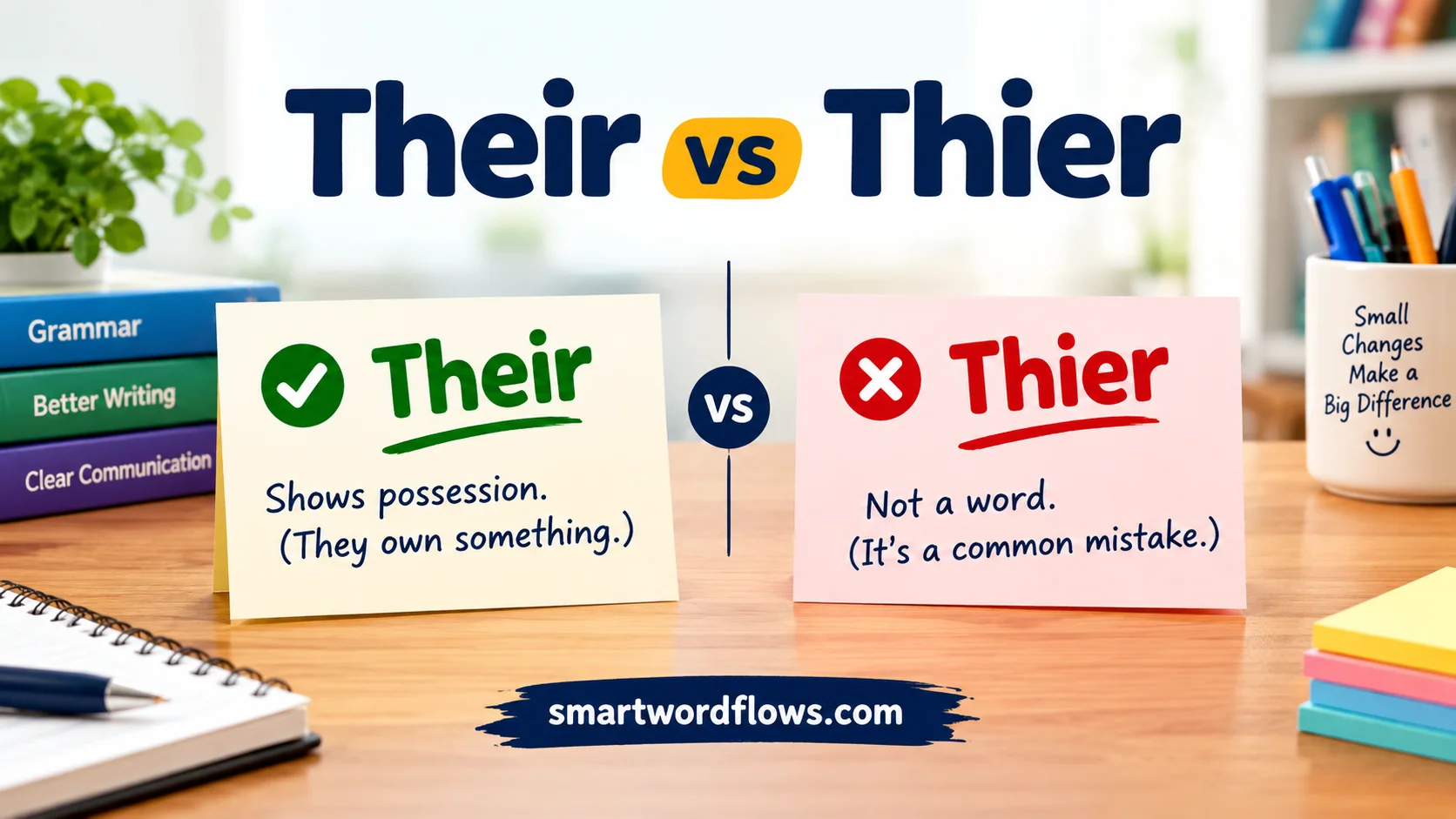

Their vs Thier is a common spelling confusion that can make your English writing look less polished. Although “thier” may seem correct at first glance, their is the standard spelling. Understanding this simple difference can help you avoid mistakes in emails, essays, articles, and everyday writing.
The word their is used to show possession or ownership, while “thier” is simply a misspelling with no standard meaning in English. This small spelling error often happens because the letters are written in the wrong order. Learning the correct form and remembering its proper usage can make your writing clearer, more accurate, and professional.
Quick Answer: Their or Thier?
Their is the correct spelling.
Thier is incorrect in standard English and should not be used as the possessive form of they.
Here’s the simplest comparison:
- Their = correct spelling
- Thier = misspelling
- Their = shows possession or connection
- Thier = has no standard grammatical role
Correct Example
Their house has a red front door.
Incorrect Example
❌ Thier house has a red front door.
The easiest way to remember the difference is simple: their has the letters e-i, not i-e.
If you’re writing an email, essay, article, report, résumé, or social media post, use their.
Comparison Overview
| Word | Correct Spelling? | Grammatical Role | Meaning | Example |
| Their | Yes | Possessive determiner | Belonging to or connected with them | Their car is outside. |
| Thier | No | None in standard English | Common misspelling of their | ❌ Thier car is outside. |
The distinction is straightforward once you separate spelling from meaning. Their carries a specific grammatical function. Thier doesn’t.
For example, in the sentence “The students brought their books,” the word their tells you that the books belong to the students or are associated with them.
By contrast, replacing their with thier doesn’t create a different meaning. It simply creates a spelling error.
What Does Their Mean?
Their is a possessive determiner. It normally appears before a noun to show that something belongs to, relates to, or is associated with people, animals, or things already mentioned.
Consider these examples:
- Their house is near the school.
- The players changed their uniforms.
- The company updated their website.
- The birds returned to their nest.
- The children finished their homework.
In each sentence, their connects the noun that follows it with another person, group, animal, organization, or entity.
Their as a Possessive Determiner
A possessive determiner comes before a noun.
Compare:
- my car
- your phone
- his jacket
- her book
- our house
- their office
You wouldn’t normally say “their” by itself when you need a possessive pronoun. That’s where theirs comes in.
For example:
This is their car.
But:
This car is theirs.
That small distinction matters because their and theirs don’t perform exactly the same grammatical job.
A useful way to think about it is this:
Their + noun
Theirs = stands in place of a noun
So you can write:
- Their decision surprised us.
- The decision was theirs.
But you wouldn’t normally write:
- ❌ The decision was their.
Their With Plural Antecedents
The most familiar use of their refers to more than one person or thing.
For example:
Sarah and David sold their house.
Here, their refers to Sarah and David.
Another example:
The students submitted their assignments.
The word their refers to the students as a group.
You can also use it with groups of animals or things:
The dogs returned to their owner.
The companies announced their results.
The basic idea remains the same: their identifies something as belonging to or being connected with the people, animals, or things being discussed.
Their With a Singular Person
English also uses their with a singular person in certain situations. This usage is now widely recognized in standard English.
For example:
Someone left their phone on the table.
Here, someone refers to one person. However, the sentence doesn’t identify that person’s gender.
Instead of writing:
Someone left his or her phone on the table.
You can write:
Someone left their phone on the table.
Oxford and Cambridge both document this use of their with singular references. Cambridge gives examples involving someone and everyone, while Oxford describes their as a form that can replace his or her when the person’s sex isn’t known or isn’t mentioned.
This isn’t merely a casual internet habit. It’s an established feature of modern English usage.
What Does Thier Mean?
Thier is a misspelling of their.
It isn’t the standard spelling of a separate English word. When someone writes thier, they usually intend to write their but accidentally reverse the e and i.
For example:
❌ The children packed thier bags.
The corrected sentence is:
The children packed their bags.
The problem isn’t the sentence’s meaning. The reader can usually understand it immediately. The problem is the spelling.
Is Thier a Word?
In standard modern English, thier isn’t the correct possessive form of they.
The standard form is:
their
This distinction matters especially in polished writing. A single typo might not change the meaning of a sentence, but repeated spelling mistakes can make professional or academic writing look careless.
That’s why it’s worth learning the correct spelling rather than treating their and thier as interchangeable.
Why Do People Spell Their as Thier?
The most common reason is letter-order confusion.
The correct spelling is:
t-h-e-i-r
The common misspelling is:
t-h-i-e-r
Only two letters have switched places, yet that small change makes the word incorrect.
English spelling creates plenty of opportunities for this kind of mistake. Words don’t always follow a simple spelling rule, and familiar letter patterns can sometimes interfere with one another.
Typing quickly makes the problem even easier to create. Your fingers may produce thier before your eyes catch the error.
Main Differences Between Their and Thier
The main difference between their vs thier isn’t meaning. It’s correctness.
Their vs Thier Spelling
Their uses the sequence e-i:
t-h-e-i-r
Thier uses i-e:
t-h-i-e-r
Only the first spelling is correct when you mean the possessive form of they.
Their vs Thier Meaning
Their has a clear grammatical meaning. It indicates possession, association, or connection.
For example:
The employees returned to their desks.
The desks are associated with the employees.
Thier, on the other hand, doesn’t provide an alternative meaning. It’s simply an incorrect spelling.
Their vs Thier Grammar
Their functions as a possessive determiner.
You can place it before a noun:
- their house
- their family
- their project
- their opinion
- their responsibilities
Thier doesn’t function this way in standard English.
So if you’re asking whether to write:
thier project
or:
their project
the answer is always their project.
Their vs Thier in Standard Writing
The correct form is especially important in:
- Academic essays
- Business emails
- Résumés
- Cover letters
- Website content
- Reports
- Formal letters
- School assignments
- Professional documentation
A spelling checker will often catch thier, but you shouldn’t rely entirely on automated tools. Good writing still requires proofreading.
Their vs Thier Examples
Examples make the distinction much clearer.
Correct Examples With Their
The students finished their project before Friday.
The company announced their new policy.
The children put away their toys.
The players thanked their coach.
The neighbors painted their house.
The birds returned to their nest.
Everyone should bring their identification.
Notice how their comes before a noun or noun phrase in each example.
Incorrect Examples With Thier
These sentences contain the common spelling mistake:
❌ The students finished thier project.
❌ The children put away thier toys.
❌ The players thanked thier coach.
❌ Everyone should bring thier identification.
The correction is easy: replace thier with their.
Their in Different Sentence Structures
Their can appear in many kinds of sentences.
Simple statement:
Their dog is friendly.
Question:
Where is their office?
Negative statement:
Their team isn’t ready yet.
Longer sentence:
Although the students were tired, they completed their assignment before leaving.
The grammatical role doesn’t change. Their still connects the noun with the people or group being discussed.
Also Read This: Outting vs Outing: Which Spelling Is Correct?
Their vs They’re vs There
The confusion doesn’t stop at their vs thier. English has another famous trio that causes even more trouble:
their, they’re, and there.
These words sound the same or very similar in many varieties of English. Their meanings and grammatical functions, however, are different.
Their
Their expresses possession or connection.
The children packed their bags.
Ask yourself:
Whose bags?
The answer is the children’s.
They’re
They’re is a contraction of they are.
They’re waiting outside.
You can test this by expanding the contraction:
They are waiting outside.
If they are works, they’re is probably the correct choice.
There
There often refers to a place:
The keys are over there.
It can also appear in constructions that introduce or identify something:
There is a problem with the printer.
There are three messages in your inbox.
Quick Their, They’re, and There Test
Try this simple three-step check:
| Word | Question to Ask | Example |
| Their | Does it show possession or connection? | Their house is large. |
| They’re | Can I replace it with “they are”? | They’re ready. |
| There | Does it refer to a place or introduce something? | Put it there. |
This test catches many common errors within seconds.
Why Is Their Commonly Misspelled as Thier?
There isn’t a complicated grammatical reason behind the error. Most cases come down to spelling memory and letter order.
Letter Reversal
The correct sequence is:
ei
The common mistake reverses it:
ie
That creates:
- Correct: their
- Incorrect: thier
This is a tiny visual difference. When you’re typing quickly, it’s easy to miss.
Confusion With Spelling Patterns
English learners often encounter spelling patterns involving i and e. The familiar phrase “i before e” can create confusion because English spelling contains many exceptions and different patterns.
Trying to force every word into one spelling rule can therefore cause more problems than it solves.
The better approach is to memorize their as a complete word.
Fast Typing
Typing quickly can produce transposed letters.
You may know exactly what you want to write, yet your fingers can still place two letters in the wrong order. That’s why proofreading remains useful even when you know the word perfectly.
Visual Memory
Repeated exposure helps.
The more often you read correctly spelled words such as:
- their
- they’re
- there
- theirs
the easier it becomes to recognize the correct visual pattern.
How to Remember the Correct Spelling of Their
The best spelling trick doesn’t need to be complicated.
Remember “Their” With EI
Focus on the middle:
their
Not:
thier
A short memory line can help:
“Their” has EI in the middle.
When you hesitate, look at those two letters first.
Practice Their in Context
Instead of repeatedly writing the word by itself, use it in real sentences.
For example:
- Their house is nearby.
- Their dog is sleeping.
- Their team won the match.
- Everyone brought their own lunch.
- The workers returned to their desks.
Context strengthens both spelling and meaning at the same time.
Use Spell Check as a Final Check
Spell checkers can catch obvious errors such as thier. However, they can’t solve every grammar problem.
For example, software may recognize that their is spelled correctly without knowing whether you actually needed there or they’re.
Compare:
Their going to the store.
The spelling of their is technically correct. The sentence is still wrong because the intended phrase is they’re going.
That distinction shows why proofreading should involve both spelling and meaning.
Their in Common Grammar Situations
Understanding where their belongs makes the spelling easier to remember.
Their + Singular Noun
Their house is beautiful.
Their car needs repairs.
Their manager called this morning.
The noun can be singular while their refers to multiple people.
Their + Plural Noun
Their books are on the table.
Their friends arrived early.
Their plans changed suddenly.
Again, their shows association or possession.
Their + Adjective + Noun
You can place an adjective between their and the noun:
Their new house is larger.
Their expensive equipment was damaged.
Their old car still runs well.
The pattern is:
their + adjective + noun
Singular Their
Singular their appears when they refers to one person.
For example:
If a customer has a question, they can contact their representative.
Here, their refers to one customer without specifying whether that customer is male or female.
Oxford and Cambridge both recognize this use in modern English.
This can also appear when someone personally uses singular they/them pronouns:
Jordan finished their presentation.
In that sentence, their is connected to one individual.
Common Mistakes With Their
Even after learning the difference between their and thier, several related mistakes can remain.
Mistake 1: Writing Thier
❌ They finished thier work.
Correct:
They finished their work.
Mistake 2: Confusing Their and They’re
❌ Their going to the store.
Correct:
They’re going to the store.
Why? Because they’re means they are.
Mistake 3: Confusing Their and There
❌ Their is a problem with the computer.
Correct:
There is a problem with the computer.
Here, there introduces the existence of a problem.
Mistake 4: Using Their Instead of Theirs
❌ The blue car is their.
Correct:
The blue car is theirs.
When the possessive word stands alone instead of directly modifying a noun, theirs is the appropriate form.
Compare:
That is their car.
That car is theirs.
Mistake 5: Assuming Their Only Refers to Groups
Modern English uses their with singular references too.
Someone forgot their keys.
This usage is documented by major English dictionaries and is common in contemporary English.
A Simple Case Study: Choosing the Right Word
Imagine you’re writing this sentence:
“The customer said ___ package had arrived.”
You have three possibilities:
- their
- they’re
- there
Now test each one.
Their package works because the package belongs to or is associated with the customer.
They’re package doesn’t work because they’re means they are.
There package doesn’t work because there doesn’t show possession.
Therefore:
The customer said their package had arrived.
Now consider another sentence:
“___ waiting outside.”
Try the same test.
Their waiting outside doesn’t make grammatical sense.
They’re waiting outside works because it expands to:
They are waiting outside.
There waiting outside is also incorrect in standard English.
This kind of substitution test can solve the problem quickly.
Their vs Thier: Quick Reference
| Question | Answer |
| Is their correct? | Yes |
| Is thier correct? | No |
| What does their mean? | Belonging to or associated with them |
| What part of speech is their? | Possessive determiner |
| Can their refer to one person? | Yes, in established singular-they usage |
| What does they’re mean? | They are |
| What does there often indicate? | A place or an existential construction |
| What is the possessive pronoun form? | Theirs |
| Why is thier common? | It’s usually a letter-order spelling mistake |
FAQs :
1. Is “their” or “thier” correct?
Their is the correct spelling. “Thier” is a common spelling mistake and isn’t considered a standard English word.
2. What does “their” mean?
Their is a possessive word used to show that something belongs to or is associated with people or things already mentioned.
Example: The students finished their homework.
3. Why do people spell “their” as “thier”?
The mistake usually happens because the letters i and e are placed in the wrong order. Since both spellings look similar, “thier” can be an easy typing or spelling error.
4. Is “thier” ever correct in English?
No. In standard modern English, thier is considered a misspelling. When you want to show possession, use their.
5. How can I remember the spelling of “their”?
A simple way is to remember “their” has “heir” inside it. An heir is someone who receives something that belongs to another person, which can help you remember the correct letter order.
Conclusion :
Their is the correct spelling, while thier is a common misspelling. Remember that their shows possession, and avoid switching the i and e. Using the correct form will make your English writing clearer, more accurate, and professional.