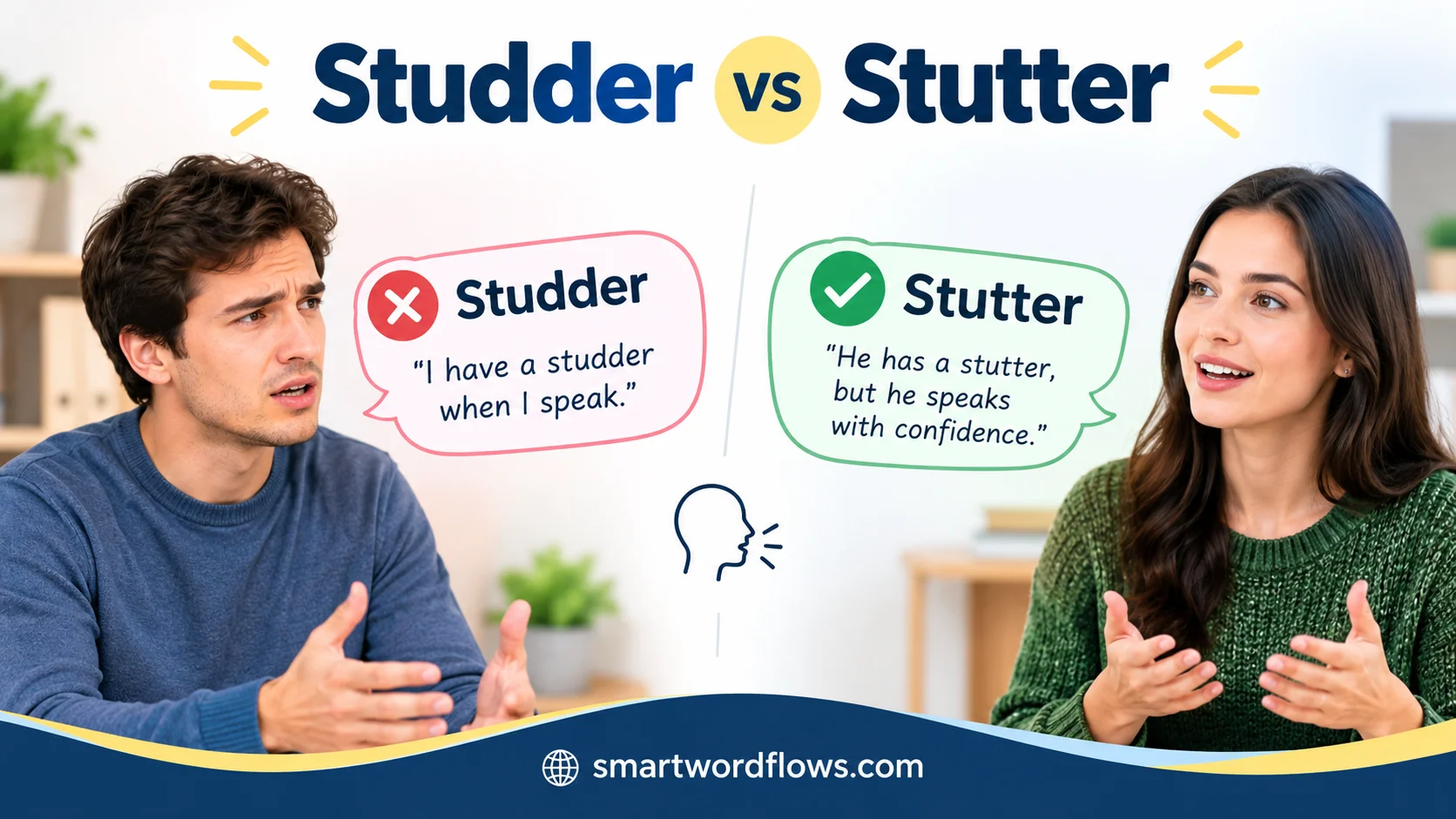

When comparing Studder vs Stutter, the key difference is spelling: stutter is the correct standard English form, while studder is usually a misspelling.
The word stutter describes a speech disorder involving repeated sounds, words, pauses, or interruptions while speaking. Knowing the correct spelling helps students, writers, teachers, parents, and English learners communicate more accurately and search for reliable educational or medical information. It also improves the clarity and professionalism of your writing.
Quick Answer
Stutter is the correct standard spelling when you mean speaking with repeated sounds, prolonged sounds, interruptions, or blocks.
Studder is generally incorrect when used as a spelling of stutter. It does have a separate, uncommon dictionary meaning: Merriam-Webster defines studder as a worker who inserts watch hairsprings into studs.
Here is the simplest way to remember the difference:
Stutter = speech difficulty or interrupted speech.
Studder = a rare specialized noun, not the standard spelling of stutter.
For everyday writing, schoolwork, professional communication, and general English, stutter is the word you want.
Comparison Overview
The difference between studder and stutter becomes much clearer when you compare their meanings, grammatical roles, and frequency of use.
| Feature | Stutter | Studder |
| Standard English spelling for speech | Yes | No |
| Common English word | Yes | No, very uncommon |
| Used as a verb | Yes | Rare specialized usage |
| Used as a noun | Yes | Yes, but with a specialized meaning |
| Refers to disrupted speech | Yes | No |
| Refers to repeated speech sounds | Yes | No |
| Past tense | Stuttered | Not studdered for speech |
| -ing form | Stuttering | Not studdering for speech |
| Appropriate in ordinary writing | Yes | Generally no |
| Closely related word | Stammer | No |
Cambridge defines stutter as speaking or saying something with difficulty, including pausing or repeating sounds. Its American English entry gives the pronunciation as /ˈstʌt̬.ɚ/.
The important point is that studder and stutter aren’t interchangeable spellings. They may sound similar enough to cause confusion, but standard written English favors stutter for the speech-related meaning.
Main Differences Between Studder vs Stutter
The biggest difference is simple: stutter is the standard word for disrupted or repeated speech, while studder usually isn’t.
Stutter Is the Standard Spelling
When someone repeats sounds, syllables, or words involuntarily, English uses the word stutter.
For example:
- “He began to stutter when he became nervous.”
- “She has a noticeable stutter.”
- “The child sometimes stutters when speaking quickly.”
- “He stuttered through the first few sentences.”
- “She has been stuttering since childhood.”
Merriam-Webster lists stutter as both a verb and a noun. As a verb, it can mean speaking with involuntary disruption or blocking, while the noun refers to an instance or habitual tendency to stutter.
Studder Is Usually a Misspelling
If someone writes:
“He started to studder when answering the question.”
the standard correction is:
“He started to stutter when answering the question.”
The same applies to related forms. Studdered should normally become stuttered, while studdering should become stuttering when the intended meaning involves speech.
Studder Does Have a Rare Dictionary Meaning
There is one important wrinkle. Studder isn’t simply a completely nonexistent sequence of letters.
Merriam-Webster lists studder as a noun meaning a worker who inserts watch hairsprings into studs.
That specialized definition has little connection to everyday conversations about speech. Consequently, someone writing about communication, speaking, or speech fluency should choose stutter, not studder.
What Does “Stutter” Mean?
Stutter has several related uses, but its most familiar meaning concerns speech.
As a verb, stutter means to speak with interruptions, repetitions, prolongations, or difficulty getting sounds out smoothly. Cambridge gives examples involving pauses and repeated parts of words.
Consider this example:
“C-c-can we go now?”
A writer might use stuttered to describe the way the speaker delivered those words.
Stuttering can involve several different speech behaviors. The American Speech-Language-Hearing Association, or ASHA, identifies observable features such as whole-word repetitions, sound or syllable repetitions, sound prolongations, and blocks.
Stutter as a Verb
When stutter functions as a verb, it describes an action.
Examples include:
- “He tends to stutter when speaking in front of a large audience.”
- “She stuttered while trying to explain what happened.”
- “The boy sometimes stutters when he’s tired.”
- “He began stuttering during the interview.”
- “She didn’t usually stutter during casual conversations.”
The verb can also describe something that operates unevenly.
For example:
“The engine began to stutter before it stopped.”
Cambridge recognizes this broader sense of stutter for something that works or happens in an irregular, uneven way.
Stutter as a Noun
Stutter also works as a noun.
Examples include:
- “He has a mild stutter.”
- “Her stutter became more noticeable when she was nervous.”
- “The actor’s character has a pronounced stutter.”
- “He spoke confidently despite his stutter.”
- “His stutter didn’t prevent him from giving the presentation.”
This distinction matters because many writers know stutter only as an action. In reality, the word comfortably functions as both a noun and a verb.
What Does “Studder” Mean?
Studder has a very limited and specialized meaning in English.
Merriam-Webster defines studder as “a worker who inserts watch hairsprings into studs.”
That meaning is highly specialized and rarely appears in ordinary conversations or general writing.
Therefore, context matters.
If you’re writing:
“She has a studder.”
you almost certainly intend “She has a stutter.”
If you’re discussing the specialized occupation listed in the dictionary, however, studder may be the intended word.
The important lesson is that a rare dictionary entry doesn’t automatically make two spellings interchangeable. English contains many obscure words that happen to resemble more common words.
Why Do People Confuse Studder and Stutter?
The confusion largely comes from the way the word sounds.
English spelling doesn’t always provide a perfect map of pronunciation. When people hear stutter, they may mentally reconstruct the middle of the word as studder, particularly because the spoken consonants can make the spelling less obvious.
There’s another reason this mistake survives: English has many words containing -dd- and -tt- patterns. A writer who relies heavily on sound rather than visual familiarity may choose the wrong consonant.
The safest approach is simple:
Don’t spell the word according to how you think it sounds. Remember the established spelling: stutter.
A useful memory trick is:
STU + TTER = STUTTER
The word contains “tt”, not “dd.”
How to Use “Stutter” Correctly in a Sentence
Using stutter correctly becomes easy once you identify whether you’re describing an action, a characteristic, or an uneven process.
Using Stutter as a Verb
Use stutter when you’re describing someone speaking with repeated or interrupted sounds.
Examples:
- “I sometimes stutter when I’m under pressure.”
- “He stuttered when the teacher called on him.”
- “She doesn’t usually stutter during informal conversations.”
The verb can appear in different tenses without changing its basic meaning.
Using Stutter as a Noun
Use stutter as a noun when you’re naming the speech characteristic itself.
Examples:
- “His stutter doesn’t define his ability to communicate.”
- “She has worked with a speech-language pathologist about her stutter.”
- “The character’s stutter plays an important role in the story.”
Using Stutter Figuratively
English also uses stutter metaphorically to describe something that repeatedly stops, hesitates, or operates unevenly.
For example:
- “The engine began to stutter.”
- “The economy experienced a stuttering recovery.”
- “The computer’s audio began to stutter during the video.”
Cambridge recognizes this figurative or non-speech use for something that doesn’t work or happen smoothly.
This broader meaning is useful because it shows that stutter isn’t limited to human speech.
Correct Forms of the Word “Stutter”
Once you know the base spelling, its common grammatical forms are straightforward.
| Grammatical form | Correct spelling | Example |
| Base form | stutter | “I sometimes stutter.” |
| Third-person singular | stutters | “He stutters when nervous.” |
| Past tense | stuttered | “She stuttered during the speech.” |
| Present participle | stuttering | “He is stuttering less today.” |
| Noun | stutter | “She has a mild stutter.” |
Merriam-Webster specifically lists stuttered, stuttering, and stutters under the verb entry.
Notice that none of these standard forms changes the tt to dd.
That gives you a reliable spelling pattern:
stutter → stutters → stuttered → stuttering
Not:
studder → studders → studdered → studdering
The second sequence is incorrect when you’re trying to describe speech.
Stuttered vs Studdered
Stuttered is the correct past-tense form of stutter.
For example:
“He stuttered when he tried to answer.”
Not:
“He studdered when he tried to answer.”
The reason is simple. The past tense comes from the established base word stutter, not from the commonly mistaken spelling studder.
More Examples of “Stuttered”
- “She stuttered when she introduced herself.”
- “He stuttered through the first few words.”
- “The speaker stuttered briefly before continuing.”
- “The child stuttered more when he felt rushed.”
- “He stuttered but still communicated his point clearly.”
These examples also demonstrate why context matters. A stutter may affect speech fluency without preventing someone from expressing sophisticated thoughts or ideas.
Read More: Well Deserved vs. Well-Deserved: Which Is Correct?
Studdering vs Stuttering
The correct present participle is stuttering.
For example:
“He is stuttering more than usual today.”
Not:
“He is studdering more than usual today.”
The spelling follows the base word:
stutter + ing = stuttering
This form appears frequently when describing an ongoing action or the broader phenomenon of stuttering.
Merriam-Webster defines stuttering as both the present participle of stutter and a noun referring to involuntary disruption or blocking of speech.
Stutter vs Stammer: Are They the Same?
Stutter and stammer have closely overlapping meanings, although usage varies by region and context.
Cambridge defines stammer as speaking with unusual pauses or repeated sounds and explicitly compares it with stutter.
In American English, stutter is the more familiar everyday term for the speech-related condition or behavior. Stammer remains a valid English word and can describe similar speech patterns.
A simple comparison looks like this:
| Word | General meaning | Common US usage |
| Stutter | Speech with repetitions, interruptions, prolongations, or blocks | Very common |
| Stammer | Speech with unusual pauses or repeated sounds | Valid, but less common |
The two words can overlap considerably. You shouldn’t assume that every speaker uses them to describe completely different speech patterns.
Stutter in American English
Since this article focuses on US English, stutter is the preferred standard spelling for the speech-related meaning.
Cambridge gives the American pronunciation as /ˈstʌt̬.ɚ/.
The first syllable carries the primary stress, and the word contains two t’s in its written form.
The spelling remains the same whether you’re using the word in casual conversation, academic writing, workplace communication, or general nonfiction.
For example:
- Casual: “I sometimes stutter when I’m nervous.”
- Academic: “Stuttering can involve repetitions, prolongations, and blocks.”
- Professional: “The speaker occasionally stuttered during the presentation.”
- Narrative: “He paused, then stuttered out an apology.”
The register may change, but the spelling doesn’t.
Stutter vs Studder in Formal and Professional Writing
In formal writing, stutter is clearly the safer and standard choice when discussing speech.
You should use stutter in:
- School assignments
- College papers
- Business documents
- Medical or educational discussions
- Articles and blog posts
- Workplace communication
- Personal essays
- Fiction and dialogue descriptions
- Speech-related research
Writing studder when you mean stutter can distract readers because it looks like a spelling mistake.
Consider these two sentences:
Incorrect:
“He began to studder during the interview.”
Correct:
“He began to stutter during the interview.”
The corrected sentence immediately looks natural to an English reader.
Common Mistakes With Studder and Stutter
Spelling mistakes become easier to avoid when you know exactly where they occur.
Writing “Studder” Instead of “Stutter”
This is the most common error.
Wrong: “She has a studder.”
Right: “She has a stutter.”
Writing “Studdered” Instead of “Stuttered”
The past tense retains the tt spelling.
Wrong: “He studdered through his response.”
Right: “He stuttered through his response.”
Writing “Studdering” Instead of “Stuttering”
The same principle applies to the present participle.
Wrong: “He was studdering.”
Right: “He was stuttering.”
Assuming Pronunciation Determines Spelling
English contains countless examples where spelling and pronunciation don’t line up perfectly.
If you write studder because it seems to match the sound, you’re allowing pronunciation to override the established spelling.
When you’re unsure, remember the written form rather than inventing a phonetic spelling.
Assuming Every Dictionary Entry Is a Common Word
The existence of studder in Merriam-Webster doesn’t make it an alternative spelling of stutter. It has a separate specialized meaning.
Dictionary entries can include rare technical, historical, dialectal, or occupational vocabulary. Context determines whether such a word belongs in ordinary writing.
Facts About Stuttering
Understanding the word becomes more useful when you understand what it actually describes.
The American Speech-Language-Hearing Association reports that more than 3 million Americans stutter. It also emphasizes that stuttering isn’t simply a matter of repeating sounds. It can involve physical tension, avoidance, and emotional or social effects.
Some important facts include:
- Stuttering can involve sound or syllable repetitions.
- Whole-word repetitions can occur.
- Sounds may be prolonged.
- Blocks can occur when someone cannot immediately produce a sound.
- The frequency and intensity can vary from situation to situation.
- Stuttering isn’t an indicator of intelligence.
- Everyone experiences some ordinary speech disfluencies from time to time.
ASHA specifically notes that “There is not a connection between stuttering and intelligence.”
That distinction matters because casual descriptions of stuttering sometimes rely on unfair stereotypes. Clear language should describe the speech pattern without making assumptions about someone’s intelligence, confidence, personality, or ability.
A Practical Case Study: Choosing Between Studder and Stutter
Imagine you’re editing a sentence for a school article:
“Daniel started to studder during his presentation.”
At first glance, studder may seem plausible because it resembles the sound of the spoken word. However, checking the standard spelling reveals the issue.
The corrected sentence is:
“Daniel started to stutter during his presentation.”
Now suppose the writer changes the tense:
“Daniel was studdering during his presentation.”
Again, the standard form is:
“Daniel was stuttering during his presentation.”
Finally, suppose the sentence uses the noun:
“Daniel has a studder.”
The correct form becomes:
“Daniel has a stutter.”
This small example shows why learning the base spelling solves several mistakes at once.
How to Remember the Correct Spelling of Stutter
A good spelling trick doesn’t need to be complicated.
Think of the word as:
STU + TTER
The final part contains two t’s.
You can also connect the spelling to its grammatical forms:
- stutter
- stutters
- stuttered
- stuttering
Every form keeps the recognizable stutt- pattern.
Another useful trick is to remember that “studder” has a d that doesn’t belong in the ordinary speech-related word.
When writing quickly, stop and ask:
“Am I talking about speech?”
If the answer is yes, choose stutter.
When Should You Use “Stutter” Instead of “Studder”?
Use stutter when you’re describing:
- Repeated speech sounds
- Repeated syllables
- Interrupted speech
- Speech blocks
- Prolonged speech sounds
- A person’s speech characteristic
- The act of speaking with interruptions
- A machine or process that operates unevenly
Use studder only when you’re dealing with its specific specialized meaning or another proper-name context where that spelling is genuinely intended.
For almost every ordinary writing situation involving speech, the decision is easy:
Choose “stutter.”
Stutter Synonyms and Related Words
Several words relate to stutter, but they aren’t always perfect substitutes.
Stammer
Stammer is the closest general synonym. It describes speech involving unusual pauses or repeated sounds. Cambridge lists stammer and stutter as closely related terms.
Disfluency
Disfluency is a broader term describing interruptions or disruptions in fluent speech. Not every normal hesitation counts as stuttering.
Hesitate
Hesitate means to pause or delay before speaking or acting. It doesn’t necessarily imply a speech disorder or repeated sounds.
Repeat
Repeat simply means saying something again. Repetition can occur during stuttering, but the words aren’t exact synonyms.
Block
In discussions of stuttering, a block can describe a moment when someone struggles to initiate or produce a sound. ASHA identifies blocking as one observable feature of stuttering.
Therefore, replacing stutter with one of these words requires attention to context.
Stutter vs Studder: Quick Reference
| If you mean… | Use |
| Speaking with repeated sounds | stutter |
| Speaking with blocks or interruptions | stutter |
| A speech characteristic | stutter |
| The past tense | stuttered |
| The -ing form | stuttering |
| A person who stutters | person who stutters |
| A rare watchmaking-related occupation | studder |
| The standard spelling in US English | stutter |
The central distinction is therefore very clear: stutter is the standard everyday English word for the speech-related meaning.
FAQs :
1. Is “studder” or “stutter” correct?
Stutter is the correct standard English spelling. Studder is generally considered a misspelling or nonstandard variation.
2. What does “stutter” mean?
Stutter refers to a speech difficulty involving repeated sounds, words, pauses, or interruptions during speaking.
3. Is “studder” a real English word?
“Studder” is sometimes seen online, but it isn’t the standard spelling used in formal English. Use stutter instead.
4. Why do people spell stutter as “studder”?
The mistake usually happens because the words sound similar, especially when people type quickly or rely on pronunciation.
5. How can I remember the correct spelling?
Remember that the correct word is stutter, with “tt” in the middle. Using this spelling keeps your writing accurate and professional.
Conclusion :
When comparing Studder vs Stutter, stutter is the correct spelling in standard English. Although “studder” appears online, it’s generally a spelling error or nonstandard form. Use stutter when discussing speech difficulties, writing formally, or searching for reliable information.