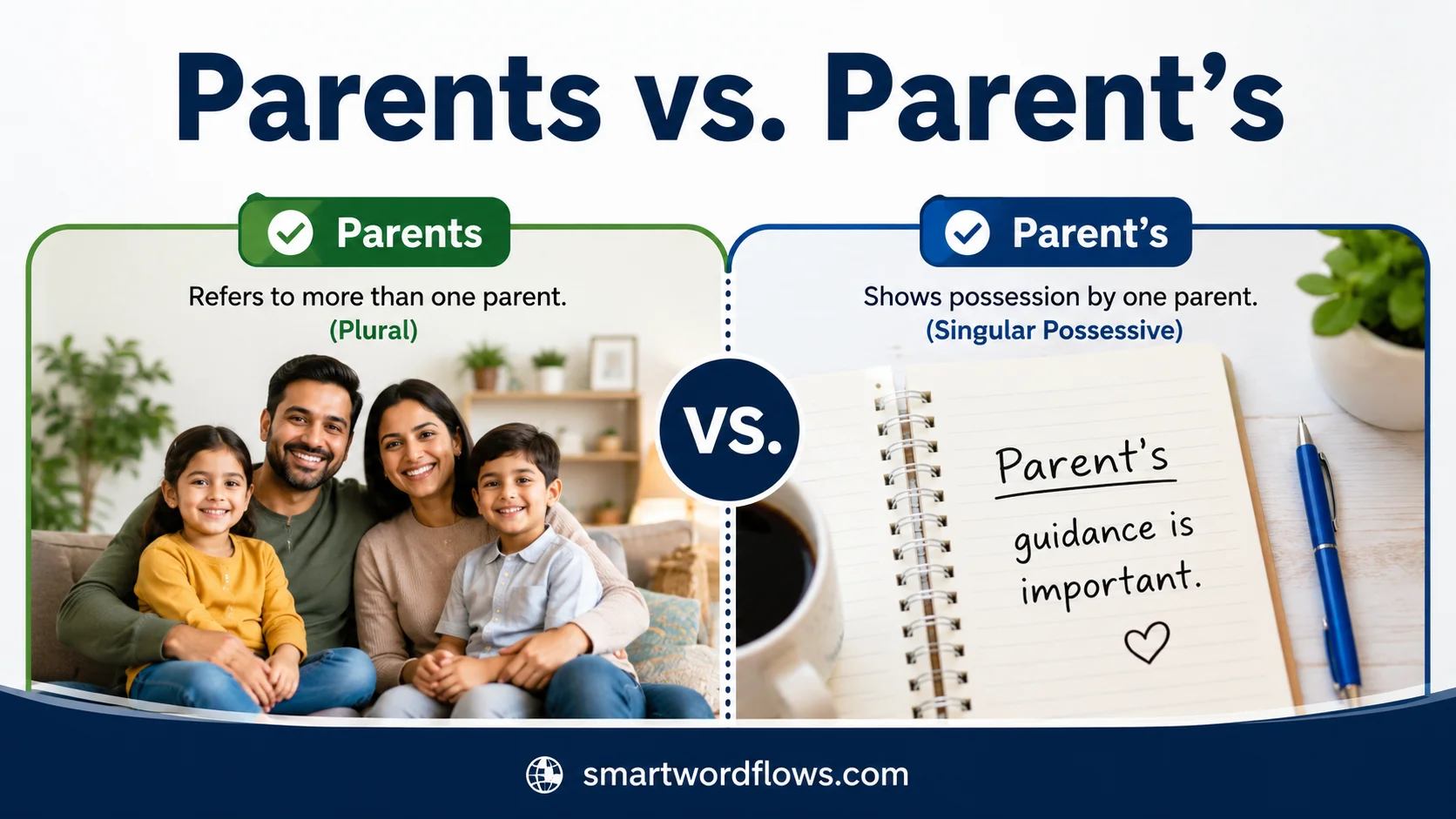

When you’re learning English, Parents vs. Parent’s can cause grammar confusion. Parents is a plural noun for more than one person, usually two parents or both parents. Parent means one parent or a single parent. Parent’s is the singular possessive form and shows ownership by one parent. The apostrophe and its apostrophe placement change the meaning. For example, “My parents are kind” means both parents, while “My parent’s car is new” shows that one parent owns the car. This correct form keeps your sentence clear.
The plural possessive form parents’ shows possession by multiple parents. For example, “My parents’ anniversary” refers to an anniversary shared by both parents, while “my parent’s anniversary” connects it to one parent. Understanding possessive nouns, English possessives, punctuation, and sentence structure helps writers avoid an incorrect form. In academic writing, professional communication, and legal documentation, this small punctuation choice improves clarity and control, precision, and credibility. Always check who the owner is before choosing the correct apostrophe.
Quick Answer
Parents means more than one parent and does not show possession.
Parent’s means something belonging to or associated with one parent. It is the singular possessive form.
Parents’ means something belonging to or associated with two or more parents. It is the plural possessive form.
Here is the easiest way to remember the difference:
| Form | What it means | Example |
| parent | One parent | My parent is waiting. |
| parents | More than one parent | My parents are waiting. |
| parent’s | Belonging to one parent | My parent’s car is outside. |
| parents’ | Belonging to multiple parents | My parents’ car is outside. |
The most important rule is this:
First count the parents. Then ask whether you need to show possession.
If you’re talking about several parents without showing possession, use parents. If one parent owns or is connected to something, use parent’s. If several parents own or are connected to something, use parents’.
Cambridge’s grammar guidance follows the same basic rule: singular nouns normally take ’s for possession, while regular plural nouns ending in s take an apostrophe after the s.
Comparison Overview
The three forms become much clearer when you place them side by side.
| Word | Number | Possessive? | Meaning | Example |
| parent | Singular | No | One parent | The parent arrived early. |
| parents | Plural | No | Two or more parents | The parents arrived early. |
| parent’s | Singular | Yes | Belonging to one parent | The parent’s car arrived. |
| parents’ | Plural | Yes | Belonging to multiple parents | The parents’ cars arrived. |
Consider these four sentences:
- The parent is waiting.
- The parents are waiting.
- The parent’s phone is ringing.
- The parents’ phones are ringing.
Each sentence tells you something different.
In the first sentence, one parent is waiting. In the second, multiple parents are waiting. The third identifies something associated with one parent. The fourth identifies something associated with several parents.
That small apostrophe is doing real grammatical work.
A useful visual rule
One parent → parent’s
Two or more parents → parents’
Two or more parents without possession → parents
This rule works in most ordinary situations.
Main Differences Between Parents vs. Parent’s
The central difference between parents vs. parent’s comes down to number and possession.
Parents means more than one parent
Parents is simply the plural form of parent.
For example:
My parents live in California.
The sentence tells us that more than one parent lives in California. Nothing belongs to anyone in the word parents, so no apostrophe appears.
Other examples include:
- Her parents came to visit.
- The parents attended the school event.
- Many parents worry about their children’s education.
- His parents supported his decision.
- The parents waited outside the classroom.
Cambridge defines parent as a mother or father or someone who cares for a person in a parental role. Its plural form is parents.
Parent’s means belonging to one parent
Parent’s contains an apostrophe before the s because it is a singular possessive.
For example:
My parent’s car is parked outside.
Here, parent refers to one parent. The car belongs to or is associated with that parent.
Compare:
My parents are outside.
with:
My parent’s car is outside.
The first sentence describes people. The second describes something connected to one person.
More examples:
- The parent’s signature is required.
- The parent’s decision surprised the teacher.
- I borrowed my parent’s car.
- The parent’s phone was ringing.
- The parent’s permission was necessary.
Parents’ means belonging to multiple parents
Parents’ is the plural possessive form.
For example:
The parents’ meeting starts at six.
The word parents already refers to multiple people. Because the sentence shows a relationship between those parents and the meeting, the apostrophe comes after the s.
More examples:
- The parents’ meeting begins at 7 p.m.
- We visited my parents’ house.
- The parents’ concerns were discussed.
- Both parents’ signatures were required.
- The parents’ opinions differed.
This follows the standard possessive pattern for regular plural nouns ending in s.
What Does “Parents” Mean?
Parents is the plural form of parent. It normally refers to two or more parents.
The word itself doesn’t indicate ownership.
For example:
My parents are coming tomorrow.
There is no possessive relationship here. The speaker simply identifies more than one parent.
That’s why this sentence is incorrect:
❌ My parent’s are coming tomorrow.
The apostrophe doesn’t belong there because the writer isn’t showing possession. They are simply making parent plural.
The correct version is:
✅ My parents are coming tomorrow.
Examples of “parents” without possession
- Parents often make difficult decisions for their children.
- Her parents live nearby.
- The parents attended the meeting.
- Several parents volunteered for the event.
- His parents encouraged him to apply.
- The school contacted the parents.
- Many parents attended the graduation ceremony.
A good test is to ask:
Am I talking about more than one parent without saying that something belongs to them?
If the answer is yes, use parents.
What Does “Parent’s” Mean?
Parent’s is the singular possessive form of parent.
The basic structure is:
parent + ’s = parent’s
It tells the reader that something belongs to, comes from, or is closely associated with one parent.
For example:
The parent’s signature was missing.
The signature belongs to one parent.
Another example:
I found my parent’s keys.
The keys belong to one parent.
Possession doesn’t always mean literal ownership. English uses possessive forms for many kinds of relationships and associations. Cambridge notes that possessive ’s can show that something belongs to someone or has a close relationship with that person or thing.
Examples of singular possession
- The parent’s car was damaged.
- The parent’s phone rang.
- The parent’s concern was understandable.
- The parent’s permission was needed.
- The parent’s decision affected the child.
- The parent’s signature appears below.
- The parent’s responsibility doesn’t end at the school gate.
The important point isn’t whether the parent literally owns the object. The important point is that the noun phrase identifies a relationship with one parent.
What Does “Parents’” Mean?
Parents’ is the plural possessive form of parents.
The structure is:
parents + ’ = parents’
Notice that the apostrophe comes after the s.
For example:
We visited my parents’ house.
The house is associated with multiple parents.
Compare that with:
We visited my parent’s house.
This suggests that the house belongs to or is associated with one parent.
Both sentences can be grammatically correct. The intended meaning determines which one you should use.
Examples of “parents’”
- The parents’ meeting was postponed.
- My parents’ house is in Texas.
- The parents’ concerns were taken seriously.
- Both parents’ signatures were required.
- The teacher answered the parents’ questions.
- The parents’ decision surprised everyone.
Cambridge specifically gives the general rule that a singular noun takes ’s, while a plural noun ending in s takes an apostrophe after the s.
Read More: Worshipped vs Worshiped: Difference, Meaning, Usage, and Examples
The Core Apostrophe Rule Behind These Forms
The easiest way to understand parent’s and parents’ is to learn the broader possessive rule.
Singular noun + ’s
A singular noun generally forms its possessive with ’s.
Examples:
- child → child’s
- teacher → teacher’s
- student → student’s
- parent → parent’s
So:
The teacher’s desk is clean.
The parent’s signature is missing.
Regular plural noun ending in -s + ’
When a regular plural noun already ends in s, add only an apostrophe.
Examples:
- teachers → teachers’
- students → students’
- parents → parents’
- players → players’
So:
The teachers’ lounge is upstairs.
The students’ books are on the table.
The parents’ meeting starts soon.
This distinction is one of the most reliable ways to avoid apostrophe errors.
What the apostrophe does not do
An apostrophe does not normally make a noun plural.
Therefore:
❌ parent’s = plural
is incorrect.
Instead:
parents = plural
and:
parent’s = singular possessive
The distinction may look small, but the grammar is completely different.
Parent’s House vs. Parents’ House
This is one of the clearest examples of the difference.
Parent’s house
I stayed at my parent’s house.
This means the house belongs to or is associated with one parent.
Parents’ house
I stayed at my parents’ house.
This normally means the house belongs to or is associated with multiple parents.
The apostrophe position tells you how many possessors you’re dealing with.
| Phrase | Meaning |
| parent’s house | House associated with one parent |
| parents’ house | House associated with multiple parents |
| parents house | Incorrect if possession is intended |
The same pattern applies to many other nouns:
- teacher’s classroom = one teacher
- teachers’ classroom = multiple teachers
- student’s desk = one student
- students’ desks = multiple students
Once you understand the pattern, parents vs. parent’s becomes much less confusing.
Parent’s Signature vs. Parents’ Signatures
Official forms provide another useful example.
Suppose a school says:
A parent’s signature is required.
The phrase refers to the signature of one parent.
Now consider:
Both parents’ signatures are required.
Here, the school wants signatures from multiple parents.
There are actually three different constructions worth noticing:
| Phrase | Meaning |
| a parent’s signature | Signature belonging to one parent |
| parents’ signature | Signature associated with multiple parents, though context may make the singular object unusual |
| parents’ signatures | Multiple signatures belonging to multiple parents |
The last version is especially clear when each parent must sign separately.
For example:
The form requires both parents’ signatures.
That means each parent needs to provide a signature.
Parents’ Meeting, Parent’s Meeting, or Parents Meeting?
School-related phrases frequently create apostrophe confusion.
The standard possessive phrase parents’ meeting refers to a meeting for or involving multiple parents.
For example:
The parents’ meeting begins at 6 p.m.
The apostrophe follows the s because parents is plural.
However, parent meeting can also be correct in some contexts. Here, parent functions as a noun modifier rather than a possessive.
For example:
We scheduled a parent meeting for next Tuesday.
This construction doesn’t use an apostrophe because the writer isn’t forming a possessive.
That distinction matters. Not every noun that modifies another noun needs an apostrophe.
Compare these phrases
- parents’ meeting — possessive construction
- parent meeting — noun modifier
- parent-teacher meeting — compound noun
- parent’s meeting — meeting associated with one parent
In ordinary school contexts, parents’ meeting is the natural choice when the meeting involves multiple parents.
Parents vs. Parent’s in Common Everyday Phrases
The same rule appears in dozens of everyday expressions.
| Phrase | Meaning |
| parent’s advice | Advice from one parent |
| parents’ advice | Advice from multiple parents |
| parent’s home | Home associated with one parent |
| parents’ home | Home associated with multiple parents |
| parent’s permission | Permission from one parent |
| parents’ permission | Permission from multiple parents |
| parent’s responsibility | Responsibility of one parent |
| parents’ responsibility | Responsibility shared by multiple parents |
| parent’s concern | Concern of one parent |
| parents’ concerns | Concerns of multiple parents |
Notice something important: number and possession can change independently.
For example:
The parents’ concern was understandable.
This can be grammatically possible when multiple parents share one concern.
Meanwhile:
The parents’ concerns were understandable.
This suggests that multiple parents had multiple concerns.
The apostrophe answers the possession question. The noun’s singular or plural form also communicates number.
Common Mistakes With Parents and Parent’s
Using “parent’s” as the plural
Incorrect:
❌ My parent’s are visiting.
Correct:
✅ My parents are visiting.
Why? The sentence needs a plural noun, not a possessive noun.
Using “parents” for possession
Incorrect:
❌ I went to my parents house.
Correct:
✅ I went to my parents’ house.
Why? The house is associated with multiple parents, so the plural possessive form requires an apostrophe after s.
Using “parent’s” when multiple parents are meant
Incorrect for the intended meaning:
❌ My parent’s anniversary is tomorrow.
If the anniversary belongs to both parents, write:
✅ My parents’ anniversary is tomorrow.
The singular possessive suggests one parent.
Writing “parents’s”
Incorrect:
❌ My parents’s car is outside.
Correct:
✅ My parents’ car is outside.
A regular plural noun ending in s takes only the apostrophe for possession.
Adding an apostrophe when no possession exists
Incorrect:
❌ My parents’ live nearby.
Correct:
✅ My parents live nearby.
The word parents is simply plural in this sentence.
How to Know Which Form to Use
When you’re unsure, don’t guess. Use this three-step process.
Step 1: Count the parents
Ask whether you’re talking about:
- one parent
- more than one parent
If you mean one, start with parent.
If you mean more than one, start with parents.
Step 2: Ask whether you’re showing possession
Does something belong to or relate to the parent or parents?
If not, stop there.
My parents arrived.
If yes, continue.
Step 3: Put the apostrophe in the right place
For one parent:
parent’s
For multiple parents:
parents’
This gives you a simple formula:
One + possession = parent’s
Multiple + possession = parents’
Multiple + no possession = parents
A Simple Trick to Remember the Difference
Here’s a useful memory trick:
Count first. Apostrophe second.
Don’t begin by staring at the apostrophe. First determine how many parents you’re talking about.
If it’s one:
parent’s
If it’s several:
parents’
If you’re simply talking about several parents:
parents
Another useful test is the “of” test.
Ask whether you could naturally rewrite the phrase using of one parent or of the parents.
For example:
The parent’s car
can become:
The car of one parent.
That points toward parent’s.
Now:
The parents’ car
can become:
The car of the parents.
That points toward parents’.
This isn’t a perfect replacement for every English possessive construction, but it works well for this particular distinction.
Does “Parent’s” Ever Mean “Parents”?
No. Parent’s is not the normal plural form of parent.
The apostrophe indicates possession when it appears in this construction.
So:
parents = more than one parent
while:
parent’s = belonging to one parent
Consider:
My parents are teachers.
This means more than one parent works as a teacher.
Now:
My parent’s students are here.
This means the students belong to or are associated with one parent’s teaching role.
The two forms shouldn’t be treated as interchangeable.
How Pronunciation Can Make the Difference Confusing
There is a practical reason this mistake happens so often: parent’s and parents’ can sound very similar in ordinary speech.
When you hear:
“my parents’ house”
you don’t hear the apostrophe.
Speech doesn’t display punctuation. Writing does.
That’s why context becomes important in conversation, while spelling carries more grammatical information on the page.
Cambridge explains that the pronunciation patterns for possessive ’s and plural forms follow established pronunciation rules, which helps explain why these forms can sound alike even though their written forms have different grammatical functions.
This is also why proofreading matters. A sentence can sound perfectly natural while still containing an apostrophe error.
Parents vs. Parent’s vs. Parents’: Real Sentence Examples
Examples with “parents”
- My parents live in Florida.
- Her parents attended the ceremony.
- His parents supported his decision.
- The parents arrived early.
- Many parents attended the workshop.
- The school contacted the parents.
- Their parents encouraged them to study.
In every example, parents simply refers to multiple parents.
Examples with “parent’s”
- The parent’s signature is missing.
- I borrowed my parent’s car.
- The parent’s decision surprised everyone.
- The parent’s phone was ringing.
- The parent’s permission was required.
- The parent’s concern was understandable.
- The parent’s responsibility was clearly explained.
Each example refers to one parent who has a relationship with the following noun.
Examples with “parents’”
- My parents’ house is nearby.
- The parents’ meeting starts at seven.
- Both parents’ signatures were required.
- The teacher answered the parents’ questions.
- The parents’ concerns were discussed.
- We visited our parents’ home.
- The parents’ decision affected the schedule.
Each example uses parents’ to show possession or association involving multiple parents.
A Practical Case Study: Choosing the Correct Form
Imagine a school sends three messages.
Message A
Parents are invited to attend the event.
This is correct because the school is addressing multiple parents. There is no possessive relationship.
Message B
A parent’s signature is required.
This is correct if the school needs a signature from one parent.
Message C
Both parents’ signatures are required.
This is correct when the school needs signatures from two parents.
The underlying rule never changes.
Count the people. Then check possession.
That is the entire engine behind the three forms.
Parents vs. Parent’s Quick Reference Chart
Keep this chart handy when you’re writing.
| What you mean | Correct form | Example |
| One parent | parent | The parent arrived. |
| Several parents | parents | The parents arrived. |
| Something belonging to one parent | parent’s | The parent’s car is new. |
| Something belonging to several parents | parents’ | The parents’ car is new. |
The three-second test
Ask yourself:
“How many parents?”
Then ask:
“Am I showing possession?”
Your answer will usually give you the correct form immediately.
FAQs:
1. What is the difference between parents and parent’s?
Parents is the plural form of parent and refers to more than one parent. Parent’s is the singular possessive form and shows ownership by one parent.
2. When should I use parents’?
Use parents’ when something belongs to or is connected with multiple parents. For example, “My parents’ house is large.”
3. Is “my parent’s anniversary” correct?
It can be correct when referring to one parent. However, if you mean the anniversary of both parents, “my parents’ anniversary” is the correct form.
4. What does the apostrophe mean in parent’s?
The apostrophe in parent’s usually shows possession by one parent. It tells the reader that something belongs to or is associated with a single parent.
5. How can I remember parents vs. parent’s vs. parents’?
Think of parents as plural, parent’s as one parent owning something, and parents’ as multiple parents owning or sharing something.
Conclusion:
Understanding parents, parent’s, and parents’ becomes simple when you focus on number and ownership. Parents means more than one parent, parent’s shows possession by one parent, and parents’ shows possession by multiple parents. The apostrophe may look small, but its position can completely change the meaning of a sentence. By checking whether you mean one parent or more than one, you can choose the correct form and make your writing clearer, more accurate, and easier to understand.