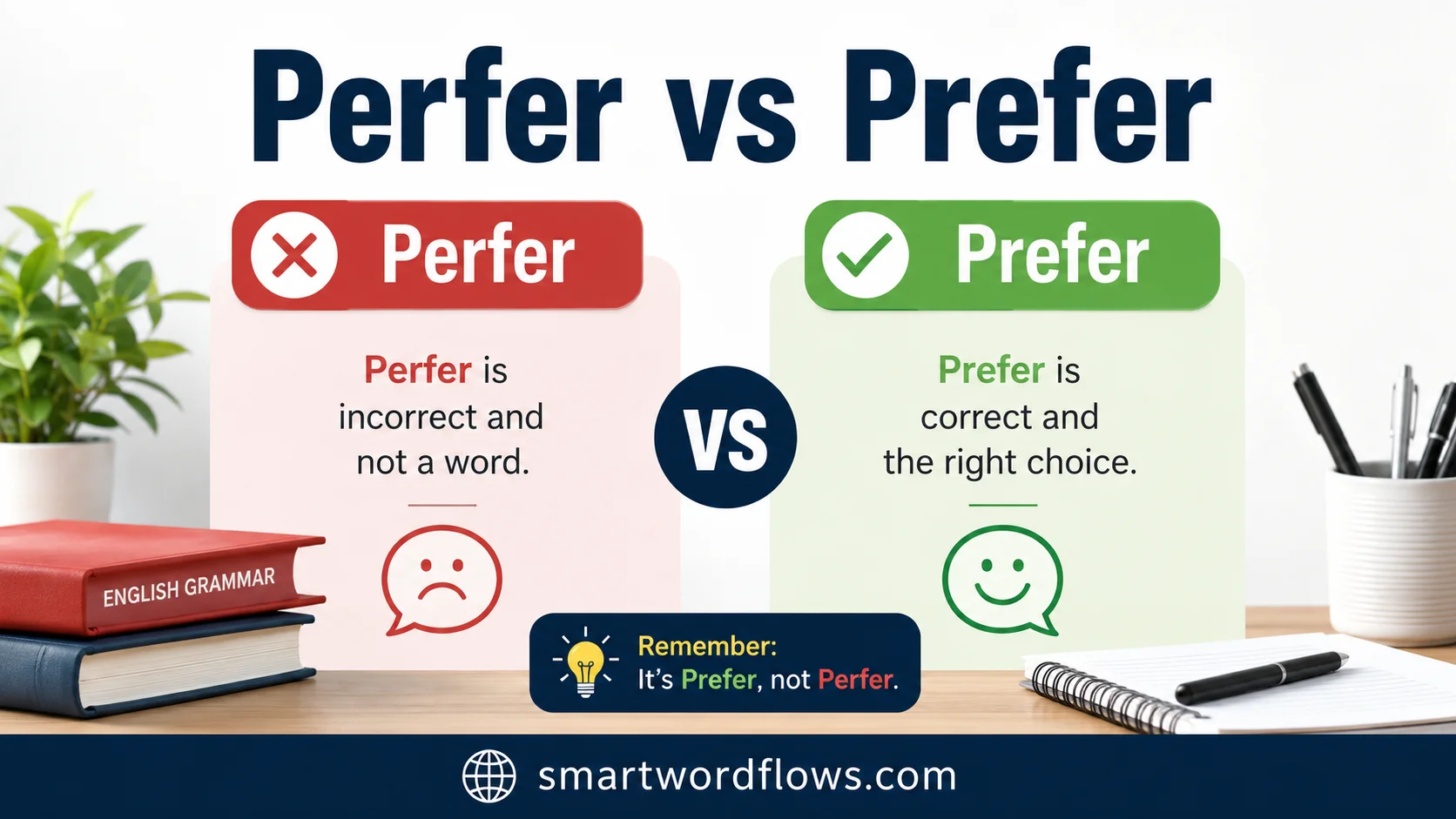

Perfer vs Prefer often causes spelling confusion for learners during fast typing, emails, social media, and daily communication. Prefer is the correct spelling and a standard English verb, while Perfer is a common misspelling. Pronunciation can create pronunciation confusion because the first vowel may sound like a weak vowel sound. This can make the spelling difference difficult to remember. The meaning of prefer is to like one thing more than another or choose one option. Regular proofreading, writing practice, and grammar correction can improve writing accuracy and English language skills.
A useful guide can explain grammar rules, spelling rules, and common mistakes with real examples and practical examples. In correct sentence structure, you can use prefer X to Y, prefer doing something, or would prefer + infinitive, depending on the context. These patterns help improve writing clarity, proper grammar, and communication clarity in formal writing, everyday writing, and professional communication. Using grammar check tools, text correction, and careful writing habits can also strengthen word recognition, language usage, and overall writing skills.
Quick Answer
Prefer is the correct spelling.
Perfer is a misspelling and isn’t the standard spelling of the verb.
| Word | Correct? | Meaning | Example |
| prefer | ✅ Yes | To like or favor one thing more than another | I prefer tea to coffee. |
| perfer | ❌ No | Common misspelling of prefer | I perfer tea. ❌ |
The easiest rule is simple:
If you mean “like one thing more than another,” use prefer.
For example:
- ❌ I perfer working in the morning.
- ✅ I prefer working in the morning.
- ❌ She perfered the blue dress.
- ✅ She preferred the blue dress.
- ❌ They perfer online meetings.
- ✅ They prefer online meetings.
Prefer is the form you should use in standard American English.
Comparison Overview
The difference between perfer vs prefer isn’t a matter of style, dialect, or personal preference. One is standard English and the other is a spelling error.
| Feature | Prefer | Perfer |
| Standard English word | ✅ Yes | ❌ No |
| Correct spelling | ✅ Yes | ❌ No |
| Functions as a verb | ✅ Yes | ❌ No |
| Used in American English | ✅ Yes | ❌ No |
| Used in British English | ✅ Yes | ❌ No |
| Means “favor one option” | ✅ Yes | ❌ No |
| Appears in formal writing | ✅ Yes | ❌ No |
| Common online typo | Sometimes | ✅ Yes |
Example Comparison
Correct:
I prefer tea to coffee.
Incorrect:
I perfer tea to coffee.
The difference comes down to the spelling of the first part of the word. The standard form begins pref-, giving us prefer.
Main Differences Between Perfer vs Prefer
The biggest difference is straightforward: prefer is a real standard English word, while perfer is a misspelling.
Prefer Is the Correct Word
Prefer works as a verb. It describes a stronger liking, choice, or inclination toward one option.
Examples include:
- I prefer summer to winter.
- She prefers quiet restaurants.
- We prefer to leave early.
- They preferred the original design.
- He prefers reading before bed.
The word can describe a general preference or a specific choice.
Perfer Is a Spelling Mistake
Perfer doesn’t function as the standard English equivalent of prefer.
If you’re writing a professional email, article, application, assignment, or report, don’t use perfer.
For example:
❌ I perfer the second option.
Write:
✅ I prefer the second option.
Prefer Doesn’t Mean the Alternative Is Bad
This small distinction often gets overlooked.
If someone says:
“I prefer tea to coffee.”
That doesn’t necessarily mean they dislike coffee. It simply means tea ranks higher in their personal preference.
Think of prefer as a ranking word. You’re putting one option ahead of another.
What Does Prefer Mean?
Prefer means to like, favor, or choose one thing more than another.
The word can describe personal taste, practical choices, habits, or specific decisions.
Consider these examples:
- I prefer beaches to mountains.
- Maria prefers handwritten notes.
- We prefer smaller meetings.
- He prefers to walk rather than drive.
- They prefer the earlier flight.
In each case, the speaker identifies an option that has greater appeal.
Prefer as a Verb
The grammatical role of prefer is important.
I prefer tea.
Here, prefer is the verb.
Compare it with:
Tea is my preference.
Here, preference is a noun.
The relationship between these words is useful:
- prefer → verb
- prefers → third-person singular verb
- preferred → past tense and past participle
- preferring → -ing form
- preference → noun
Learning the entire word family makes spelling much easier.
Why Is “Perfer” Incorrect?
The spelling perfer often appears because the word’s pronunciation can make the spelling less obvious.
When people speak quickly, the individual sounds in prefer may not feel as distinct as they look on the page. A writer who hasn’t memorized the spelling may naturally type perfer.
Another reason is simple visual confusion. English contains many words beginning with per-, so writers may unconsciously reshape prefer into a more familiar pattern.
However, pronunciation doesn’t change the standard spelling.
Common Reasons People Write “Perfer”
The mistake often comes from:
- Fast typing
- Phonetic spelling
- Unfamiliarity with the word
- Pronunciation confusion
- Typing without proofreading
- Mixing up the letters in the first syllable
The important point is that perfer isn’t an accepted alternative spelling.
Prefer Spelling: How to Remember It
A useful way to remember prefer is to focus on its beginning:
P-R-E-F-E-R
Notice the pref- sequence.
This also connects naturally with preference:
- prefer
- preference
- preferred
- preferring
If you’re unsure, remember the shared beginning:
pref-
That small visual cue can prevent the common perfer mistake.
A Simple Memory Trick
Think:
PRE + FER = PREFER
The first four letters are P-R-E-F, not P-E-R-F.
So:
- ❌ perfer
- ✅ prefer
Prefer Pronunciation and Spelling
Pronunciation can explain why some people make the perfer vs prefer mistake.
Prefer has two syllables:
pre-fer
The second syllable receives the main stress in standard pronunciation.
You don’t need to pronounce every letter separately. English spelling rarely works that way. Instead, learn the whole word as a single unit.
Why Pronunciation Isn’t a Reliable Spelling Guide
English contains many words whose spelling doesn’t perfectly mirror their pronunciation.
For that reason, hearing a word isn’t always enough to reconstruct its spelling.
With prefer, the safest approach is to remember the written form:
prefer
rather than trying to spell it exactly as it sounds.
How to Use “Prefer” Correctly
Knowing that prefer is correct is only the first step. The next challenge is using it naturally.
Several grammatical patterns are especially common.
Prefer + Noun
You can place a noun directly after prefer.
Examples:
- I prefer coffee.
- She prefers silence.
- We prefer mornings.
- They prefer traditional methods.
This structure works well when the preference itself is clear from context.
Prefer + -ing Form
You can also use a gerund or -ing form.
Examples:
- I prefer walking.
- She prefers reading.
- They prefer working from home.
- We prefer eating early.
This pattern works particularly well when you’re discussing activities.
Prefer to + Verb
Another common construction uses to followed by the base form of a verb.
Examples:
- I prefer to walk.
- She prefers to cook.
- We prefer to arrive early.
- They prefer to work independently.
Don’t confuse this grammatical to with the comparison pattern discussed below.
Would Prefer + to + Verb
When talking about a particular choice or a polite request, would prefer is common.
Examples:
- I would prefer to stay home.
- We’d prefer to meet tomorrow.
- She would prefer to wait.
- I’d prefer to speak privately.
This construction often sounds more polite or specific than simply saying I prefer.
Prefer A to B: The Standard Comparison Pattern
One of the most important grammar patterns with prefer is:
prefer A to B
Examples:
- I prefer tea to coffee.
- She prefers cats to dogs.
- They prefer walking to driving.
- We prefer summer to winter.
This pattern directly compares two things.
Why “Prefer Than” Causes Problems
A common mistake is inserting than after prefer.
For example:
❌ I prefer tea than coffee.
In standard usage, the traditional comparison construction is:
✅ I prefer tea to coffee.
That’s because prefer commonly takes the pattern prefer X to Y.
Compare the Structures
| Incorrect or less suitable pattern | Standard pattern |
| I prefer tea than coffee. | I prefer tea to coffee. |
| She prefers walking than driving. | She prefers walking to driving. |
| They prefer trains than buses. | They prefer trains to buses. |
The easiest rule is:
Prefer A to B.
Prefer Over vs Prefer To
You may also encounter prefer A over B, especially in contemporary American English.
For example:
I prefer tea over coffee.
This construction is understandable and widely encountered. However, prefer A to B is the classic comparison pattern and remains an especially useful structure to know.
Prefer To
Use:
I prefer tea to coffee.
This is a clear, established comparison structure.
Prefer Over
You may also see:
I prefer tea over coffee.
This emphasizes choosing one option instead of another.
The choice between to and over can depend on sentence structure, context, and style. For learners, prefer A to B is the safest core pattern to master first.
Prefer Rather Than
Another useful construction is:
I prefer to walk rather than drive.
You can also write:
She prefers to call rather than text.
This construction works particularly well when comparing two actions.
Prefer vs Like: What’s the Difference?
Like and prefer overlap, but they don’t communicate exactly the same idea.
Like expresses positive feeling or enjoyment.
I like coffee.
Prefer usually establishes a stronger choice or comparison.
I prefer coffee to tea.
You can like both options and still prefer one.
For example:
I like both movies, but I prefer the first one.
That’s perfectly logical. Like tells us that both movies appeal to you. Prefer tells us which one ranks higher.
Quick Comparison
| Word | Main function | Example |
| like | Express enjoyment or positive feeling | I like jazz. |
| prefer | Show greater liking between options | I prefer jazz to rock. |
| favorite | Identify the top choice | Jazz is my favorite genre. |
Prefer vs Favorite: What’s the Difference?
These words are related but grammatically different.
Prefer is generally a verb.
I prefer blue.
Favorite can function as an adjective or noun.
Blue is my favorite color.
Another example:
I prefer this restaurant.
versus:
This is my favorite restaurant.
The first sentence emphasizes a preference. The second identifies the top choice.
Prefer, Preferred, Preferring, and Preference
The spelling gets slightly trickier when prefer changes form.
| Word | Grammatical role | Example |
| prefer | Base verb | I prefer tea. |
| prefers | Third-person singular | She prefers tea. |
| preferred | Past tense/past participle | We preferred the earlier flight. |
| preferring | -ing form | He is preferring the quieter option. |
| preference | Noun | My preference is tea. |
Why Does “Preferred” Have Two Rs?
The word preferred contains two r’s:
preferred
not:
prefered
The final consonant doubles when forming preferred.
Examples:
- ❌ I prefered the blue one.
- ✅ I preferred the blue one.
- ❌ She prefered tea.
- ✅ She preferred tea.
Why Does “Preferring” Have Two Rs?
The same spelling principle appears in:
preferring
not:
prefering
Examples:
- ❌ He is prefering the smaller room.
- ✅ He is preferring the smaller room.
That said, prefer is often used in other constructions instead of the progressive form because preference frequently describes a state rather than an ongoing action.
For example:
I prefer tea.
is much more natural in many situations than:
I am preferring tea.
The exact choice depends on context.
Read More: Parents vs. Parent’s: Differences, Meaning, and Correct Usage
Common Grammar Mistakes With Prefer
Spelling isn’t the only problem. Several grammar errors appear repeatedly with this verb.
Mistake: Writing “Perfer”
❌ I perfer tea.
✅ I prefer tea.
This is the basic spelling error.
Mistake: Writing “Prefered”
❌ She prefered the first option.
✅ She preferred the first option.
Remember the double r.
Mistake: Writing “Prefering”
❌ We are prefering the quieter location.
✅ We are preferring the quieter location.
Again, the r doubles.
Mistake: Using “Prefer Than”
❌ I prefer tea than coffee.
✅ I prefer tea to coffee.
The core comparison pattern is prefer A to B.
Mistake: Forgetting the Third-Person “S”
❌ She prefer coffee.
✅ She prefers coffee.
The subject determines the verb form.
Compare:
- I prefer
- You prefer
- We prefer
- They prefer
- He prefers
- She prefers
- It prefers
Correct and Incorrect Examples of Prefer
The following examples bring the main rules together.
| Incorrect | Correct |
| I perfer tea. | I prefer tea. |
| She prefer coffee. | She prefers coffee. |
| We prefered the first option. | We preferred the first option. |
| He is prefering the blue one. | He is preferring the blue one. |
| I prefer tea than coffee. | I prefer tea to coffee. |
| She prefer walking than driving. | She prefers walking to driving. |
| I would prefer stay home. | I would prefer to stay home. |
The errors fall into three main categories:
- Spelling: perfer, prefered, prefering
- Verb agreement: prefer instead of prefers
- Grammar patterns: prefer than instead of prefer to
Prefer in American English
For American readers, the standard spelling is prefer.
The same spelling also appears in British English. This isn’t one of those words where American and British spelling differ.
For example:
- American English: prefer
- British English: prefer
You don’t need to switch to perfer for an American audience. In fact, doing so would introduce an error.
Examples in Everyday American English
Workplace:
I prefer email for routine updates.
Restaurant:
I prefer a table near the window.
Travel:
We prefer direct flights.
School:
I prefer studying in the morning.
Conversation:
Do you prefer coffee or tea?
These sentences all use the same basic verb correctly.
Prefer in Real-Life Writing
The word prefer appears in much more than grammar exercises. You’ll find it in ordinary conversations, professional communication, forms, surveys, customer service, and instructions.
In an Email
I would prefer to meet on Thursday.
This sounds clear and professional.
In Customer Service
Please let us know if you prefer email or phone support.
Here, prefer helps present a choice without sounding demanding.
In a Workplace
Our team prefers written instructions for complex tasks.
The sentence describes a general team preference.
In Everyday Conversation
Do you prefer watching movies at home or going to the theater?
This invites a comparison between two activities.
A Practical Case Study: Choosing Between Two Options
Imagine a manager asks an employee:
“Would you rather work from home or come into the office?”
The employee might answer:
“I prefer working from home because it’s quieter.”
Notice what happens here.
Prefer identifies the favored option.
The explanation afterward gives the reason.
Another employee could say:
“I prefer working in the office to working from home because I enjoy collaborating in person.”
This example demonstrates the useful pattern:
prefer A to B
The sentence doesn’t claim that working from home is terrible. It simply ranks the office option higher.
How to Remember the Difference Between Perfer and Prefer
If the spelling still trips you up, use a three-step check.
Check the First Four Letters
Ask yourself:
Does the word start with “pref”?
If yes, you’re on the right track.
pref + er = prefer
Remember the Related Noun
The noun is:
preference
Seeing pref- in both words reinforces the spelling.
Watch the Past Forms
The word family gives you another clue:
- prefer
- prefers
- preferred
- preferring
- preference
If you remember the family, perfer starts looking obviously out of place.
Quick Reference: Prefer Grammar Rules
| Pattern | Correct example |
| prefer + noun | I prefer tea. |
| prefer + -ing | I prefer walking. |
| prefer to + verb | I prefer to walk. |
| prefer A to B | I prefer tea to coffee. |
| would prefer to + verb | I would prefer to leave. |
| prefer rather than | I prefer to walk rather than drive. |
| past form | I preferred the earlier option. |
| -ing form | She is preferring the quieter setting. |
| noun form | My preference is tea. |
Facts to Remember About Prefer
Here are the most useful facts at a glance:
- Prefer is the standard spelling.
- Perfer is a misspelling.
- Prefer functions as a verb.
- The noun form is preference.
- The third-person singular form is prefers.
- The past form is preferred.
- The -ing form is preferring.
- The classic comparison pattern is prefer A to B.
- Would prefer to + verb is useful for specific choices.
- Prefer than is not the standard comparison pattern.
- Prefer has the same spelling in American and British English.
- You can prefer one option without disliking the other.
FAQs:
1. Is Perfer or Prefer correct?
Prefer is the correct spelling. Perfer is a common spelling mistake and should be avoided in formal and everyday writing.
2. What does Prefer mean?
Prefer means to like one thing more than another or to choose one option instead of another.
3. Why do people write Perfer?
People often write Perfer because of pronunciation confusion, fast typing, or a habit of adding an extra letter.
4. How do you use Prefer in a sentence?
You can use prefer X to Y, prefer doing something, or would prefer + infinitive, depending on the sentence and context.
5. How can I remember the spelling Prefer?
Practice the correct spelling, use proofreading and grammar check tools, and remember that the correct form is Prefer, not Perfer.
Conclusion:
The difference between Perfer vs Prefer is simple once you remember the correct spelling. Prefer is the standard English verb, while Perfer is an incorrect spelling. Prefer means to like or choose one thing more than another. Pronunciation and fast typing can make this word confusing, especially for learners. Regular practice, proofreading, and attention to spelling rules can help you avoid this mistake. Using Prefer correctly also improves your writing accuracy, grammar, and overall communication.