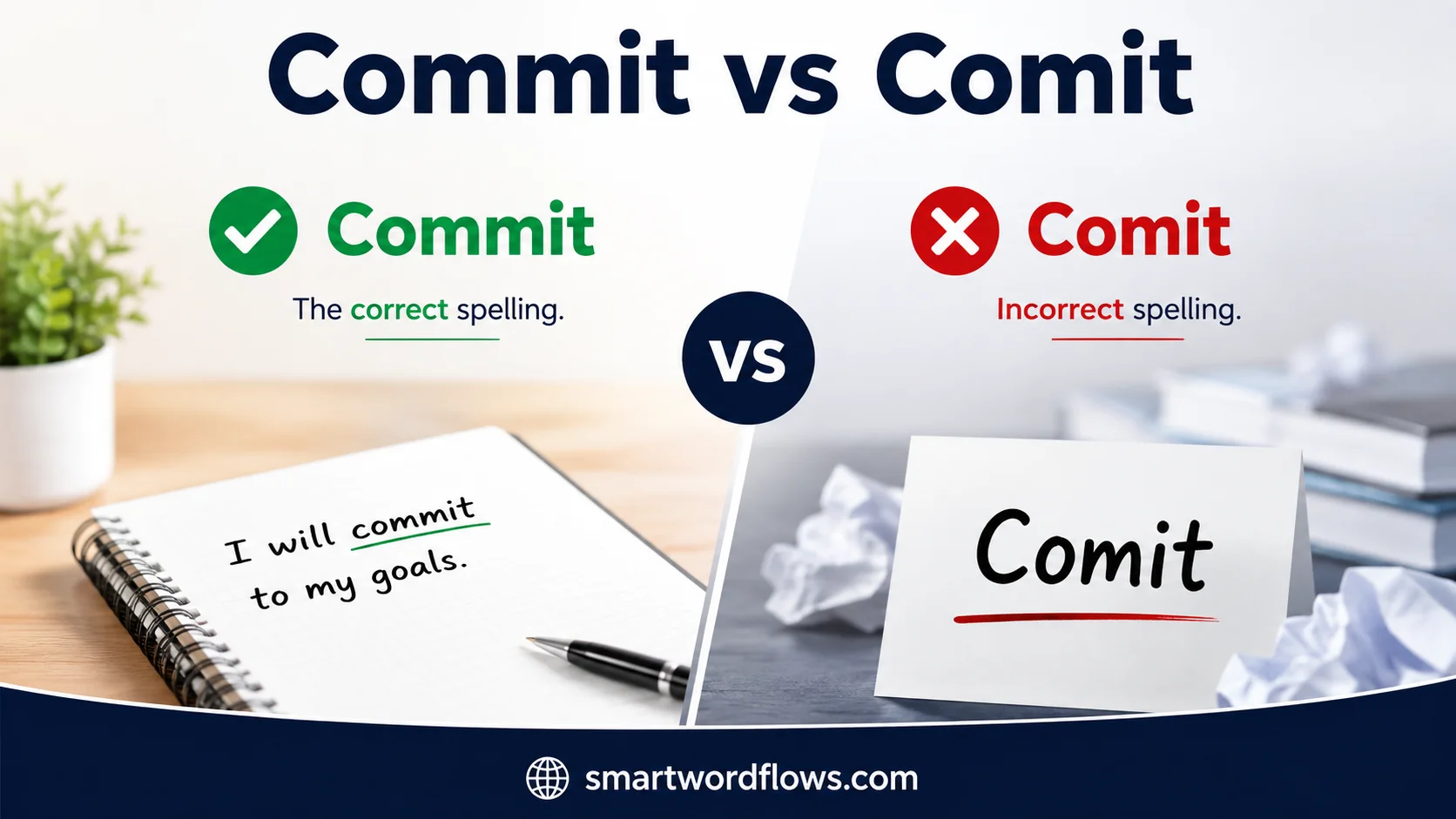

Commit vs Comit is a common English spelling issue that Many people and writers often face. The correct word is commit, while comit is a misspelling. The key difference is the double letters “m” in commit. This small spelling mistake can make professional writing, academic work, SEO content, and business communication look unclear or unprofessional. At a quick glance, the words seem similar, but using the correct spelling helps avoid confusion and makes your message clearer.
To understand the commit meaning, learn its proper usage, pronunciation, and basic grammar rules. In real-world situations, commit and commits may appear in different sentences. Simple examples, tips, and memory tricks can help you avoid this common mistake. If you pause and wonder whether to type comit or commit, remember the double m. This simple trick can improve your writing, help you write clearly and confidently, and make your communication more professional.
Quick Answer
Commit is the correct spelling.
Comit is a misspelling and should not be used in standard English.
Here is the basic difference:
| Word | Correct Spelling? | Meaning |
| commit | Yes | To dedicate yourself to something, carry out an action, or perpetrate an offense |
| comit | No | Incorrect spelling of commit |
For example:
- Correct: She decided to commit to the new schedule.
- Incorrect: She decided to comit to the new schedule.
The same double m appears in related forms:
- commit
- commits
- committed
- committing
- commitment
A useful way to remember it is simple: commit has two m’s.
Comparison Overview
The commit vs comit comparison is straightforward because only one spelling is correct in standard English. The real challenge comes from remembering the double m and knowing how the word changes when you use it in different grammatical forms.
| Feature | Commit | Comit |
| Standard English spelling | Yes | No |
| Part of speech | Verb | Not a standard English verb |
| Correct in formal writing | Yes | No |
| Correct in casual writing | Yes | No |
| Past tense | committed | Incorrect |
| -ing form | committing | Incorrect |
| Noun form | commitment | Incorrect |
| Example | I commit to the plan. | I comit to the plan. |
The distinction matters in school assignments, business emails, resumes, reports, applications, and professional communication. A single missing letter can make an otherwise polished sentence look careless.
Main Differences Between Commit vs Comit
The biggest difference between commit vs comit is that commit is the correct English word while comit is not the standard spelling.
1. Commit Is Correct
Commit is a standard English verb. It has several meanings depending on context.
You can commit to something when you agree to dedicate time, effort, money, or attention to it.
The team committed to completing the project before Friday.
You can also commit an action, error, offense, or crime.
The company admitted that it had committed an error.
The word can also appear in expressions such as commit something to memory.
She practiced the vocabulary until she could commit the words to memory.
2. Comit Is Incorrect
Comit is generally a spelling error rather than a separate English word with a different meaning.
For example:
He comit to his responsibilities.
The correct sentence is:
He commits to his responsibilities.
Because comit isn’t the standard spelling, replacing commit with comit can make your writing look like a typo.
3. The Double M Matters
The most important spelling feature is the double m:
com + mit = commit
Not:
com + it = comit
The spelling stays recognizable across the word family:
- commit
- committed
- committing
- commitment
That consistency makes the spelling easier to learn once you notice the pattern.
What Does Commit Mean?
The word commit has several related meanings. Its exact meaning depends heavily on the words around it.
Commit Meaning: Dedicate Yourself to Something
One of the most common modern uses is commit to.
When you commit to something, you make a firm decision to give it your effort, attention, resources, or support.
For example:
I committed to studying for one hour every evening.
The sentence suggests more than a casual intention. The speaker has made a serious decision to follow through.
Other examples include:
- She committed to improving her writing skills.
- They committed to a long-term partnership.
- We committed to finishing the work on time.
- He committed himself to helping the community.
The noun commitment comes from this same idea.
Commit Meaning: Carry Out an Action
Commit can also mean to perform or carry out an action.
This meaning often appears with actions that have a negative or serious quality.
For example:
The investigation revealed that someone had committed fraud.
Other common combinations include:
- commit a crime
- commit fraud
- commit an offense
- commit an error
- commit a mistake
- commit an act of violence
The word doesn’t always describe illegal behavior. You can commit an error without doing anything criminal.
Commit Something to Memory
The phrase commit something to memory means to learn something well enough to remember it.
For example:
The student used repetition to commit the formula to memory.
This expression is more formal than simply saying remember or memorize.
Compare:
- I need to memorize these definitions.
- I need to commit these definitions to memory.
Both communicate a similar idea. The second sounds somewhat more deliberate or formal.
Commit Something to Writing
Another established expression is commit something to writing.
It means to put an idea, decision, agreement, or statement into written form.
For example:
The two parties agreed to commit the terms to writing.
This phrase often appears in formal, legal, academic, and business contexts.
Why Is Commit Spelled With Two Ms?
The spelling of commit follows an established English spelling pattern involving a short stressed final syllable.
The important practical point for most writers is that commit belongs to a word family that keeps the double m:
- commit
- commits
- committed
- committing
- commitment
The spelling becomes especially noticeable in committed and committing. Both forms contain two m’s.
Consider these examples:
She committed to the project.
She is committing more resources to the project.
The double m remains even though the ending changes.
English has many spelling patterns that aren’t obvious from pronunciation alone. That’s why relying only on what you hear can sometimes lead to mistakes. Seeing the word repeatedly in context helps build a stronger spelling memory.
Commit vs Comit: Why Do People Misspell It?
The commit vs comit mistake is easy to understand. When people hear commit, they may not consciously notice that the middle consonant is written twice.
Several factors can contribute to the error.
Pronunciation Doesn’t Show Every Letter
When someone says commit, the word sounds like two syllables. The pronunciation doesn’t announce, “There are two m’s here.”
That creates a familiar problem in English spelling. A sound can correspond to different written patterns.
Fast Typing Causes Missing Letters
Typing quickly can also turn commit into comit. The second m is easy to skip, especially when you’re writing quickly.
This is particularly common when the same word appears repeatedly in an email, report, or assignment.
Related Words Can Help
Learning the entire word family makes the spelling easier.
If you remember:
commit → committed → committing → commitment
the double m becomes much harder to forget.
Spell-Check Isn’t a Complete Solution
Modern writing software can catch many spelling errors. However, it shouldn’t be your only line of defense.
A spelling checker might catch comit, but understanding the correct spelling helps you recognize the mistake before software does.
Commit as a Verb
Commit is primarily used as a verb.
A verb tells us about an action, decision, or state. With commit, the object or phrase that follows often tells us exactly what kind of action is involved.
Consider these examples:
- She committed to the plan.
- He committed a serious error.
- They committed the details to writing.
- The student committed the material to memory.
Notice how the meaning changes with the surrounding words.
Commit to
The structure commit to + noun is extremely common.
They committed to the agreement.
You can also use commit to + gerund when discussing an activity:
She committed to practicing every morning.
The word after to in this structure is important. Here, to functions as a preposition, so a verb that follows it normally takes the -ing form.
Correct:
I committed to improving my English.
Incorrect:
I committed to improve my English.
Committed as a Past-Tense Form
The past tense of commit is committed.
Notice that the word doesn’t become comited. It keeps the double m and adds another t:
commit → committed
Examples:
- She committed to the project last month.
- They committed a serious error.
- He committed himself to the training program.
Committed can also function as an adjective.
She is committed to her work.
Here, committed describes her attitude or level of dedication.
Committing as the -ing Form
The present participle of commit is committing.
Correct:
They are committing additional resources to the project.
Incorrect:
They are comiting additional resources to the project.
The spelling contains two m’s:
committing
This form also contains two t’s.
Why Does “Committing” Look So Long?
The word changes from commit to committing by adding -ing while maintaining the spelling pattern of the base word.
Think of it as a word family rather than a collection of unrelated spellings:
commit → committing
Once you recognize the family, the spelling becomes much easier.
Commitment as a Noun
Commitment is the noun form related to commit.
It refers to a dedication, obligation, promise, or willingness to give time and effort to something.
For example:
Her commitment to the project impressed everyone.
Other examples include:
- The job requires a serious commitment.
- His commitment to learning is obvious.
- They made a financial commitment to the organization.
- Long-term relationships require commitment.
A useful distinction is:
Commit = the action of dedicating yourself.
Commitment = the dedication or obligation itself.
Compare:
She committed to the training program.
and:
Her commitment to the training program was impressive.
Commit Verb Forms
Understanding the full verb family can prevent spelling mistakes.
| Grammatical Form | Correct Word | Example |
| Base form | commit | I commit to the plan. |
| Third-person singular | commits | She commits to every project. |
| Past tense | committed | He committed to the agreement. |
| Past participle | committed | They have committed to the plan. |
| Present participle | committing | We are committing more resources. |
| Noun | commitment | Their commitment is strong. |
The forms committed and committing deserve special attention because they’re common places for spelling errors.
How to Use Commit in a Sentence
The easiest way to understand commit is to see it in different contexts.
Examples With Commit to
- I commit to finishing this assignment tonight.
- She committed to exercising regularly.
- They committed to improving the service.
- The company committed to reducing unnecessary costs.
- He committed himself to the project.
Examples With Commit an Error
- The employee committed an error in the report.
- Even experienced professionals can commit mistakes.
- The software update caused the system to commit an unexpected error.
Examples With Commit a Crime
- The suspect was accused of committing a crime.
- The investigation focused on who committed the offense.
- Technology can sometimes help investigators identify people who commit fraud.
Examples With Commit to Memory
- Students often commit important facts to memory.
- She committed the new vocabulary to memory through repetition.
- The athlete committed the instructions to memory before the competition.
Examples With Commit to Writing
- The agreement should be committed to writing.
- They decided to commit the final terms to writing.
- Important decisions should be recorded rather than left to memory.
Commit vs Committed vs Commitment
These words share the same root, but they don’t perform the same grammatical job.
| Word | Function | Example |
| commit | Verb | I commit to this goal. |
| commits | Verb | She commits to the plan. |
| committed | Past-tense verb/adjective | They committed to the project. |
| committing | Present participle | He is committing more time to it. |
| commitment | Noun | Her commitment is admirable. |
Understanding these differences can prevent awkward sentences.
For instance:
She has a strong commit to the project.
The correct noun is commitment:
She has a strong commitment to the project.
Likewise:
He is commit to the plan.
The correct form is:
He is committed to the plan.
Read More: Grately vs Greatly: Differences, Correct Usage
Common Mistakes With Commit
Spelling comit instead of commit is the most obvious mistake. However, writers make several other errors with this word family.
Mistake 1: Writing Comit
We comit to providing better service.
We commit to providing better service.
Mistake 2: Writing Comited
She comited to the agreement.
She committed to the agreement.
Mistake 3: Writing Comiting
They are comiting more resources.
They are committing more resources.
Mistake 4: Writing Comitment
His comitment to the team is impressive.
His commitment to the team is impressive.
Mistake 5: Confusing Commit With Commitment
They made a long-term commit to the project.
They made a long-term commitment to the project.
In casual business or technology contexts, commit can sometimes appear as a noun. However, standard general English usually calls for commitment when you mean dedication or an obligation.
Commit vs Comit: Easy Ways to Remember the Spelling
A simple memory trick can save you from repeatedly making the same mistake.
Remember: Commit Has Two Ms
Write it mentally as:
COMMIT
The middle MM is the key.
You can connect it with commitment:
commit → commitment
Both words keep the double m.
Another useful chain is:
commit → committed → committing → commitment
Every form reminds you that the word begins with comm-.
A Simple Mnemonic
Make a commitment to remember the two Ms in commit.
The word commitment itself can reinforce the spelling of commit.
Commit Pronunciation
In standard American English, commit is pronounced approximately like:
kuh-MIT
The stress falls on the second syllable.
That pronunciation helps explain why some writers don’t notice the double m when spelling the word. Spoken English doesn’t visually reveal repeated letters.
The important point is that pronunciation and spelling aren’t identical systems. You should use the established spelling commit rather than trying to reconstruct the spelling entirely from sound.
Commit vs Comit in American English
In standard American English, commit is the accepted spelling.
Comit isn’t simply an American alternative to a British spelling. It is a misspelling.
This distinction matters because English contains genuine spelling differences between varieties. For example, American and British English sometimes differ in words such as color/colour and organize/organise.
That isn’t what happens with commit/comit.
There is no standard American-versus-British spelling choice here:
- American English: commit
- British English: commit
The correct spelling remains commit.
Commit vs Similar Words
Sometimes spelling confusion becomes easier to solve when you compare a word with related vocabulary.
Commit vs Admit
Commit and admit are different verbs.
Commit can mean to dedicate yourself to something or carry out an action.
She committed to the plan.
Admit can mean to acknowledge something as true or allow someone to enter.
He admitted that he was wrong.
The words may look somewhat similar, but their meanings and uses are different.
Commit vs Submit
Submit usually means to present something for consideration, approval, or judgment.
Please submit your application before Friday.
Commit has a different meaning:
She committed to completing the application.
One word involves presenting something. The other can involve making a firm dedication.
Commit vs Devote
Devote and commit to can sometimes express similar ideas.
Compare:
She devoted herself to her studies.
She committed herself to her studies.
Both suggest serious dedication.
However, commit has several meanings that devote doesn’t. You can commit a crime, commit an error, or commit something to memory.
Commit vs Complete
These words are completely different in meaning.
Complete means to finish something.
I completed the report.
Commit can mean to dedicate yourself to something.
I committed to writing the report.
You can commit to a task without necessarily having completed it yet.
Common Phrases and Collocations With Commit
Certain combinations appear frequently in natural English.
| Phrase | Meaning | Example |
| commit to a goal | Dedicate yourself to achieving something | She committed to her goal. |
| commit to a plan | Agree to follow a plan | They committed to the new plan. |
| commit to a decision | Stand firmly behind a decision | He committed to the decision. |
| commit a crime | Carry out a criminal act | The person committed a crime. |
| commit fraud | Carry out fraudulent activity | The company was accused of committing fraud. |
| commit an error | Make an error | The analyst committed an error. |
| commit to memory | Learn something thoroughly | He committed the facts to memory. |
| commit to writing | Put something into written form | They committed the agreement to writing. |
| commit oneself | Dedicate oneself to something | She committed herself to the cause. |
Learning these combinations is more useful than memorizing the dictionary definition alone. Words become easier to use when you understand the phrases that naturally surround them.
Commit vs Comit Examples at a Glance
Here’s a quick reference for the most common spelling mistakes:
| Incorrect | Correct | Example |
| comit | commit | I commit to this plan. |
| comits | commits | She commits to every deadline. |
| comited | committed | He committed to the project. |
| comiting | committing | They are committing more resources. |
| comitment | commitment | Her commitment is impressive. |
The pattern is clear. If the word begins with commit-, don’t drop the second m.
A Practical Case Study: Commit in Professional Writing
Imagine a manager writing this sentence in an email:
We comit to resolving the issue within two business days.
The meaning is understandable. However, the spelling error weakens the professionalism of the message.
A corrected version reads:
We commit to resolving the issue within two business days.
Now consider a different sentence:
Our comitment to quality remains strong.
The correct version is:
Our commitment to quality remains strong.
The lesson is simple: knowing the word family helps you avoid several mistakes at once.
This matters particularly in professional writing because words such as commit, committed, and commitment frequently appear in emails, proposals, reports, policies, business plans, and formal statements.
Facts About the Word Commit
A few useful facts make the word easier to understand:
- Commit is a verb.
- Commitment is its common noun form.
- Committed can function as a past-tense verb or an adjective.
- Committing is the present participle and gerund form.
- Commit has two m’s.
- Committed has two m’s and two t’s.
- Committing has two m’s and two t’s.
- Comit is not the standard spelling of the verb.
- Commit to commonly expresses dedication or agreement.
- Commit a crime means to carry out a criminal act.
- Commit something to memory means to learn it thoroughly.
- Commit something to writing means to put it into written form.
How to Check Whether You Should Write Commit or Comit
When you’re unsure, use this quick process:
- Look at the spelling.
Does the word have two m’s? - Check the meaning.
Are you talking about dedication, carrying out an action, or putting something into memory or writing? - Check the word form.
If you’re describing a noun, you may need commitment rather than commit. - Check the tense.
If the action happened in the past, use committed. - Check an -ing construction.
Use committing, not comiting.
A quick review can prevent an entire family of spelling errors.
FAQs:
1. Is “comit” a correct English word?
No. Comit is a common spelling mistake. The correct English word is commit, spelled with two “m”s.
2. What is the correct spelling: commit or comit?
The correct spelling is commit. Remember the double m to avoid writing comit.
3. What does “commit” mean?
Commit means to carry out an action, make a firm decision, or dedicate yourself to something. Its exact meaning depends on the sentence.
4. Why do people spell commit as “comit”?
People often write comit because they forget the double letter in commit. The two forms look very similar, which can cause confusion.
5. How can I remember the spelling of commit?
Use the simple memory trick: commit has double m. Remembering this can help you spell the word correctly in everyday and professional writing.
Conclusion
Commit is the correct spelling, while comit is a common misspelling. The easiest way to remember the difference is to focus on the double m in commit. Using the correct form improves your writing, prevents spelling errors, and helps your communication look clear and professional.