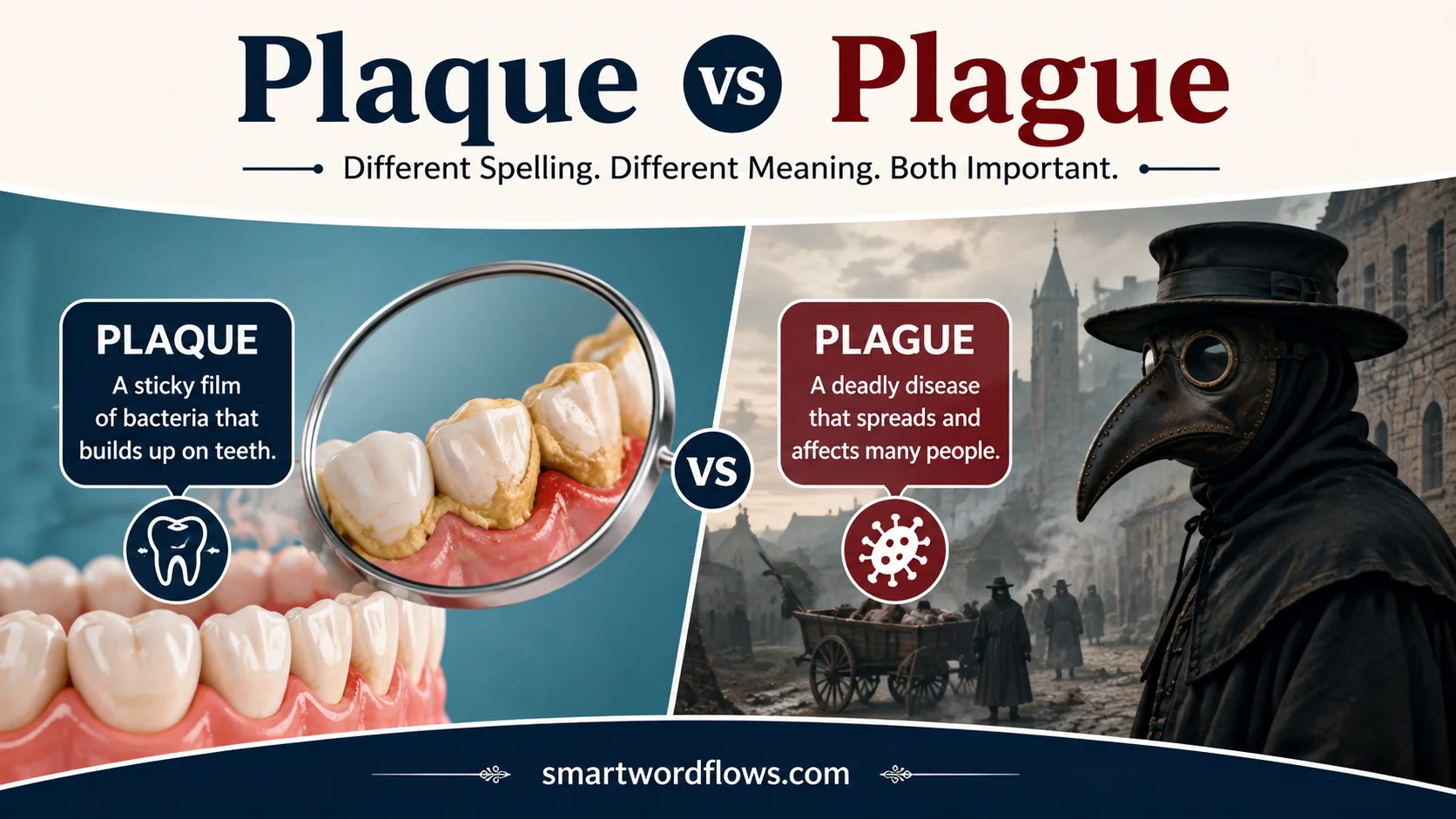

Plaque vs Plague: Difference, Meaning, and Correct Usage is a common topic that helps clear the confusion between placque vs plaque. Many writers and students question the correct spelling because plaque looks unusual with silent letters. The extra “c” in placque is a common mistake, but it is a misspelling in standard English. Learning the difference, meaning, and correct usage helps improve writing confidence.
A plaque is a noun with different meanings depending on the context. It can mean a metal badge, wooden badge, sign, marker, or recognition award with an inscription. In health terms, dental plaque is a bacterial film or oral biofilm that forms on the tooth surface. Understanding its definition, etymology, and language usage improves vocabulary and communication skills.
Quick Answer: Plaque vs Plague Difference
The simple difference between plaque and plague is:
| Word | Meaning | Common Uses |
| Plaque | A sticky substance on teeth or a flat plate with writing on it | Dental health, awards, memorials, historical markers |
| Plague | A serious infectious disease or a widespread harmful problem | Medicine, history, disasters, figurative expressions |
Example:
- The dentist removed the plaque from my teeth.
- The medieval plague killed millions of people.
A quick way to remember it:
Plaque sticks. Plague spreads.
Comparison Overview: Plaque vs Plague
The words plaque and plague differ in meaning, pronunciation, spelling, and usage. They are not interchangeable, even though many people confuse them.
| Feature | Plaque | Plague |
| Pronunciation | “Plak” | “Playg” |
| Meaning | A buildup, sign, or recognition plate | Disease outbreak or widespread problem |
| Main Areas of Use | Dentistry, awards, history | Medicine, history, social issues |
| Origin | Related to a flat plate or surface layer | Related to a deadly disease outbreak |
| Example | Dental plaque can cause cavities. | The plague spread across Europe. |
Both words have important meanings, but they belong to completely different contexts.
If you are talking about teeth, a memorial sign, or an award, use plaque. If you are discussing a disease, infestation, or major problem affecting many people, use plague.
Main Differences Between Plaque vs Plague
The biggest difference between plaque vs plague is what each word represents.
Plaque describes something that is usually physical and visible. It can be a substance that collects on teeth or an object attached to a wall, building, or monument.
Plague, however, describes something harmful that spreads. It often refers to disease, but writers also use it to describe serious problems that affect large groups of people.
Meaning Difference Between Plaque and Plague
What Does Plaque Mean?
Plaque has two major meanings in English.
The first meaning relates to dentistry. Dental plaque is a soft, sticky film that forms on teeth when bacteria combine with food particles and saliva.
If plaque remains on teeth for too long, it can contribute to:
- Tooth decay
- Cavities
- Gum inflammation
- Gum disease
- Bad breath
Dental plaque develops naturally throughout the day. This is why regular brushing, flossing, and professional cleanings are important.
For example:
“Skipping brushing allows plaque to build up along the gum line.”
The second meaning of plaque refers to a flat decorative or commemorative plate.
These plaques are often made from:
- Metal
- Stone
- Wood
- Ceramic
They usually display information about a person, event, achievement, or historical location.
Examples include:
- A plaque honoring a famous scientist
- A plaque marking a historic building
- An award plaque given to an employee
Example sentence:
“The city placed a plaque outside the old courthouse to explain its history.”
What Does Plague Mean?
The word plague mainly refers to a dangerous infectious disease. Historically, the most famous example is the Black Death, one of the deadliest pandemics in human history.
The Black Death occurred during the 14th century and caused the deaths of millions of people across Europe, Asia, and North Africa.
The disease was caused by the bacterium Yersinia pestis. It was commonly spread through infected fleas carried by rodents.
Important facts about historical plague:
| Fact | Detail |
| Disease name | Plague |
| Main bacteria | Yersinia pestis |
| Famous outbreak | Black Death |
| Time period | 14th century |
| Main historical impact | Millions of deaths worldwide |
Today, plague still exists in some parts of the world, but modern medicine can treat it effectively with antibiotics when diagnosed early.
However, plague does not only refer to disease. English speakers also use it in a broader way to describe anything that causes widespread trouble.
Examples:
- A plague of insects destroyed the crops.
- The community faced a plague of misinformation.
- Noise pollution has become a plague in crowded cities.
In these examples, the word does not describe a disease. It describes something unwanted that spreads or creates problems.
Plaque Meaning in Dentistry
Dental plaque is one of the most common uses of the word plaque.
Your mouth naturally contains millions of bacteria. After you eat, bacteria mix with leftover food particles and create a thin film over your teeth.
That film is called dental plaque.
How Dental Plaque Forms
The process happens in several steps:
- Food particles remain in the mouth after eating.
- Bacteria attach to the teeth.
- A sticky layer develops.
- The plaque produces acids that attack tooth enamel.
If you remove plaque regularly, it usually does not cause serious problems. However, untreated plaque can harden into tartar, which is much harder to remove.
Plaque vs Tartar
| Plaque | Tartar |
| Soft and sticky | Hard and mineralized |
| Can be removed with brushing and flossing | Usually requires professional cleaning |
| Forms daily | Develops from untreated plaque |
This difference is important because many people confuse plaque with tartar.
Plaque Meaning as a Recognition or Memorial Sign
The second major meaning of plaque relates to honoring or remembering something.
A plaque often serves as a permanent reminder.
You may see plaques on:
- Historic buildings
- Monuments
- Schools
- Parks
- Office walls
For example, a university may install a plaque recognizing a professor’s contribution. A city may place a plaque at a historical site explaining an important event.
Common types of plaques include:
| Type of Plaque | Purpose |
| Memorial plaque | Honors a person or event |
| Award plaque | Recognizes achievement |
| Historical plaque | Marks an important location |
| Donor plaque | Recognizes financial support |
Plague Meaning in History and Medicine
The word plague has a powerful historical connection because of major disease outbreaks.
The most famous example is the Black Death, which changed societies, economies, and populations across continents.
The plague caused:
- Massive population loss
- Labor shortages
- Economic changes
- Social disruption
Historical records show that the Black Death reshaped Europe during the Middle Ages.
Today, when people hear the word “plague,” they often immediately think about this historical event.
However, modern outbreaks are usually identified by specific disease names rather than simply being called “plagues.”
Plaque vs Plague Pronunciation Difference
Although the spelling looks similar, the pronunciation is different.
Plaque Pronunciation
Plaque sounds like:
“plak”
It rhymes with:
- Back
- Track
- Black
Example:
“The dentist checked for plaque.”
Plague Pronunciation
Plague sounds like:
“playg”
It rhymes with:
- Vague
- Page
- Stage
Example:
“The plague affected many communities.”
The vowel sound is the main difference.
Read More: Encode vs. Incode Correct Usage: Which One Should You Use?
Plaque vs Plague Spelling Difference
The spelling difference is small but important.
| Word | Ending | Sound |
| Plaque | -que | “k” sound |
| Plague | -gue | “g” sound |
The letters at the end change both pronunciation and meaning.
A simple memory trick:
- Plaque has “que” like a quiet layer that sticks.
- Plague has “gue” like germs that spread.
Common Mistakes When Using Plaque and Plague
Many writers confuse these words because they look almost identical.
Mistake: Using Plague for Teeth
Incorrect:
“The dentist removed the plague from my teeth.”
Correct:
“The dentist removed the plaque from my teeth.”
Teeth cannot have a disease called plague. They develop plaque.
Mistake: Using Plaque for a Disease
Incorrect:
“The plague spread throughout Europe and caused millions of deaths.”
Actually, this sentence is correct because it uses plague.
Incorrect example:
“The plaque spread throughout Europe.”
This changes the meaning completely.
Mistake: Confusing Award Plaques With Disease
Incorrect:
“She received a plague for her achievement.”
Correct:
“She received a plaque for her achievement.”
An award is a physical object, so it uses plaque.
How to Remember the Difference Between Plaque and Plague
Remember this simple rule:
Plaque is placed. Plague is spread.
- A plaque is placed on teeth, walls, or buildings.
- A plague spreads among people, animals, or communities.
Another memory method:
Plaque = Plate
Both words begin with “pla” and relate to something flat or attached.
Plague = Germs
Think of disease and problems that spread.
Professional Usage of Plaque vs Plague
Using the correct word matters in professional writing because these terms appear in healthcare, education, history, and business.
Healthcare Writing
Use plaque when discussing:
- Oral hygiene
- Dental care
- Tooth health
Use plague when discussing:
- Infectious diseases
- Historical outbreaks
- Disease research
Historical Writing
Use plaque for:
- Memorial markers
- Building signs
- Recognition displays
Use plague for:
- Disease outbreaks
- Historical pandemics
Business Writing
Companies often give:
- Achievement plaques
- Recognition plaques
- Service plaques
Using “plague” instead would create an embarrassing mistake.
Related Words and Phrases
Words Related to Plaque
- Dental plaque
- Tooth buildup
- Tartar
- Memorial plaque
- Award plaque
- Recognition plaque
- Engraved plaque
Words Related to Plague
- Epidemic
- Pandemic
- Outbreak
- Infection
- Disease
- Infestation
- Crisis
Each word has its own meaning and should match the situation.
FAQs:
1. Is placque a correct spelling?
No, placque is not a correct spelling in standard English. The correct spelling is plaque. The extra “c” in placque is a common spelling error.
2. What does plaque mean?
Plaque has multiple meanings. It can be a decorative or commemorative plate with an inscription, such as an award or memorial marker. It can also refer to a sticky bacterial layer that forms on teeth.
3. How do you pronounce plaque?
The word plaque is pronounced as “plak” (similar to the word black without the “b” sound). The letters “que” at the end are silent.
4. What is dental plaque?
Dental plaque is a thin, sticky layer of bacteria and food particles that builds up on the surface of teeth. If it is not removed through brushing and cleaning, it can contribute to tooth decay and gum problems.
5. How can I remember the correct spelling of plaque?
A simple way to remember is that plaque has only one “c” and ends with “que.” Think of a plaque award or dental plaque, both use the same spelling.
Conclusion
Understanding the difference between plaque vs placque helps avoid a common spelling mistake in English. The correct spelling is plaque, while placque is an incorrect form that is not accepted in standard English. A plaque can refer to a commemorative sign, award, marker, or dental plaque that develops on teeth due to bacteria. By learning its meaning, definition, and correct usage, writers and students can improve their vocabulary and communicate more accurately.