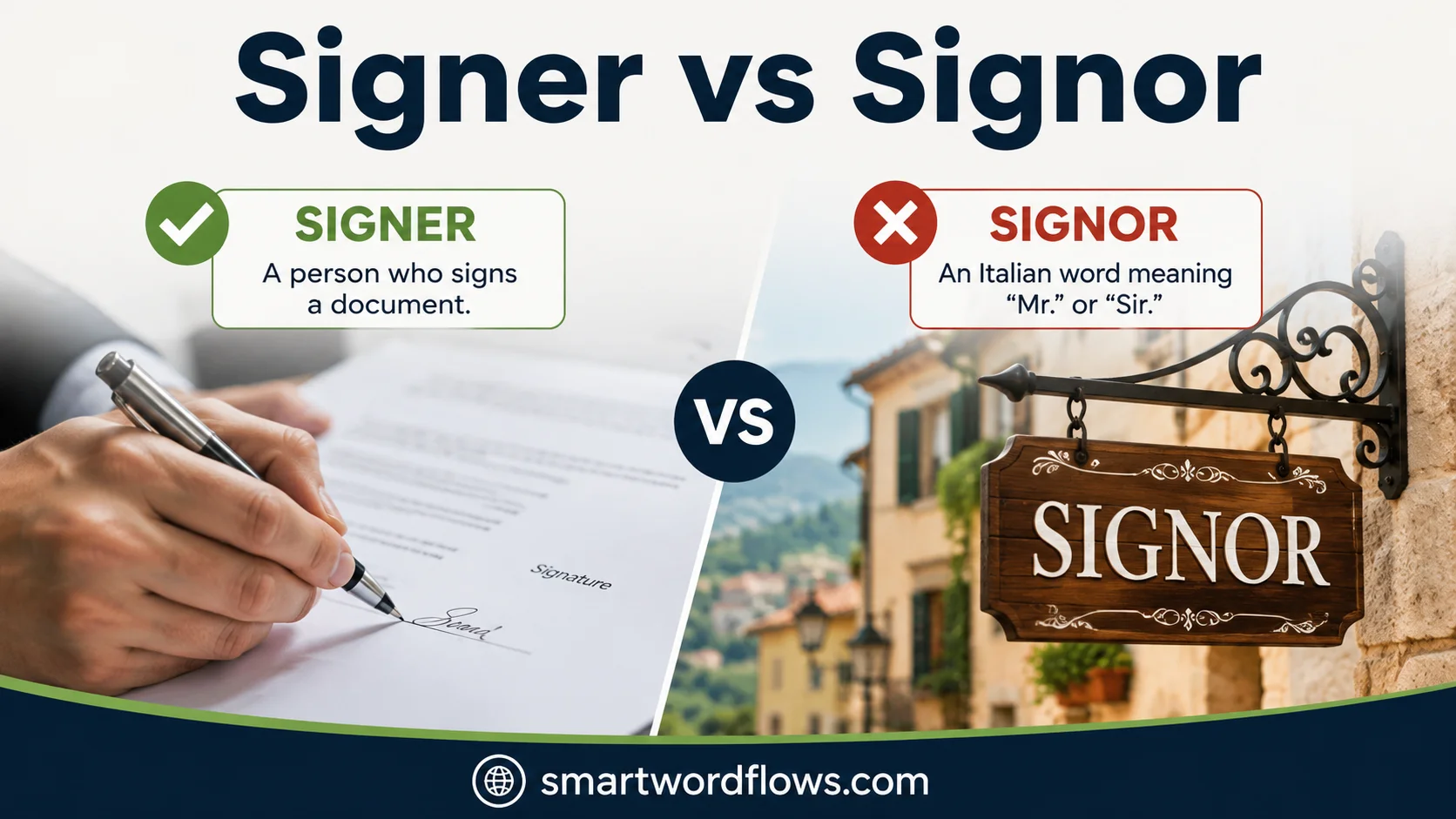

Signer vs Signor can be confusing because these similar words have different meanings, origins, and uses. A signer is a person who writes a signature on a document, contract, or other legal paper. The correct spelling matters in formal writing, emails, and banking documents. A signer may also refer to someone using American Sign Language. Understanding this difference helps English learners, writers, and professionals use the right word clearly, correctly, and accurately in everyday communication.
A signor is a polite Italian way to say mister, especially when speaking about an Italian man. You may see signor in an Italian menu, during dining, or when talking with a waiter in Rome. The two words can look almost identical, causing confusion, hesitation, and common mistakes. A simple way to remember them is to connect signer with signatures and documents, while connecting signor with Italian manners, culture, and polite communication in real-life situations.
Quick Answer
Signer means a person who signs a document, agreement, form, or petition.
Signor is an Italian honorific used before a man’s name, like Mr. in English.
So:
- Use signer when you talk about someone signing something.
- Use signor when you address or mention an Italian man respectfully.
Comparison Overview
Here is a simple side-by-side view of signer vs signor:
| Feature | Signer | Signor |
| Meaning | A person who signs | An Italian title meaning Mr. |
| Language | English | Italian |
| Part of speech | Noun | Noun used as a title |
| Common use | Contracts, forms, agreements | Names, greetings, formal address |
| Example | The signer must initial every page. | Signor Rossi arrived at noon. |
| Pronunciation | SIGH-ner | seen-YOR or see-NYOR |
The table makes the distinction easy to see. Even though the words look close, they do different jobs.
Main Differences Between Signer and Signor
The main differences between signer and signor come down to meaning, language, and context. If you understand those three things, you will almost never mix them up again.
Meaning
A signer is someone who signs a document, form, letter, petition, contract, or agreement. The word comes from the verb sign. That makes the meaning direct and practical.
A signor, on the other hand, is a title used in Italian. It is equivalent to Mr. in English. It does not describe an action. It describes respect and formality.
Language
Signer is an English word.
Signor is an Italian word.
That alone explains a lot. English uses signer in legal and everyday contexts. Italian uses signor as part of polite speech.
Function in a Sentence
A signer is usually the subject or object in a sentence about signing.
Example:
- The signer reviewed the agreement before signing.
A signor usually appears before a surname.
Example:
- Signor Bianchi welcomed the guests.
Context
Use signer in:
- contracts
- forms
- legal paperwork
- petitions
- authorization documents
- compliance records
Use signor in:
- Italian names
- formal greetings
- travel and cultural writing
- translated speech
- etiquette-related contexts
Pronunciation
People often mix these words up because they look similar in writing. Pronunciation helps separate them.
- Signer usually sounds like SIGH-ner
- Signor is closer to see-NYOR or seen-YOR
That means they do not even sound the same in careful speech.
What Does Signer Mean?
A signer is a person who signs something. That is the simplest and most useful definition. The word appears often in legal, business, and administrative writing.
A signer may be:
- a person signing a contract
- a customer authorizing a bank form
- a witness signing a statement
- a person approving a consent document
- someone joining a petition or declaration
The word is practical, specific, and common in formal English.
Where You Will See Signer
You will often see signer in places like:
- employment contracts
- rental agreements
- loan forms
- government documents
- affidavits
- consent forms
- digital signature platforms
For example:
- Each signer must provide identification.
- The signer accepts the terms by signing below.
- Every signer receives a copy of the final agreement.
Signer in Legal and Business Writing
Legal writing often uses signer because it identifies the person responsible for authorizing a document. This matters because signatures create obligation, agreement, and accountability.
For example, in a contract:
- the signer confirms consent
- the signer may be bound by the terms
- the signer’s identity may need verification
That is why you will see phrases like:
- authorized signer
- primary signer
- co-signer
- signer name
- signer signature
These terms are common in banks, law offices, and company paperwork.
Simple Examples of Signer
- The signer must date the form.
- A signer may not alter the contract after approval.
- Each signer agreed to the same terms.
- The signer submitted the document electronically.
- The bank requested proof from the signer.
What Does Signor Mean?
Signor is an Italian courtesy title used for men. It is similar to Mr. in English. It is respectful and formal, and it usually comes before a surname.
Examples:
- Signor Rossi
- Signor Bianchi
- Signor Conti
It is not used to describe signing. It is not a job title. It is not a noun for a document signatory. It is a name form used in Italian language and culture.
How Signor Works in Italian Contexts
In Italian, titles help show politeness. Signor is used in formal speech, written communication, introductions, and respectful reference.
For example:
- Signor Marco, would you like to sit here?
- We spoke with Signor Leone after the meeting.
- The reservation was made under Signor Ferri.
You may see signora for a woman, which is similar to Mrs. or Ms. in English, depending on context. You may also see signorina, though that form is less common in modern polite use.
Signor in English Writing
English writing may use signor when it refers to Italian names, Italian characters, or Italian settings. It can appear in travel writing, literature, movies, or history.
For example:
- Signor Dante greeted the visitors at the villa.
- The hotel staff referred to him as Signor Moretti.
- The guide introduced us to Signor Romano.
Here, the title is not translated into “Mr.” because the Italian form may be part of the original context.
Side-by-Side Meaning of Signer vs Signor
Here is a clearer comparison for everyday use:
| Word | Meaning | Used With | Correct Context |
| Signer | A person who signs | Documents, forms, agreements | English business and legal writing |
| Signor | Italian title meaning Mr. | A man’s surname | Italian names and formal address |
This is the fastest way to remember it.
When to Use Signer
Use signer when the sentence is about signing.
Common situations
- Someone signs a contract
- Someone authorizes paperwork
- A form needs approval
- A person joins a petition
- A digital signature is required
Good examples
- The signer agreed to the terms.
- The signer must verify their identity.
- Every signer received the final copy.
- The signer checked the contract carefully before approval.
Helpful rule
If you can replace the word with “person who signs”, then signer is the right choice.
Read More: Plaque vs Plague: Difference, Meaning, and Correct Usage
When to Use Signor
Use signor when the sentence is about an Italian man’s name or title.
Common situations
- Italian business correspondence
- Formal introductions
- Travel writing
- Literary references
- Historical or cultural discussion
Good examples
- Signor Bellini will speak first.
- We met Signor Alberti in Rome.
- The letter was addressed to Signor Carlo Marino.
- Signor Paolo thanked the guests.
Helpful rule
If the word appears before an Italian surname and acts like Mr., then signor is right.
Why People Confuse Signer and Signor
These words cause trouble for a few very human reasons.
They look almost the same
Only one letter changes. That is enough to cause mistakes during fast reading or typing.
They may feel similar to English learners
Someone who knows the word sign may assume signor has something to do with signing. It does not.
Auto-correct can make it worse
Typing tools may not know the intended meaning and may suggest the wrong word.
The context is not always obvious
In short messages or partial sentences, the surrounding words may not make the meaning clear.
That is why context matters more than spelling alone.
Common Mistakes to Avoid
Here are the biggest mistakes people make with signer vs signor.
Using signor for a signing person
Wrong:
- The signor completed the contract.
Correct:
- The signer completed the contract.
Using signer as an Italian title
Wrong:
- Signer Rossi arrived at the meeting.
Correct:
- Signor Rossi arrived at the meeting.
Assuming they mean the same thing
They do not. One is English. One is Italian. Their meanings are unrelated.
Forgetting the surname rule with signor
Signor normally appears before a last name, not by itself in casual English use.
Memory Trick to Remember the Difference
Here is an easy trick.
Signer has the word sign inside it.
That reminds you of signing documents.
Signor sounds more like an Italian title.
That reminds you of Italian names and formal address.
A short memory line works well:
“Signer signs. Signor shows respect.”
That tiny phrase can save you from mistakes.
Examples in Real-Life Use
Business context
- Every signer must provide a full legal name.
- The signer received an email copy of the agreement.
Legal context
- The signer acknowledged the terms before closing the deal.
- Each signer was informed of their responsibilities.
Travel and cultural context
- Signor Rossi recommended a small café near the station.
- The guide introduced us to Signor Paolo after dinner.
Formal writing context
- The signer confirmed the contract date.
- Signor Bianchi responded with a polite greeting.
These examples show how different the two words really are.
A Small Case Study: Contract Error vs Italian Courtesy
Imagine a company preparing two documents.
Case A: Business contract
The legal team writes:
- “Each signor must sign below.”
That is wrong. The document is about people who sign. The correct sentence should be:
- “Each signer must sign below.”
Here, signer is the right word because the context is legal and practical.
Case B: Travel brochure in Italy
A travel brochure writes:
- “Please meet Signer Giovanni at the hotel.”
That is also wrong. The sentence should be:
- “Please meet Signor Giovanni at the hotel.”
Here, signor is correct because the context is Italian courtesy.
This simple comparison shows how one letter can change the entire meaning of a sentence.
Signer vs Signor in Grammar
Both words are nouns, but they behave differently.
Signer
- Common noun
- Refers to a role or action-linked person
- Often used with legal and business language
Examples:
- a signer
- the signer
- multiple signers
Signor
- Title or honorific
- Used before names
- Strongly tied to Italian usage
Examples:
- Signor Rossi
- Signor Bianchi
- Signor Moretti
Capitalization
- Signer is usually lowercase unless it starts a sentence or appears in a title.
- Signor is capitalized when used before a name, just like Mr. is often capitalized in formal use.
Related Words You Should Know
Signatory
A signatory is a person who signs a treaty, contract, or formal agreement. It is close to signer, but more formal.
Example:
- The signatory countries signed the treaty.
Signature
A signature is the written mark or name used to approve something.
Example:
- Her signature appears at the bottom of the page.
Signing
Signing is the act of putting a signature on something.
Example:
- The signing took place on Friday.
These words may appear near signer, but they are not the same thing.
Quick Usage Guide
Here is the fastest way to choose the right word.
| If the sentence is about… | Use |
| Someone signing a form | Signer |
| An Italian man’s title | Signor |
| A legal agreement | Signer |
| A formal Italian greeting | Signor |
Common Questions People Ask
Is signer a real word?
Yes. It is a standard English noun for a person who signs something.
Is signor an English word?
No. It comes from Italian and functions as a title.
Can signer and signor be used interchangeably?
No. They mean different things and belong to different contexts.
Which one is used in contracts?
Signer.
Which one is used before an Italian surname?
Signor.
Best Practices for Correct Usage
To avoid mistakes, keep these habits in mind:
- Read the sentence slowly before publishing it.
- Check whether the sentence is about signing or about a title.
- Look for the language context. Is it English or Italian?
- Replace the word in your head with the meaning. If the sentence still works, you probably chose the right one.
- When in doubt, use the context as your guide.
A clean sentence is often the best proof that the word choice is right.
Signer vs Signor at a Glance
- Signer = a person who signs
- Signor = Italian title meaning Mr.
- Signer belongs to English legal and business writing
- Signor belongs to Italian names and formal speech
- The two words look similar but serve completely different purposes
FAQs:
1. What is the difference between signer and signor?
A signer is a person who signs a document, while signor is a polite Italian term meaning mister.
2. When should I use signer?
Use signer for someone who writes or provides a signature, especially on legal documents, contracts, or forms.
3. What does signor mean?
Signor is an Italian title used politely for a man, similar to Mr. or mister in English.
4. Are signer and signor interchangeable?
No. Although their spelling and sound are similar, their meanings and uses are completely different.
5. How can I remember signer vs signor?
Remember signer with signature and documents, while signor is connected with an Italian mister.
Conclusion
The difference between signer vs signor becomes simple once you remember their meanings. Signer refers to someone who signs a document, while signor is a polite Italian term for a man. Understanding their spelling and context helps you avoid confusion and use each word correctly in legal, professional, and everyday communication.