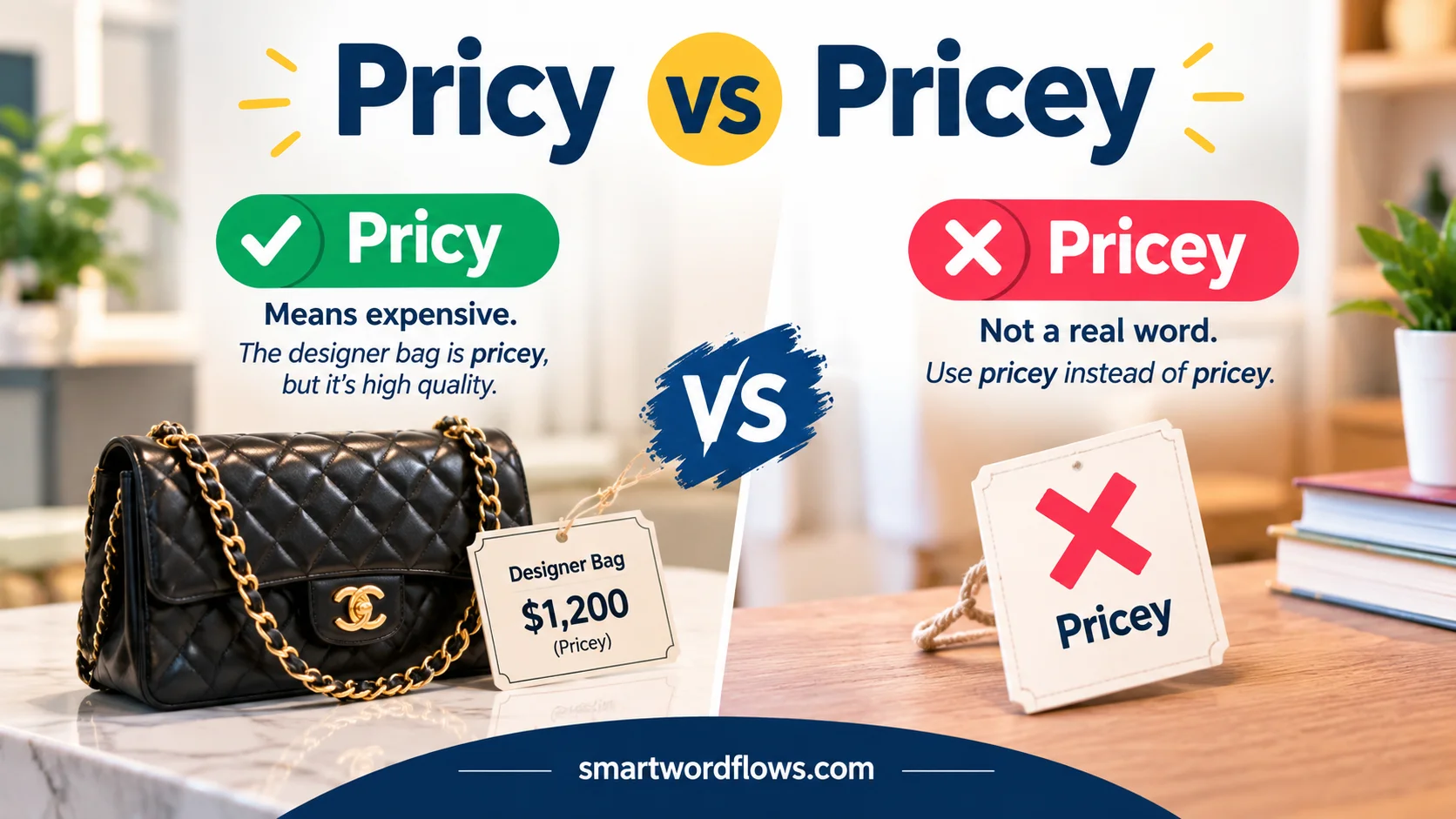

When learning English, understanding Pricy vs Pricey can help you avoid common spelling mistakes. Both forms describe something that costs a high price, but pricey is the more widely accepted spelling in Standard English. You may still see pricy in dictionaries and casual writing, but it is less common. For students, writers, bloggers, and professionals, choosing the familiar form can make your writing clearer, more natural, and easier for readers to understand.
The difference becomes simple when you connect pricey with the noun price. The word pricey works as an adjective for something expensive or costly. It commonly appears in informal writing, conversations, reviews, and everyday English. In formal writing, business documents, essays, and professional articles, pricey is generally the safer choice because it is more common. Learning its meaning, usage, and correct spelling can help English learners communicate more clearly and confidently.
Quick Answer: Pricy vs Pricey
Pricey and pricy are both correct spellings of an adjective meaning expensive or costing a lot of money.
However, pricey is much more common and is the spelling most readers are likely to expect. For general American English writing, pricey is the safest and most familiar choice.
For example:
- The restaurant is too pricey for my budget.
- The restaurant is too pricy for my budget.
Both sentences mean the same thing.
Pricy vs Pricey at a Glance
| Word | Correct? | Meaning | Commonness | Best Default Choice |
| Pricey | Yes | Expensive | More common | Yes |
| Pricy | Yes | Expensive | Less common | Usually no |
So, if you’re wondering “Is it pricy or pricey?”, the simple answer is: both are valid, but pricey is the more common spelling.
Comparison Overview
| Feature | Pricy | Pricey |
| Part of speech | Adjective | Adjective |
| Basic meaning | Expensive | Expensive |
| Refers to cost | Yes | Yes |
| Recognized English word | Yes | Yes |
| Meaning differs from the other spelling | No | No |
| Common in everyday writing | Less common | More common |
| Suitable for US English | Yes | Yes |
| Conversational tone | Yes | Yes |
| Recommended general choice | Sometimes | Usually |
The important point is that you don’t need to learn two separate definitions. Pricy and pricey describe the same idea.
If a friend says, “That phone is pricey,” they’re saying the phone costs a lot. If someone writes, “That phone is pricy,” the intended meaning remains exactly the same.
The spelling changes. The meaning doesn’t.
Main Differences Between Pricy vs Pricey
At first glance, the difference seems tiny: pricy has one fewer letter than pricey. That single letter, however, creates a spelling preference that matters when you’re trying to produce polished English.
Meaning
Both pricy and pricey mean expensive.
You can use either word to describe something that costs more money than expected, more than you want to spend, or more than seems reasonable in a particular situation.
For example:
- That laptop is pricey.
- That laptop is pricy.
- The hotel was surprisingly pricey.
- The hotel was surprisingly pricy.
There is no meaningful difference in what these sentences communicate.
The word doesn’t necessarily mean that something is objectively overpriced. It can simply indicate that the cost is high from the speaker’s perspective.
For example, if a $5,000 vacation is described as pricey, the speaker is commenting on its cost. Another person with a larger budget might not consider the same vacation expensive.
Spelling
The biggest difference between the two forms is their spelling.
Pricey keeps the final e from price:
price → pricey
Pricy removes that e:
price → pricy
This creates two accepted spellings for the same adjective.
The spelling pricey is particularly intuitive because readers can immediately connect it with the noun price. That’s one reason it remains the more familiar form.
Usage Frequency
Although both forms exist, pricey is considerably more common in contemporary English.
That matters because familiar spellings usually make reading easier. When readers see pricey, they generally recognize the word instantly. Pricy may make some readers pause because they’re more accustomed to the version containing e.
This doesn’t make pricy incorrect. It simply means that pricey has stronger everyday recognition.
Tone
Both words usually have a casual or conversational tone.
For example:
That new gaming monitor is pretty pricey.
This sounds natural in conversation, a product review, or a casual blog post.
In a highly formal document, however, expensive, costly, or high-priced may fit better depending on the context.
What Does “Pricey” Mean?
Pricey is an adjective that means expensive.
It’s commonly used when talking about products, services, restaurants, hotels, housing, travel, electronics, clothing, and other things that require significant spending.
For example:
- The new iPhone is pricey.
- We found a pricey apartment downtown.
- That restaurant has a pricey menu.
- The repair turned out to be quite pricey.
- Luxury watches can be extremely pricey.
The word often carries a conversational feel. Someone might say something is pricey without making a formal judgment about whether the item is worth the money.
Pricey Does Not Always Mean Overpriced
This distinction is easy to miss.
Pricey tells you that something costs a lot. It doesn’t automatically mean that the item is a bad deal.
Consider this sentence:
The hotel is pricey, but the service is excellent.
Here, pricey means expensive. The speaker isn’t necessarily saying the hotel charges an unfair price.
Compare that with:
The hotel is overpriced.
Overpriced makes a stronger claim. It suggests that the cost is too high for the value provided.
Therefore, don’t automatically treat pricey and overpriced as synonyms.
What Does “Pricy” Mean?
Pricy is an alternative spelling of pricey. It also means expensive.
You might see it in sentences such as:
- That camera is rather pricy.
- The hotel gets pricy during the holiday season.
- Buying a house in that area can be pricy.
- The repair was more pricy than expected.
The word works grammatically just like pricey.
Is Pricy a Real Word?
Yes.
Pricy isn’t simply a typo that should always be corrected. It is an established spelling variant of pricey.
That said, recognizing a word as valid doesn’t mean every spelling has equal popularity. English contains many accepted variants where one form appears much more frequently than another.
That’s exactly what happens with pricy and pricey.
If your goal is to write for a broad American audience, pricey usually offers the clearest and most familiar choice.
Why Are There Two Spellings: Pricy and Pricey?
The variation comes from how English forms adjectives from nouns.
The noun price can take the suffix -y to form an adjective:
price + y → pricey
English spelling doesn’t always handle suffixes in a completely uniform way. Writers and dictionaries have recorded variants over time, including the shorter form pricy.
The difference is therefore not based on two separate meanings. Instead, it reflects a spelling variation.
Price + Y
The most transparent formation is:
price → pricey
The original word remains easy to recognize.
The Shorter Form
The alternative is:
price → pricy
The e disappears before the adjective ending.
Both forms are understandable. The longer spelling has simply become much more familiar to modern readers.
Is “Pricy” a Correct Word?
Yes, pricy is a correct and recognized spelling.
Calling it a spelling error would be misleading. If you encounter pricy in a published article, book, review, or other piece of writing, the writer may be intentionally using the variant.
Still, there’s an important practical distinction between correct and preferred.
A word can be grammatically and lexically valid while another spelling is more widely used. In this case, pricey is the more familiar choice.
When Should You Use Pricy?
You can use pricy when:
- Your preferred style guide allows it.
- You’re following the spelling used by an existing publication.
- Consistency with surrounding content matters.
- You simply prefer that established variant.
However, if you’re writing general web content and want maximum reader familiarity, pricey is usually the more straightforward option.
Is “Pricey” a Correct Word?
Absolutely. Pricey is a standard and widely recognized English adjective.
It’s especially common in everyday American English.
You can use it naturally when discussing:
- Restaurants
- Hotels
- Cars
- Electronics
- Clothing
- Real estate
- Travel
- Repairs
- Services
- Luxury goods
For example:
The restaurant looks great, but the menu is pretty pricey.
That’s a natural sentence for a review or conversation.
Pricy vs Pricey in American English
For American English, pricey is the spelling most readers will recognize first.
That doesn’t make pricy wrong. It simply gives pricey a practical advantage when your priority is familiarity.
This becomes especially relevant for websites, blogs, product reviews, and educational content. Readers generally don’t want to stop and wonder whether an unfamiliar spelling is intentional.
Why Pricey Works Well in Everyday Writing
Pricey has a familiar visual connection with price.
When readers see:
price → pricey
the relationship is immediately obvious.
That’s useful in quick-reading environments such as websites and social media.
Should You Completely Avoid Pricy?
Not necessarily.
Avoiding it as a default doesn’t mean treating it as an error. If a publication consistently uses pricy, changing every occurrence to pricey may create unnecessary inconsistency.
The better approach is simple:
Choose one spelling and use it consistently.
Pricy vs Pricey in Formal Writing
Neither word is particularly formal. Both have a conversational quality.
If you’re writing an academic paper, business report, legal document, or formal analysis, a more neutral term may work better.
Consider these alternatives:
| Conversational | More Neutral/Formal |
| Pricey | Expensive |
| Pricy | Expensive |
| Pricey product | High-priced product |
| Pricey service | Costly service |
| Pricey option | Higher-cost option |
For example:
Casual:
The software is pretty pricey.
More formal:
The software carries a relatively high cost.
The best choice depends on your audience and the tone of the document.
When “Pricey” Is Better Than “Expensive”
Don’t assume that the more formal word is always better.
If you’re writing a friendly product review, pricey can sound more natural:
The headphones sound fantastic, but they’re pretty pricey.
Replacing it with expensive isn’t wrong. It simply changes the tone slightly.
Pricey often feels more conversational and personal.
Read This: Suprise vs Surprise: Which Is Correct Spelling?
Pricy vs Pricey Examples
Seeing the two forms side by side makes the relationship much clearer.
Examples With “Pricey”
- That smartphone is too pricey for my budget.
- The restaurant has a pricey menu.
- We stayed at a pricey hotel near the beach.
- Luxury cars can be incredibly pricey.
- The repair wasn’t cheap. It was surprisingly pricey.
- Those shoes look great, but they’re a little pricey.
Examples With “Pricy”
- That smartphone is too pricy for my budget.
- The restaurant has a pricy menu.
- We stayed at a pricy hotel near the beach.
- Luxury cars can be incredibly pricy.
- The repair wasn’t cheap. It was surprisingly pricy.
- Those shoes look great, but they’re a little pricy.
Notice something important: the meaning remains unchanged.
Side-by-Side Sentence Comparison
| With Pricey | With Pricy |
| This laptop is pricey. | This laptop is pricy. |
| The rent is getting pricey. | The rent is getting pricy. |
| That’s a pricey restaurant. | That’s a pricy restaurant. |
| The repair became pricey. | The repair became pricy. |
| Their services are pricey. | Their services are pricy. |
The only change is the spelling.
Common Mistakes With Pricy and Pricey
Even though the difference is small, several mistakes can occur.
Mistake: Assuming Pricy Is Always Wrong
Some writers automatically mark pricy as incorrect.
That’s too broad.
Pricy is an accepted spelling variant, even though it isn’t as common as pricey.
Mistake: Assuming the Words Have Different Meanings
They don’t.
A pricy hotel and a pricey hotel both describe a hotel that costs a lot.
Mistake: Switching Between Both Forms
Using pricey in one paragraph and pricy in the next can make your writing look inconsistent.
For example:
The car is pricey. Its maintenance can also be pricy.
This isn’t grammatically wrong. However, choosing one spelling throughout the article usually creates a cleaner editorial style.
A consistent version would be:
The car is pricey. Its maintenance can also be pricey.
Mistake: Confusing Pricey With Priced
Pricey and priced aren’t interchangeable.
Pricey means expensive.
Priced describes something in relation to its assigned price.
Compare:
The watch is pricey.
This means the watch is expensive.
The watch is priced at $2,000.
This tells you the listed price.
Mistake: Confusing Pricey With Prize
The words pricey and prize look somewhat similar, but their meanings have nothing to do with each other.
- Pricey = expensive
- Price = the amount of money something costs
- Prize = something awarded as a reward
For example:
The prize was valuable, but the event wasn’t pricey.
Pricey vs Expensive: What’s the Difference?
Pricey and expensive have closely related meanings, but they don’t always sound identical.
Expensive is neutral and works comfortably in both casual and formal contexts.
Pricey often sounds more conversational.
Compare:
The equipment is expensive.
This sounds neutral.
The equipment is pricey.
This sounds more casual and may express the speaker’s personal reaction to the cost.
Pricey Can Sound Softer
Sometimes pricey makes a comment about cost feel less blunt.
For example:
That’s an expensive restaurant.
This is direct.
That’s a pretty pricey restaurant.
The second sentence sounds more conversational and subjective.
Neither is inherently better. The appropriate choice depends on the context.
How to Remember the Spelling of Pricey
If you want the easiest spelling to remember, connect the adjective directly to price:
PRICE → PRICEY
The word pricey keeps the recognizable base price intact.
A simple memory trick is:
If you can see “price” inside “pricey,” you can remember the common spelling.
This doesn’t mean pricy is incorrect. It simply helps you remember the spelling that most readers are familiar with.
Pricy vs Pricey: Which One Should You Use?
For most general writing, pricey is the practical default.
Use pricey when:
- You’re writing for a broad US audience.
- You want the most familiar spelling.
- You’re writing a blog or website.
- You’re writing a product or restaurant review.
- You’re having a casual conversation.
- You want to avoid making readers question the spelling.
Use pricy when:
- Your publication prefers that variant.
- You’re following an established house style.
- You’re maintaining consistency with quoted or existing material.
- You intentionally prefer the shorter variant.
A Simple Decision Rule
When you’re unsure, remember:
Both are correct. Pricey is the more common choice.
That’s the key distinction.
Pricy vs Pricey: Quick Decision Guide
| Situation | Recommended Form |
| Everyday US English | Pricey |
| Blog writing | Pricey |
| Product reviews | Pricey |
| Casual conversation | Pricey |
| Formal writing | Consider expensive or costly |
| Following a publication’s style | Follow its preferred form |
| Alternative accepted spelling | Pricy |
| Meaning “expensive” | Either |
This approach keeps the choice simple without incorrectly labeling pricy as a misspelling.
A Practical Case Study: Choosing a Spelling in a Blog
Imagine you’re writing a review of a luxury hotel.
You could write:
The hotel is pricey, but its location makes it convenient for tourists.
Or:
The hotel is pricy, but its location makes it convenient for tourists.
Both sentences work.
However, if your audience consists primarily of American readers, pricey will usually feel more familiar.
Now imagine that the rest of your publication consistently uses pricy. In that situation, changing a single occurrence to pricey may create inconsistency.
The lesson isn’t that one spelling is forbidden. It’s that audience familiarity and consistency both matter.
FAQs:
Is “pricey” or “pricy” correct?
Both pricey and pricy are accepted spellings for an adjective meaning expensive. However, pricey is more common and is generally the preferred form in modern English.
What does “pricey” mean?
Pricey means something is expensive or costs more money than expected. For example, “That restaurant is quite pricey” means the restaurant is relatively expensive.
Is “pricy” a misspelling of “pricey”?
No. Pricy is an accepted spelling, so it is not necessarily a spelling mistake. However, pricey is much more widely used and may look more natural to most readers.
Which spelling should I use in formal writing?
Pricey is usually the better choice for formal and professional writing because it is more common and familiar. It can be used in essays, articles, business writing, and other contexts where clear communication matters.
Why does “pricey” have an extra “e”?
The spelling pricey keeps the base word price and adds the suffix -y. Remembering the connection between price and pricey can make the spelling easier to remember.
Conclusion:
The difference between pricy vs pricey is mainly a matter of spelling preference and usage frequency. Both words can mean expensive, and both are recognized in English. However, pricey is the more common form and is generally the safest choice when you want your writing to look natural and familiar. Pricy can still appear in dictionaries and everyday writing, so seeing it does not automatically mean it is incorrect. For most students, writers, and professionals, remembering price → pricey is a simple way to make the right choice.