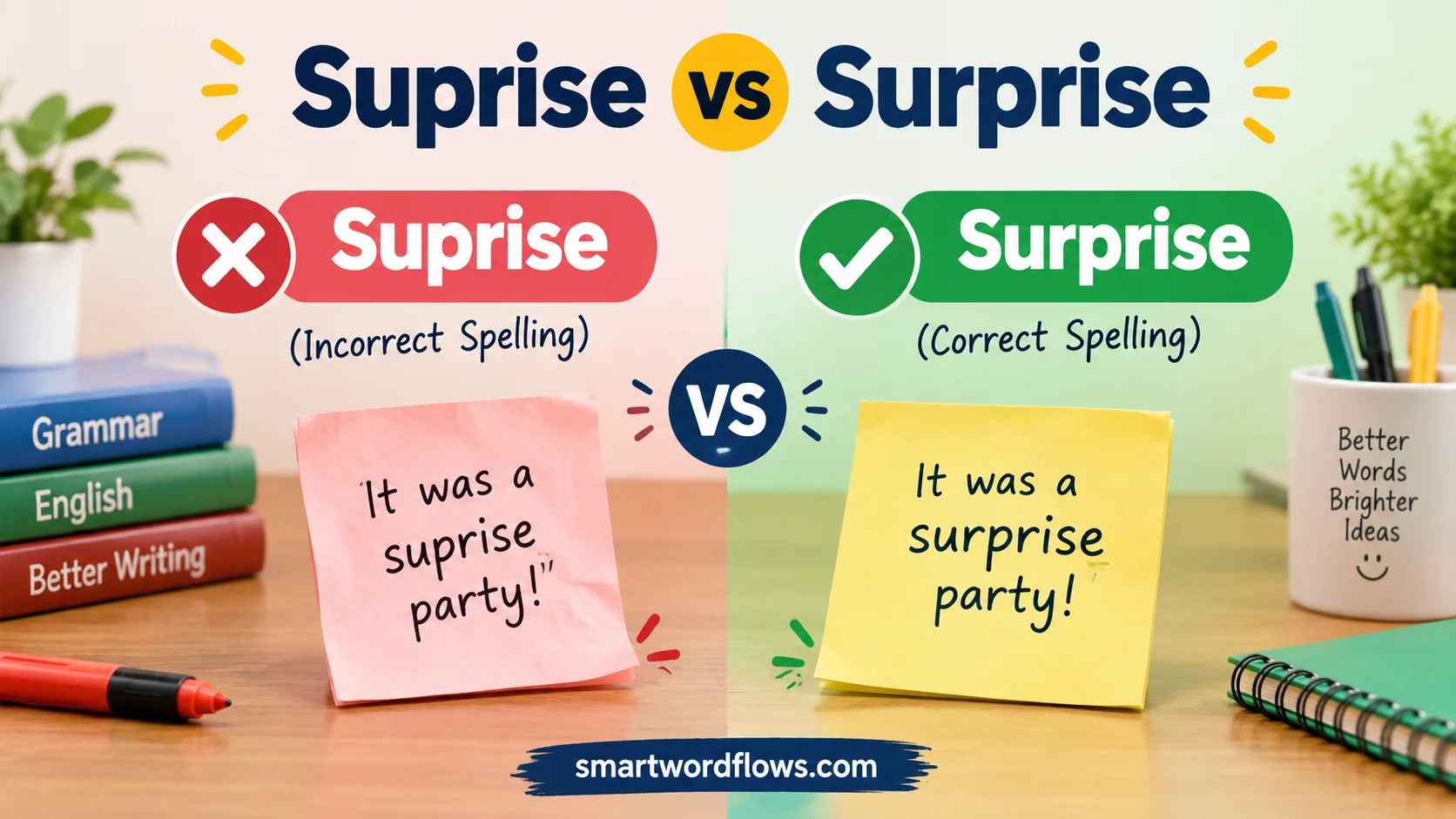

Confused about Suprise vs Surprise? These two forms may sound similar, but only surprise is the correct spelling in standard English. The word suprise is a common spelling mistake caused by missing the second r. Surprise can work as both a noun and a verb, describing an unexpected event or the act of making someone feel astonished. Remembering the double r can make the correct spelling easier to recognize, especially when writing quickly in everyday English conversations or messages.
The correct spelling matters for effective communication, whether you are writing emails, essays, or social media posts. Although suprise may look reasonable because of its pronunciation, it has no meaning as a standard English word. Surprise can describe a surprise gift, surprise party, or the feeling caused by something unexpected. Learning this simple spelling difference improves clarity and understanding and helps your writing appear more careful and professional. Once you remember the two r’s, you can easily keep the word straight.
Quick Answer
Surprise is the correct spelling.
Suprise is an incorrect spelling and should not be used in standard English. The mistake happens because writers often leave out the first r after the letters “su.”
- Surprise — correct
- Suprise — incorrect
- Surprize — nonstandard modern spelling
- Suprize — incorrect
The correct spelling is:
S-U-R-P-R-I-S-E
A simple way to remember it is that surprise has two R’s.
Correct Example
The birthday party was a complete surprise.
Incorrect Example
The birthday party was a complete suprise.
If you’re writing an email, article, school assignment, message, or professional document, use surprise.
Comparison Overview
The difference between suprise and surprise is straightforward. One is the accepted English spelling while the other is simply a spelling error.
| Word | Correct Spelling? | Meaning | Standard Usage |
| Surprise | Yes | Something unexpected or to cause unexpected feelings | Standard English |
| Suprise | No | No separate standard meaning | Misspelling |
| Surprize | No | Historical/nonstandard variant | Not recommended in modern standard English |
| Suprize | No | Misspelling | Incorrect |
The important point is that suprise doesn’t have a different meaning from surprise. It isn’t a separate English word with its own definition. In ordinary modern writing, it represents a misspelling of surprise.
Main Differences Between Suprise vs Surprise
The biggest difference is spelling rather than meaning.
Surprise contains two r’s:
S-U-R-P-R-I-S-E
Suprise contains only one:
S-U-P-R-I-S-E
That missing r makes the second form incorrect.
| Feature | Surprise | Suprise |
| Spelling | Correct | Incorrect |
| Number of R’s | Two | One |
| Standard dictionary word | Yes | No |
| Used as a noun | Yes | No |
| Used as a verb | Yes | No |
| Suitable for formal writing | Yes | No |
| Suitable for professional writing | Yes | No |
Why the Extra “R” Matters
The extra r isn’t optional. English spelling sometimes contains letters that aren’t obvious from pronunciation. Surprise is a good example.
When people say the word quickly, the middle consonants can blend together. That makes it easy to remember the sound while forgetting one of the letters.
The spelling, however, remains:
SURPRISE
Think of the word as having two checkpoints:
SUR → PRISE
Put them together and you get SURPRISE.
This isn’t a pronunciation rule. It’s simply a useful spelling trick.
What Does “Surprise” Mean?
Surprise describes something unexpected. It can refer to an event, an emotion, an action, or the reaction caused by something that wasn’t expected.
The word has several common uses in everyday English.
Surprise as a Noun
As a noun, surprise refers to an unexpected event, discovery, gift, result, or feeling.
For example:
- The party was a wonderful surprise.
- Her visit came as a surprise.
- I have a surprise for you.
- The election result was a surprise to many people.
In these sentences, surprise names something unexpected.
You can also use it with adjectives to describe the type or degree of surprise.
Common combinations include:
- big surprise
- complete surprise
- pleasant surprise
- unexpected surprise
- welcome surprise
- total surprise
- nasty surprise
For example, Finding an old friend at the restaurant was a pleasant surprise.
Surprise as a Verb
Surprise can also function as a verb. In this form, it means to cause someone to feel unexpected shock, wonder, or pleasure.
For example:
- The gift surprised her.
- I want to surprise my parents.
- The news surprised everyone.
- His sudden arrival surprised us.
Notice how the form can change depending on the tense.
| Tense | Example |
| Present | I surprise my friends sometimes. |
| Past | I surprised my friends yesterday. |
| Present participle | I am surprising my friends. |
| Past participle | I have surprised my friends. |
The spelling family remains connected to the same root word.
Why Is “Suprise” Incorrect?
Suprise is incorrect because standard English spells the word with an r immediately after “su.”
The correct sequence is:
SURPRISE
Not:
SUPRISE
This mistake is particularly common when someone remembers the pronunciation but doesn’t visualize the spelling. Fast typing can make the problem even more common.
For instance, someone might type:
I have a suprise for you.
The intended word is clearly surprise, but the first r has been omitted.
Is “Suprise” Ever a Different Word?
No. In normal modern English, suprise isn’t an accepted alternative spelling with a different meaning.
If you see it online, it will generally be a typo or spelling mistake.
That distinction matters because some English words genuinely have accepted spelling variants. Suprise isn’t normally one of them.
How to Spell “Surprise” Correctly
If you frequently make this mistake, don’t try to memorize the entire word as one large block.
Break it into smaller parts:
SUR + PRISE
Then combine them:
SURPRISE
The key is the first R.
A Simple Memory Trick
Remember:
A surprise has two R’s.
You can visualize the spelling like this:
SU-R-PRI-SE
The two r’s are separated by several letters:
SURP R ISE
Another useful method is to connect the word with a familiar phrase such as surprise party.
Write it a few times:
- surprise party
- surprise party
- surprise party
Repeated exposure can make the correct spelling more automatic.
How Do You Pronounce “Surprise”?
In standard US English, surprise is pronounced with the main stress on the second syllable.
The pronunciation is commonly represented as /sərˈpraɪz/.
The word has two syllables:
sur-prise
The first syllable is unstressed while the second receives the main stress.
The spelling and pronunciation don’t always make every letter equally noticeable. That’s one reason people may remember the sound but accidentally drop an r when writing it.
A Common Pronunciation and Spelling Connection
Don’t assume that every letter you hear clearly will appear equally obvious in speech. English frequently reduces unstressed vowels and blends consonant sounds.
That’s why spelling surprise from memory can be harder than simply recognizing it when you read it.
The best approach is to remember the written form separately:
SURPRISE = two R’s
Common Examples of “Surprise” in Sentences
Seeing the word in different contexts makes the distinction easier to remember.
Everyday Examples
- What a surprise!
- I have a surprise for you.
- The gift was a complete surprise.
- She planned a surprise birthday party.
- His visit came as a pleasant surprise.
- Nobody expected the surprise announcement.
Examples Using “Surprise” as a Verb
- I didn’t mean to surprise you.
- The results surprised everyone.
- She wants to surprise her sister.
- The sudden question surprised me.
- His answer surprised the teacher.
Examples Using “Surprised”
- I was surprised by the news.
- She looked surprised when she opened the box.
- They were surprised to see him there.
Examples Using “Surprising”
- The final result was surprising.
- It was surprising to see so many people attend.
- The amount of rainfall was surprising for that season.
Surprise vs Surprised vs Surprising
These three words belong to the same word family. However, they don’t function in exactly the same way.
| Word | Common Function | Meaning | Example |
| Surprise | Noun/verb | An unexpected event or to cause surprise | The gift was a surprise. |
| Surprised | Adjective/verb form | Experiencing an unexpected reaction | She was surprised. |
| Surprising | Adjective | Causing surprise | The result was surprising. |
| Surprisingly | Adverb | In a surprising manner | Surprisingly, he agreed. |
A useful distinction is between surprised and surprising.
You generally describe a person’s reaction with surprised:
I was surprised.
You describe the thing causing the reaction as surprising:
The news was surprising.
This difference prevents another common grammar mistake.
Read More: Intention vs Intension: Meaning, Differences, and Correct Usage
Common Spelling Mistakes With “Surprise”
Although suprise is the main error in this comparison, several other incorrect forms appear online.
Suprise
Suprise is missing the first r.
- The gift was a suprise.
- The gift was a surprise.
This is the exact spelling mistake discussed in suprise vs surprise.
Surprize
Surprize replaces the final s sound’s spelling with z.
You may occasionally encounter surprize in older texts or historical spelling contexts. However, surprise is the standard modern spelling to use in contemporary English.
- It was a surprize.
- It was a surprise.
Suprize
Suprize combines the missing r problem with the nonstandard z spelling.
- What a suprize!
- What a surprise!
Surprize vs Surprise
If you’re choosing between surprize and surprise in modern standard English, use surprise.
The same principle applies to professional, academic, and general-purpose writing.
How to Remember the Correct Spelling of Surprise
Spelling mistakes often disappear once you attach the word to a memorable pattern.
Here are several practical ways to remember surprise.
Remember the Two R’s
The easiest trick is:
SURPRISE has two R’s.
That’s the feature people most often forget.
Break It Into Parts
Instead of trying to recall every letter at once, use:
SUR + PRISE
Then join the pieces:
SURPRISE
Use a Familiar Phrase
Practice the word inside phrases you already know:
- surprise party
- surprise gift
- surprise visit
- surprise guest
- pleasant surprise
Seeing the word repeatedly in meaningful phrases helps reinforce the spelling.
Write It in Context
Rather than writing the word alone, create sentences:
The surprise party starts at seven.
I prepared a surprise for my friend.
Context gives your memory something concrete to attach to the spelling.
“Surprise” in Common Phrases
The word surprise appears in many everyday expressions.
Surprise Party
A surprise party is a gathering secretly organized for someone who doesn’t know about it beforehand.
Her friends organized a surprise party for her.
Pleasant Surprise
A pleasant surprise is something unexpected that makes someone happy.
The free upgrade was a pleasant surprise.
Big Surprise
Big surprise can describe something genuinely unexpected. It can also be used sarcastically when something wasn’t surprising at all.
It was a big surprise when they announced the winner.
Surprise Visit
A surprise visit happens when someone arrives without the other person expecting them.
My cousin made a surprise visit last weekend.
Surprise Guest
A surprise guest is someone whose appearance wasn’t expected by the audience or people involved.
The concert featured a surprise guest.
Surprise Ending
A surprise ending changes or reveals something unexpected near the end of a story, movie, or other narrative.
The novel has a clever surprise ending.
Surprise Announcement
A surprise announcement is information released unexpectedly.
The company made a surprise announcement on Monday.
Suprise vs Surprise in Everyday Writing
The spelling difference becomes especially important when you’re writing quickly.
Imagine sending this message:
I have a suprise for you.
The reader will probably understand what you mean. However, understanding the intended meaning doesn’t make the spelling correct.
For casual texting, a typo may not matter much. In professional or academic writing, however, repeated spelling mistakes can distract readers and weaken the appearance of polished writing.
Where You Should Always Use “Surprise”
Use the correct spelling in:
- School assignments
- College papers
- Business emails
- Blog posts
- Website content
- Resumes and cover letters
- Reports
- Presentations
- Formal messages
- Social media captions
- Marketing copy
A spell checker will usually catch suprise, but it’s still useful to recognize the mistake yourself.
A Simple Case Study: Spotting the Mistake
Consider this sentence:
Maria planned a suprise dinner for her parents.
At first glance, the sentence looks fine because suprise closely resembles the correct word.
Now compare the spellings:
Suprise → S-U-P-R-I-S-E
Surprise → S-U-R-P-R-I-S-E
The correct version contains an additional R.
The corrected sentence becomes:
Maria planned a surprise dinner for her parents.
Nothing else needs to change. The issue is purely spelling.
This is a useful example because it shows why proofreading matters. A single missing letter can turn a standard word into a misspelling.
Correct and Incorrect Examples
| Incorrect | Correct |
| What a suprise! | What a surprise! |
| I have a suprise for you. | I have a surprise for you. |
| It was a big suprise. | It was a big surprise. |
| She planned a suprise party. | She planned a surprise party. |
| The news came as a suprise. | The news came as a surprise. |
| He wanted to surprize everyone. | He wanted to surprise everyone. |
When Should You Use “Surprise”?
Use surprise whenever you mean something unexpected or the act of causing an unexpected reaction.
For example:
As a noun:
The announcement was a surprise.
As a verb:
The announcement surprised everyone.
As an adjective-related form:
It was a surprising announcement.
The exact form depends on the grammatical role of the word in the sentence.
FAQs:
Is “suprise” a correct English word?
No. Suprise is a common spelling mistake. The correct spelling is surprise, with two r’s.
Is “surprise” a noun or a verb?
Surprise can be both a noun and a verb. As a noun, it can describe an unexpected event or feeling. As a verb, it means to cause someone to feel surprised.
Why do people spell surprise as “suprise”?
People often write suprise because of the word’s pronunciation. When speaking, the second “r” is not obvious, so it can be accidentally left out when writing.
What is an example of surprise as a noun?
“She received a surprise gift on her birthday.” Here, surprise describes the unexpected gift.
What is an example of surprise as a verb?
“The news surprised everyone.” In this sentence, surprised describes the action of causing people to feel astonished.
Conclusion:
The correct spelling is surprise, not suprise. The word surprise can function as both a noun and a verb, while suprise is simply a common spelling mistake. Remembering the two r’s is an easy way to avoid this error in emails, essays, social media posts, and everyday writing.