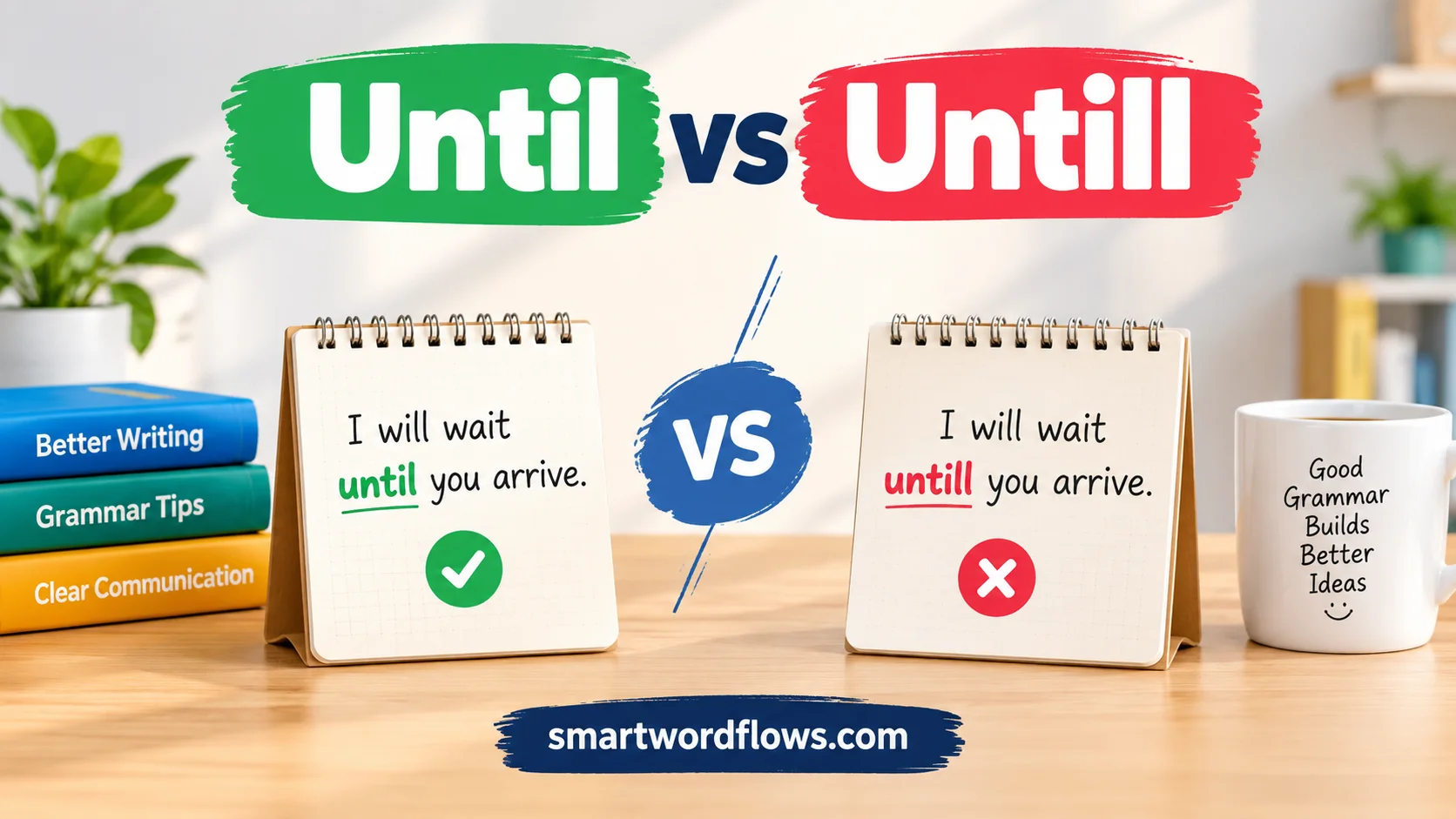

Until vs Untill is a common spelling confusion in English. Until is the correct spelling, while untill is a common misspelling with an extra L. A simple mnemonic is to remember that until has one L, not a double L. This useful spelling pattern helps English learners, writers, and native speakers avoid a spelling mistake. Good grammar, vocabulary, accuracy, and correct usage make your writing clearer in daily and professional situations, especially when choosing the right word for formal writing.
The word until can act as a preposition or conjunction and shows that something continues up to a time, event, or point. You can use it in everyday conversations, professional emails, academic writing, instructions, and formal documents. Untill is not a separate standard English word and has no different meaning. Checking standard dictionaries and practicing real-life examples can improve writing skills, clear English, error-free English, and spelling accuracy in school, work, and online content every day with greater confidence overall.
Quick Answer
Until is the correct spelling.
Untill is incorrect in standard modern English. It isn’t an alternative form of until, and it doesn’t have a separate meaning.
The correct form has one L:
- Until
- Untill
For example:
- I will wait until 6 p.m.
- I will wait untill 6 p.m.
- Don’t leave until I call you.
- Don’t leave untill I call you.
The word until means up to a particular time, event, or point. It often describes an action or situation that continues before something changes.
For example:
She stayed at the office until 8 p.m.
This means she remained at the office up to 8 p.m.
The spelling untill doesn’t create a new grammatical form. If you see it in writing, it should normally be corrected to until.
Comparison Overview
| Word | Correct Spelling? | Meaning | Usage |
| Until | Yes | Up to a particular time or point | Standard English |
| Untill | No | No separate standard meaning | Common misspelling |
| Till | Yes | Up to a particular time or point | Standard alternative to until |
| ’Til | Informal | Shortened form associated with until | Casual writing |
The key point is simple: until and till can have the same basic meaning, while untill is simply a spelling error.
Main Differences Between Until vs Untill
The biggest difference between until vs untill isn’t meaning. It’s correctness.
| Feature | Until | Untill |
| Standard English | ||
| Correct spelling | ||
| Means “up to” | — | |
| Used as a preposition | — | |
| Used as a conjunction | — | |
| Appropriate in formal writing | ||
| Common spelling mistake | No | Yes |
If you’re writing an email, article, essay, report, message, or school assignment, choose until.
What Does “Until” Mean?
Until expresses a limit in time or a point at which something changes.
It can refer to a specific clock time:
- Wait until 5 p.m.
- The clinic is open until 9 p.m.
It can also refer to a day or date:
- I’ll stay here until Friday.
- The offer is available until December 31.
However, until doesn’t have to refer to a specific date or clock time. It can introduce an event or condition:
- Wait until she arrives.
- Don’t start until everyone is ready.
- Keep walking until you reach the bridge.
In each example, the action continues up to a particular point.
Until as a Preposition
Until works as a preposition when it comes before a noun or another time expression.
For example:
- We stayed there until midnight.
- The store remains open until Saturday.
- He worked until lunchtime.
- They lived there until 2024.
Here, until establishes the endpoint of an action or situation.
Consider this sentence:
I studied until midnight.
The sentence doesn’t simply tell you when you studied. It tells you that the studying continued up to midnight.
That’s the central idea behind the word.
Until as a Conjunction
Until also works as a conjunction when it introduces another clause.
For example:
- Wait until I return.
- Don’t open the door until I tell you.
- She didn’t leave until the meeting ended.
- We won’t know until the results arrive.
In these sentences, until connects two parts of the sentence.
The second part usually tells you the event that marks the endpoint.
For example:
Wait until the teacher arrives.
The waiting continues first. The teacher’s arrival marks the point at which the waiting can stop.
Why Is “Untill” Incorrect?
The spelling untill is incorrect in standard English because the accepted spelling is until, with only one final l.
The extra l doesn’t change the pronunciation or meaning. It simply creates a spelling error.
You may see untill because English contains many words with doubled consonants. For example:
- running
- stopped
- beginning
- planned
That pattern can make untill look believable. However, English spelling doesn’t always follow a single predictable rule.
The correct spelling must simply be learned:
until = U-N-T-I-L
A useful visual reminder is:
Until has one L.
Common “Untill” Mistakes
These are incorrect:
- I’ll call you untill tomorrow.
- Wait untill I get home.
- The shop is open untill 10 p.m.
- Don’t start untill everyone arrives.
Correct them like this:
- I’ll call you until tomorrow.
- Wait until I get home.
- The shop is open until 10 p.m.
- Don’t start until everyone arrives.
Until vs Till: Are They the Same?
Here’s where things get more interesting.
Till is a legitimate English word. In many sentences, it has essentially the same meaning as until.
Compare:
- Wait until noon.
- Wait till noon.
Both sentences tell someone to wait up to noon.
You can also write:
- She worked until midnight.
- She worked till midnight.
The meaning remains substantially the same.
However, until is often the safer choice when you’re writing for a broad audience or aiming for a neutral style.
Is “Till” Actually Correct?
Yes.
Till is not simply a shortened spelling of until. It has an established history and functions as a genuine English word.
That means you don’t need to treat till as a mistake.
For example:
I’ll stay till you come back.
This is grammatically acceptable.
Still, context matters. Some writers prefer until in formal or polished writing because it feels more neutral and familiar.
What About “’Til”?
You may also encounter ’til, especially in casual writing.
For example:
- Wait ’til I tell you.
- I won’t leave ’til you’re ready.
This form is informal. It’s common in conversational writing, song titles, creative work, and casual expressions.
For formal writing, until is usually the clearest option.
Until vs By: An Important Difference
A much more important usage distinction involves until and by.
These words can both relate to time. However, they don’t communicate exactly the same idea.
Until generally describes something that continues up to a time.
By generally identifies a deadline or the latest point by which something happens.
Compare:
| Sentence | Meaning |
| I worked until 6 p.m. | The work continued up to 6 p.m. |
| I finished the work by 6 p.m. | The work was completed no later than 6 p.m. |
| Stay here until noon. | Remain here up to noon. |
| Arrive by noon. | Get here no later than noon. |
The difference becomes obvious with a simple example.
If someone says:
Submit the assignment by Friday.
You can submit it Wednesday, Thursday, or Friday. Friday is the deadline.
But:
I’ll work on the assignment until Friday.
This describes continued activity up to Friday.
Until Means Continuation
Think of until as drawing a line at the end of an ongoing action.
For example:
She waited until the bus arrived.
The waiting continued before the bus arrived.
By Means Deadline
Think of by as setting a latest acceptable point.
For example:
She must arrive by 8 p.m.
She could arrive at 7 p.m. or 7:30 p.m. The important point is that she shouldn’t arrive later than 8 p.m.
This distinction prevents many common time-related errors.
Also Read This: Pricy vs Pricey: Which Spelling Is Correct?
How to Use “Until” Correctly
Until + Time
The simplest pattern is until + time expression.
Examples include:
- I’ll wait until 7 p.m.
- The office stays open until Friday.
- He worked until midnight.
- We stayed there until sunrise.
This construction tells the reader when the action or situation reaches its endpoint.
Until + Event
You can also place a clause after until.
Examples:
- Wait until I come back.
- Don’t eat until everyone arrives.
- She stayed until the movie ended.
- We’ll wait until the rain stops.
This structure is particularly common in everyday English.
Until + Condition or Change
Until can describe a situation that continues while a condition remains unchanged.
For example:
Keep stirring until the sauce thickens.
The stirring continues while the sauce is still thin. Once it reaches the desired condition, the action stops.
Another example:
Stay inside until the storm passes.
The instruction applies up to the point when the storm has passed.
Until at the Beginning of a Sentence
Until can introduce a dependent clause at the beginning of a sentence.
For example:
Until the bus arrives, wait here.
The introductory clause establishes the time condition.
Another example:
Until you finish your homework, don’t start the game.
When an introductory until clause comes first, a comma commonly separates it from the main clause.
Compare:
- Until the store opens, we’ll wait outside.
- We’ll wait outside until the store opens.
The second version doesn’t normally need a comma because the until clause follows the main clause.
Until at the End of a Sentence
Until can also appear naturally toward the end of a sentence.
Examples:
- I didn’t understand it until today.
- She stayed until the end.
- We waited until midnight.
- They didn’t leave until the rain stopped.
This structure often appears when the sentence describes something that didn’t happen before a particular point.
For example:
He didn’t realize the mistake until later.
The mistake became known to him at a later point.
Common Mistakes With “Until”
Mistake: Writing “Untill”
This is the most obvious error.
I’ll stay untill Monday.
I’ll stay until Monday.
Remember: until has one L.
Mistake: Confusing “Until” and “By”
These words can describe different relationships with time.
Please finish the report until Friday.
This can be confusing because finish usually describes completion rather than continuous activity.
A clearer sentence is:
Please finish the report by Friday.
However:
I’ll work on the report until Friday.
Here, work describes an ongoing activity. Therefore, until fits naturally.
Mistake: Using “For” Instead of “Until”
For usually expresses duration.
Until identifies an endpoint.
Compare:
- I waited for two hours.
- I waited until 6 p.m.
The first sentence tells you how long you waited.
The second tells you when the waiting ended.
You can even combine the ideas:
I waited for two hours until the bus finally arrived.
The two expressions provide different information.
Until in Everyday English
You encounter until constantly in ordinary communication.
At Work
- I’ll be in the office until 5 p.m.
- Please wait until the manager arrives.
- We won’t finish until tomorrow.
At School
- Study until you understand the lesson.
- Don’t submit the assignment until you’ve checked it.
- The library is open until 8 p.m.
While Traveling
- The train doesn’t leave until 9 p.m.
- We’ll stay here until the next bus arrives.
- Wait until the traffic clears.
In Daily Conversation
- Call me when you get home.
- Don’t open it until your birthday.
- I’ll wait until you’re ready.
- We can talk until dinner.
These examples show why until is such a useful word. It works naturally in countless situations.
Until in Formal and Informal Writing
One advantage of until is its flexibility.
You can use it in formal writing:
The application period remains open until June 30.
You can also use it in casual conversation:
I’ll wait until you get here.
There’s no need to replace until simply because you’re writing formally.
In casual contexts, till may sound natural:
I’ll wait till you get here.
For a polished article, report, application, or academic assignment, until provides a straightforward choice.
A Simple Way to Remember the Correct Spelling
If untill keeps appearing in your writing, use a quick memory trick:
Remember: Until = One L
Write the word several times:
until — until — until
Then connect the spelling with its meaning:
Until = up to a point in time.
You don’t need a complicated spelling rule. The most useful fact is simply that the standard spelling contains one L.
A Quick Self-Check
Whenever you’re unsure, ask:
Am I trying to write the word meaning “up to a particular time or point”?
If yes, write:
until
Not:
untill
Until vs Untill Examples at a Glance
| Incorrect | Correct | Why |
| Wait untill noon. | Wait until noon. | Until is the correct spelling. |
| I’ll stay untill Friday. | I’ll stay until Friday. | The endpoint is Friday. |
| Don’t leave untill I call. | Don’t leave until I call. | The action continues before the call. |
| The shop closes untill 10. | The shop stays open until 10. | Until uses one L. |
| We won’t know untill tomorrow. | We won’t know until tomorrow. | Until introduces the endpoint. |
| Stay untill the rain stops. | Stay until the rain stops. | Until introduces an event. |
Practical Examples of “Until”
Here are additional examples showing different sentence structures:
- Time: The restaurant serves breakfast until 11 a.m.
- Date: The offer remains available until December 31.
- Event: Wait until the meeting ends.
- Condition: Keep cooking until the vegetables become tender.
- Negative sentence: She didn’t call until Monday.
- Instruction: Don’t open the package until you’re ready.
- Future action: I’ll stay here until you return.
- Past action: They waited until the storm passed.
Notice the common thread. Each sentence establishes a point that marks the end of an action, state, or waiting period.
A Closer Look at Negative Sentences With “Until”
Negative sentences can sometimes confuse learners because until interacts with the timing of the action.
Consider:
I didn’t leave until 8 p.m.
This means the person remained there and left at 8 p.m. or around that point. The important idea is that the leaving did not happen before 8 p.m.
Another example:
She didn’t start studying until dinner ended.
This tells you that studying began after dinner ended.
The structure is especially common in English:
didn’t + action + until + endpoint
Examples:
- He didn’t sleep until midnight.
- We didn’t start until everyone arrived.
- They didn’t notice the problem until later.
Understanding this pattern helps you interpret everyday English more accurately.
Case Study: Choosing the Right Word in a Sentence
Consider these three sentences:
I’ll work until Friday.
I’ll finish the project by Friday.
I’ll work till Friday.
The first sentence uses until to describe continued work.
The second uses by to establish a completion deadline.
The third uses till, which can carry the same basic time meaning as until.
Now consider:
I’ll work untill Friday.
This sentence has a spelling problem. The intended word is clearly until, so the corrected version is:
I’ll work until Friday.
This small example captures the main distinction between the four forms.
FAQs:
1. Is “until” or “untill” correct?
Until is the correct spelling in standard English. Untill is a common spelling mistake and should be avoided.
2. What does “until” mean?
Until means up to a particular time, event, or point. It can show when something continues or stops.
3. Is “untill” a real English word?
No. Untill is not recognized as a standard English word. It is simply a common misspelling of until.
4. Why do people spell “until” as “untill”?
People often add an extra L because many English words contain double letters. Remembering that until has only one L can help prevent this mistake.
5. Can “until” be used as a preposition and conjunction?
Yes. Until can function as both a preposition and a conjunction, depending on how it is used in a sentence.
Conclusion:
Until is the correct spelling, while untill is an incorrect and common misspelling. The easiest way to remember the difference is to focus on the one L in until. Learning this simple spelling rule will help you write more accurately in everyday conversations, emails, essays, and formal documents.