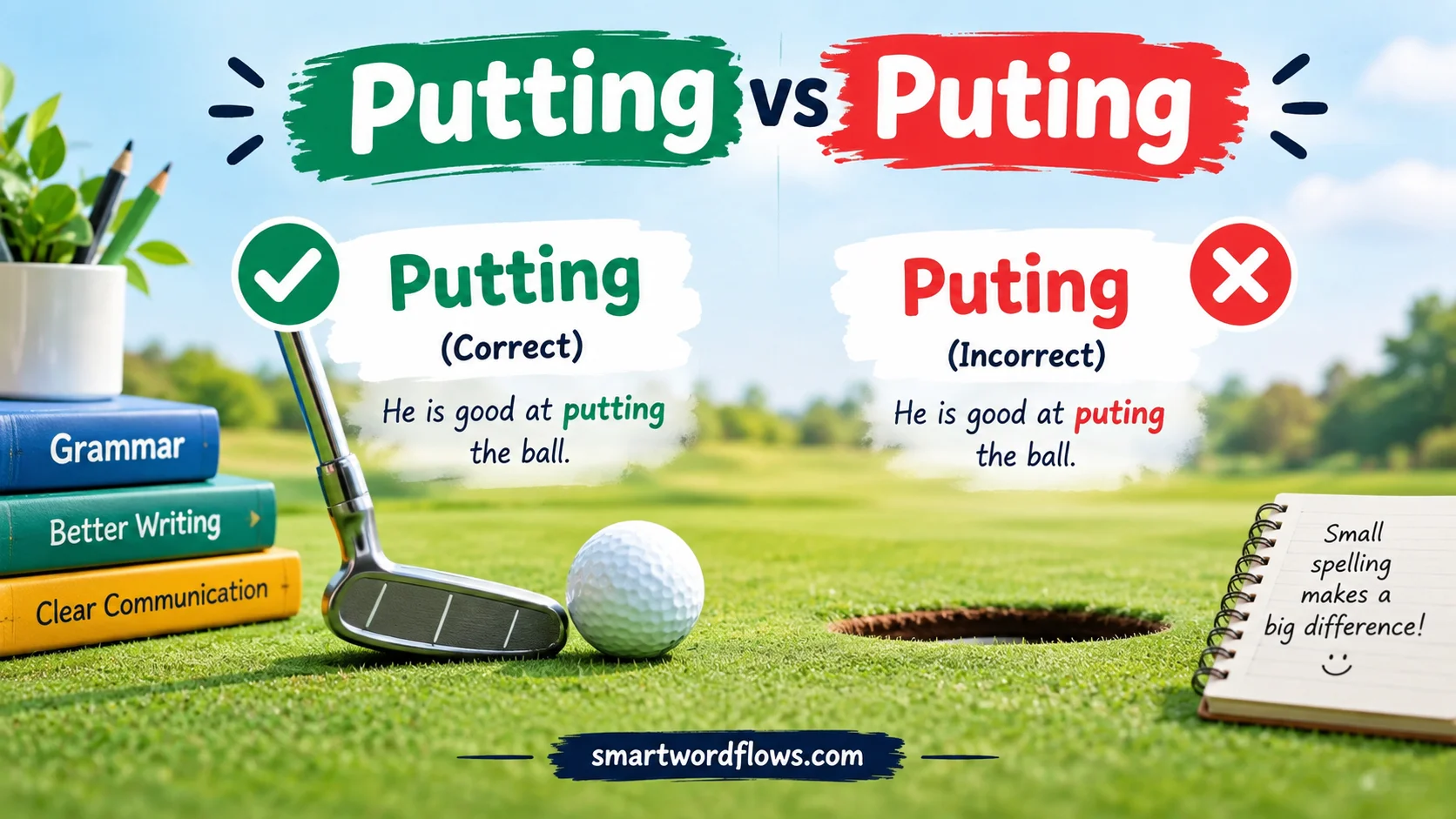

English spelling can be tricky when a single extra letter changes a word from correct to incorrect. Putting vs Puting is a perfect example. Both forms may look almost identical, but only one belongs in standard English writing.
The correct spelling is putting, with two t’s. It comes from the verb put and serves as its present participle and gerund form. You use it in sentences such as “She is putting the dishes away” or “Putting things in order takes time.”
The spelling puting, with only one t, is a misspelling. Although it may seem reasonable to simply add -ing to put, English spelling rules require the final t to be doubled. This small spelling detail matters in school assignments, professional writing, emails, articles, and everyday communication.
If you’ve ever paused while writing putting and wondered whether that second t really belongs there, you’re not alone. Let’s break down the spelling, grammar, meaning, and common mistakes so you can use the word confidently.
Quick Answer: Putting or Puting?
Putting is the correct spelling.
Puting is incorrect in standard English.
The word putting comes from the verb put plus the suffix -ing:
put + ing = putting
Examples
- Correct: She is putting her phone on the desk.
- Incorrect: She is puting her phone on the desk.
- Correct: He keeps putting off his homework.
- Incorrect: He keeps puting off his homework.
- Correct: Putting the books away will make the room cleaner.
- Incorrect: Puting the books away will make the room cleaner.
The key point is simple: always use two t’s in putting.
Comparison Overview
| Word | Correct Spelling? | Function | Example |
| Putting | ✅ Yes | Present participle / gerund | She is putting the keys away. |
| Puting | ❌ No | Misspelling | He is puting the box there. |
| Put | ✅ Yes | Base verb | Please put the book here. |
| Put | ✅ Yes | Past tense | She put the book there yesterday. |
| Put | ✅ Yes | Past participle | He has put the book on the shelf. |
The interesting part is that put behaves differently from many common English verbs. Its past tense and past participle are also put, while its -ing form becomes putting.
For example:
I put the bag here.
I am putting the bag here.
I have put the bag here.
That unusual pattern makes put worth remembering.
Main Differences Between Putting vs Puting
The main difference between putting and puting is spelling and correctness.
Putting Is the Correct Form
Putting is the standard English form of put when adding -ing.
It can function as a present participle:
She is putting the groceries away.
It can also function as a gerund:
Putting things off can create unnecessary stress.
In both cases, the spelling remains putting.
Puting Is a Misspelling
Puting isn’t the standard spelling of any ordinary English form of put. The missing t makes the word incorrect.
For example:
❌ He is puting his shoes outside.
The corrected sentence is:
✅ He is putting his shoes outside.
This isn’t a difference in meaning. Puting is simply a spelling error.
The Extra T Matters
That second t isn’t decorative. It is part of the correct spelling.
Think of the formation this way:
PUT → PUTTING
not:
PUT → PUTING
Once you remember that pattern, the confusion becomes much easier to avoid.
What Does “Putting” Mean?
Putting is the -ing form of the verb put. The basic meaning of put is to move, place, or position something somewhere.
For example:
She is putting the plates on the table.
Here, putting describes the action of placing the plates on the table.
However, put has many meanings beyond physical placement. Because of that, putting appears in a wide range of expressions and phrasal verbs.
Putting as an Action
When putting works as a present participle, it commonly appears with forms of be.
Examples include:
- I am putting the clothes away.
- She is putting her books in a bag.
- They are putting the furniture together.
- We were putting the chairs outside.
The word shows an ongoing action.
Putting as a Gerund
An -ing form can also act as a noun. In that role, putting is a gerund.
For example:
Putting things off until tomorrow can cause problems.
Here, putting isn’t describing what someone is doing at this exact moment. Instead, the activity itself is being discussed.
Another example:
Putting safety first is always important.
The entire phrase putting safety first acts as the subject of the sentence.
Putting in Phrasal Verbs
English frequently combines put with short words such as away, off, on, up, together, and aside.
When the verb takes its -ing form, the spelling remains putting:
- putting away
- putting off
- putting on
- putting up
- putting together
- putting aside
- putting down
- putting back
For example:
She is putting away her clothes.
They’re putting together a new project.
He keeps putting off his work.
The additional word can change the meaning of the expression, but it doesn’t change the spelling of putting.
Why Is “Putting” Spelled With Two T’s?
The spelling comes from a common English spelling pattern involving the suffix -ing.
When certain verbs form their -ing forms, the final consonant is doubled before the suffix. This is especially common with short verbs that end in a single consonant after a short vowel sound.
Examples include:
| Base Verb | + -ing | Correct Form |
| run | run + ing | running |
| sit | sit + ing | sitting |
| stop | stop + ing | stopping |
| plan | plan + ing | planning |
| get | get + ing | getting |
| put | put + ing | putting |
So, for put, the correct written form is:
put + ing → putting
The final t is doubled.
Why Doesn’t “Puting” Work?
If you simply attach -ing without applying the spelling rule, you might produce:
put + ing → puting
But standard English spelling uses putting instead.
This is one of those cases where English spelling needs to be learned as a pattern rather than guessed from pronunciation alone.
Why “Puting” Is Incorrect
The spelling puting often appears because writers apply a simplified rule:
“Take the base verb and add -ing.”
That approach works for some words but doesn’t work for every verb.
For example:
- play → playing
- read → reading
- jump → jumping
But other verbs require a spelling change:
- run → running
- sit → sitting
- stop → stopping
- put → putting
Therefore, simply attaching -ing isn’t always enough.
A Common Spelling Trap
Consider these three words:
- put
- putting
- putted
The first two are common standard forms, while putted has specialized uses, particularly in golf.
The -ing form is especially important because it appears frequently in everyday English.
You might say:
I’m putting dinner on the table.
She’s putting her shoes on.
We’re putting the plan together.
Because the word occurs so often, learning its correct spelling is worthwhile.
Putting in Different Sentence Structures
Knowing the spelling is only half the job. You also need to know how putting functions in a sentence.
Putting in the Present Progressive
The present progressive uses a form of be + putting.
Examples:
- I am putting the dishes away.
- She is putting her phone on silent.
- He is putting the boxes in the garage.
- They are putting up a new fence.
The structure is:
Subject + am/is/are + putting + object
For example:
She + is + putting + the book on the table.
Putting in the Past Progressive
You can also use putting with was or were.
Examples:
- I was putting the groceries away.
- She was putting her children to bed.
- They were putting chairs in the room.
The spelling doesn’t change.
Putting as a Gerund
When putting acts like a noun, it can appear at the beginning of a sentence.
Examples:
Putting things away immediately saves time.
Putting off important tasks can make them harder later.
Putting safety first reduces unnecessary risks.
Here, putting refers to an activity or process rather than simply describing an action happening right now.
Putting With an Object
The verb put normally involves placing something somewhere.
For example:
She is putting the keys on the counter.
The word putting introduces the action, while the keys identifies what is being moved and on the counter tells us where it goes.
This makes putting especially useful when describing physical actions.
Putting vs Puting in American English
In American English, the standard spelling is putting.
There isn’t a standard American-English variation called puting. If you’re writing an essay, email, article, report, résumé, or social media post, use putting.
The same spelling is also standard in British English.
That means this isn’t one of those cases where American and British English use different spellings, such as:
- color / colour
- center / centre
- traveled / travelled
Instead, putting remains the standard form across major varieties of English.
Read More: Their vs Thier: Which Spelling Is Correct?
Putting vs Other Words Ending in -ing
Comparing putting with similar words can make the spelling rule easier to understand.
Run → Running
The final consonant is doubled:
run + ing = running
Not:
❌ runing
Sit → Sitting
Again, the final consonant doubles:
sit + ing = sitting
Not:
❌ siting
Notice that siting actually exists as a different word in English, but it comes from site, not sit. That’s a useful reminder that dropping a letter can sometimes create a completely different word.
Stop → Stopping
The same pattern appears:
stop + ing = stopping
Not:
❌ stoping
Put → Putting
And finally:
put + ing = putting
Not:
❌ puting
The comparison makes the pattern easier to recognize.
Common Mistakes With Putting
Even fluent English speakers can make occasional spelling mistakes. Here are some of the most common problems involving putting.
Mistake: Writing “Puting”
Incorrect:
He is puting his wallet in his pocket.
Correct:
He is putting his wallet in his pocket.
The correction is simply to restore the second t.
Mistake: Using “Putting” Without a Helping Verb
Incorrect:
I putting the books away.
Correct:
I am putting the books away.
When putting works in the present progressive, it normally needs a form of be such as am, is, or are.
Mistake: Confusing Put and Putting
Consider these sentences:
Put the phone on the table.
She is putting the phone on the table.
The first sentence gives a command. The second describes an ongoing action.
Both words are related, but they serve different grammatical roles.
Putting vs Put: An Important Difference
Because put and putting come from the same verb, learners sometimes use them interchangeably.
They aren’t interchangeable in every sentence.
Use “Put” for the Base Form
Examples:
Please put the bag here.
I need to put these books away.
They will put the chairs outside.
Use “Putting” for the -ing Form
Examples:
She is putting the bag here.
I am putting these books away.
They are putting the chairs outside.
The choice depends on the grammatical structure.
A Useful Fact About the Verb “Put”
The verb put has an unusual conjugation pattern.
For many common verbs, the past tense changes:
walk → walked
play → played
jump → jumped
But put stays the same:
| Verb Form | Word |
| Base form | put |
| Present participle | putting |
| Past tense | put |
| Past participle | put |
Examples:
I put the keys on the desk every morning.
Yesterday, I put the keys on the desk.
I have put the keys on the desk.
But when you add -ing, the spelling changes to putting.
That’s an important distinction for English learners.
Putting in Common Expressions
The word appears in many everyday expressions. Learning these phrases can help reinforce the correct spelling.
Putting It Aside
Putting something aside means setting it aside physically or temporarily.
She is putting aside some money for college.
Putting It Off
Putting something off means delaying it.
Stop putting off your homework.
Putting Together
Putting something together can mean assembling it or organizing ideas.
We’re putting together a presentation.
Putting Away
Putting something away means returning it to its proper place.
He’s putting away the groceries.
Putting On
Putting something on commonly means dressing yourself or placing something on another surface.
She is putting on her jacket.
Putting Up
Depending on context, putting up can mean raising, displaying, installing, or tolerating something.
They’re putting up a new sign.
These expressions all keep the same spelling: putting.
Putting vs Puting Examples
The fastest way to reinforce a spelling rule is to see it in context.
| Incorrect | Correct |
| She is puting the book away. | She is putting the book away. |
| He is puting his shoes on. | He is putting his shoes on. |
| They are puting up a fence. | They are putting up a fence. |
| I’m puting the food in the fridge. | I’m putting the food in the fridge. |
| She keeps puting off the meeting. | She keeps putting off the meeting. |
| Puting things away keeps the room tidy. | Putting things away keeps the room tidy. |
More Correct Examples
- Putting your phone away can help you focus.
- He is putting the dishes into the cabinet.
- She was putting together a new bookshelf.
- We’re putting the final details together.
- They are putting their bags in the car.
- I keep putting off that difficult task.
- Putting the right tools in one place saves time.
- He is putting his jacket on.
- She is putting the groceries away.
- They were putting chairs around the table.
How to Remember the Correct Spelling
A simple memory trick can prevent the mistake:
PUT + ING = PUTTING
Think of the word as put + ting.
The double t is easy to miss when you’re writing quickly, especially because the pronunciation doesn’t make the spelling difference obvious.
Another useful trick is to connect putting with familiar words such as:
- sitting
- running
- stopping
- getting
- planning
These words all show how English sometimes doubles a final consonant before -ing.
A Quick Mental Check
Whenever you write puting, stop for one second.
Ask yourself:
“Am I describing the -ing form of put?”
If the answer is yes, write:
putting
That tiny check can eliminate the mistake.
Putting vs Puting: A Practical Spelling Test
Try these sentences yourself before checking the answers.
Question One
She is ______ the books on the shelf.
- A. puting
- B. putting
Answer: B. putting
Question Two
They were ______ together a new table.
- A. putting
- B. puting
Answer: A. putting
Question Three
He keeps ______ off his homework.
- A. puting
- B. putting
Answer: B. putting
Question Four
______ things away after using them keeps your room organized.
- A. Putting
- B. Puting
Answer: A. Putting
The pattern remains consistent: putting always has two t’s.
FAQs:
1. Is “putting” or “puting” correct?
Putting is the correct spelling. It is the -ing form of the verb put. The spelling puting is incorrect in standard English because the final t is doubled.
2. Why does putting have two t’s?
The final consonant is doubled when forming the -ing form of certain short verbs. Therefore, put + ing = putting, not “puting.”
3. Is “puting” ever correct?
No. Puting is not the standard spelling of the -ing form of put. In normal English writing, always use putting.
4. What is the difference between put and putting?
Put is the base form of the verb, while putting is its present participle or gerund form. For example, “Please put the book here” and “She is putting the book on the table.”
5. How can I remember the spelling of putting?
A simple way to remember it is PUT + ING = PUTTING. Think of the word as put + ting, with two t’s. This will help you avoid the common mistake of writing “puting.”
Conclusion:
The correct spelling is putting, with two t’s. The spelling puting is a common mistake and should be avoided in standard English writing. Whether you are using the word as a present participle, such as “She is putting the books away,” or as a gerund, such as “Putting things in order takes time,” the spelling remains the same.
The easiest way to remember it is put + ing = putting. Unlike the incorrect “puting,” putting is the standard form used in both American and British English. Once you remember the doubled t, you’ll be able to use putting confidently in everyday writing, schoolwork, emails, and professional communication.