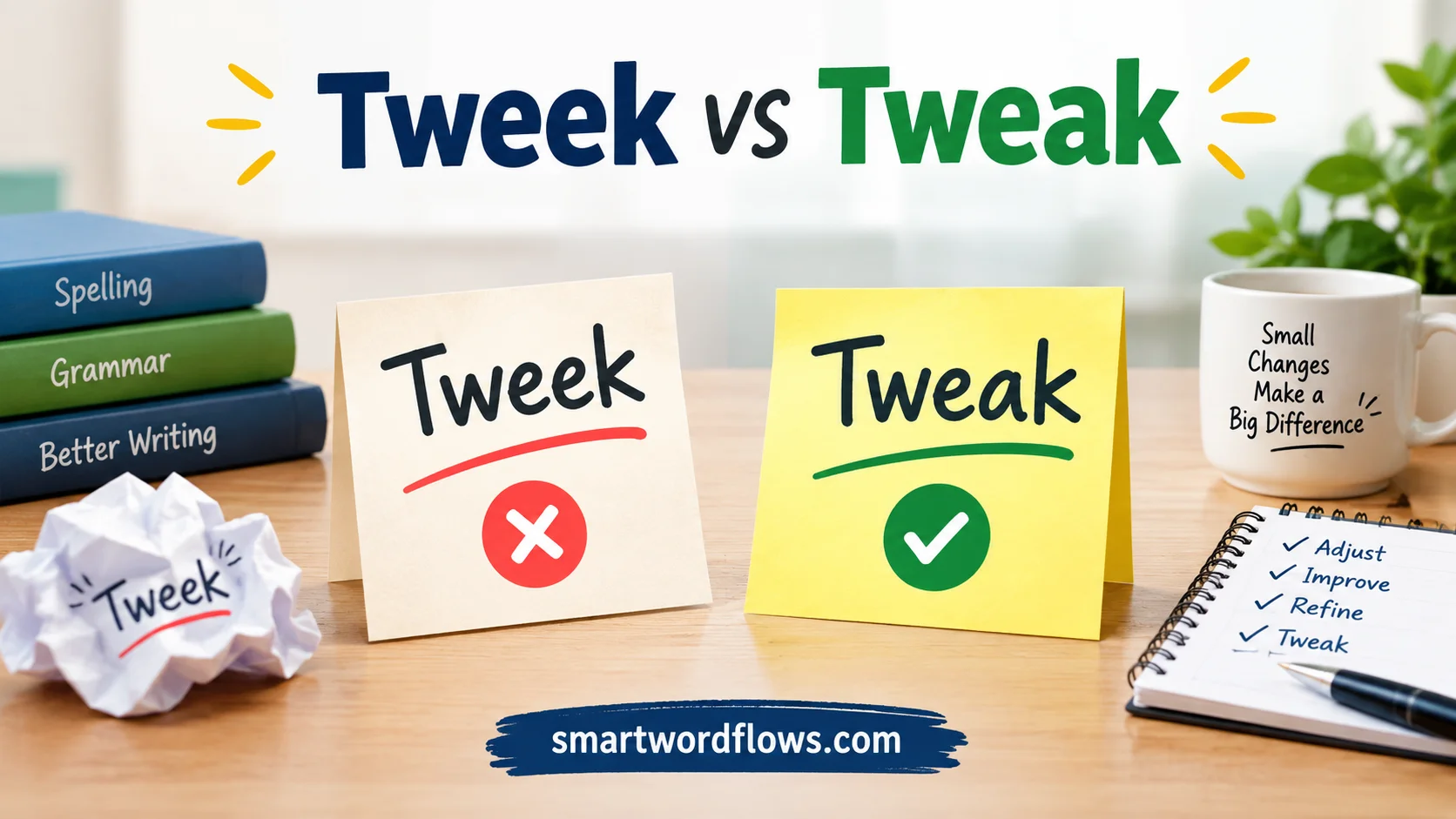

Have you ever paused while writing because you weren’t sure whether Tweek vs Tweak was the right spelling? This small spelling confusion is surprisingly common because both words look and sound almost identical. However, they aren’t used equally in standard English. Tweak is the correct and widely accepted word, while tweek is generally considered a spelling mistake. Understanding this simple difference can help you write more clearly and avoid unnecessary errors in everyday, academic, and professional communication.
The word tweak means to make a small adjustment, change a detail, or improve something slightly. You’ll often see it used when discussing writing, technology, software, design, settings, and everyday tasks. For example, you might tweak a sentence to make it clearer or tweak a phone setting to improve its performance. Although tweek may appear in certain names, slang, or specific references, it normally isn’t the standard spelling of the English word.
Quick Answer
Tweak is the correct standard English spelling when you mean to make a small change, adjustment, or improvement.
Tweek is generally a misspelling of tweak in ordinary English writing.
For example:
- ✅ I need to tweak the settings.
- ❌ I need to tweek the settings.
- ✅ She tweaked the recipe slightly.
- ❌ She tweeked the recipe slightly.
- ✅ We’re tweaking the design.
- ❌ We’re tweeking the design.
The confusion mainly comes from pronunciation. Tweak is pronounced /twiːk/, which sounds very similar to words containing the spelling ee, such as week and seek. However, its standard spelling contains ea.
According to Cambridge Dictionary, tweak means to make a small change to something in order to improve it or make it work better. Major dictionaries including Merriam-Webster and Collins Dictionary also recognize tweak as the standard word.
Comparison Overview
The simplest way to understand Tweek vs Tweak is to compare how each form functions in normal English.
| Feature | Tweak | Tweek |
| Standard English spelling | Yes | No, usually |
| Means “make a small adjustment” | Yes | No |
| Common dictionary word | Yes | Not as the standard form |
| Verb | Yes | No for the ordinary meaning |
| Noun | Yes | No for the ordinary meaning |
| Past tense | Tweaked | Usually incorrect |
| -ing form | Tweaking | Usually incorrect |
| US English | Correct | Usually incorrect |
| UK English | Correct | Usually incorrect |
| Pronunciation | /twiːk/ | Often intended to sound like tweak |
| Proper-name use | Possible | Possible |
| Common spelling mistake | No | Yes |
So, if you’re writing a sentence about changing a setting, improving a paragraph, adjusting a recipe, or making a minor modification, choose tweak.
The Basic Rule
If you mean “make a small adjustment,” spell it T-W-E-A-K: tweak.
That one rule solves most tweek vs tweak questions.
Main Differences Between Tweek vs Tweak
Although the two spellings look almost identical, they don’t have the same status in standard English.
Tweak Is the Standard English Word
Tweak is an established English word that works as both a verb and a noun.
As a verb, it means to make a small adjustment:
We need to tweak the website before publishing it.
As a noun, it means a small adjustment itself:
The website only needs a few small tweaks.
The word works naturally in everyday conversation as well as technical, professional, and academic writing.
You can tweak:
- A recipe
- A sentence
- A paragraph
- A website
- Software
- Phone settings
- A schedule
- A business strategy
- A presentation
- A design
- A workout routine
- A plan
The common idea is small-scale adjustment, rather than complete replacement.
Tweek Is Usually a Misspelling
When someone writes:
I need to tweek this paragraph.
they almost certainly mean:
I need to tweak this paragraph.
The mistake makes sense from a pronunciation standpoint. Tweak sounds like /tweek/, which can lead writers to choose ee instead of ea.
However, English spelling doesn’t always follow pronunciation in a simple way. That’s why tweak uses ea, even though its vowel sound resembles the sound in week.
Tweek Can Appear in Special Contexts
It’s also important not to make the opposite mistake and claim that the sequence Tweek can never appear.
You may encounter Tweek as:
- A character name
- A username
- A fictional name
- A brand or product name
- A title
- A specialized term
- A deliberately stylized spelling
For example, Tweek Tweak is the name of a fictional character from South Park. In that context, Tweek is a proper name, not a misspelling of the ordinary verb tweak.
Context matters.
If someone writes, “I need to tweek my settings,” the standard correction is tweak. If a person’s official name is Tweek, changing it to Tweak would obviously be incorrect.
What Does “Tweak” Mean?
The modern everyday meaning of tweak is relatively simple: to make a small change to something in order to improve, adjust, or fine-tune it.
The change doesn’t usually involve rebuilding something from scratch.
Think of it this way:
Major change: Replace the entire website.
Small change: Tweak the website’s font size.
That distinction gives the word much of its character.
Tweak as a Verb
As a verb, tweak describes the action of making a minor modification.
Examples include:
I tweaked the brightness settings on my phone.
She tweaked the introduction before submitting the article.
The chef tweaked the recipe by adding more garlic.
The developer tweaked the software to improve performance.
Notice how each sentence involves something that already exists. The person isn’t starting over. They’re making a targeted adjustment.
Tweak as a Noun
Tweak also works as a noun.
Here, it refers to the small adjustment itself.
The design needs a minor tweak.
A few tweaks made the article easier to read.
The engineer suggested several tweaks to the system.
The plural form is tweaks.
This noun usage has become especially common in business, technology, writing, marketing, and design.
Other Meanings of “Tweak”
Although the “small adjustment” meaning is the one you’ll encounter most often, tweak has other dictionary-recorded uses.
The word can also describe a small pull, pinch, or twist, especially when referring to a physical action.
For example:
He gave the knob a quick tweak.
The exact sense depends on context.
That said, modern professional writing frequently uses tweak in the figurative sense of adjusting or improving something slightly.
This is why you’ll often see phrases such as:
- Tweak the settings
- Tweak the design
- Tweak the wording
- Tweak the strategy
- Tweak the formula
- Tweak the configuration
Why Do People Spell “Tweak” as “Tweek”?
The spelling error isn’t random. There are several understandable reasons behind it.
The Pronunciation Creates Confusion
Tweak is pronounced /twiːk/.
That vowel sound appears in many familiar words containing ee:
- Week
- Seek
- Keep
- Sleep
- Deep
- Green
Because people often learn new words through conversation, they may hear tweak before they see it written.
When they eventually type it, tweek can feel like the obvious spelling.
It isn’t.
English Has Multiple Ways to Represent Similar Sounds
English spelling doesn’t assign one fixed letter combination to every sound.
Compare:
- tweak
- week
- peak
- seek
- unique
These words don’t all use the same spelling pattern to produce similar vowel sounds.
That’s one reason pronunciation alone isn’t enough to determine spelling.
The Word “Week” May Reinforce the Error
There’s another psychological trap.
The word week is extremely common. It has the same long e sound found in tweak. Someone familiar with week may unconsciously transfer its spelling pattern to tweak.
That creates:
tweak → tweek
The pronunciation stays close, but the spelling changes.
Tweak Pronunciation: Is It Pronounced Like “Tweek”?
Yes. Tweak is commonly pronounced /twiːk/.
For an English learner, an easy approximation is:
tweak = “tweek”
But there’s an important distinction:
The pronunciation may sound like “tweek,” while the spelling is “tweak.”
That’s the key point.
You shouldn’t change the spelling simply because the pronunciation resembles another spelling pattern.
Tweak vs Tweek in American and British English
Some English spelling differences genuinely depend on region.
For example:
- color / colour
- center / centre
- organize / organise in some usage systems
However, tweak vs tweek isn’t one of those US-versus-UK differences.
The standard spelling tweak is used in both American and British English.
So you shouldn’t assume:
American English = tweak
British English = tweek
That’s incorrect.
Whether you’re writing for readers in New York, London, California, Manchester, Texas, or Edinburgh, tweak remains the standard spelling for the ordinary word.
Correct Forms of “Tweak”
Knowing the related forms makes it easier to avoid spelling mistakes.
Tweak
This is the base form.
I need to tweak the settings.
Tweaks
This can function as either a third-person singular verb or a plural noun.
She tweaks the design regularly.
The designer made several tweaks.
Tweaked
This is the past tense and past participle.
He tweaked the settings yesterday.
The software has been tweaked for better performance.
Tweaking
This is the present participle and gerund form.
She is tweaking the presentation.
Tweaking the settings may solve the problem.
The important spelling pattern is that these forms keep the root tweak.
Tweak vs Tweaked vs Tweaking
These forms look different because English grammar changes the ending, but the spelling of the root remains consistent.
| Form | Grammatical role | Example |
| tweak | Base verb | I need to tweak the design. |
| tweaks | Verb or plural noun | She tweaks the settings. |
| tweaked | Past tense / past participle | We tweaked the schedule. |
| tweaking | Present participle / gerund | They are tweaking the software. |
A common mistake is to carry the incorrect tweek spelling into these forms.
That produces errors such as:
- ❌ tweeked
- ❌ tweeking
- ❌ tweeks
The standard forms are:
- ✅ tweaked
- ✅ tweaking
- ✅ tweaks
When to Use “Tweak”
The word tweak fits naturally in many situations where you make a relatively small adjustment.
Tweak in Technology
Technology is one of the most common areas where you’ll encounter the word.
You might:
- Tweak display settings
- Tweak audio settings
- Tweak software
- Tweak code
- Tweak performance
- Tweak a configuration
- Tweak a device
For example:
I tweaked the graphics settings to improve performance.
The sentence suggests a modest adjustment rather than replacing the entire system.
Tweak in Writing
Writers and editors use tweak frequently.
You can tweak:
- A headline
- An introduction
- A sentence
- A paragraph
- Word choice
- Tone
- Formatting
For example:
The editor tweaked the headline to make it more specific.
That doesn’t suggest rewriting the entire article. It suggests a focused improvement.
Tweak in Cooking
Recipes provide another easy example.
I tweaked the recipe by adding a little more garlic.
The basic recipe remains intact. Only a small part changes.
You could also say:
She made a few tweaks to the seasoning.
This sounds natural because seasoning can be adjusted without rebuilding the dish.
Tweak in Business and Planning
Businesses often use tweak when describing minor strategic changes.
Examples include:
- Tweak a marketing campaign
- Tweak a pricing strategy
- Tweak a schedule
- Tweak a business plan
- Tweak a product
- Tweak a workflow
For instance:
The company tweaked its marketing strategy after reviewing customer feedback.
The wording suggests refinement rather than a complete strategic overhaul.
Read More: Putting vs Puting: Which Spelling Is Correct?
When “Tweak” Isn’t the Best Word
Although tweak is useful, it doesn’t replace every word meaning “change.”
Choosing the right word depends on the size and purpose of the modification.
Tweak vs Change
Change is the broadest option.
We changed the design.
This doesn’t tell the reader whether the modification was tiny or dramatic.
By contrast:
We tweaked the design.
suggests a relatively small adjustment.
Tweak vs Modify
Modify often sounds more formal and can describe a broader alteration.
The engineer modified the system.
This could involve a significant technical change.
The engineer tweaked the system.
This usually suggests smaller adjustments.
Tweak vs Redesign
Redesign implies a substantial change in structure, appearance, or function.
The company redesigned its website.
That’s very different from:
The company tweaked its website.
A redesign could involve a completely new layout. A tweak might involve changing the navigation, spacing, colors, or wording.
Tweak vs Fine-Tune
These two words overlap considerably.
Fine-tune often suggests careful adjustment toward a desired level of performance.
The technician fine-tuned the machine.
Tweak can sound more casual:
The technician tweaked the machine’s settings.
Both can be correct. The surrounding context determines which sounds more natural.
Common “Tweek” Mistakes and Their Corrections
Because the error often spreads to related forms, it’s useful to see the pattern clearly.
| Incorrect | Correct |
| tweek the settings | tweak the settings |
| a small tweek | a small tweak |
| several tweeks | several tweaks |
| tweeked the design | tweaked the design |
| tweeking the software | tweaking the software |
| tweek the recipe | tweak the recipe |
| tweek the wording | tweak the wording |
The correction isn’t complicated.
Remember the root:
T-W-E-A-K
Then build the grammatical forms from that spelling.
Is “Tweek” Ever a Real Word?
This question needs a more careful answer than simply saying “no.”
In ordinary standard English, tweek isn’t the standard spelling for the verb meaning “make a small adjustment.”
However, the sequence Tweek can appear legitimately as a proper name or specialized term.
Tweek as a Proper Name
One familiar example is Tweek Tweak, a fictional character from the animated television series South Park.
In that context, Tweek is part of a character’s name.
That doesn’t mean the standard verb has two spellings.
Consider the difference:
I need to tweak the settings.
Here, tweak is an ordinary English verb.
Tweek Tweak is a fictional character.
Here, Tweek is a proper name.
The context completely changes the situation.
Tweek as a Username or Brand
People can also deliberately create names with unusual spellings.
A username might be Tweek123. A company could theoretically choose Tweek as its brand name. A fictional work might use the spelling for stylistic reasons.
Those uses don’t establish tweek as the standard spelling of the English verb.
That’s an important distinction whenever you’re checking spelling.
Tweak vs Tweek: Examples in Everyday Sentences
Seeing the word in realistic sentences makes the difference easier to remember.
At Work
We need to tweak the schedule before tomorrow’s meeting.
The schedule already exists. Only a small adjustment is needed.
In Technology
Try tweaking the display settings if the screen looks too dark.
The user isn’t replacing the device. They’re making a minor configuration change.
In Writing
I tweaked the final paragraph to make the conclusion clearer.
The writer made a targeted improvement.
In Cooking
You can tweak the recipe by adding more chili powder.
The basic recipe stays the same.
In Design
The designer made a few tweaks to the homepage.
The page didn’t need a complete redesign.
In Everyday Conversation
Give me a minute to tweak a couple of things.
This casual usage sounds natural because the speaker expects only minor changes.
Case Study: “Tweak” in a Real Editing Situation
Imagine you’ve written a 2,000-word article.
The structure works. The information is accurate. The headings make sense. However, three paragraphs feel too long, the introduction needs a stronger hook, and one heading doesn’t clearly describe its section.
You don’t need to throw the entire article away.
Instead, you might:
- Tweak the introduction.
- Tweak three long paragraphs.
- Tweak one heading.
- Tweak a few transitions.
- Tweak several sentences for clarity.
The article remains fundamentally the same.
That’s exactly where tweak works well. It describes targeted improvement without implying a complete transformation.
Tweak Synonyms and Related Words
Several words overlap with tweak, but each carries a slightly different shade of meaning.
| Word | Meaning or typical use |
| Adjust | Change something slightly to achieve a better fit or result |
| Modify | Change part of something |
| Refine | Improve details or quality |
| Alter | Change something from its existing form |
| Fine-tune | Make careful adjustments for better performance |
| Revise | Change something after reviewing it |
| Change | General word for making something different |
Tweak is particularly useful when you want to communicate that the adjustment is small, focused, and practical.
For example:
I changed the plan.
This could mean anything.
I tweaked the plan.
This suggests that the plan remains largely intact.
How to Remember the Spelling “Tweak”
The easiest way to remember the spelling is to focus on the middle letters:
T-W-E-A-K
The word contains EA, not EE.
Use the “Small Adjustment” Reminder
Think:
A tweak makes a small change.
Then connect the idea to the spelling:
tweak = small adjustment
tweek = usually the spelling mistake
You can also remember the phrase:
Make a tweak, not a remake.
The rhyme makes the correct spelling easier to recall.
Don’t Let Pronunciation Trick You
When you hear tweak, it may sound like “tweek.”
That’s fine.
Just remember:
Sounds like “tweek.”
Spells like “tweak.”
This distinction is especially helpful for English learners who encounter the word mainly through conversation.
Tweak vs Tweek: Quick Decision Guide
When you’re unsure which form to use, ask one simple question:
Are You Talking About a Small Adjustment?
Yes → Use “tweak.”
I need to tweak the settings.
No → Check what you actually mean.
If you’re referring to a person’s name, fictional character, username, brand, or another proper noun, Tweek may be correct if that’s the established spelling.
The key isn’t simply memorizing that one spelling is “good” and the other is “bad.” Instead, identify what the word is doing in the sentence.
Common Questions About Tweek vs Tweak
Is It “Tweek” or “Tweak”?
Tweak is the standard spelling when you mean to make a small adjustment or improvement.
For example:
I need to tweak the settings.
Tweek is generally a misspelling in this context.
Is “Tweek” a Real English Word?
Tweek isn’t the standard spelling of the ordinary English verb tweak. However, Tweek can appear as a proper name, fictional character name, username, brand, or specialized term.
So context matters.
What Does “Tweak” Mean?
Tweak usually means to make a small change or adjustment to something.
For example:
She tweaked the recipe to improve the flavor.
It can also have other dictionary-recorded senses involving a small physical pull, pinch, or twist.
Is “Tweak” American or British English?
Tweak is standard in both American and British English.
It isn’t a US-versus-UK spelling difference.
How Do You Spell the Past Tense of Tweak?
The correct past tense is tweaked.
Correct:
He tweaked the settings yesterday.
Incorrect:
He tweeked the settings yesterday.
Is It “Tweaking” or “Tweeking”?
The standard form is tweaking.
The e at the end of tweak is dropped before adding -ing:
tweak → tweaking
Not:
tweek → tweeking
Why Is “Tweak” Spelled With “Ea”?
English spelling doesn’t always match pronunciation perfectly. In tweak, the letters ea represent the long e sound.
The pronunciation resembles words such as week, but that doesn’t mean the spelling follows the same pattern.
Here are 5 clear FAQs followed by a concise conclusion, ready to add to your article.
Faqs :
1. Is “Tweek” or “Tweak” correct?
Tweak is the correct standard English spelling. It means to make a small change or adjustment to something. “Tweek” is usually a spelling error when someone intends to write “tweak.”
2. What does “tweak” mean?
Tweak means to make a slight modification or adjustment to improve something. For example, you can tweak a sentence, adjust software settings, or tweak a design.
3. Is “tweek” a real word?
“Tweek” can appear as a name, slang term, or specific reference, but it isn’t the standard spelling of the common English word meaning “make a small adjustment.”
4. Why do people confuse “tweek” and “tweak”?
People often confuse these spellings because they look very similar and can sound alike in speech. The different vowels make the spelling easy to mix up, especially when typing quickly.
5. How can I remember the correct spelling of tweak?
A simple way to remember tweak is to associate it with a small change. Think of tweaking something as adjusting it just a little rather than changing it completely.
Conclusion :
The difference between tweek and tweak is simple once you know the correct spelling. Tweak is the standard English word used for making a small adjustment, improvement, or change. Although “tweek” may appear in names or unusual references, it’s generally incorrect when you mean the common verb. Remembering this distinction will help you avoid spelling errors and make your writing more accurate, clear, and professional.