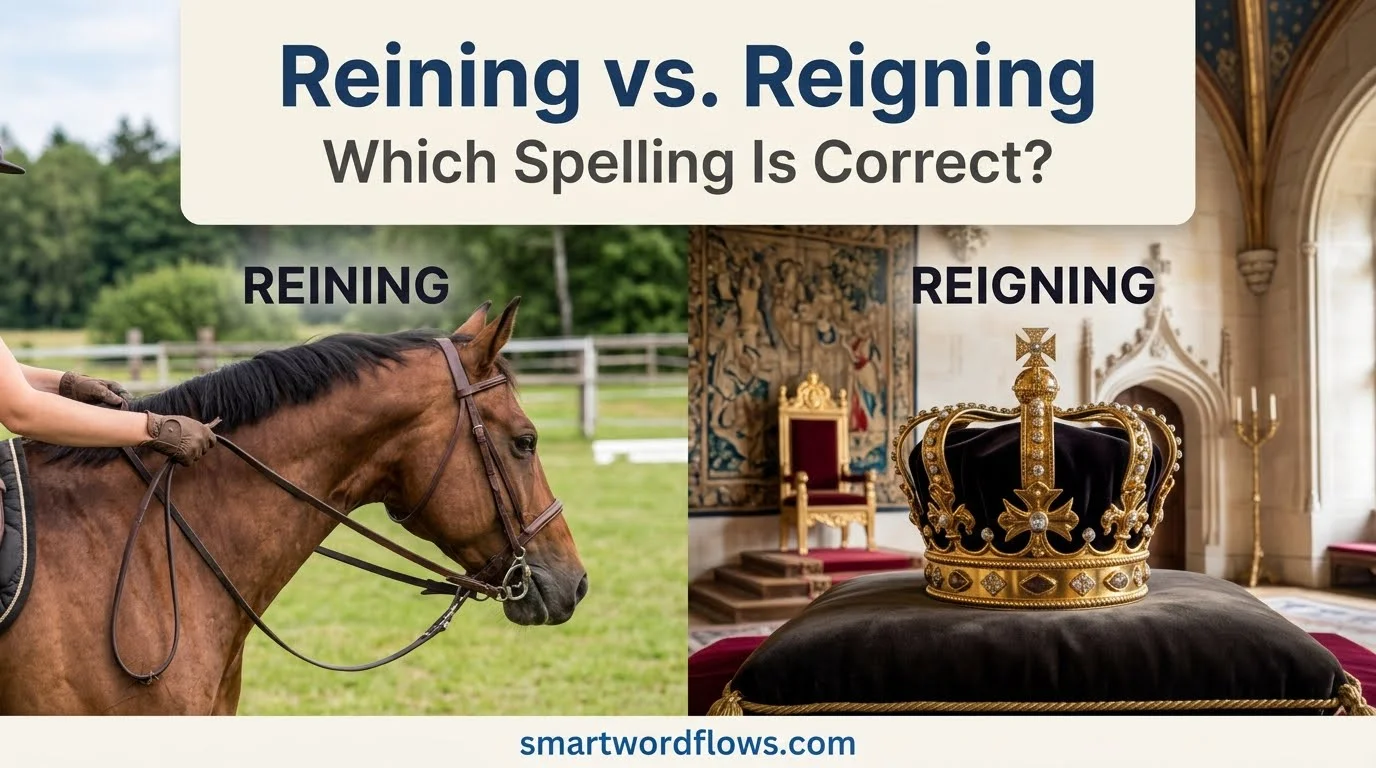

Reining vs. Reigning: Which Spelling Is Correct?TLE explains how reining means control, while reigning means ruling or holding a title in English. These almost identical words have the same sound in standard English, making them a source of classic English confusion for many writers. This spelling confusion can lead to grammar mistakes, common spelling mistakes, and clarity issues in everyday writing and written communication. The key distinction is their meaning: reining means controlling, guiding, or restraining, while reigning relates to ruling, authority, or holding a title. Understanding these similar words improves word choice, writing clarity, writing accuracy, and grammar accuracy. A simple approach and a useful memory aid can help you choose the right word, avoid second-guessing and hesitation, and prevent common word usage errors.
Reining comes from reins, the straps or ropes used to control a horse. In horse riding and other equestrian activities, reins guide horse movement through controlled action and restrained action. The phrase reining in expenses means controlling spending or managing costs, so the word describes an act of control, guidance, or restraint. By contrast, reigning describes a monarch, king, queen, or country ruler who holds a position of authority over a country or kingdom. A reigning monarch rules during a period of rule, also called a ruling period or period of ruling. Similarly, a reigning champion holds a competitive title after winning it. In a royalty or royal authority context, you might write, “The queen reigns over the kingdom,” or “The monarch rules the country.” These usage examples highlight the semantic differences between control versus rule and make the word distinction easier to remember.
Rain is a third word with a different meaning. It refers to water that falls from the sky as droplets, or precipitation that comes from clouds. Rainfall, falling rain, and weather often appear in weather forecasts and weather discussions. Although their meanings differ, rain, reign, and rein share the same pronunciation in ordinary conversation. Consider this sentence example: “I pulled back on the reins of the horse as I saw rain falling over the royal kingdom where the evil queen reigns.” In one sentence, each word has a different use. A horse-drawn carriage in a royal procession could bring all three ideas together. However, you can usually clear up confusion by connecting each word to what it belongs to: reining to horses, reigning to ruling, and rain to precipitation. These contextual clues, semantic relationships, and word associations support vocabulary development, language learning, and proper usage. One important exception occurs in equestrian sport, where Reining is the name of a specific riding discipline that involves trained horses and precise movements. This is why contextual meaning, English grammar, English spelling, and sentence structure help you distinguish similar words and achieve correct word usage.
Quick Answer
- Reining: The present participle of rein, meaning to guide, control, or restrain. Example: The company is reining in unnecessary expenses.
- Reigning: The present participle of reign, meaning to rule or hold a position or title. Example: The reigning champion defended her title.
- Reining in: The correct expression when you mean controlling, limiting, or reducing something.
- Reigning champion: The correct expression for a person or team that currently holds a championship title.
- Pronunciation: Both words sound the same in standard American English.
Easy memory trick: A rein helps you control a horse, while a reign describes a ruler’s authority. Think control for reining and rule for reigning.
Comparison Overview
Although reining and reigning sound alike, their meanings, base words, and typical uses differ. Comparing them side by side makes the distinction easier to remember.
| Feature | Reining | Reigning |
| Base word | Rein | Reign |
| Part of speech | Present participle of rein | Present participle of reign |
| Main meaning | Controlling, guiding, or restraining | Ruling or currently holding a title |
| Literal use | Guiding a horse with reins | Exercising royal or sovereign authority |
| Figurative use | Limiting spending, emotions, or behavior | Holding a championship or position of authority |
| Common expression | Reining in expenses | Reigning champion |
| Example | She is reining in her spending. | He is the reigning world champion. |
| Memory clue | Rein means control | Reign means rule |
The key difference lies in their root words. Reining comes from rein, the strap or line used to guide a horse. Reigning comes from reign, which refers to a period of rule or the exercise of sovereign authority.
Once you identify the intended meaning, choosing the correct spelling becomes much easier.
What Does Reining Mean?
Reining is the present participle of the verb rein. It describes the act of guiding, controlling, or restraining something. The word has a literal meaning connected to horseback riding and a figurative meaning that appears frequently in everyday English.
According to Dictionary.com’s definition of rein, the verb can mean to guide an animal with reins or to curb and control something. Both meanings share the same basic idea: directing movement or keeping something within limits.
For example, when a rider pulls the reins gently to slow a horse, the rider is reining the animal. When a manager limits unnecessary expenses, the manager is reining in spending.
Reining in Horses
The word reining has a direct connection to horseback riding. Reins are straps attached to a horse’s bridle that allow a rider to communicate directions and influence the animal’s movement.
A rider may use the reins to guide a horse left or right, slow its pace, or bring it to a halt. In this context, reining describes a physical action rather than an abstract idea.
Consider these examples:
- The rider was reining in the horse as they approached the narrow trail.
- She practiced reining the horse to the left during her riding lesson.
- He kept reining in his horse whenever it began moving too quickly.
- The instructor demonstrated how to guide the horse without pulling harshly on the reins.
Notice how each sentence involves guiding or controlling an animal. The spelling reining fits because the action comes from the verb rein.
Reining In Spending, Costs, and Behavior
In everyday writing, reining appears most often in the expression reining in. This phrase means controlling, limiting, or restraining something that has become excessive or difficult to manage.
You don’t need to own a horse to use the expression. English speakers often apply the original idea of controlling reins to money, emotions, habits, and decisions.
Here are several common situations:
- Personal finances: A family is reining in its spending after several expensive months.
- Business management: The company is reining in operating costs to improve its financial position.
- Emotions: He is reining in his anger before responding to the criticism.
- Behavior: Parents are reining in their children’s screen time on school nights.
- Project management: The team is reining in the project’s scope to meet its deadline.
The phrase doesn’t always mean stopping something completely. Often, it means bringing an activity under better control.
For example, a company that reins in its marketing budget might still spend money on advertising. It simply reduces unnecessary expenses or sets clearer limits.
This distinction matters because reining in suggests restraint rather than necessarily eliminating the activity altogether.
Examples of Reining in a Sentence
The following sentences show how reining works in different contexts.
| Example sentence | Meaning of reining |
| The family is reining in its monthly expenses. | Controlling spending |
| The rider was reining in the horse near the gate. | Slowing or guiding the horse |
| She is reining in her frustration during the meeting. | Controlling an emotion |
| The manager is reining in unnecessary purchases. | Limiting spending |
| The coach is reining in the team’s excitement before the final. | Helping the team control its behavior |
A useful detail: reining can appear in different grammatical structures. You might write, “She is reining in her spending,” or “Reining in expenses requires careful planning.” In the first sentence, it forms part of a verb phrase. In the second, it describes an activity.
What Does Reigning Mean?
Reigning is the present participle of reign. It means ruling, exercising authority, or holding a position or title associated with rule.
The word traditionally refers to monarchs, such as kings and queens. However, English also uses it in sports, entertainment, business, and other areas where someone holds a prominent position.
Collins Dictionary’s entry for reign includes meanings related to sovereign authority, dominance, and the period during which a person or influence holds power.
For example, a reigning monarch currently holds the position of sovereign. A reigning champion holds a championship title going into the relevant competition.
The essential idea is rule or current status, not physical restraint.
Reigning Monarchs and Leaders
The traditional use of reigning involves someone who rules a country or holds a royal title. The word can describe a monarch’s current position or the exercise of authority.
Consider these examples:
- The reigning monarch attended the official ceremony.
- The queen was reigning over the kingdom during a period of major change.
- The country welcomed its reigning sovereign at the national celebration.
- The monarch is reigning while the government handles day-to-day administration.
The last example illustrates an important distinction. A monarch can reign without personally making every government decision. In constitutional monarchies, the sovereign holds the royal position while elected officials generally manage government policy.
The word also appears figuratively in discussions of leaders and influential people. For example, a writer might say that a business executive is reigning over the industry. This describes dominance or influence rather than literal royal authority.
What Does Reigning Champion Mean?
The expression reigning champion describes a person or team that currently holds a championship title from a previous victory.
Imagine that a basketball team wins its league championship in June. When the next season begins, the team may be called the reigning champion because it enters the new season as the titleholder.
The term doesn’t guarantee that the team will win again. It identifies its existing status.
Here are some examples:
- The reigning champion returned to defend her title.
- The reigning world champion prepared for the upcoming boxing match.
- The tournament organizers invited the reigning champion to compete again.
- The reigning league champions opened the season against their longtime rivals.
A reigning champion can lose the next competition and still have been correctly described as the reigning champion before that result. The expression refers to the title held at the relevant time.
It also helps to distinguish three related terms:
| Term | Meaning | Example |
| Reigning champion | The current titleholder entering a competition | The reigning champion begins the tournament on Friday. |
| Former champion | Someone who held the title in the past | The former champion now works as a coach. |
| New champion | Someone who has just won the title | The new champion celebrated after the final match. |
These terms describe different stages of a titleholder’s status. Choosing the right one helps readers understand whether a victory is recent, current, or part of the past.
Examples of Reigning in a Sentence
Reigning also appears when writers describe authority, dominance, or a prevailing influence.
- The reigning monarch greeted visitors at the palace.
- The reigning champion hopes to win another title.
- The company has a new leader, but its founder remains the reigning authority on the product’s history.
- Optimism was reigning throughout the office after the successful launch.
- The reigning trend in home design favors simple, functional spaces.
The last two examples use the word figuratively. Optimism doesn’t literally rule an office, and a design trend doesn’t occupy a throne. Instead, the language emphasizes that an attitude or influence is widespread or dominant.
Use this broader meaning when the sentence concerns something that prevails or holds sway.
Read More:Oversight vs. Oversite: Which Spelling Is Correct?
Main Differences Between Reining and Reigning
The main difference between reining and reigning comes from their base words. One refers to control or restraint; the other refers to rule, authority, or dominance.
Although the words sound alike, they aren’t interchangeable. Using the wrong spelling can change the meaning of an otherwise clear sentence.
Reining vs. Reigning: Word Origins
Understanding the origins of these words provides a useful memory aid.
The word rein has roots in Middle English and older French forms, ultimately connecting to the Latin retinēre, meaning to hold back or retain. That history fits its modern use: reins guide an animal, while the verb rein means to guide or restrain.
These origins explain why the words developed different meanings despite their similar spellings.
- Rein → control: Reining in expenses means limiting spending.
- Reign → rule: A reigning champion holds a title.
You don’t need to memorize the Latin roots to write correctly. Still, knowing the connection between rein and restraint, and between reign and royalty, makes the distinction easier to remember.
Reining vs. Reigning Pronunciation
In standard American English, reining and reigning are pronounced identically: /ˈreɪnɪŋ/.
Both have two syllables, with the stress on the first syllable. The silent g in reigning doesn’t create a different sound.
Because they sound alike, these words are homophones. Homophones share a pronunciation but differ in spelling, meaning, or sometimes both.
This creates a common problem in writing. You can say either word aloud and still leave the listener unsure which meaning you intend until the context becomes clear.
For instance, these sentences sound alike when spoken:
- The business is reining in its costs.
- The business is reigning in its market.
The first sentence describes controlling expenses. The second could describe a business dominating its market, although a more natural phrasing might be “The business is reigning supreme in its market.”
Pronunciation alone won’t solve the spelling problem. Instead, identify the idea you want to express before choosing the word.
Reining vs. Reigning: When to Use Each Word
Use reining when the sentence involves guiding, controlling, restraining, or limiting something.
Use reigning when the sentence involves ruling, holding a title, or exercising a dominant influence.
Compare these pairs:
| Reining | Reigning |
| The manager is reining in expenses. | The monarch is reigning over the kingdom. |
| She is reining in her temper. | She is the reigning champion. |
| The rider is reining in the horse. | The reigning leader addressed the crowd. |
| The company is reining in unnecessary purchases. | The team is the reigning league champion. |
Ask yourself one question: Does the sentence mean control, or does it mean rule?
If it means control, reining is usually the right choice. If it means rule or title ownership, reigning is the appropriate spelling.
Reining In vs. Reigning In: Which Phrase Is Correct?
Reining in is the correct expression when you mean controlling, limiting, or restraining something. Reigning in is generally incorrect when used with that meaning.
The expression comes from the idea of using reins to control a horse. Over time, English speakers extended the phrase to describe controlling things that have no physical reins, such as spending, emotions, and behavior.
Consider these examples:
- Correct: The government is reining in public spending.
- Incorrect: The government is reigning in public spending.
- Correct: She is reining in her excitement.
- Incorrect: She is reigning in her excitement.
In each example, the intended meaning involves restraint rather than rule. Therefore, reining is the correct spelling.
Common Mistakes With Reining In
Writers often choose reigning because they associate the expression with authority or power. However, the phrase reining in has its own established meaning.
Here are common mistakes and their corrections.
| Incorrect sentence | Correct sentence | Explanation |
| The company is reigning in its expenses. | The company is reining in its expenses. | The company is limiting costs. |
| He needs to start reigning in his anger. | He needs to start reining in his anger. | He needs to control his emotions. |
| The school is reigning in unnecessary activities. | The school is reining in unnecessary activities. | The school is reducing or limiting activities. |
| We are reigning in our monthly budget. | We are reining in our monthly spending. | The intended meaning is controlling expenses. |
The final example also highlights a useful wording distinction. People commonly rein in spending, rein in costs, or rein in a budget. Saying rein in a budget can make sense, but rein in spending is often more precise when you mean reducing expenses.
When Reigning Is Correct
Don’t assume that reigning becomes incorrect whenever the word in appears nearby. The correct choice depends on the sentence’s meaning and structure.
For example:
- The reigning champion is competing in the final.
- The monarch has been reigning in the country for several years.
- The reigning trend in the industry continues to attract attention.
In the second example, reigning in the country means ruling within that country. The word in identifies the location of the rule; it doesn’t form the expression reining in.
Compare these two sentences:
- The king is reigning in the kingdom. — He is ruling there.
- The king is reining in his spending. — He is controlling his expenses.
The surrounding words reveal the intended meaning. This is why understanding the phrase matters more than simply looking for the word in.
Reining vs. Reigning vs. Raining
There’s a third word worth learning: raining. It sounds like reining and reigning in standard American English, but it describes water falling from clouds.
All three words are pronounced alike, yet each has a distinct meaning.
| Word | Base word | Meaning | Example |
| Reining | Rein | Controlling or restraining | She is reining in her spending. |
| Reigning | Reign | Ruling or holding a title | He is the reigning champion. |
| Raining | Rain | Water falling from clouds | It is raining outside. |
The spelling raining also appears in figurative expressions such as raining compliments or raining down criticism. In these phrases, something arrives in large amounts, much like falling rain.
For example:
- Correct: It is raining heavily today.
- Correct: The manager is reining in unnecessary costs.
- Correct: The reigning champion won another match.
- Incorrect: It is reigning heavily today.
- Incorrect: The manager is raining in unnecessary costs.
To remember all three, picture their meanings:
- Reining: A rider holding the reins of a horse.
- Reigning: A monarch wearing a crown.
- Raining: Raindrops falling from the sky.
These mental images give each spelling its own clear identity.
Common Mistakes to Avoid With Reining and Reigning
Even experienced writers confuse these words because spell-checkers may accept both. A spelling tool can recognize a correctly spelled word without knowing whether you used it properly.
Watch for these common errors.
- Using reigning in to mean reducing: Write reining in spending when you mean controlling expenses.
- Writing reining champion: Use reigning champion for the current titleholder.
- Confusing control with authority: A manager might rein in costs, while a monarch reigns over a kingdom.
- Mixing up raining with the other two words: Use raining for precipitation or appropriate figurative expressions involving things falling in abundance.
- Ignoring the surrounding context: A sentence about financial restraint needs a different word from one about a championship title.
- Assuming a spell-checker will catch every mistake: Both reining and reigning are valid spellings, so grammar software may not flag the wrong choice.
One practical habit can prevent most of these mistakes: reread the sentence and replace the disputed word with its meaning.
If you can replace it with controlling, choose reining. If you can replace it with ruling or holding the current title, choose reigning.
How to Remember the Difference Between Reining and Reigning
You don’t need complicated grammar rules to distinguish these words. A simple connection between each spelling and its meaning is enough.
Reining = Rein = Control
Think of the reins a rider holds to guide a horse. The reins help the rider influence the animal’s movement, speed, and direction.
The same idea applies when you rein in an activity or behavior. You’re bringing something under control.
Examples include:
- Reining in unnecessary spending.
- Reining in an emotional response.
- Reining in a project’s growing costs.
- Reining in a horse before a turn.
Memory trick: If the sentence means control or restrain, choose reining.
Reigning = Reign = Rule
Think of a king or queen who reigns over a kingdom. The word connects to royal authority and the period during which someone holds power.
You can also use it for championship titles and other positions of dominance.
Examples include:
- A reigning monarch.
- A reigning world champion.
- A reigning league champion.
- A trend reigning supreme in the market.
Memory trick: If the sentence means rule, dominate, or hold a title, choose reigning.
A Simple Trick for Choosing the Correct Spelling
When you’re unsure, ask yourself what the sentence describes.
Example one: “The store is ___ in its operating costs.”
The store wants to control or reduce expenses. Therefore, the correct word is reining.
Example two: “The ___ champion entered the tournament.”
The sentence describes someone who currently holds a title. Therefore, the correct word is reigning.
This quick test works in most everyday situations. If the meaning remains unclear, rewrite the sentence to make your intended idea more specific.
Reining vs. Reigning Examples in Everyday Writing
The best way to master these words is to see them in realistic situations. The following examples demonstrate how context guides the choice.
Examples of Reining
Personal finance: After several months of overspending, Maya started reining in her shopping habits.
Here, reining in means controlling unnecessary purchases rather than eliminating shopping altogether.
Business management: The company is reining in travel expenses to stay within its annual budget.
The company is limiting costs to meet a financial target.
Horseback riding: The rider was reining in the horse as they approached the stable.
The rider was using the reins to slow or guide the animal.
Emotional control: Daniel took a deep breath, reining in his frustration before answering the question.
The phrase describes controlling an emotional response.
Project planning: The design team is reining in new ideas so it can finish the project on time.
The team is limiting the project’s scope rather than allowing new features to create delays.
Examples of Reigning
Royal authority: The reigning monarch attended a ceremony celebrating the country’s history.
The word describes the monarch who currently holds the royal position.
Sports: The reigning champion returned to defend her title.
The athlete entered the competition as the current titleholder.
Business leadership: The executive spent years reigning over the company’s most successful division.
The sentence uses reigning figuratively to describe authority and influence.
Popular culture: The singer was the reigning star of the music charts for much of the year.
The word emphasizes the singer’s dominance in that period.
General influence: Calm and cooperation were reigning in the office after the team resolved its disagreement.
Here, reigning describes the prevailing atmosphere.
These examples show why the words cannot replace each other. One centers on restraint, while the other emphasizes rule, dominance, or a prevailing condition.
Frequently Asked Questions
Is Reining or Reigning Correct?
Both reining and reigning are correct English words. Use reining when describing control or restraint, and use reigning when describing rule, authority, or current title ownership.
For example, a company is reining in expenses, while an athlete is a reigning champion.
Is It Reining In or Reigning In?
Reining in is correct when you mean controlling, limiting, or restraining something.
For example, “The company is reining in its expenses” means the company is trying to control its spending. Reigning in doesn’t convey that meaning.
However, reigning in a country can be correct when it means ruling within that country.
What Does Reigning Champion Mean?
A reigning champion is a person or team that currently holds a championship title from a previous victory.
For example, a team that won last season’s league championship may enter the next season as the reigning champion. The term describes its current titleholder status, not a guarantee of future success.
Are Reining and Reigning Pronounced the Same?
Yes. In standard American English, both words are pronounced /ˈreɪnɪŋ/. They are homophones, meaning they share the same pronunciation but have different spellings and meanings.
Because they sound alike, you must rely on context to select the correct spelling.
How Can You Easily Remember Reining vs. Reigning?
Connect reining with rein, the strap used to guide a horse. This reminds you that reining means controlling or restraining.
Connect reigning with reign, which refers to royal rule or authority. This reminds you that reigning describes ruling or holding a title.
Is Reining a Real Word?
Yes. Reining is the present participle of rein. It describes guiding a horse or controlling something, as in “She is reining in unnecessary expenses.”
It is not simply a misspelling of reigning. Each word has its own meaning and grammatical use.
Can Reigning Be Used Outside Royalty?
Yes. Although reigning traditionally relates to monarchs, English also uses it for championship titles, influential people, and dominant trends.
Expressions such as reigning champion and reigning supreme are common examples. In these contexts, the word describes current status, dominance, or influence rather than literal royal rule.
Conclusion
The difference between reining vs. reigning comes down to meaning. Reining describes guiding, controlling, or restraining something, while reigning describes ruling, exercising authority, or holding a current title. Both words sound the same, but their uses are distinct.
Remember the connection between rein and control, and between reign and rule. Write reining in expenses when discussing financial restraint, but use reigning champion when describing a current titleholder. If you encounter raining, remember that it refers to precipitation or related figurative expressions. Once you focus on what your sentence actually means, choosing the correct spelling becomes straightforward.




2 thoughts on “Reining vs. Reigning: Which Spelling Is Correct?”