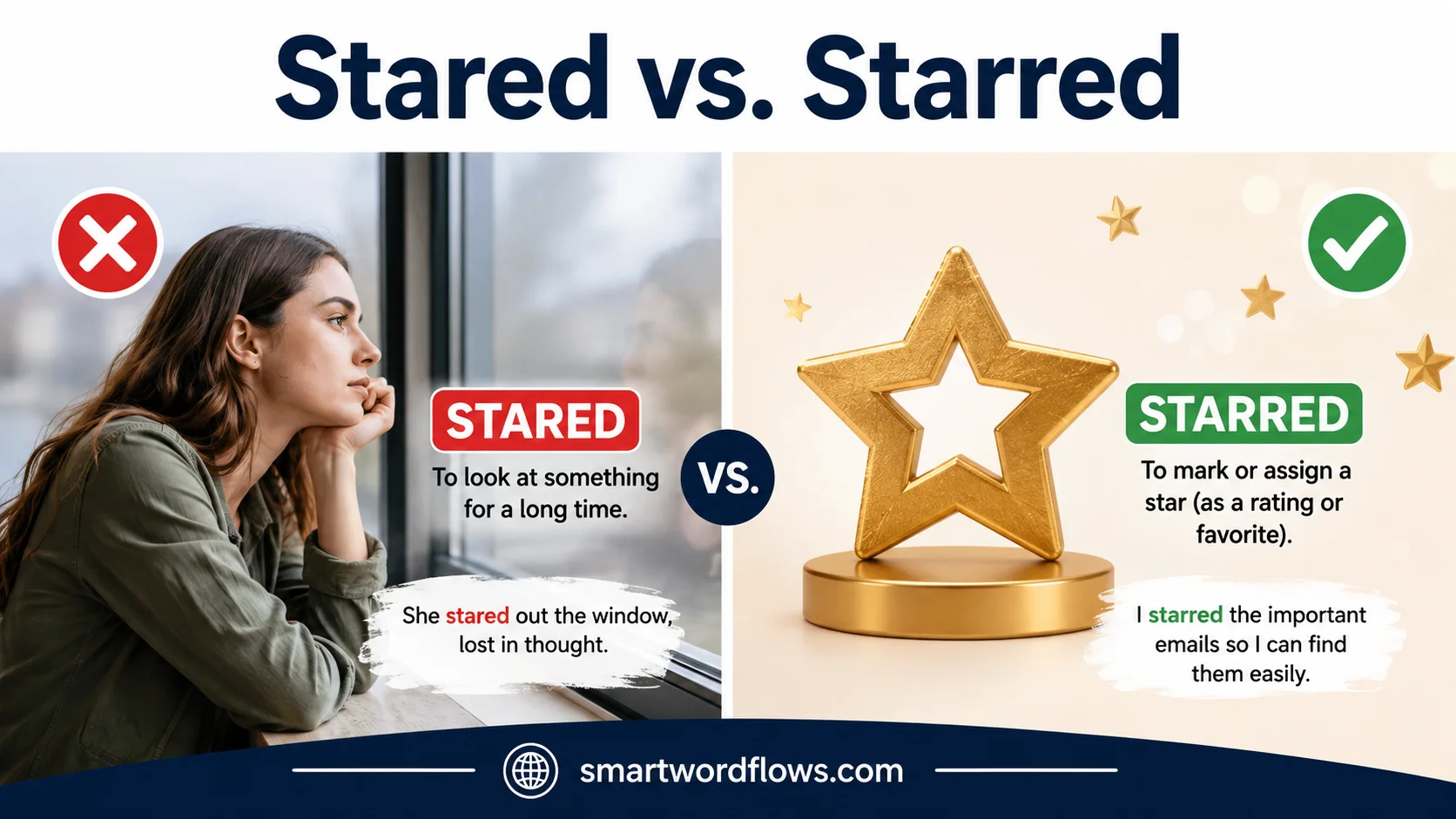

Stared vs. Starred can be confusing because both words sound the same, yet they have completely different meanings. Stared is the past tense of stare, meaning to look at someone or something with fixed attention. Starred, however, is the past tense of star, meaning to play a leading role, feature prominently, or mark something with a star. Knowing this distinction helps you use the correct word in everyday writing.
When you understand the context, choosing between these words becomes much easier. Use stared when describing someone who looked intently at something, such as a person, object, or scene. Use starred when discussing a performer, movie, television show, important item, or marked entry. Although their pronunciation is identical, their meanings and grammatical uses are clearly different.
Quick Answer
Stared means looked at someone or something steadily or intensely for a period of time.
She stared at the painting for several minutes.
Starred is the past tense of star. It commonly means appeared as a leading performer in a movie, show, play, or other production. It can also mean marked something with a star or asterisk.
She starred in the new television series.
The easiest memory trick is simple:
- Stared = looked
- Starred = involved a star
So, if you’re talking about someone’s eyes, you probably need stared. If you’re talking about an actor’s role or marking something with a star, starred is usually the right choice.
Comparison Overview
| Word | Base word | Main meaning | Common example |
| Stared | stare | Looked at something continuously or intensely | He stared at the screen. |
| Starred | star | Appeared prominently in a production | She starred in the film. |
| Starred | star | Marked something with a star | I starred the important questions. |
| Starred | star | Described something associated with star ratings or an asterisk | It was a starred hotel. |
The biggest difference isn’t pronunciation. It’s meaning.
When someone stares, their eyes remain focused on something. When someone stars, they take a prominent role or use a star symbol to identify something.
This distinction matters because spell-checkers may not catch the mistake. Both stared and starred are correctly spelled English words. A sentence containing the wrong one can therefore look perfectly acceptable to a grammar checker.
Main Differences Between Stared vs. Starred
The difference between stared vs. starred becomes clear when you look at their roots.
Stared Comes From “Stare”
Stared is the past tense and past participle of stare.
To stare means to look at someone or something continuously, often with strong attention. Depending on the context, staring can communicate surprise, confusion, curiosity, fear, concentration, admiration, or discomfort.
For example:
Everyone stared at the magician after the unexpected trick.
The people aren’t performing in a show. They’re simply looking at the magician.
Starred Comes From “Star”
Starred comes from the verb star.
In entertainment, to star means to appear as a leading or prominent performer.
The actress starred in a historical drama.
Here, nobody is necessarily looking at the actress. Instead, the actress played a major role in the production.
Starred also has other uses. You might star an email, star an item on a list, or describe something as starred when a star or asterisk marks it.
The Simplest Difference
Think about the subject of the sentence.
If the subject is using their eyes, you probably need stared.
If the subject is playing a prominent role or marking something with a star, you probably need starred.
| Meaning | Correct word |
| Looked intensely | Stared |
| Looked continuously | Stared |
| Appeared in a leading acting role | Starred |
| Played a prominent role | Starred |
| Marked with a star | Starred |
| Marked with an asterisk | Starred |
What Does “Stared” Mean?
Stared describes the act of looking at someone or something for an extended period, usually with fixed attention.
Unlike the general verb looked, stared often suggests that the person’s eyes remained focused on the same thing.
For example:
I looked at the clock.
This simply tells us that you directed your eyes toward the clock.
Compare that with:
I stared at the clock.
Now the sentence suggests prolonged attention. Perhaps you were waiting for an important time, feeling nervous, or wondering why the clock had stopped.
Common Meanings of Stared
Depending on context, stared can communicate several feelings:
- Surprise: She stared at the unexpected result.
- Confusion: He stared at the instructions without understanding them.
- Shock: They stared at the damage in silence.
- Curiosity: The child stared at the unusual object.
- Concentration: She stared at the puzzle while thinking.
- Fear: He stared at the dark doorway.
- Admiration: The visitors stared at the breathtaking view.
The word itself doesn’t always tell you exactly why someone is staring. The surrounding context supplies the emotion.
Examples of Stared
- She stared at the painting for nearly ten minutes.
- He stared at his phone after reading the unexpected message.
- The children stared at the fireworks with wide eyes.
- I stared at the question because I couldn’t understand it.
- Everyone stared when the lights suddenly went out.
Common Ways to Use “Stared”
The word stared often appears with specific prepositions and particles. Learning these patterns makes your writing sound more natural.
Stared At
Stared at is the most common construction.
He stared at me without saying anything.
Use this structure when you want to identify the person or thing receiving the person’s attention.
More examples include:
- She stared at the computer screen.
- The dog stared at the empty bowl.
- He stared at the stranger across the room.
Stared Into
Stared into often describes looking deeply or continuously into a space, distance, or object.
She stared into the distance while thinking about her decision.
Another familiar expression is:
He stared into space for several minutes.
The phrase stared into space usually suggests that someone is lost in thought rather than actively studying a particular object.
Stared Out
Stared out can describe looking outward, particularly through a window.
She stared out the window during the long journey.
This phrase often creates a reflective mood because the person is looking outside while thinking or waiting.
Stared Down
Stared down has a more forceful meaning.
It can describe looking directly at someone in an attempt to intimidate them or make them retreat.
The two competitors stared each other down before the match began.
This isn’t simply ordinary looking. The phrase suggests challenge, confidence, pressure, or confrontation.
What Does “Starred” Mean?
Starred is the past tense and past participle of star. Its meaning depends heavily on context.
The most familiar meaning relates to entertainment and performance.
Starred as a Performer
When an actor starred in a movie, television show, play, or similar production, that actor had a leading or prominent role.
Tom Hanks starred in Forrest Gump.
The construction starred in is especially important because learners sometimes incorrectly write stared in when they mean an acting role.
Correct:
The actor starred in the movie.
Incorrect for this meaning:
The actor stared in the movie.
The second sentence would literally suggest that the actor looked intensely inside the movie, which isn’t the intended meaning.
Starred as a Marking
Starred can also refer to something marked with a star or asterisk.
For example:
I starred the questions that needed more research.
Here, the person didn’t appear in a movie. They placed a star next to certain questions.
Digital platforms also use stars to indicate things such as:
- Favorites
- Important messages
- Saved items
- Selected entries
- Special status
So you might reasonably write:
She starred the email so she could find it later.
Starred as an Adjective
Starred can also function as an adjective.
For example:
The restaurant is listed as a three-starred establishment.
In other contexts, starred can describe something marked with an asterisk.
The exact meaning depends on the noun that follows it and the wider context.
Stared vs. Starred Examples
Seeing the two words side by side makes the distinction much easier.
| Sentence | Word | Meaning |
| She stared at the moon. | Stared | Looked intensely |
| He stared at the stranger. | Stared | Looked continuously |
| They stared into the distance. | Stared | Looked steadily |
| She starred in the movie. | Starred | Had a leading role |
| He starred in the play. | Starred | Performed prominently |
| I starred the important messages. | Starred | Marked them |
| She starred the questions she wanted to revisit. | Starred | Marked them with a star |
Notice the useful pattern:
stared at usually involves looking.
starred in usually involves performing.
starred something can involve marking it.
Why Does “Stared” Have One R While “Starred” Has Two?
The spelling difference comes from the different base words.
Stare → Stared
The word stare already ends with a silent e.
When you form its past tense, you add -d:
stare → stared
You don’t write starred because that would change the word’s identity and meaning.
Star → Starred
The base word star takes the past-tense ending -ed.
Its spelling becomes:
star → starred
The final consonant doubles before the ending.
This gives you a useful visual distinction:
stare + d = stared
star + red = starred
The two forms may look only slightly different, but that extra r changes the underlying word.
How to Use “Stared” Correctly
Using stared correctly mostly depends on recognizing that the sentence describes prolonged looking.
Use “Stared” for Fixed Attention
The student stared at the difficult equation.
The student is looking at the equation for an extended period.
Use “Stared” for an Emotional Reaction
She stared at him in disbelief.
The staring communicates an emotional response.
Use “Stared” for Thoughtfulness
He stared into space while trying to remember her name.
The person isn’t necessarily looking at a physical object. Their gaze remains unfocused while they think.
Use “Stared” for Confrontation
The two men stared at each other across the room.
The phrase can suggest tension, curiosity, or confrontation depending on context.
How to Use “Starred” Correctly
The correct use of starred depends on what the star represents.
Use “Starred In” for Performances
The actor starred in a successful television series.
This is one of the most important patterns to remember.
Use “Starred” for Marked Items
She starred the most important points in her notes.
The action involves adding a star or similar marker.
Use “Starred” for Prominent Roles
The production starred several experienced performers.
This usage emphasizes the performers who had important roles.
Use “Starred” in Rating Contexts Carefully
A star rating describes quality or classification through a system involving stars.
For example:
The guide listed the hotel among its starred properties.
However, the exact wording varies across rating systems. When discussing a specific hotel, restaurant, or service, it’s better to use the terminology that the relevant rating organization actually uses.
Stared vs. Starred: Correct and Incorrect Examples
Many errors become obvious once you compare them directly.
| Incorrect | Correct | Explanation |
| She starred at the painting. | She stared at the painting. | The sentence describes looking. |
| He stared in the movie. | He starred in the movie. | The sentence describes an acting role. |
| I stared the email. | I starred the email. | The email received a star marker. |
| They starred at each other. | They stared at each other. | They were looking at one another. |
| She stared in the play. | She starred in the play. | She performed in a prominent role. |
A Useful Test
When you’re unsure, replace the word with a simpler word.
If looked works, choose stared.
She looked at the painting.
She stared at the painting.
If appeared prominently works, choose starred.
She appeared prominently in the movie.
She starred in the movie.
This substitution test works surprisingly well.
Read More: Trek vs Treck: Which Spelling Is Correct?
Stared vs. Starred Sentence Patterns
Learning complete patterns is often easier than memorizing isolated definitions.
Patterns With Stared
Subject + stared + at + object
He stared at the screen.
Subject + stared + into + noun
She stared into the distance.
Subject + stared + out + of + place
He stared out of the window.
Subject + stared + down + person
The player stared down his opponent.
Patterns With Starred
Subject + starred + in + production
She starred in the documentary.
Subject + starred + object
I starred the important paragraph.
Starred + noun
The starred items require additional attention.
Understanding these structures gives you more control than simply remembering that one word has one spelling.
Stared vs. Starred in Different Contexts
Context provides one of the strongest clues.
In Everyday Conversations
Use stared when describing someone looking at something for an extended time.
Why are you staring at me?
Past tense:
Why did you stare at me?
Further past:
She said I stared at her during dinner.
In Movies and Television
Use starred when describing an actor’s prominent role.
The actress starred in the series for five seasons.
In Theater
The same rule applies.
He starred in the school’s production of the play.
In Emails and Apps
Use starred when an item receives a star marker.
I starred the email because I need to answer it tomorrow.
In Lists and Documents
Use starred when stars identify particular entries.
The starred questions require written answers.
Stared vs. Starred Pronunciation
Pronunciation can make this pair particularly confusing.
In many varieties of English, stared and starred sound very similar. In some accents, they may be effectively homophonous in ordinary speech.
That means hearing the word isn’t always enough to determine its spelling.
Instead, identify the meaning.
Ask yourself:
Is someone looking?
Use stared.
Is someone performing, marking something, or being associated with stars?
Use starred.
This approach is much more reliable than trying to hear the extra r.
Staring vs. Starring: The Present-Tense Version
The same spelling issue appears before -ing.
Staring
Staring is the present participle of stare.
She is staring at the screen.
It means looking continuously or intensely.
Starring
Starring is the present participle of star.
The film is starring several well-known actors.
It relates to performing a prominent role.
| Word | Base verb | Meaning | Example |
| Staring | stare | Looking intensely | He is staring at the door. |
| Starring | star | Appearing prominently | The movie is starring a talented cast. |
The same memory trick still works:
Looking → staring
Star-related role → starring
Common Mistakes With Stared and Starred
Mistake 1: Writing “Starred At”
This is probably the most common mix-up.
If someone looks intensely at something, write:
She stared at him.
Not:
She starred at him.
Mistake 2: Writing “Stared In a Movie”
If someone had a leading role, write:
He starred in the movie.
Not:
He stared in the movie.
The preposition in is a useful clue when you’re describing a performance.
Mistake 3: Assuming Starred Only Relates to Acting
Starred has broader uses.
Someone can star an email or star a question without having anything to do with entertainment.
Mistake 4: Adding Three Rs
The correct spelling is:
starred
Not:
starrred
English spelling can be quirky enough without adding an extra letter.
Mistake 5: Trusting Spell-Check Too Much
A spelling checker may accept both words because both are legitimate.
For example:
He starred at the painting.
The spelling isn’t necessarily wrong in isolation. The problem is word choice.
That’s why context matters more than spell-check.
Stared vs. Looked vs. Watched vs. Gazed vs. Glared
Stared belongs to a larger group of verbs describing visual attention. Understanding the differences helps you choose more precise language.
| Word | Meaning | Example |
| Looked | Directed your eyes toward something | She looked at the door. |
| Stared | Looked continuously or intensely | She stared at the door. |
| Watched | Observed something, often as it moved or changed | She watched the children play. |
| Gazed | Looked steadily, often with calm interest or admiration | He gazed at the stars. |
| Glared | Looked angrily or fiercely | She glared at him. |
Consider these sentences:
He looked at the ocean.
This is neutral.
He stared at the ocean.
This suggests prolonged attention.
He gazed at the ocean.
This sounds more peaceful or admiring.
He glared at the ocean.
This sounds unusual unless the context makes the anger meaningful.
The verb doesn’t merely describe eyesight. It can shape the emotional atmosphere of the sentence.
A Real-World Case Study: Choosing the Right Word
Imagine you’re writing about an actor attending a movie premiere.
You might write:
The actress starred in the film and then stared at the crowd during the interview.
Both words appear in one sentence, yet they perform completely different jobs.
Starred tells readers about her professional role.
Stared tells readers about her behavior.
This example demonstrates why context matters more than visual similarity.
Now imagine writing about an important email:
I starred the message and then stared at my screen while deciding how to respond.
Again, both words are correct.
The first describes marking an item.
The second describes looking intensely.
That’s the key distinction in action.
Stared vs. Starred: A Simple Memory Trick
Here’s the easiest way to remember the difference:
Think Eyes → Stared
If someone’s eyes are fixed on something, use stared.
She stared at the photograph.
Think Star → Starred
If the sentence involves a star, a starring role, or a star marker, use starred.
She starred in the photograph-based documentary.
A second trick can help with the spelling:
Stare has an e.
stare → stared
Star has no final e and doubles the r.
star → starred
When the spelling starts to blur, return to the base word.
Practice Quiz: Stared or Starred?
Choose stared or starred in each sentence.
- She ___ at the unusual painting.
- The actor ___ in three major films.
- I ___ the message for later.
- They ___ at each other across the room.
- He ___ in the school play.
- She ___ into space while thinking.
- The director ___ the young performer in the new production.
- We ___ at the scoreboard in disbelief.
- He ___ the questions that needed further research.
- The actress ___ in the television drama.
Answers
- stared — She looked at the painting intensely.
- starred — The actor had prominent roles.
- starred — The message received a star marker.
- stared — They looked at each other continuously.
- starred — He had a prominent role in the play.
- stared — She looked into space while thinking.
- starred — The performer had a prominent role.
- stared — They looked at the scoreboard in disbelief.
- starred — He marked the questions with stars.
- starred — She appeared in a prominent role.
Stared vs. Starred: Quick Reference Guide
| Question | Answer |
| Does stared come from stare? | Yes |
| Does starred come from star? | Yes |
| Does stared describe prolonged looking? | Yes |
| Can starred describe an acting role? | Yes |
| Can starred mean marked with a star? | Yes |
| Should you write “stared at” for prolonged looking? | Yes |
| Should you write “starred in” for a leading role? | Yes |
| Are both words correctly spelled? | Yes |
| Can pronunciation make them difficult to distinguish? | Yes |
| Is meaning the best way to choose between them? | Yes |
FAQs:
1. What is the difference between stared and starred?
Stared is the past tense of stare, meaning to look at something or someone intently. Starred is the past tense of star, meaning to feature prominently or play a leading role.
2. Is “stared” a correct word?
Yes. Stared is a correct English word. For example: She stared at the painting for several minutes.
3. Is “starred” a correct word?
Yes. Starred is correct and commonly used when talking about actors, performers, or something marked with a star. For example: He starred in a popular movie.
4. Do stared and starred sound the same?
Yes, in most varieties of English, stared and starred are pronounced the same. Their meanings and spellings are different, so context helps you choose the correct word.
5. How can I remember stared vs. starred?
Use stared when the sentence involves looking. Use starred when it involves performing, featuring, or marking with a star.
Conclusion:
Stared and starred may sound identical, but they have completely different meanings. Remember that stared relates to looking intently, while starred relates to featuring, performing, or marking something with a star. Understanding this simple distinction will help you use both words correctly and confidently.