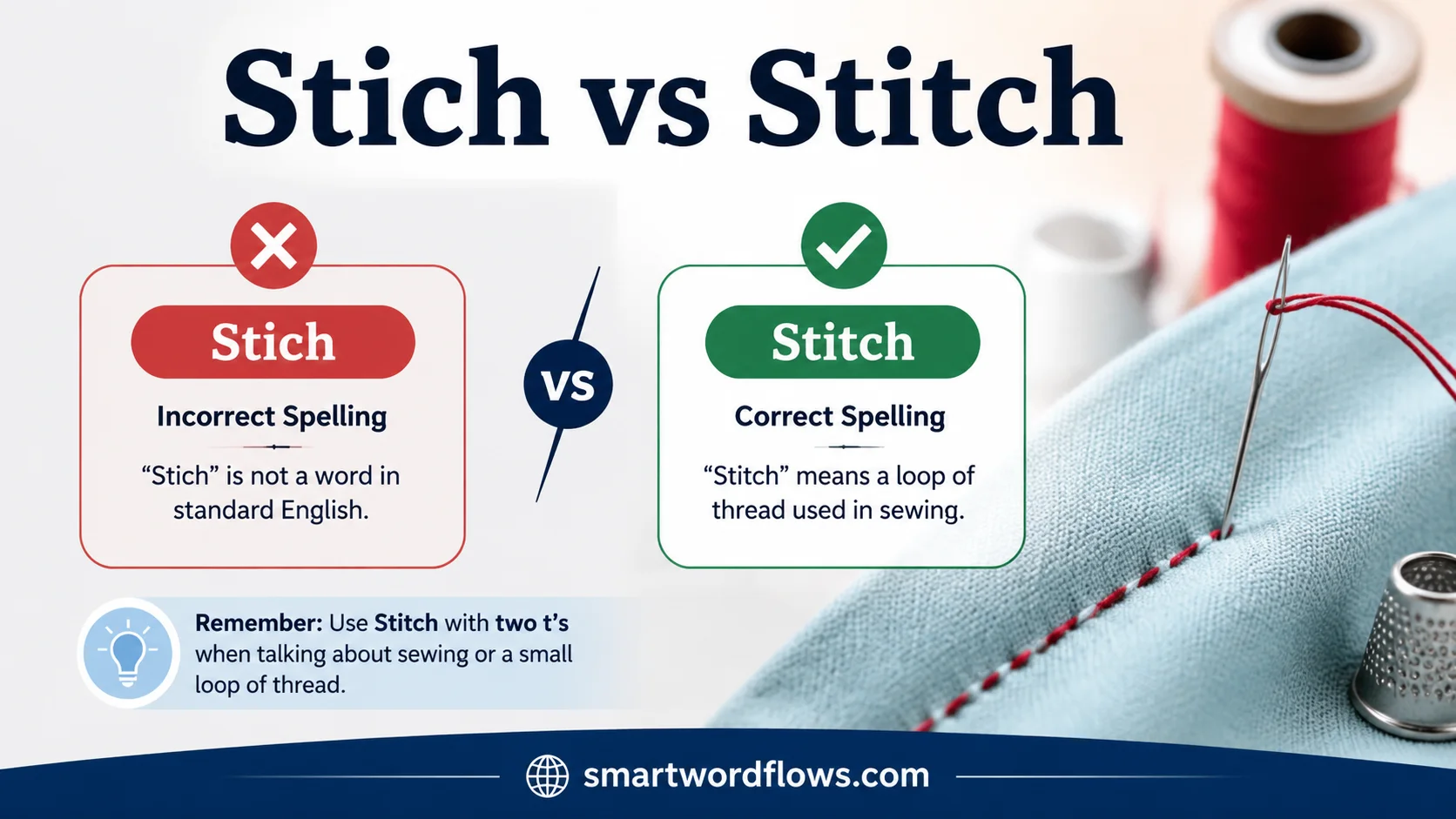

Stich vs Stitch Difference and Usage can be confusing because stich and stitch look similar and sound almost the same. However, stitch is the correct spelling in standard English, while stich is usually a common error or typo. In sewing, knitting, and embroidery, a stitch means a loop of thread. In a medical context, it can also mean a suture. Understanding this small difference helps you choose the right word and write more accurately.
The easiest way to remember the correct spelling is to notice the extra t in stitch. When typing quickly, people may accidentally write stich, especially when autocorrect does not catch the mistake. This simple spelling error can create confusion, but it is easy to avoid with a little attention. Whether you are writing a message, discussing sewing, or explaining a medical situation, using stitch keeps your sentences clear, accurate, and professional.
Quick Answer
The main difference between stich and stitch is their meaning and usage.
Stitch is a common English word that refers to a thread loop used to join fabric, a medical suture used to close a wound, or a sharp pain often felt during exercise.
Stich is a rare literary term that means a single line of verse or poetry, especially in ancient Greek and Byzantine literature.
| Word | Meaning | Common Field | Example |
| Stitch | A thread loop, wound closure, or sharp side pain | Sewing, medicine, sports | “She used a stitch to fix the torn shirt.” |
| Stich | A line of poetry or verse | Literature and classical studies | “The poem was written in several stichs.” |
In simple terms:
- Stitch = sewing, repairing, pain
- Stich = poetry line
Comparison Overview
The words stich and stitch look almost identical, but their meanings come from different origins and appear in different situations.
Stitch appears frequently in everyday conversations. You might hear it when someone talks about sewing clothes, getting stitches after an accident, or feeling a side stitch while running.
On the other hand, stich rarely appears in normal conversations. It belongs mostly to academic writing, literary analysis, and discussions about ancient poetry structures.
| Feature | Stitch | Stich |
| Spelling | S-T-I-T-C-H | S-T-I-C-H |
| Commonness | Very common | Very rare |
| Word type | Noun and verb | Mainly noun |
| Main meaning | Sewing, medical repair, pain | A line of poetry |
| Origin | Old English | Greek word “stichos” |
| Used in daily speech | Yes | Almost never |
| Example | “The doctor removed the stitches.” | “Each stich represented a poetic line.” |
A simple way to remember the difference is this:
Stitch has an extra “t” because it connects things together, such as pieces of cloth or skin. Stich connects ideas through lines of poetry.
Main Differences Between Stich and Stitch
The biggest differences between stich and stitch come down to meaning, history, and context.
Meaning Difference Between Stich and Stitch
The word stitch has several modern meanings.
It can describe:
- A small loop of thread used in sewing.
- A piece of work created by sewing.
- A medical thread used to close a cut.
- A sudden pain in the side during exercise.
For example:
“The tailor added a final stitch to the jacket.”
Here, stitch refers to sewing.
Another example:
“The runner stopped because he felt a stitch in his side.”
In this sentence, stitch describes physical discomfort.
The word stich, however, has a specialized meaning. It refers to a single line of poetry or verse.
For example:
“The ancient poem contained several stichs describing heroic battles.”
Here, stich refers to poetic structure.
Usage Difference Between Stich and Stitch
Stitch is used in everyday situations.
Common examples include:
- Sewing projects
- Clothing repairs
- Medical treatment
- Sports conversations
- Idiomatic expressions
Examples:
- “My grandmother taught me how to stitch clothes.”
- “The doctor gave him five stitches.”
- “I got a stitch while jogging.”
Stich appears mainly in specialized literary discussions.
Examples:
- “The researcher analyzed each stich in the ancient manuscript.”
- “The poet arranged the work into separate stichs.”
Because stich is uncommon, many readers may assume it is a spelling mistake. However, in the correct context, it is a valid English word.
What Does Stitch Mean?
Stitch is one of the most commonly used words in English. It works as both a noun and a verb.
As a noun, it describes a small piece of sewing or a medical closure.
As a verb, it means joining something together using thread.
Stitch Meaning in Sewing
The original and most familiar meaning of stitch relates to sewing.
A stitch is a single movement of a needle and thread through fabric. Many individual stitches combine to create a seam or design.
Common types of stitches include:
| Stitch Type | Purpose |
| Running stitch | Simple joining of fabric |
| Backstitch | Creates strong seams |
| Cross-stitch | Decorative embroidery |
| Blanket stitch | Finishing fabric edges |
| Chain stitch | Creating decorative patterns |
For example:
“She used a cross-stitch pattern to decorate the pillow.”
Sewing experts use different stitches depending on the strength, appearance, and purpose of the project.
Stitch Meaning in Medicine
In medical language, a stitch refers to a suture used to close a wound.
Doctors use stitches when a cut is too deep to heal properly on its own.
Common reasons someone may need stitches include:
- Deep cuts
- Surgical procedures
- Serious skin injuries
- Accidental wounds
Example:
“The nurse cleaned the wound before applying stitches.”
Medical stitches help keep damaged skin together while the body repairs itself.
Stitch Meaning in Sports
Athletes often use the word stitch to describe a sharp pain in the side of the body.
This usually happens during activities such as:
- Running
- Swimming
- Cycling
- Intense workouts
Example:
“The runner slowed down after feeling a painful stitch under his ribs.”
Experts often call this a side stitch or exercise-related transient abdominal pain.
Although the exact cause is still debated, many researchers believe it may involve irritation around the diaphragm or abdominal lining.
Common Expressions With Stitch
The word stitch also appears in several popular expressions.
A Stitch in Time Saves Nine
This famous saying means solving a small problem early prevents a bigger problem later.
Example:
“Fixing that small roof leak now follows the idea of a stitch in time saves nine.”
Laughing Until You’re in Stitches
This phrase means laughing extremely hard.
Example:
“That comedy show had everyone laughing in stitches.”
Read More: Dysregulated vs Disregulated: Correct Usage Explained
What Does Stich Mean?
Unlike stitch, the word stich is not commonly used in everyday English.
A stich means a single line of poetry or verse. The term is mainly found in literary studies.
Origin of the Word Stich
The word stich comes from the Greek word stichos, which means:
- Line
- Row
- Series
Ancient writers used the idea of a “line” to describe individual units of poetry.
Over time, the term entered English through scholarly discussions about classical literature.
Stich in Literature
In poetry analysis, a stich represents one complete line of verse.
For example:
“The scholar examined every stich to understand the poet’s structure.”
A stich is different from a stanza.
A stanza contains multiple lines, while a stich represents one individual line.
| Literary Term | Meaning |
| Stich | One line of poetry |
| Verse | A line or group of lines in poetry |
| Stanza | A group of connected poetic lines |
| Couplet | Two lines that usually work together |
Stich vs Stitch Examples in Sentences
Examples make the difference easier to understand.
Stitch Examples
- “The tailor repaired the coat with a strong stitch.”
- “She learned to stitch patterns into fabric.”
- “The doctor removed the stitches after the wound healed.”
- “The runner complained about a painful side stitch.”
- “A small stitch can prevent a large tear.”
Stich Examples
- “The professor explained the meaning of each stich in the ancient poem.”
- “The manuscript contained hundreds of carefully arranged stichs.”
- “The poet used each stich to build a larger message.”
Common Mistakes Between Stich and Stitch
Because these words look similar, many writers confuse them.
Mistake: Using Stich for Sewing
Incorrect:
“She added another stich to the dress.”
Correct:
“She added another stitch to the dress.”
Sewing always requires stitch.
Mistake: Using Stitch for Poetry
Incorrect:
“The poem contains twenty stitches.”
Correct:
“The poem contains twenty stichs.”
When discussing poetic lines, use stich.
Mistake: Assuming Stich Is Always Wrong
Some people believe stich is simply a misspelling. That is not true.
Although rare, stich has a legitimate meaning in literary contexts.
How to Remember the Difference Between Stich and Stitch
Remembering the spelling becomes easier when you connect each word with its meaning.
Memory Trick for Stitch
Think:
Stitch = Stuff Together
The extra T in stitch can remind you that it connects things together.
Examples:
- Fabric
- Skin
- Materials
Memory Trick for Stich
Think:
Stich = Study Text
A stich belongs to written poetry and literary study.
FAQs:
1. Is “stich” a correct English word?
No. Stich is generally a spelling mistake. The correct spelling is stitch.
2. What is the difference between stich and stitch?
Stitch is the correct English word used for sewing, knitting, embroidery, and medical sutures. Stich is usually a typo.
3. How can I remember the spelling of stitch?
Remember that stitch has an extra t before the final “ch”: s-t-i-t-c-h.
4. Is stitch used in medical situations?
Yes. A stitch can refer to a suture used to close a wound.
5. Why do people write stich instead of stitch?
People often type stich because both words look and sound similar, especially when typing quickly.
Conclusion
Understanding the stich vs stitch difference is simple: stitch is the correct spelling, while stich is usually a common typo. Remembering the extra t can help you avoid spelling mistakes and use the right word confidently.